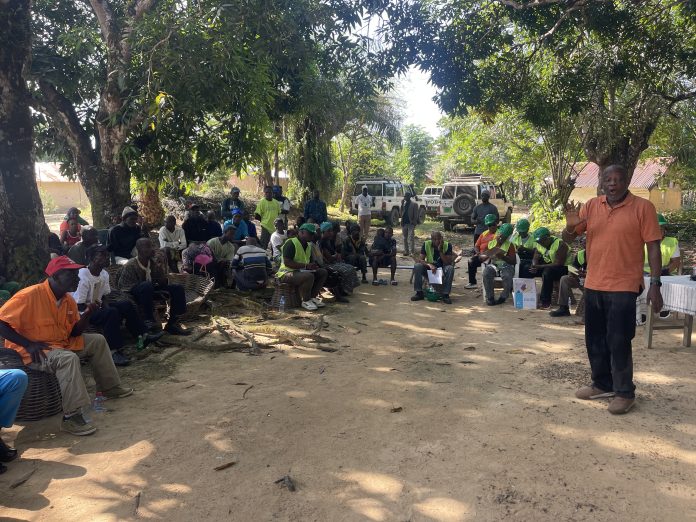
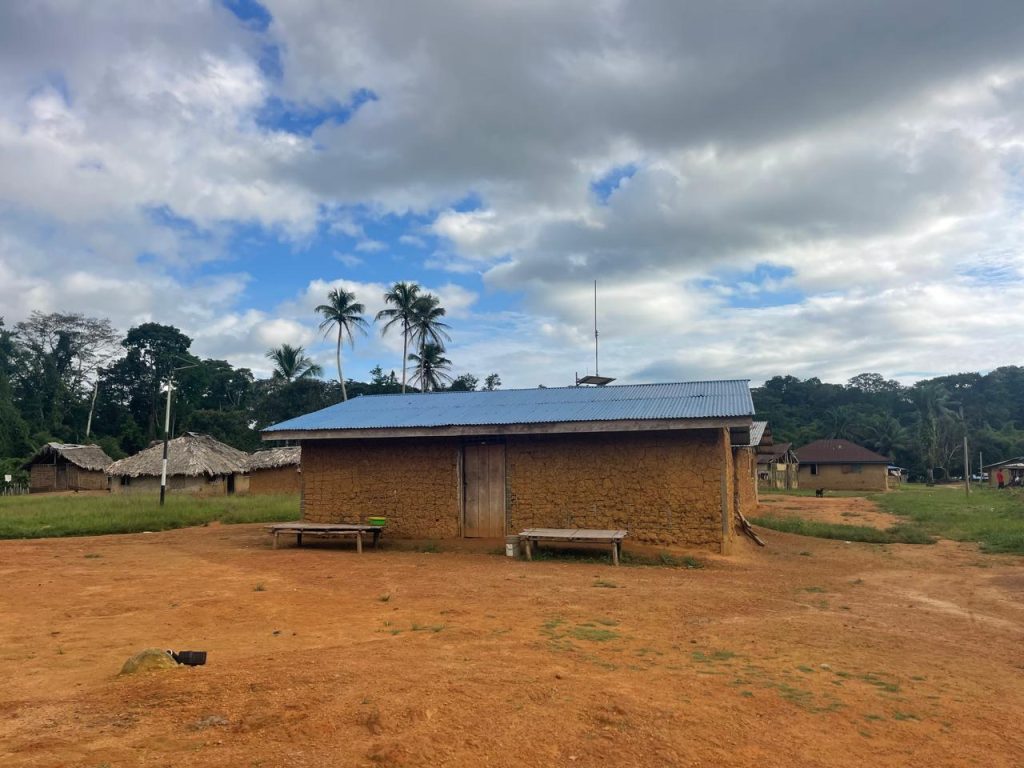
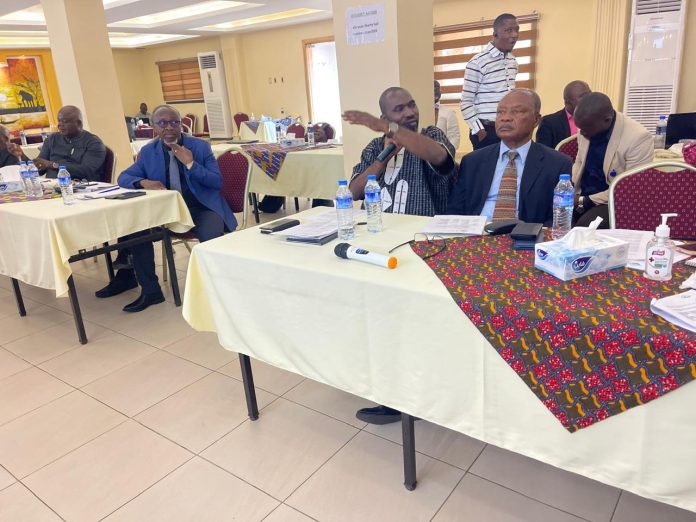
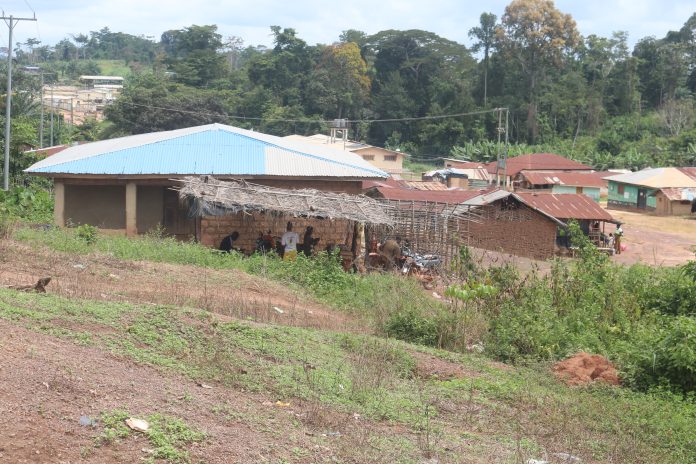
Top: A team of FDA staff in a town hall meeting with affected forest leaders in Tima Town. The DayLight/Esau J. Farr
By Esau J. Farr
TIMA TOWN, Gbarpolu County – The Forestry Development Authority (FDA) has initiated the process of establishing a new logging concession. The FDA has engaged with the communities that would be affected in Kongba District, Gbarpolu County, near the Gola Park forest management contract area, specifically “D” or FMC-D.
The FDA is conducting social and economic surveys in the area in line with the Forestry Reform Law. The law requires the regulator to seek local people’s consent for possible commercial logging activities. It also mandates the FDA to conduct an inventory of all species of the forest that qualify for a concession agreement.
“Government needs resources and if it must continue infrastructural development, we need to get those resources from the communities for the benefits of all of us,” says Rudolph Merab, the FDA Managing Director. “We want to see our communities developed. Our people in the rural area have been there for years in abject poverty. So, our intervention has to be real.”
FMCs are large-scale concessions signed between the government and logging companies. It covers at least 50,000 hectares of forestland and not more than 400,000 hectares for 25 years.
After the First and Second Liberian Civil Wars, Liberia’s forest cover area was divided into 26 large-scale contracts. They were labelled as FMC “A” to “Z”. This one in Gbarpolu and others were, however, not granted to companies due to technical reasons.
Currently, two of them are active—Geeblo Logging Company and Euro-Liberia Logging Company—according to the FDA’s records, with the rest inactive.
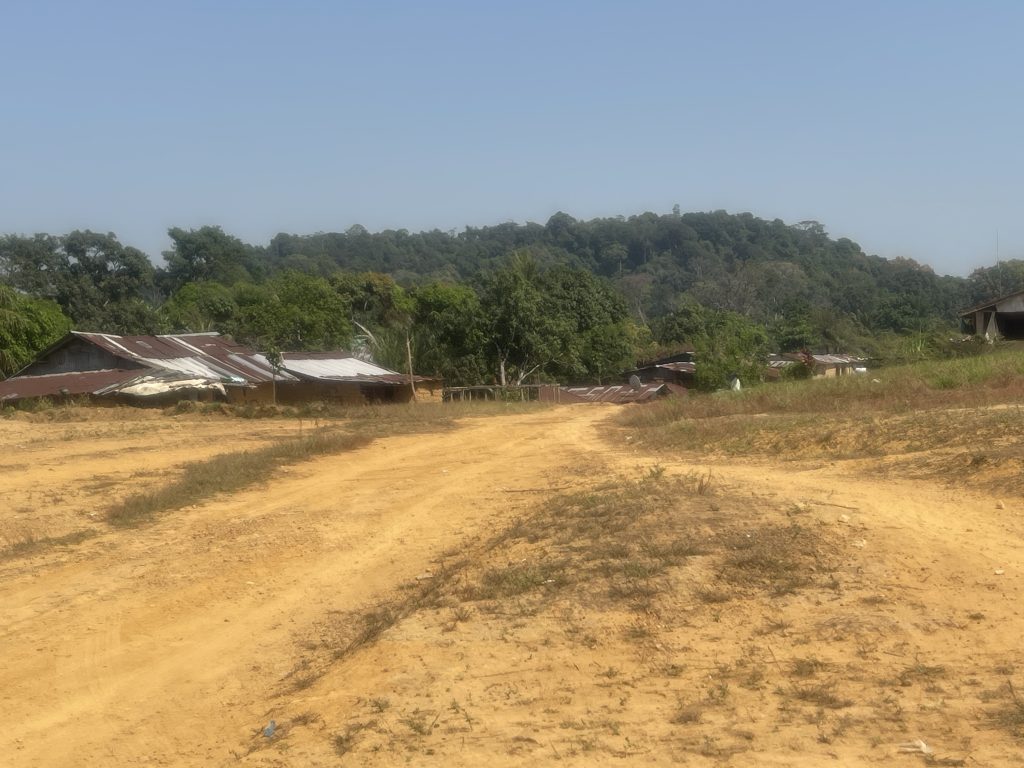
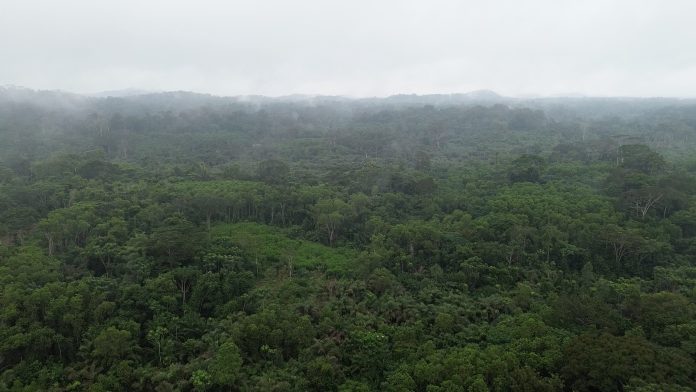
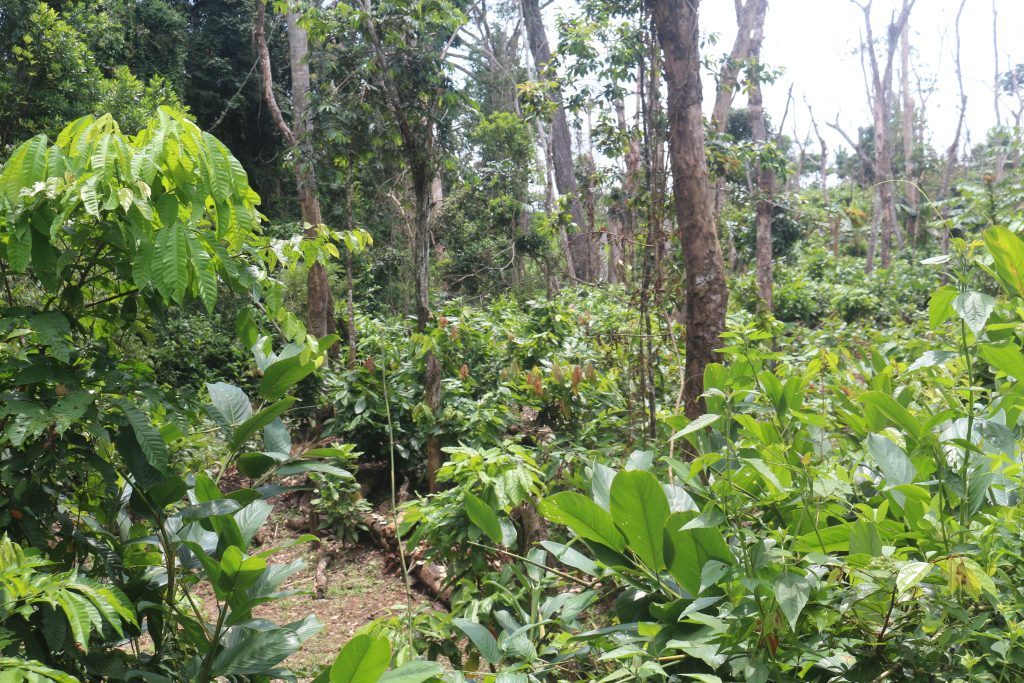
A view of a forest in Tima Town, where the FDA wants to create a logging concession. The DayLight/Esau J. Farr
When completed, the Kongba-based concession would be the first since the initial ones over 15 years ago.
“The team that is here will talk with community people. They will go into the bush to check and find the different kinds of trees there,” Ekema Witherspoon, an FDA consultant, tells a town hall meeting in Tima Town, one of the landowning communities.
“They will take some people from here and work with the team that is coming from Monrovia because your children know the forest.”
Forest leaders of Kongba welcome the idea of commercial logging in their area.
“We don’t want any more parks in our district. The only thing we want is a company that will come and improve our living conditions,” says Blama Kanneh, Paramount Chief of Kongba District.
Other chiefs agree with Kanneh.
“For us to hear you today that you want to work with us for companies to come here, we are very happy,” says Aaron Momo, Zuie Clan Chief. “If you compare other counties in Liberia with Gbarpolu County, especially Kongba District, you will feel at for us here. Development is very slow here!”
Following the FDA’s field report, companies will have to bid for the forest through the Public Procurement Concession Commission (PPCC). The winner of the bid, after legislative approval, will sign a social agreement with the would-be affected communities.
But forestry campaigners dissent from the process. Jonathan Yiah, the head of forest governance of the Sustainable Development Institute (SDI), believes it is counterproductive. Yiah references the troubled history of large-scale logging concessions.
A 2013 Liberian government-commissioned report by the London-based Moore Stephens found all seven concessions, covering 1,007,239 hectares, had been illegally awarded.
Likewise, a 2024 review by the US-based Forest Trends found that all FMCs were noncompliant.
“The FDA should refrain from pursuing another forest management contract when nearly all existing contracts are either dormant or underperforming,” says Yiah.
“Instead, the FDA should focus on implementing the recommendations from the Liberia Forest Concession Review (Phase II) of 2024.” The review determined several large-scale logging contracts did not meet essential prequalification criteria, among others.
“Resolving these critical issues should take precedence over initiating another [large-scale logging concession],” Yiah adds.
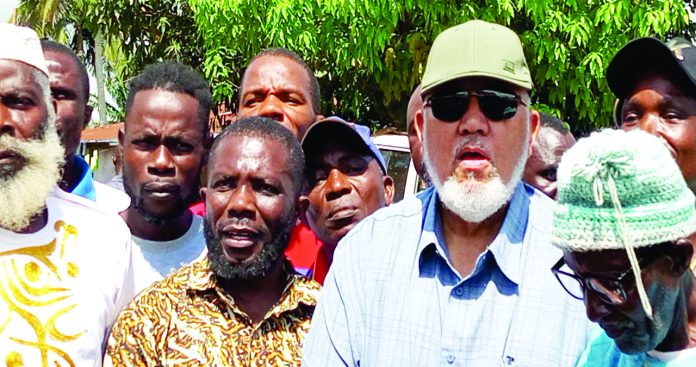
Top: FDA Managing Director Rudolph Merab in a group photo with residents of the Proposed Kwa National Park, Gbarzon District, Grand Gedeh County. Gaye Town-Thursday, November 13, 2025. The DayLight/Varney Kamara
By Varney Kamara
GAYE TOWN, Grand Gedeh – The Forestry Development Authority (FDA) recently announced a resurvey of the Grand Gedeh portion of the Proposed Kwa Protected Area within 90 days. The FDA ordered farmers to halt further degradation of the park, warning of punitive actions.
“We will cut the boundaries and ensure that the government collects what belongs to it, and then the community will get its benefit,” Merab said in a meeting with community representatives in Gaye Town, which borders the park. “I don’t want to see anybody planting cocoa or doing farming business in there.”
But Merab left out important information about the FDA’s plan after the resurvey. A document The DayLight obtained shows that the FDA targets a potential auction of the area where cocoa has been planted. The document was written on October 10, about a month before the Gaye Town meeting.
The document also shows that an unnamed FDA manager dissented from the regulator’s plan to seize and auction. The manager wrote that the “bad precedent” would undermine conservation efforts, fuel violence, and be legally misplaced.
“My technical advice is straight implementation of the law – establish boundaries at the jointly agreed areas and make the presence of the forest rangers,” wrote the unnamed manager.
A DayLight review of multiple laws and regulations confirms the manager’s dissent. While the FDA can punish encroachers, it cannot auction farmland in a proposed protected area.
Like the anonymous manager, the Wild Chimpanzee Foundation (WCF), an NGO helping to establish Kwa, opposes the seizure and auctioning plan. Clement Tweh, WCF’s Program Manager, said there was no need to seize and auction the property. He urges the FDA to remove encroachers from Kwa and identify and support livelihood programs for communities.
Tweh also disagrees with the FDA over the resurvey idea, warning the exercise would cause more harm than good.
“This will lead to more problems because lines were drawn during previous surveys. Potential conflict spots were duly identified and demarcated. I don’t see the need for another one,” Tweh said.
“All the FDA needs to do is to remove the park’s illegal occupants, and identify and support alternative livelihood activities for communities.”
The FDA insists on the resurvey. Asked whether the FDA would replicate this action in other proposed and protected areas since encroachment was commonplace, Merab nodded, depending on a “positive” outcome of Kwa’s resurvey.
“We are here because our people keep complaining about encroachment and conflict all around here. Our action is intended to resolve all these issues,” Merab told The DayLight on the margins of the Gaye Town meeting.
Kwa crosscuts River Cess, Sinoe, and Grand Gedeh Counties. It protects Liberia’s vital biodiversity within the Upper Guinean forests, West Africa’s largest remaining rainforests. With 90 percent of its primary forest intact, Kwa hosts vulnerable wildlife species such as the Western chimpanzee, pigmy hippopotamus, and slender-snouted crocodile.
Protecting Kwa is vital for Liberia’s commitment to conserve 30 percent of its rainforests, conservationists say. It contributes to the country’s climate commitment to cut deforestation and forest-related emissions by 2030.
It would be the third time that Kwa has been surveyed.
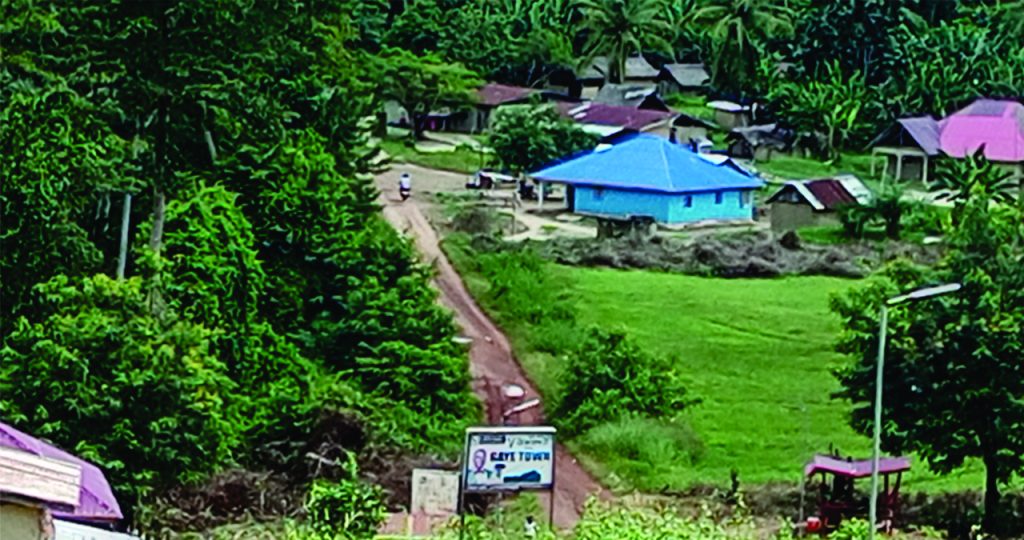
An overview of Gaye Town, Gbarzon District, where the FDA held its consultative meeting with Kwa National Park’s residents. The DayLight/Varney Kamara
Kwa, formerly known as the Krahn-Bassa Proposed Protected Forest, was first surveyed between 1950 and 1952 as part of a general survey of the Kwa National Forests, a fulfillment of the Act for the Conservation of Forests, which established legal frameworks for national parks and protected areas.
In 2023, a survey found that Kwa measured 236,246 hectares after feasibility studies and community consultation in 2016. However, it lost some 64,358 hectares to roads, encroachment, and mining, and now measures 171,888 hectares. These activities have led to habitat loss and the destruction of the ecosystem.
Conservation versus mining
The disagreements over the FDA’s resurvey come amidst miners’ interest in parts of Kwa. In July and August, Grand Gedeh Superintendent Alex Grant met representatives of GLM Inc., an affiliate of Bea Mountain Mining Corporation, Liberia’s largest gold producer.
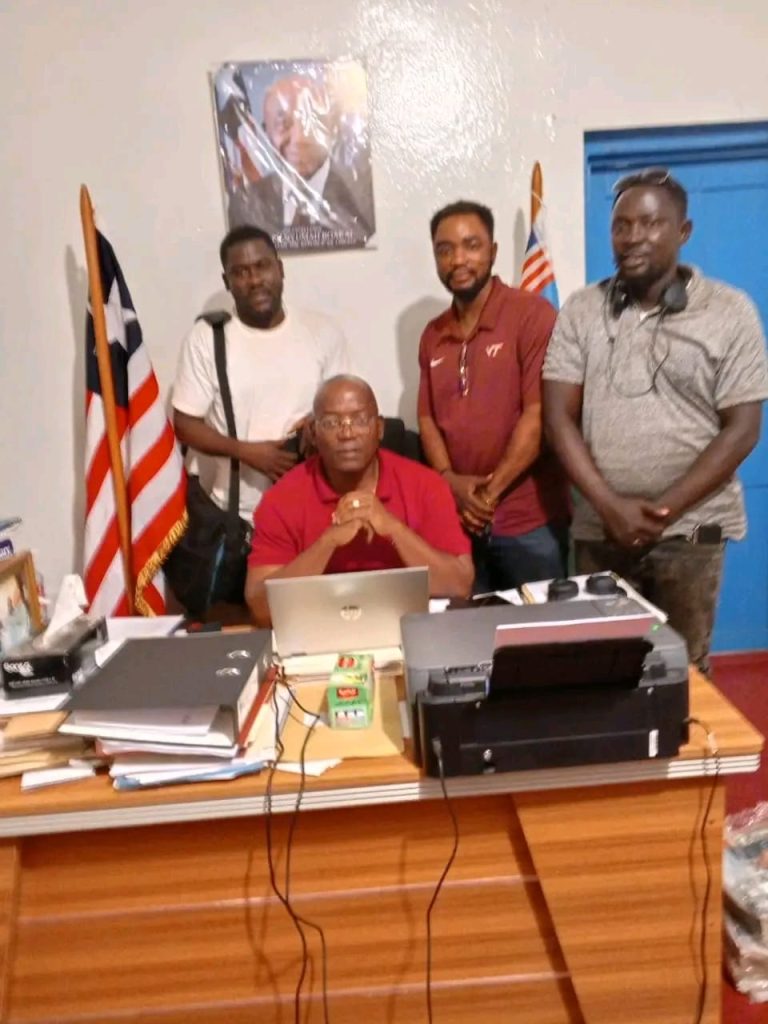
Pictures The DayLight obtained show Grant, Timothy Amos, a GLM official, and another man in a group picture with Grant in his Zwedru office. They disclosed plans to extend their operations to Boe Geewon, Grand Gedeh’s portion of Kwa.
“I remember some members of a Bea Mountain affiliate met me in my home office and said they wanted to do prospecting in parts of River Cess and Grand Gedeh,” said Grant, who has been under fire for an illegal cocoa farm deal covering 500 acres.
“I told them to go and bring their authorization from the Ministry of Mines and Energy. I did not authorize anyone to go mine in those places.”
Merab said he was unaware of miners’ interest in Kwa, and that nothing had been decided when the survey ended. “We will come back and sit down with our people to decide what to do when it is finished.”
GLM did not respond to queries from The DayLight. Amos had promised to return the question on Wednesday, but had not by Thursday.
Grand Gedeh Superintendent Alex Grant poses with a representative of GLM Inc., an affiliate of Liberia’s largest gold mining company.
Earlier this year, communities in River Cess withdrew their support for the establishment of Kwa through a petition to lawmakers, leading to the extraction of a portion of Kwa. Locals would later sign an MoU with GLM Inc., a subsidiary of Bea Mountain, which is now exploring for gold in the area.
In October, a US-based NGO, Forest Trends, published a mining report that found several licenses overlap with Kwa and other protected areas.
Mining in a proposed or protected area is illegal, under the National Forestry Reform Law, except for industrial mining, which must meet certain requirements.
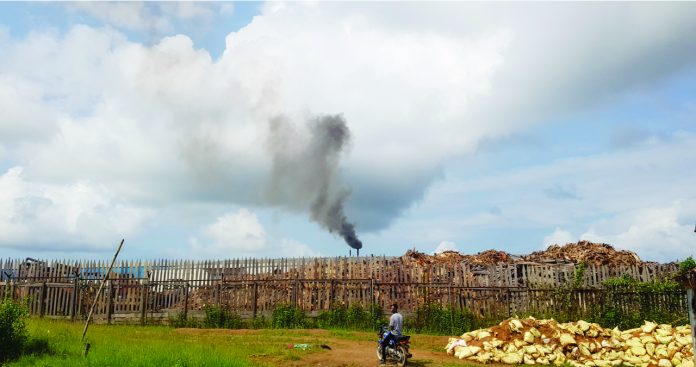
Top: Smoke billows from a sawmill operated by Krish Veneer Industries Incorporated in New Buchanan, Grand Bassa County. The DayLight/James Giahyue
By Emmanuel Sherman
Residents in communities affected by Krish Veneer Industries’ sawmill in New Buchanan, Grand Bassa County, complain of daily noise and air pollution
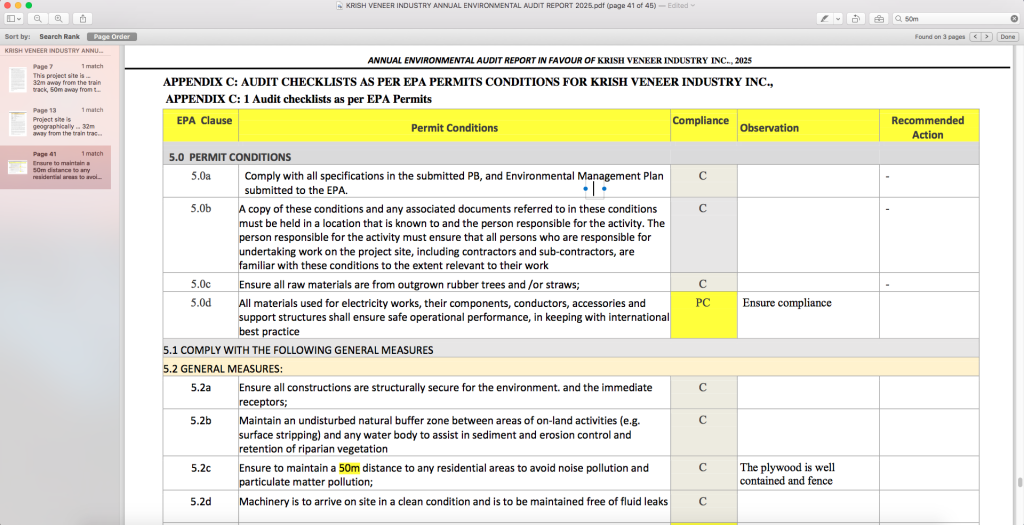
Krish’s environmental permit requires a 50-meter distance from any residence. However, satellite imagery shows several homes much closer to the facility.
An independent verifier finds Krish complies with its environmental permit, but inconsistencies undermine findings.
The evidence establishes that the verifier doctored the report, covering up the sawmill’s pollution trail.
NEW BUCHANAN, Grand Bassa County – Seedaye Mingo, a grandmother in her 60s, sits and washes in front of her house, just a few yards from a large sawmill. For her, living near the sawmill, a fresh breeze has become a distant memory.
“The smoke can be black,” Mingo said. “It can smell.”
Mingo is one of several residents in five communities in New Buchanan, Lower Hardlandsville, who are impacted by the sawmill. Residents say they are experiencing some of these health issues. They complain of nonstop chainsaw buzzing and rattling from morning to evening, and smoke from the factory’s huge chimney clouds the entire area, covering everything. A video, shot by one resident, shows smoke billowing from the sawmill into the community.
Krish Veneer Industries, an Indian-owned company, runs the gigantic sawmill. Established in 2019, Krish produces and exports timbers, plywood, and veneer, a decorative wooden material. It has a workforce of 300 people and processes between 25,000 and 27,000 cubic meters of wood yearly. It was dedicated last May by Vice President Jeremiah Koung, which is likely the largest sawmill in the country.
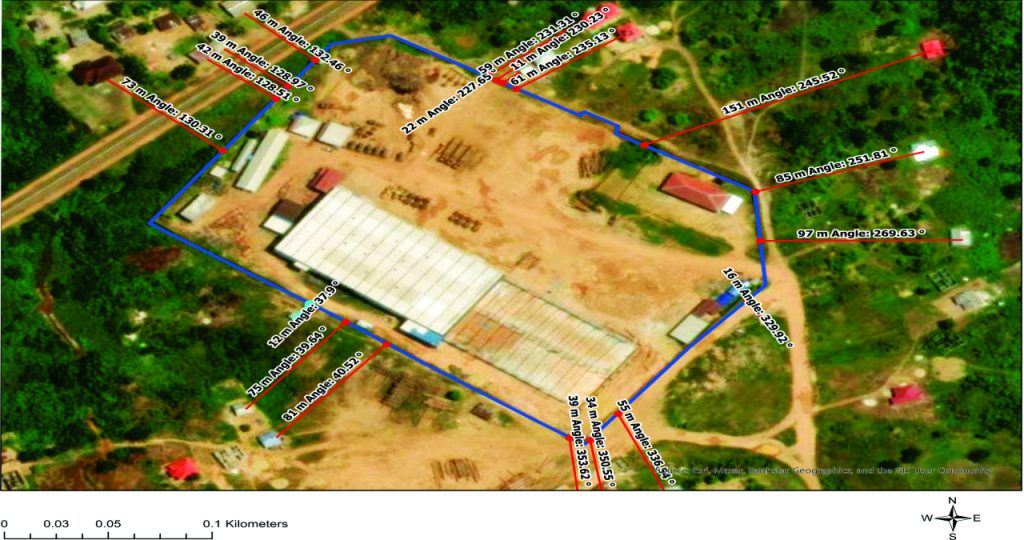
Krish’s environmental permit requires the sawmill to be at least 50 meters away from any residence to prevent pollution. However, satellite imagery, analyzed by Nerisa Group of Companies, a DayLight affiliate, shows that several homes are just a few meters from the facility.
This indicates that residents such as Mingo are exposed to noise and invisible particles suspended in the air. Noise exposure, scientists warn, can cause high blood pressure, heart disease, sleep disturbances, and stress. Similarly, suspended particles can lead to heart and lung diseases in people, and impair visibility, according to the U.S. Environmental Protection Agency.
“The smoke is getting us blind and making our children sick,” says Junior Toe, a resident of Peace community, which hosts the sawmill.
“The pollution is a serious problem. The smoke affects not only adults but also children,” said Pastor Charles Gray of Success Community.
Daniel Larwubah, EPA Grand Bassa County Coordinator, said the agency needed to conduct a study to confirm the community’s concerns. He says he will inform the head office in Monrovia to send a team to the area.
The sawmill also poses a more direct threat to residents. Last year, ashes from the flames transferred to Pastor Gray’s makeshift house. Fortunately for him, neighbors ran to his rescue and cut off the fire.
On another occasion, flames from burning wood waste caught a resident’s clothes just outside the facility.
“I decided to take the clothes from the sun, but the flames from the fire in the fence had already burned the shirt,” says Beatrice Jacobs. Paul Harris, the chairman of Prosser, and other residents, corroborate Jacobs’ story.
A map showing several residences less than 50 meters away from Krish Veneer Industries, a violation of the sawmill’s environmental permit. Nerisa Group of Companies for The DayLight
After those incidents, the community wrote Krish in January last year, complaining about the danger the sawmill posed to the neighborhood, but got no reply. Harris says they also wrote to the Environmental Protection Agency of Liberia’s Buchanan office, but also got no reply.
So, in June that year, residents complained to the Office of the Superintendent of Grand Bassa County. Before her death, Superintendent Julia Bono held a conference between the community and Krish in June, a Ministry of Internal Affairs document shows.
In the meeting, the late Bono asked the company to find somewhere else to dispose of its waste, according to Harris. She died that November. However, Krish obeyed and stopped burning its wood wastes in the open. The DayLight observed that following several visits there, it remains the case.
A Krish contractor, who asked not to be named because he was unauthorized to speak, confirmed the change. “We use matches to light the fire and put big wood in the oven. The fire would burn throughout the day from 8 am to 8 pm,” he tells this reporter.
Larwubah admits to discussing with Harris about Krish. However, he denies receiving any communication, though the community mentioned that in their letter to the Office of the Superintendent.
Krish did not reply emailed questions on The DayLight’s findings and the residents’ allegations. The newspaper contacted a Krish executive, but he hung up the phone once this reporter introduced himself.
Inconsistencies
The EPA of Liberia certifies independent firms to conduct an environmental audit to find out whether the project complies with legal requirements. By law, the regulator fines a company that violates its permit provisions, based on the audit’s findings.
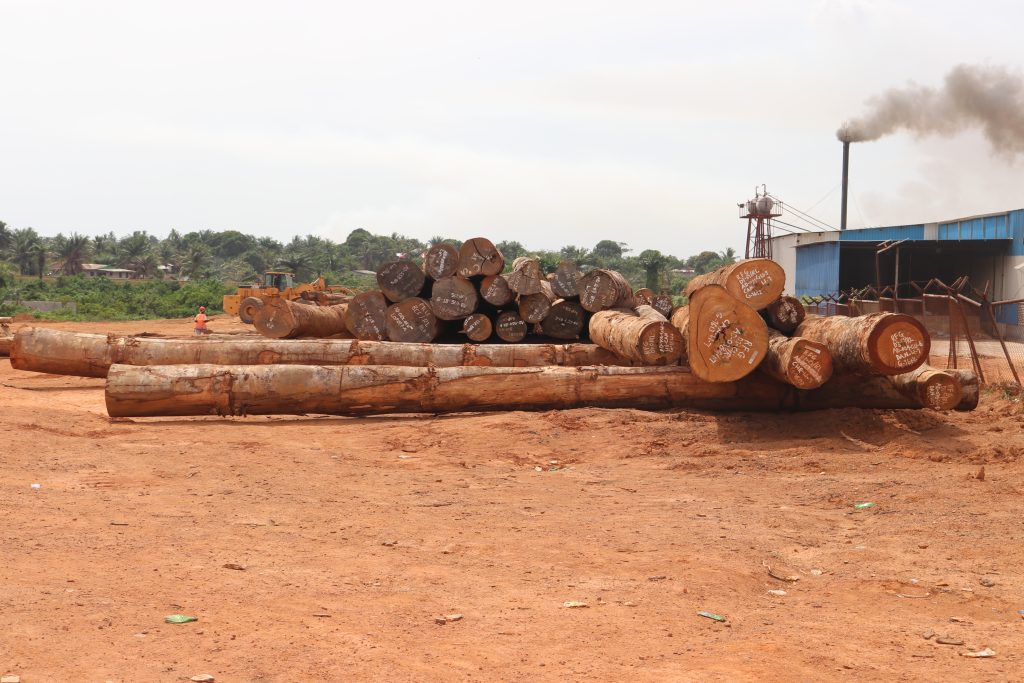
Smoke chimney mounted on top of the building, in the saw mill compound. Emmanuel Sherman/The DayLight
In Krish’s case, the Monrovia-based Environmental Consultancy Incorporated (ENCO) conducted the audit of the sawmill.
“Krish Veneer Industry is operating in a very effective and proficient manner in safeguarding the environment and its workforce…,” the audit report reads.
But residents dismiss those findings, saying they are unaware that ENCO conducted an environmental audit on the sawmill.
“Nothing of such,” says Joshua Howard, a spokesperson for the community. “They never came here in the community.”
ENCO determined Krish was “compliant” with the 50-meter provision. It established that the facility was a “well contained and [fenced].”
The satellite imagery, however, shows several homes just a few meters away from the sawmill’s fence, some 11, 12, 16 and 22 meters close to the facility. This evidence supports residents’ stories of flames from the company’s yard ending up on their premises next door.
Also, ENCO found that Krish did not employ an officer to handle community complaints in line with its environmental permit. Yet, ENCO marked Krish “compliant” in that area, an inconsistency.
The DayLight found other inconsistencies in the environmental audit report. ENCO reports that Krish respected cultural and historical sites, even though there are none in the community.
It found that Krish’s raw materials were from “outgrown rubber trees,” and that the community was forested. In reality, New Buchanan, where the sawmill sits, does not have a forest. Instead, it is one of the fastest-growing suburban communities with mushrooming homes and businesses on the Buchanan-River Cess highway.
A screenshot of Krish Veneer Industries shows findings inconsistent with scientific evidence gathered with the aid of satellite imagery.
ENCO misplaces its recommendations for finding in the “noise pollution” and “air quality control” portion of the report. It also mistakes findings for recommendations.
These inconsistencies, along with residents allegedly not partaking in the audit, prove that ENCO doctored the report, covering up Krish’s noncompliance.
The evidence indicates ENCO copied details from a 2024 report it had compiled for C&C Corporation (CCC) on the Mavasagueh Community Forest in Compound Two, about a 30-minute drive away. Interestingly, CCC supplies Krish with logs, and both companies have the same general manager, Clarence Massaquoi.
The CCC report was as problematic as the Krish audit report. While assessing potential impacts of CCC’s operations, it consulted only 24 of 39 affected communities.
Townspeople would protest their exclusion, leading to fresh elections that ultimately incorporated the 15 towns and villages left out.
ENCO did not reply to emailed questions, and when contacted, declined to speak to The DayLight.
“Go and ask the EPA,” said James B. Konowa, ENCO’s lead environmental auditor, who is a mining engineer. “We are accountable to them, not to you.”
Integrity Watch Liberia provided funding for this story. The DayLight maintained complete editorial independence over its content.
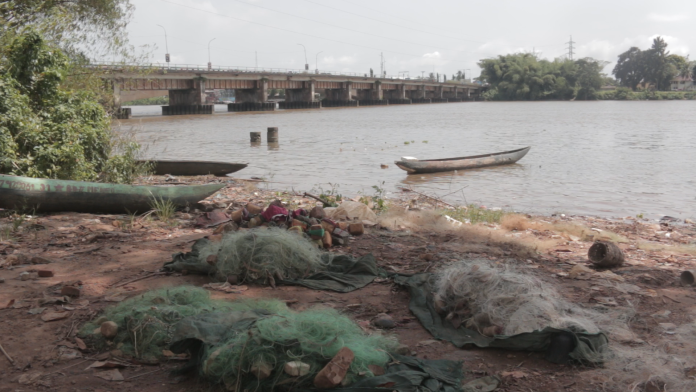
Top: Empty nets and canoes on the banks of the St. Paul River in Caldwell. The DayLight/Carlucci Cooper
By Carlucci Cooper
ST. PAUL BRIDGE – On the banks of the St. Paul River in Montserrado County, the day starts early. Paddles slicing through the water as fishermen set out before sunrise. For generations, the people along this river have survived on fishing.
But their way of life is fading away.
Where once nets came back filled with fish, now they return almost empty. Children wait on the shore for fathers whose catch can no longer feed them. The silence of empty boats has replaced the laughter that once echoed along the riverbanks.
For Roosevelt Kollie, a fisherman from St. Paul Bridge, a suburb outside Monrovia, who has fished here for over 40 years, the change is personal and painful.
“I have been fishing on this river for more than 30 years, but since companies started mining sand on the river, the fish migrated,” says Kollie. “Places where we used to catch huge quantities are now empty. The river is dying, and so is our livelihood.”
In the last decade or so, fishers like Kollie have seen their catches vanish after several companies began mining sands on the St. Paul River. This is not only changing their way of life but also drowning the fishing community in poverty.
Since 2011, the Ministry of Mines has issued 89 sand mining licenses for rivers and beaches across Liberia, including one that was issued on the 30th of October, official records show. Nineteen of those licenses were awarded for the St. Paul River, with seven currently active. Most of the licenses came after the Liberian government banned beach sand mining in 2012. The move was meant to curb coastal erosion. However, experts say it has piled pressure on rivers, hampering fishing.
Inland fishery plays a crucial role in sustaining rural life across Liberia. While ocean fisheries often take center stage, rivers, lakes, and wetlands are essential to thousands of families. A 2017 report estimated that 1,460 people engaged in inland fisheries, and the subsector produced 25 percent of the fish for rural communities.
“Fish depend on the riverbed for food. When sand is mined, it destroys their habitat and forces them to migrate into the sea,” says Dr. Eugene Shannon, former Minister of Mines and Energy. “Sometimes they return, and sometimes they’re killed by strong ocean currents. It’s not just bad for the river, it’s devastating for the people who depend on it.”
“[Sand mining] disrupts spawning and nursery grounds and leads to sedimentation, which reduces water quality and oxygen levels,” adds Ahmed Sherf, Director for Environment and Climate Change with the National Fisheries and Aquaculture Authority (NaFAA). He adds that sand mining damages mangroves, which serve as breeding and feeding grounds for various fish species.
Fishermen know this all too well.
‘’When it rains, my home leaks like outside. My children hold their books so they don’t get wet. Some days they get ready for school, but have to stay home because I can’t afford their remaining school fees,’’ says 42-year-old fisherman, Francis Wreh.
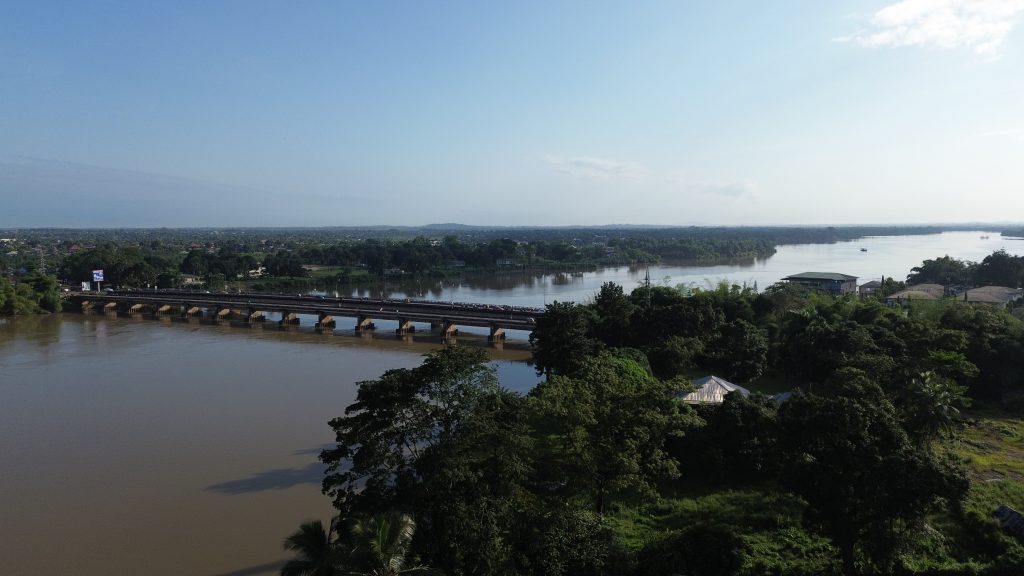
A drone shot of the St. Paul Bridge, after which the fisherfolk community bears its name. The DayLight/Carlucci Cooper
“I go to the river hoping to catch fish to sustain us, but the nets come out nearly empty, only enough to feed us.”
Hopeful, 38-year-old Archie Benson rests on a pile of sand, watching trucks pull away from the riverbank. Not long ago, he would have been pushing a canoe at this hour, nets twisted at his feet. Today, those nets sit dry behind his house. Construction works have replaced fishing, and each load of sand he helps remove feels like another piece of the river slipping away.
“I grew up on this river. Fishing was all I knew. But now I dig sand for construction from the same water that fed us. I feel like I’m undermining my own history, but my family has to survive,” explains Archie Benson, a fisherman-turned-construction-worker.
Fishmongers, too, are bearing the brunt of sand mining. For 36-year-old Tete Wilson, the market no longer echoes with fishermen calling her name. All that is left are empty tubs and tables.
“We used to sit here, and fishermen would bring fish every day, but nowadays we go chasing after them and usually come back with nothing. The fishermen themselves are crying that the water is mean,” says Wilson.
Some fishmongers travel far from St. Paul Bridge just to keep their stalls stocked. Cynthia Nagbe, 29, wakes up before sunrise, boards a taxi to reach beaches in Marshall, Margibi and sometimes Robertsport, Cape Mount, in search of fish. The journey cost her more, but she has little choice if she wants to keep her customers.
A truck collecting sand on the Roberts International Airport highway in 2021. The DayLight/Harry Browne
‘Stop river sand mining’
Sand mining in the St. Paul River might have intensified 13 years ago. However, the river’s profile suggests it would remain a goldmine for the construction industry. One of Liberia’s six largest rivers, the St. Paul flows from Guinea through Liberia into the Atlantic Ocean, spanning 301 miles. A 1963 report found that the mineral is in “unlimited quantities” in the St. Paul Bridge region.
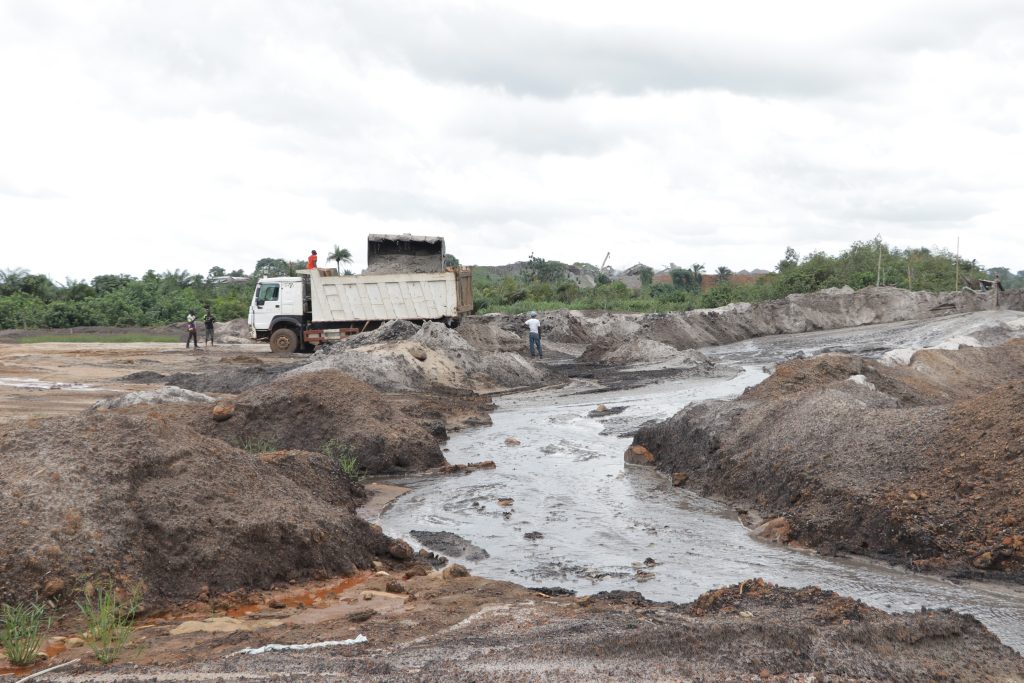
Now, mining sand from the river best explains why fish die or migrate from the area. It works by pumping a mixture of sand and water through long pipelines, using high pressure to extract sediments from the riverbed. The dredged sand is piled in a location where it is separated from the water. The water is then allowed to flow back into the river, degrading that entire ecosystem.
It gets even worse if you add rising temperatures, changing rainfall patterns, according to a 2017 climate risk profile of Liberia, and overfishing, a lack of canoe-landing sites and storage facilities, according to Sherf.
Sherf says NaFAA is partnering with the Ministry of Mines and Energy and other institutions to meet these challenges and improve fisheries. He recommends the setting up of no-mining zones near critical habitats, enforcing regulations, and promoting alternative construction materials.
Fisherfolk demand these actions now.
“We need the government to either stop river sand mining or enact laws that will protect our river. If we don’t take action, we’ll lose everything: our river, our fish, and our hustle,” says Pious Johnson, a fishmonger in St. Paul Bridge.
“We want the government to act. We survive by this river, so we’re appealing for help,” says Thomas Kollie, a fishmonger.
Annie William, a fishmonger, sits in Sinkor. The DayLight/Carlucci Cooper
The Ministry of Mines insists that companies mining sand on the St. Paul are legal and have the right to be there.
“River sand mining is legal once you have documents that qualify you to operate with a… license, and you pay your taxes,” says Agatius Coker, Mining Inspector. “That’s why we conduct periodic compliance and enforcement with these companies to ensure environmental safety.”
Coker’s comments are largely unfounded. A 2022 General Auditing Commission report revealed that Liberia’s sand mining industry is largely unregulated, with weak oversight and illegal operations.
The report calls for “comprehensive policies, rules, or regulations that are specific to the governance of river sand mining. It found one company operated in Montserrado and Bong Counties without a license, while another abused its prospecting license. It also found that field inspectors did not regularly monitor and report on companies’ operations.
It says, “[The Ministry of Mines] should review the licenses and operations of all companies mining in the St. Paul River and assess the impact of their activities, cancelling and relocating mines that are causing greater environmental degradation.”
Integrity Watch Liberia provided funding for this story. The DayLight maintained complete editorial independence over the story’s content.
Top: The Chairman of the Land Authority, Samuel Kpakio, illegally signed a deed as part of a fraudulent cocoa agreement between Grand Gedeh County and a Burkinabé businessman. Filed picture/Liberia Land Authority
By James Harding Giahyue and Varney Kamara
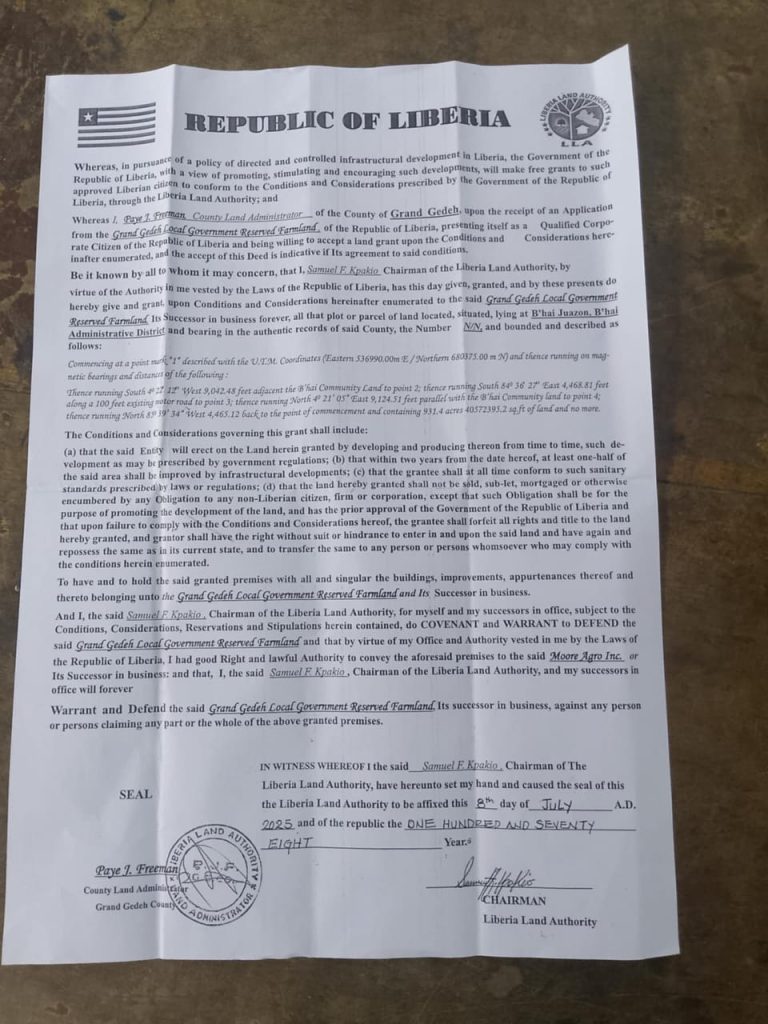
The Chairman of the Liberia Land Authority, Samuel Kpakio, signed a deed for a 500-acre cocoa farmland in Grand Gedeh County, violating a moratorium that President Joseph Boakai pronounced in the State of the Nation Address.
The transaction was a part of a fraudulent agreement between Grand Gedeh County and a Burkinabé cocoa farmer, which, authorities say, has been terminated
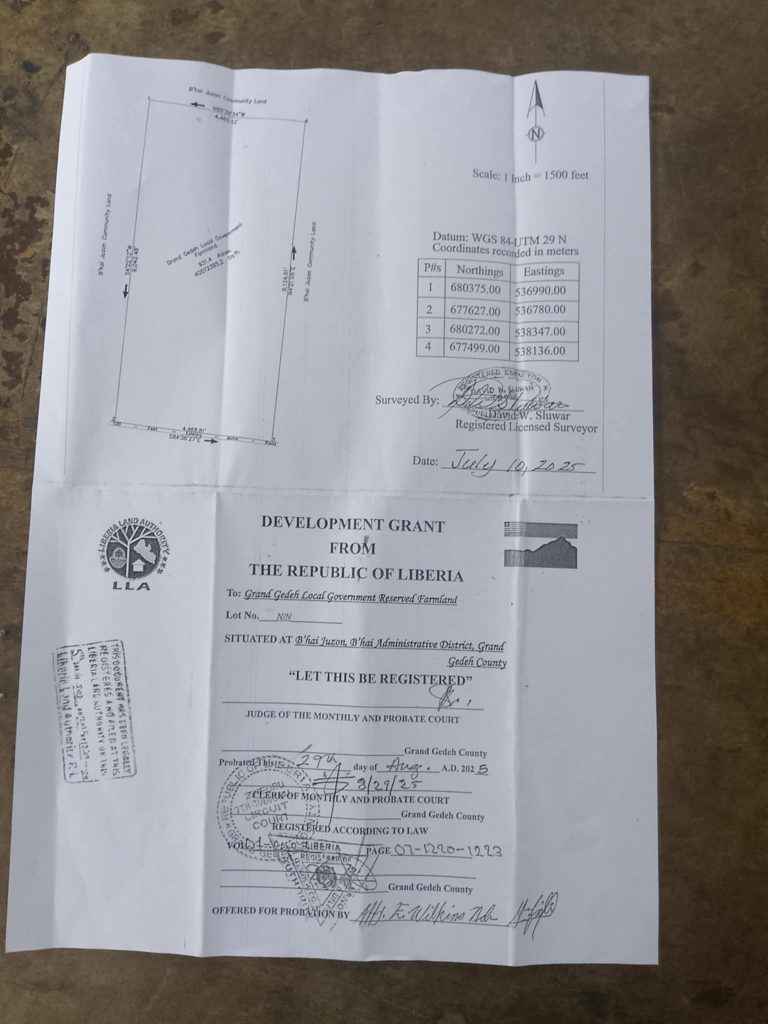
The surveyor who surveyed the land is unauthorized to conduct a government survey. Mr. Kpakio even signed the deed before the surveyor completed his work.
The survey was secretly conducted, and there was no record that the land was put out for competitive bidding as required by law
The deed was issued to an unlawful, inexistent recipient
MONROVIA – Over the weekend, the Liberia Land Authority said Grand Gedeh County Superintendent Alex Grant “misled” it in a fraudulent cocoa farming agreement with a Burkinabé businessman. The 30-year deal, worth US$600,000, has been canceled, according to county officials.
“The Superintendent and the County Land Administrator of Grand Gedeh misled the … [Land Authority] during the issuance and signing of the said deed, thereby bypassing established procedures and guidelines required for granting a development grant deed,” the Land Authority said in a statement. It provided no evidence to back that claim.
The Land Authority revoked the deed and suspended two staffers in its Grand Gedeh Office in connection with a deal that targeted 500 acres of ancestral land in the B’hai District. It said it was investigating Paye Freeman, the County Land Administrator, and David Togbasie, Land Dispute Officer. The two men would not speak on the matter.
But a DayLight investigation has uncovered that the Chairman of the Land Authority, Samuel Kpakio, masterminded the deal. Government documents and interviews with officials revealed that Kpakio violated a moratorium to support the agreement. The Land Authority boss utilized an unauthorized surveyor and skipped the legal processes, as mentioned in the weekend press release. The deed was even intended for an unlawful recipient.
The DayLight obtained the deed in question for the 500 acres and observed several issues with the document.
First, Kpakio signed the deed on July 8, 2025, when the moratorium on public land sale was active. The moratorium was issued last year and announced by President Joseph Boakai during this year’s State of the Nation Address, pending the creation of guidelines to prevent land-grabbing.
“These efforts aim to enhance tenure security, resolve conflicts, and promote sustainable land investment throughout Liberia,” the President said. It was lifted on July 31, 2025, twenty-three days after Kpakio signed the deed.
In Friday’s press release, the Land Authority detailed the accusations against Mr. Grant, citing provisions in the Land Rights Act he had allegedly violated. However, the institution glossed over its own actions and inactions, failing to say why it suspended the staffers. This concealed Kpakio’s role in the scandal, while shifting blame to Grant, Freeman, and Togbasie.
While Freeman and Togbasie’s roles in the scam are unclear, the evidence establishes Mr. Grant’s wrongdoing: not obtaining the community people’s consent. However, Mr. Kpakio’s blame game contradicts his position as head of the Land Authority.
Mr. Kpakio is no stranger to land matters. Before being appointed Chairman of the Land Authority, Mr. Kpakio served as director of land use planning and management with “distinction,” according to the institution’s website. Moreover, the Liberia Land Authority was established as a “one-stop shop” for land transactions countrywide, not the Office of the Superintendent.
The DayLight caught up with Mr. Grant in Paynesville on Saturday, but he declined an interview. However, he had admitted to his wrongdoing before canceling the agreement.
“I regret that the locals were not informed by the district’s authorities. I think is a procedural error,” Grant told a team of reporters in an interview in Zwedru City. “Once they don’t agree, and we agreed, we can both come to the negotiation table and have a conversation around it.”
A copy of a fraudulent deed bearing the signature of the Land Authority’s Chairman, Samuel Kpakio
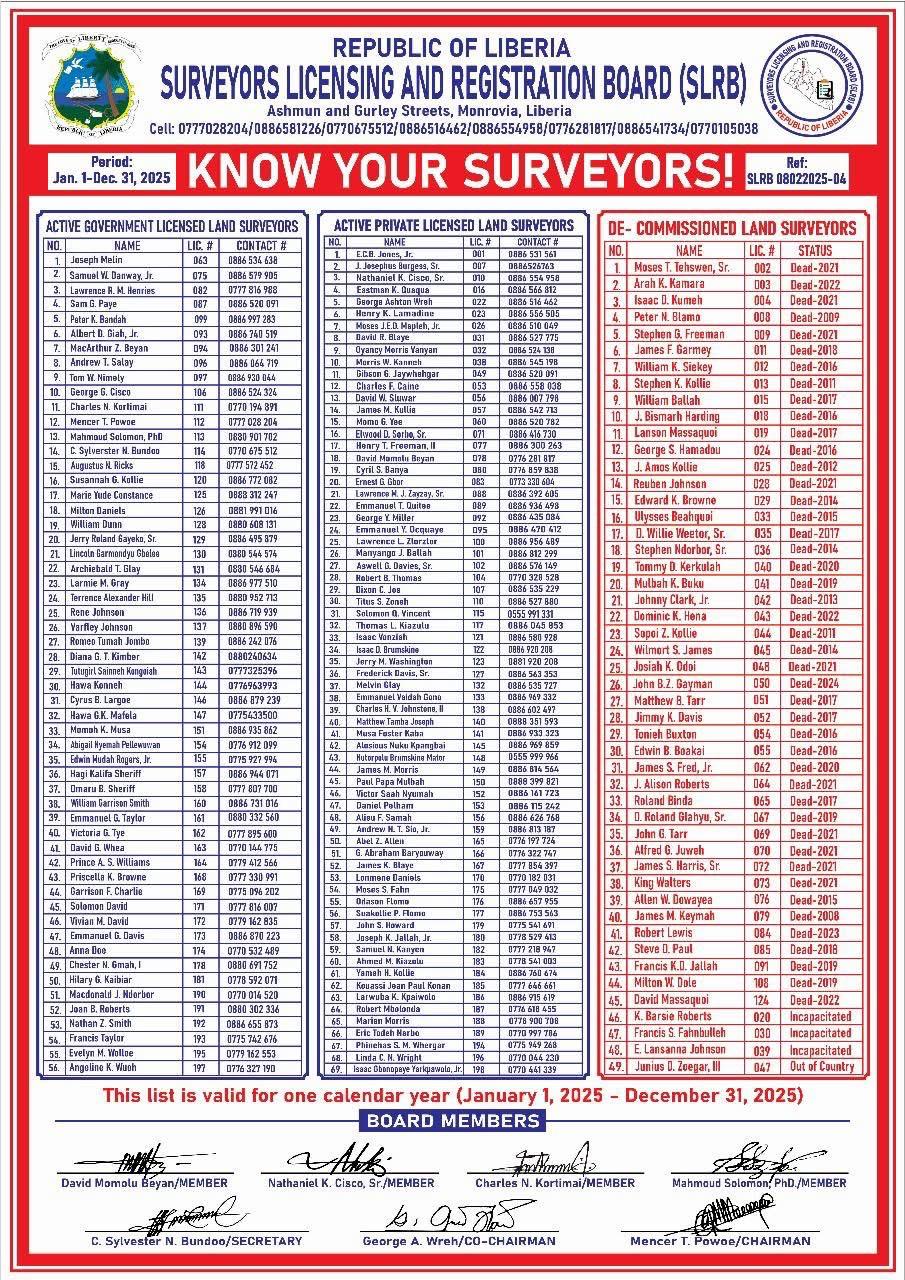
Second, The DayLight also observed another irregularity with the deed Kpakio signed that has nothing to do with Grant. David Sluwar, a licensed private surveyor, had surveyed the land and signed the document, a red flag, the surveyor’s roster shows. A private land surveyor does not survey a government plot; there are 56 government surveyors registered to do this job.
People familiar with public land procedures and processes believe Sluwar played a crucial part in the scandal. “No government surveyor could have signed that deal,” said one official, who asked not to be named over fear of retribution.
There is another issue regarding Mr. Sluwar, though. Mr. Kpakio signed the deed before the private land surveyor completed the survey, another red flag. The document shows that Mr. Sluwar signed it on July 10, two days after Mr. Kpakio. In normal land transactions, the Chairman of the Land Authority signs a deed after the survey is completed, not before.
Furthermore, details of the survey were not published in line with the Land Rights Regulation. The 2022 instrument calls for published details of a government land survey to be published in a government gazette, in at least two newspapers and radio stations, in local languages.
The regulation also requires the Land Authority to publish a survey notice for at least one month. Like the details, there is no record that a survey notice was published.
The Chairman of the Land Authority, Samuel Kpakio, signed the deed before the survey was completed.
Efforts to get Sluwar’s side of the story did not materialize. His mobile phone number was switched off on Sunday and Monday, and he did not respond to text messages. The DayLight has contacted the Surveyor Licensing and Registration Board about Mr. Sluwar’s role in the scandal.
Third, The DayLight gathered evidence that the Land Authority did not vet the land in question before Kpakio signed the deed. Normally, its vetting department verifies whether there are issues.
Failure to verify explains why the agency did not identify that the 500 acres were customary land. The land, located on the Liberia-Ivory Coast border, was unused because it is a far-to-reach area. However, the plot is easily accessible from the Ivorian side.
Fourth, there is no record that the land in question was put out for a competitive bidding process as mandated by the Land Rights Act.
The newspaper observed one more inconsistency. The deed was granted to the Grand Gedeh Local Government Reserved Farmland, which does not exist. A development grant deed is not awarded to a farmland. Rather, it is issued to a person, an institution, an NGO, or any legal entity. In fact, such a deed is so delicate that the new guidelines require the signatures of three commissioners.
Mr. Kpakio evaded all The DayLight’s efforts for an interview. He did not respond to detailed questions on WhatsApp on Sunday and directly to his office on Monday. He also declined an interview on Tuesday and was unavailable on Wednesday.
Regardless, Mr. Kpakio’s well-documented actions contradict his induction speech in February, in which he spoke about reforming the Land Authority.
“There will be no room for unethical and unprofessional conduct, both in administration and in our interactions with our development partners and the Liberian public,” said Kpakio.
“The Liberia Land Authority will operate differently this time. Our work will be grounded in our core values: quality service delivery, transparency, fairness, accountability, integrity, professionalism, and respect.”
[Additional reporting by Paul Rancy in Zwedru, Grand Gedeh County]
Integrity Watch Liberia provided funding for this story. The DayLight maintained complete editorial independence of its content.
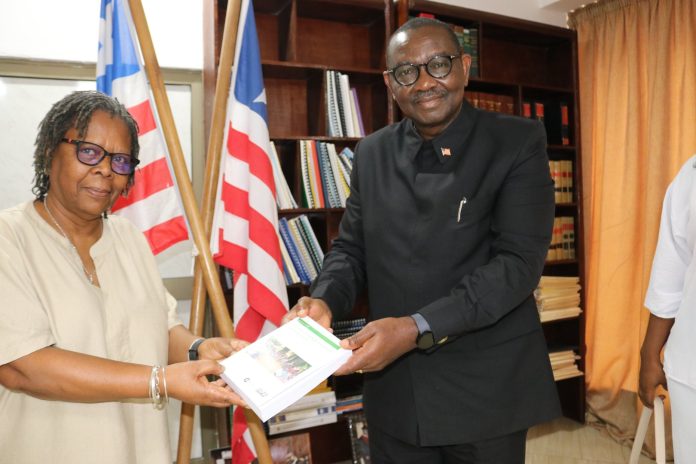
Justice Minister Oswald Tweh Receives the forest bible from MFGAP’s Team Lead Letla Mosenene. The DayLight/Harry Browne
By Varney Kamara
MONROVIA – The Ministry of Justice has received 150 copies of the “forest bible,” a book containing laws and regulations governing Liberia’s forestry sector. The ministry also received the same number of forestry compliance handbooks, a comprehensive guide for the sector’s law enforcement and procedures.
The lack of understanding of environmental laws and compliance regulations has significantly hampered prosecution and enforcement efforts in the country’s forest sector. Both books, comprising basic definitions, crimes, and fines, aim to close this gap. It is an undertaking of the Multi-stakeholder Forest Governance and Accountability Project (MFGAP), funded by the British government.
“This is a very good opportunity to understand the laws. It will improve the prosecutorial arm of the ministry because our prosecutors and county attorneys will have all of them at their fingertips,” said Justice Minister N. Oswald Tweh.
“In many instances, our prosecutors have to find the law, define and explain it. Now, summarizing them in a single place makes their task easier. This is a very good step.”
In May 2017, the Forestry Development Authority published the overview of the legal framework for forests, meant to improve sectoral governance and ensure compliance. However, progress has been marginal, with the sector plagued by irregularities and noncompliance.
Lucia Gbala, a representative of Heritage Partners and Associates, the firm that compiled the books, said it would enhance accountability in the sector.
“The best lawyers need to know where to find the laws,” Gbala said. “Putting these laws together and compiling all of the relevant laws for the work of prosecutors and other laws to be able to have easy access and educate the communities.”
Letla Mosenene, MFGAP’s team lead, said her group was working with the Ministry of Justice and other agencies to ensure adequate awareness of forestry legal frameworks.
“This is one of the efforts we are making to ensure that the people obey the laws, and that they effectively participate in governance of the forest sector,” said Mosenene. “We think this tool will go a long way to help the ministry carry on its work.”
Top: Seekon Pellokon Community Forest covers 44,989 hectares. The DayLight/Carlucci Cooper
By Emmanuel Davies
SEEKON PELLOKON, Sinoe County – A community forest has signed a logging contract with a company despite multiple reports highlighting problems with the deal.
The agreement green-lights the Liberian Hardwood Corporation to carry on logging activities in the Seekon Pellokon Community Forest in Sinoe County.
Signed on 10th September, the contract provides for a combined annual payment of US$47,930 to the community in exchange for the 44,989-hectare forestland. It provides for land rental fees, development initiatives, and education, among others, for landowning communities.
Several roads were captured for rehabilitation and maintenance throughout the lifespan of the contract. Liberian Hardwood to construct durable wooden and concrete bridges, the agreement shows.
It was signed a day after two DayLight reporters, Esau Farr and Carlucci Cooper, narrowly escaped the wrath of a masked dancer, commonly known as “Country Devil.”
Reporters Farr and Cooper had traveled to conduct an investigation for a contract-signing ceremony in the Community Forest when they were suddenly confronted by the country devil.
Seekon Pellokon’s leaders were reacting to an investigation the online newspaper published. It highlighted issues and concerns about Liberian Hardwood’s capacity to operate Seekon Pellokon amid its failure in the Bloquia and Neezonnie Community Forests in Grand Gedeh, and its management of the largest active forestry concession in Liberia, covering Grand Gedeh and River Gee Counties, 254,670 hectares. The concession is known in the sector as the forestry management contract area-F (FMC–F).
Junior Kumah, a Seekon Pellokon leader, had dismissed the warning of Liberian Hardwood failure in Grand Gedeh. Kumeh argued that they had signed a five-year contract, the company would pay after production, and they would terminate the contract if Liberian Hardwood breached the contract.
Pellokon Town in the Seekon District, Sinoe County. The DayLight/Esau J. Farr
“I am not a rocket scientist to know whether Hardwood will fail or not. All I am telling you is that what happened in Bloquia will not be repeated here. What happened to John doesn’t mean the same thing will happen to Paul,” Kumah said.
The investigation also shed light on the relationship between the company’s manager and co-owner, Jihad Akkari’s relationship with the Managing Director of the Forestry Development Authority (FDA), Rudolph Merab. The investigation accused Merab of negotiating for Akkari to get Seekon Pellokon.
“FDA is the one that is negotiating. The FDA has all those documents in its possession,” said Kumah in a phone interview.
“FDA said it would not do business with us unless the community signs a contract with Liberian Hardwood,” said Stanley Kreejarly, a Seekon Pellokon leader, confirming Kumah’s claim.
Merab did not respond to The DayLight queries for comments on the accusations. However, Akkari denied any wrongdoing. In a statement, he claimed he had lost US$4 million in Grand Gedeh, and had “the capacity to operate” the combined nearly 300,000 hectares of Seekon Pellokon and FMC – F.
This story was produced by the Community of Forests and Environmental Journalists of Liberia (CoFE).
Top: Some lawmakers at the training workshop. The DayLight/Esau J. Farr
By Esau J. Farr
MONROVIA – Lawmakers on concession committees have learned how to use a new tool to review contracts to increase revenue generated from natural resources.
Integrity Watch Liberia organized the training with funding from the Irish Aid. Participants in the event included the Legislature, especially lawmakers, Integrity Watch, and the Irish Embassy.
“Effective natural resource governance requires a strong legislature – one that can engage rigorously with concession agreements and understand their fiscal implications,” said Gérard Considine, Irish ambassador to Liberia, at the event. “You, as members of the legislature, hold that responsibility.”
Lawmakers on committees that review concessions will use the “standardized scoring framework.” Fifteen lawmakers—nine senators and six representatives—participated in the event.
Liberia’s resource sector, especially mining and concessions, is important for the country’s economic development. Concessions have, however, been marred by unfair fiscal terms, weak monitoring, a lack of transparency, and inadequate benefit-sharing with communities.
The training became necessary based on the request of lawmakers who attended previous workshops. Past participants have called for more training and a developed tool as a guide to review agreements, according to Integrity Watch.
In response, Integrity Watch collaborated with the African Parliamentary Network on Illicit Financial Flows and Taxation (APNIFFT) to develop the framework. It is in line with international best practices and provides a structured, evidence-based method for assessing agreements on legal, fiscal, social, environmental, and governance lines.
Participating lawmakers expressed their appreciation for the training and the tool. The legislators also called on the organizers of the training for greater opportunities for all members of the first branch of government, aimed at enhancing their oversight role.
“We thought this was necessary not only for the current lawmakers, but also for future lawmakers,” said Harold Aidoo, head of Integrity Watch, in an interview with The DayLight.
“This standardized scoring framework is a landmark tool to enhance the work of members of the legislature to carefully scrutinize concession agreements in Liberia.”
Top: An overview of B’hai Jozon, a border town in the Gbarzon District in Grand Gedeh County that separates Liberia and Cote d’Ivoire. The DayLight/Varney Kamara
By Varney Kamara
ZWEDRU – A cocoa lease agreement between Grand Gedeh County and a Burkinabe businessman has been canceled, County Attorney Wilkins Nah announced today on a local radio station.
Nah said he had observed several irregularities in the deal that needed to be corrected, including not getting local people’s consent.
“Upon learning about those things, I immediately called the superintendent and informed him that the Minister of Justice has ordered that we put a halt to everything until we can put in those things that are required,” said Nah.
“The superintendent and I agreed that we needed to correct some procedural errors in the agreement,” Nah added.
Grand Gedeh County administration recently signed the 30-year lease agreement granting Boubou Sebu the right to plant cocoa on 500 acres of land in the B’hai administrative district. The deal is valued at US$600,000.
But local people, prominent citizens and civil society have criticized the deal for lacking consultation and transparency, among others.
The announcement followed Superintendent Alex Grant’s admission to an error in the cocoa agreement with a Burkinabé businessman.
“I regret that the locals were not informed by the district’s authorities. I think is a procedural error,” Grant told a team of reporters in an interview in Zwedru City. “Once they don’t agree, and we agreed, we can both come to the negotiation table and have a conversation around it.”
Grant said he signed the deal because he believed it protected the land from illegal activities and to generate revenue for the county.
The land in question, Grant said, had been conflicted in the past, and that signing a legal agreement was a way of ending that conflict. He thought the district’s commissioner had informed local people of their consent.
The Commissioner of Gbarzon District, Kelvin Kayee, conceded.
“I signed it because I did not want to disrespect my boss,” said Kayee. “After that, I called a big meeting of community people and I apologized to them for not letting them know about it before signing it.”
Excluding the affected communities violates their right to consent, as stipulated in the Land Rights Act of 2018. The law requires consultations and the consent of communities before signing agreements regarding ancestral territories.
The deal sparked outrage, with locals calling for the return of their land.
“I don’t know anything about this agreement. Nobody told me about it, and we only heard this news on the Toe Town radio station the day before yesterday,” said Moses Taryor, Town Chief of B’hai Jozon. “I don’t agree to it today, tomorrow, and forever.”
“The bush is for us. But people from outside are telling us that they sold our bush. We are not happy about it. We will tell the government to return our land,” said Sam Nah, General Town Chief of B’hai Niko Clan.
One of several Burkinabe cocoa farms in the B’hai Administrative District, Grand Gedeh County. The DayLight/Varney Kamara
On Monday, a group of Grand Gedeh citizens had petitioned the southeastern county’s legislative caucus, the Ministry of Internal Affairs, and the Liberia Land Authority for the cancellation of the deal, recommending disciplinary action against Superintendent Grant.
“We can no longer move freely in our forest to hunt, farm, or gather food,” the petition read.
Before that, the Grand Gedeh Bar Association criticized Grant for a lack of transparency, demanding a review of the deal.
“Our goal is not to obstruct development but to ensure that every development is lawful and genuinely beneficial to the people of Grand Gedeh,” Kanio Bai Gbala, President of the association, posted on Facebook.
Liberia Forest Media Watch provided funding for this story. The DayLight maintained editorial independence over its content.
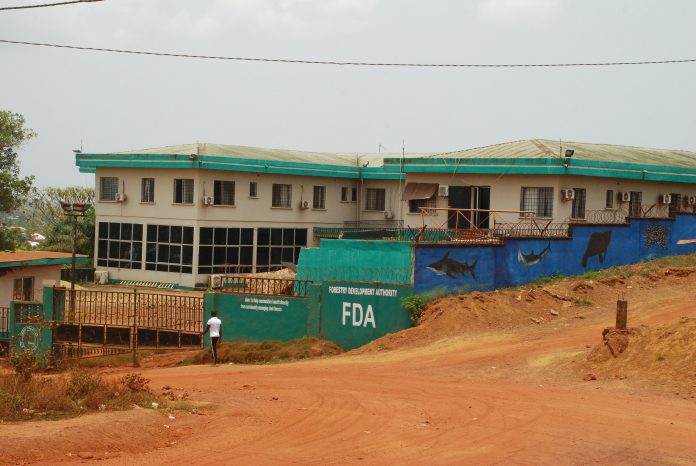
Top: The Forestry Development Authority’s headquarters in Whein Town, Paynesville. The DayLight/James Harding Giahyue
By James Harding Giahyue
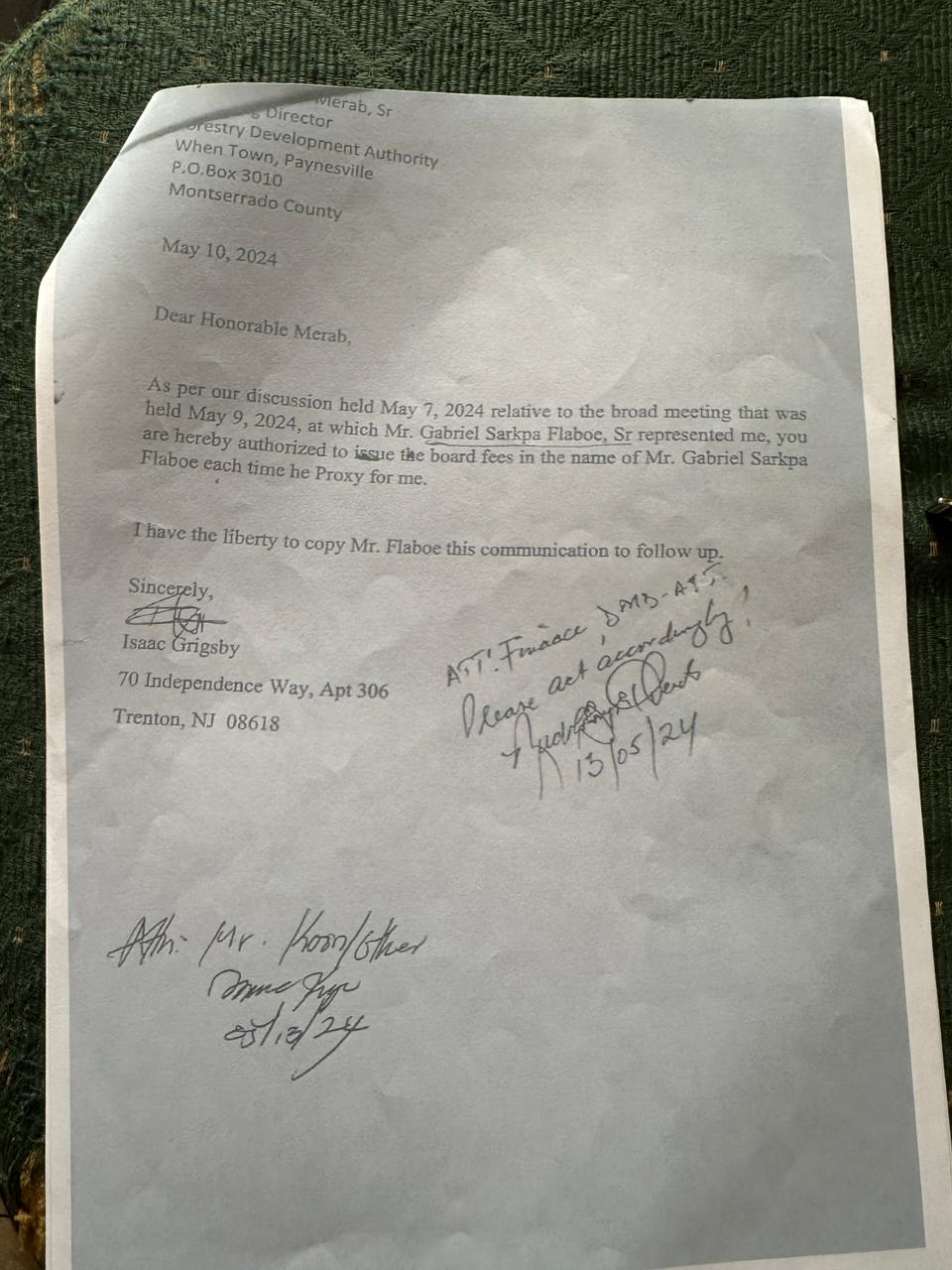
MONROVIA – A member of the Forestry Development Authority’s board of directors has resigned, following a DayLight investigation that established he received board-sitting fees through a proxy while residing in the United States of America.
“Yes, [Mr. Grigsby has resigned],” Loretta Pope-Kai, an FDA board director, told The DayLight.
“The board is yet to receive his replacement, and his proxy no longer attends meetings,” Mrs. Pope-Kai added.
The FDA did not immediately respond to queries for comment. However, two other persons, familiar with the board’s activities, confirmed the information.
Gabriel Sarkpa Flaboe, a project coordinator with the Ministry of Public Works, who served as Mr. Grigsby’s proxy, did not return questions on the matter. Efforts to contact Mr. Grigsby did materialize.
Per DayLight estimates, the New Jersey resident’s resignation saves over half a million Liberian dollars (US$2,925) for the FDA, which barely has money for fieldwork.
Before his resignation, Mr. Grigsby received L$131,625 periodically through Mr. Flaboe, who, board minutes show, made no contributions.
The amount was equivalent to US$500 for the board-sitting fee, US$50 for communication, and 25 gallons of fuel for transportation. The FDA Managing Director, Rudolph Merab, had approved Grigsby’s payment in May last year, according to official documents.
This was a production of the Community of Forest and Environmental Journalists of Liberia (CoFEJ).