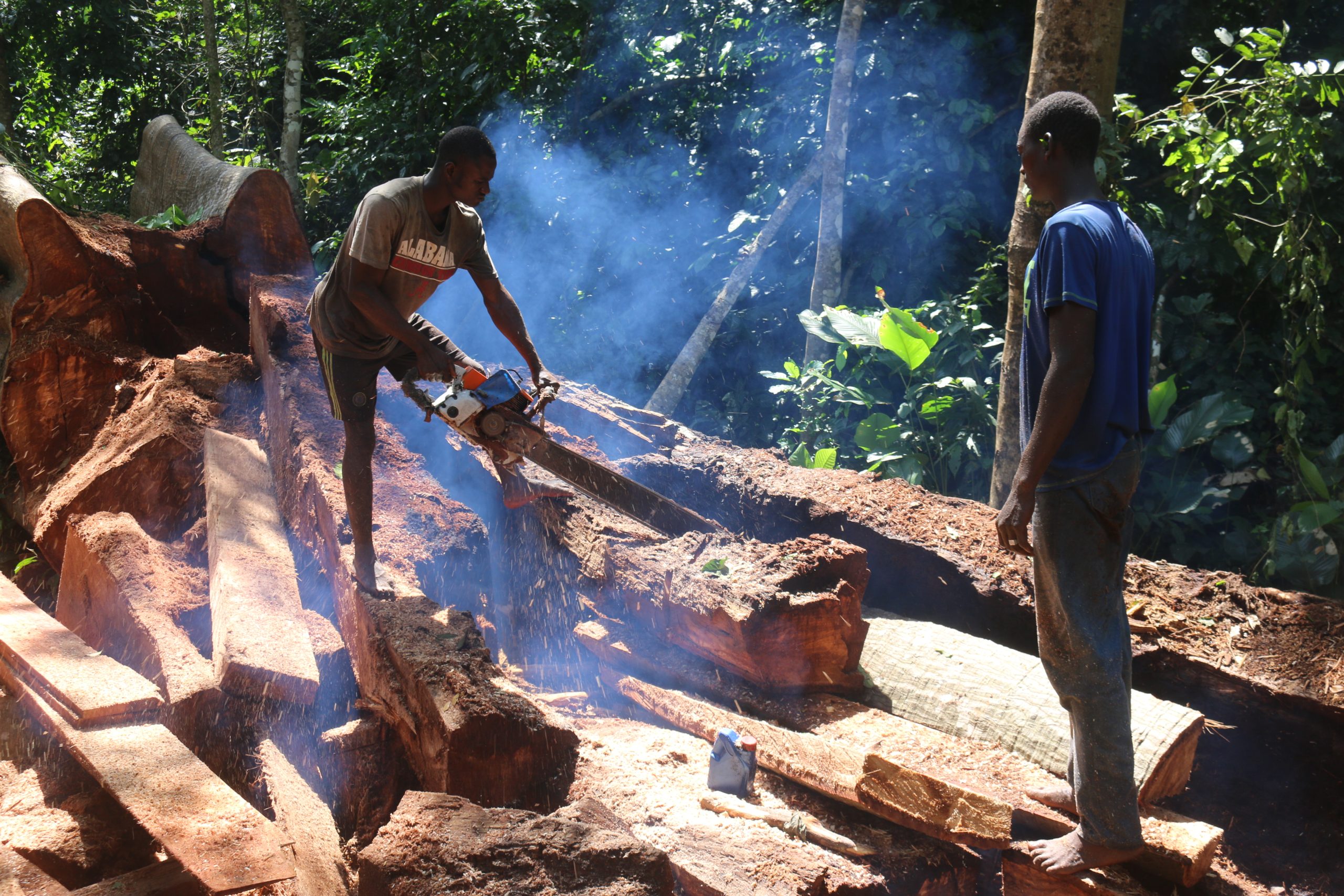
Top: Operators mill planks with a chainsaw in Borkeza, Lofa County, in 2022. The DayLight/James Harding Giahyue
By Roberto T. Kollie
MONROVIA – The Liberian government is considering one of the most significant overhauls of the National Forestry Reform Law since its enactment 20 years ago. In 2006, Liberia’s legal landscape was very different. Since then, the country has enacted major legislation, including the Community Rights Law… with Respect to Forest Lands and the Land Rights Act. Liberia has also committed to international agreements on climate change, biodiversity conservation, and legal timber trade.
Several provisions of the existing forestry law now conflict with these newer legal frameworks or fail to address emerging issues such as carbon trading, community land rights, traceability of timber exports, and mining activities in forest areas.
Government agencies, communities, civil society organizations, development partners, and the private sector will discuss the changes further before preparing any final legislative proposal. If consensus is reached, a formal amendment bill would eventually be prepared for consideration through Liberia’s legislative process.
Should the proposed reforms be adopted, they could significantly reshape how Liberia manages its forests, balances conservation with economic development, protects communities’ rights, regulates timber production, and improves transparency in one of the country’s most valuable natural resource sectors.
Here is what the proposed reforms could mean:
1. Sustainable management would become the foundation
One of the biggest proposals is the introduction of sustainable forest management as the guiding principle for every forestry decision. Instead of focusing primarily on commercial timber production, the revised law would require government institutions to balance economic development with biodiversity conservation, climate resilience, community livelihoods, transparency, and protection against illegal logging.
This change would align Liberia’s forestry sector with international agreements such as the Paris Agreement, REDD+, and other global forest governance standards.
2. A legal definition of ‘forest‘
Surprisingly, Liberia’s forestry law currently lacks a statutory definition of what constitutes a forest. The proposed amendment would establish an interim definition based on the 2018 National Forest Inventory. It would allow the Forestry Development Authority (FDA) to periodically revise technical criteria through regulations after future national forest inventories.
Supporters argue that this would reduce uncertainty in land classification and forest management.

3. Clarified community ownership
One of the most important reforms concerns ownership of forest resources. The existing law generally states that forest resources are held “in trust” by the Republic. However, the proposed amendments would recognize that forest resources located on customary land belong to communities, while those on private land belong to private landowners, consistent with the Land Rights Act.
Government trusteeship would continue primarily over forests on government and public land.
4. Greater decision-making power to communities
The draft proposes making free, prior and informed consent (FPIC) a legal requirement before any forestry license affecting customary or community forests can be approved. No forest license would be issued on community land without documented approval from local people.
The objective is to ensure that communities understand proposed projects and voluntarily agree before forests are allocated for use.
5. Stronger community forestry
The review also proposes placing community forest management agreements (CFMAs) within the National Forestry Reform Law. Currently, it is not there, as the CFMAs were created by the Community Rights Law, three years after the National Forestry Reform Law. (CFMAs are agreements between communities and the FDA for co-management of community forest resources.
Although communities already manage forests under separate legislation, supporters say integrating these arrangements into the National Forestry Reform Law would eliminate confusion and strengthen community rights.
The amendments would also clarify the respective responsibilities of community forest management bodies (CFMBs), community forest development committees (CFDCs), and community land development and management committees (CLDMCs) to reduce overlapping mandates. (CFMB was created by the Community Rights Law, CFDC was created by the National Forestry Reform Law, and the CLDMC was established by the Land Rights Act).
6. Legal but regulated chainsaw milling
One of the most controversial proposals involves chainsaw milling. Although chainsaw milling has long operated informally in many parts of Liberia, it is not currently recognized as a licensed activity.
The draft would create a formal Chainsaw Milling Permit available only to Liberian citizens, cooperatives, and authorized communities under strict conditions. It would limit operations to community forests or private land, prohibit exports of chainsaw-milled timber, require environmental approvals, and establish penalties for violations.
Supporters argue that regulation is more practical than allowing widespread informal operations.
7. Transparent revenue management
The review follows concerns raised by previous audits regarding forestry benefit-sharing.
The draft requires forestry payments to pass through designated government accounts, and not directly to individuals. It would also establish by law the National Benefit Sharing Trust Board, which manages benefits for communities affected by certain commercial logging activities. It would also require annual audits and strengthen oversight of community forestry funds.
These measures are intended to improve accountability and reduce opportunities for misuse of forestry revenues.
8. Tighter controls over mining in forests
Perhaps the most controversial proposal addresses the growing overlap between mining and forestry.
The amendments would prohibit mining in protected areas, require community land access agreements before mining on customary land, and establish stronger coordination between the Forestry Development Authority and the Ministry of Mines and Energy. Mining companies would also need FDA site assessments before forest-clearing could occur.
9. Stronger monitoring of forestry operations
The draft would require annual independent audits of all major forestry licenses, including community forestry agreements and chainsaw milling permits.
Audit reports would be published, increasing public access to information about timber harvesting, payments, community benefits, and legal compliance.
The amendments would also require the National Forest Policy to be reviewed every five years through a participatory process, involving government, communities, civil society, and the private sector.
Other Issues
But not every issue has been resolved. The review identifies several questions requiring additional consultation, including:
- Whether new Forest Management Contracts and Timber Sale Contracts should be allowed on community land or restricted to government land.
- Whether all forestry contracts should follow a uniform 25-year harvesting cycle or whether smaller community forests should have different harvesting rules.
- How large community commercial contracts should comply with public procurement principles.