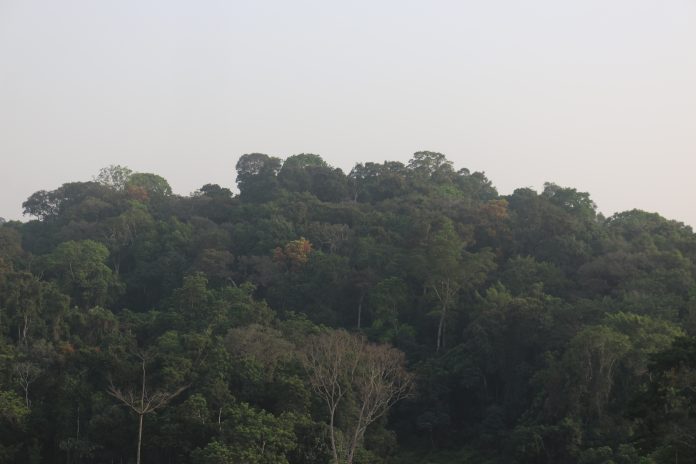
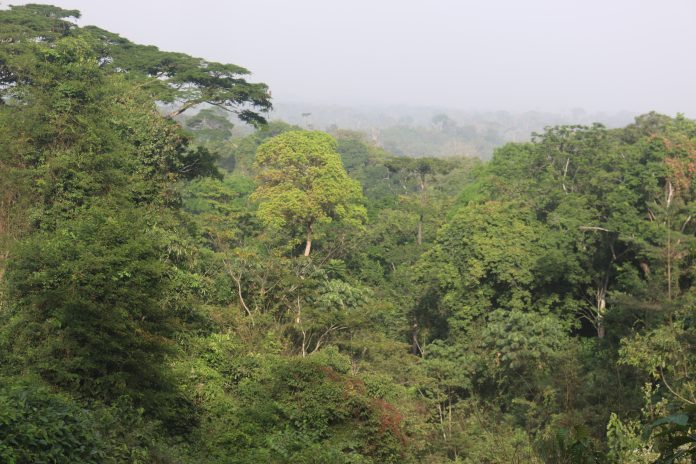
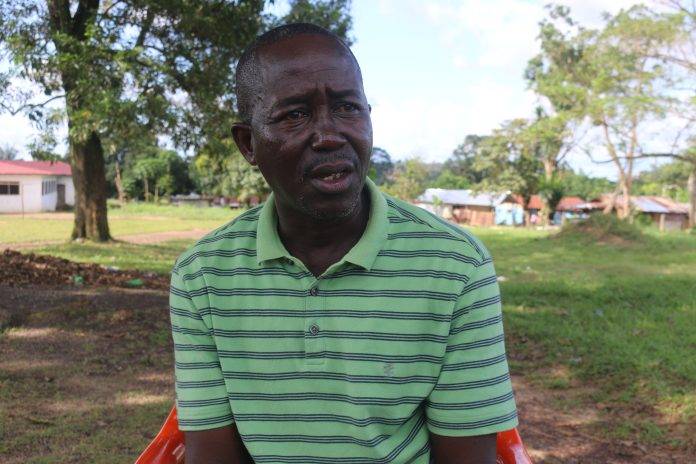
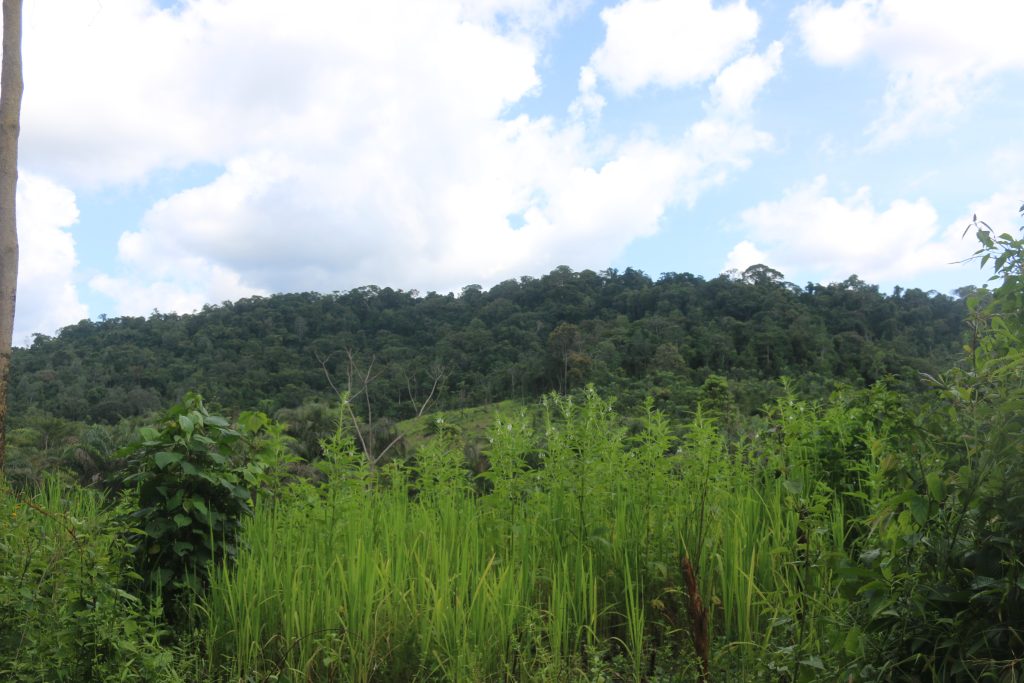
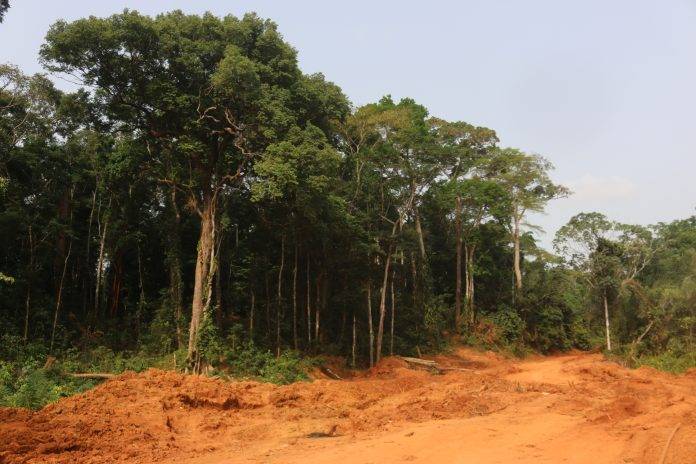
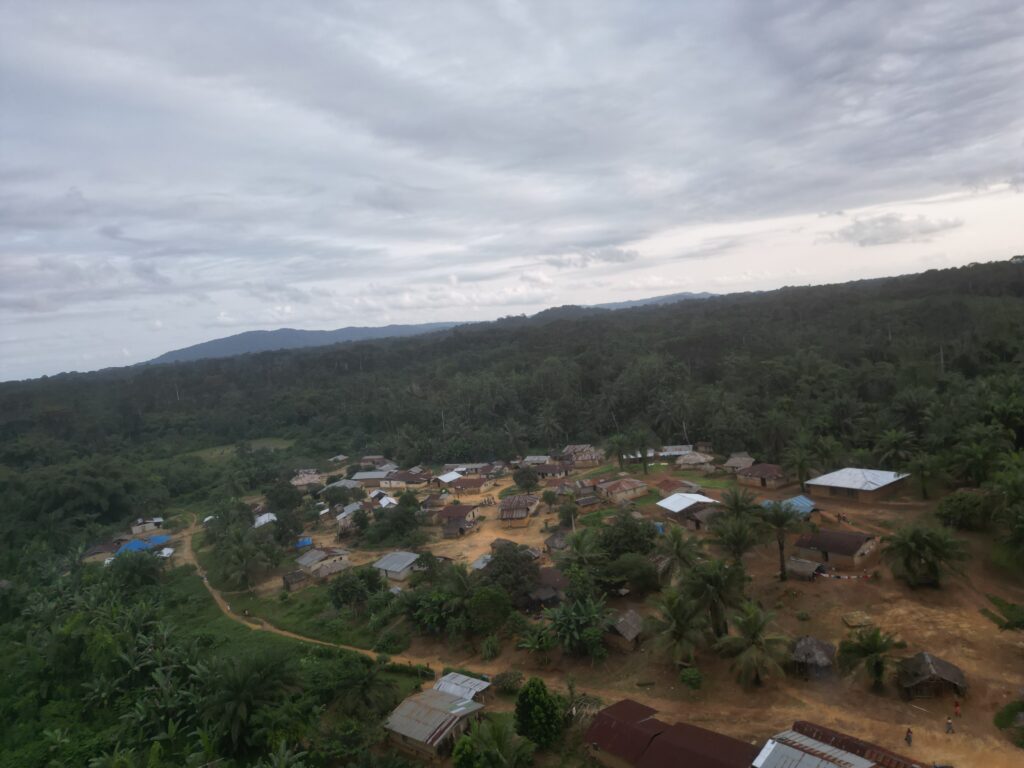
Top: Korninga B Community Forest covers 31,318 hectares in the Bokomu District of Gbarpolu County. The DayLight/James Harding Giahyue
By Esau J. Farr
MANOWALLAH, Gbarpolu County – A community forest has canceled its contract with a logging company after denying locals their benefits and development.
Korninga B Community Forest in Bokomu District, Gbarpolu County had sued Indo Africa Plantation Limited for a breach of the agreement, according to court documents. The company reneged on the terms of the agreement and denied it several benefits and undermined development which led to a lawsuit.
“The third-party forest management agreement is hereby declared canceled as though same has never existed among and between the parties…,” said Judge Zubullah Kizeku of the 16th Judicial Circuit Court in Bopolu in its summary judgment ruling. A summary judgment is a final decision made by a court based on the statements and evidence without going to trial.
Aaron Mulbah, the chief officer of Korninga B, said he was happy the community has gotten back their forest.
“It didn’t come to me as a surprise, because of the proper documentation of our issues with Indo Africa and records shown [in] court,” Mulbah said.
Indo Africa did not respond to queries.
Korninga B signed a 14-year agreement with Indo Africa, a firm owned by a Singaporean family, the Guptas. Korninga B leased its 31,318-hectare forest to Indo Africa for a forest contract.
The company agreed to pay Korninga B US$46,977 as a land rental fee, US$30,000 for scholarships and US$25,000 for medical each year.
The company further promised to construct two handpumps in each town, a youth centre and a paramount chief’s office for affected communities.
But up to four years later, the company failed to harvest a single log to make the payments. That failure violated a clause in its contract and a provision in the Community Rights Law, prompting the lawsuit. The law requires companies to begin harvest within 18 months after the signing of the agreement.
In all, Korninga B received US$65,000 in land rental fees from Indo Africa, according to Mulbah.
The community used the fund to begin the construction of a guesthouse in Henry Town, the region’s most populated place.
Mambutu Dukuly, another community leader, said that based on their experience with Indo-Africa they would conduct background checks on companies before awarding any future contracts.
“We will be looking at their financial strength, records of work, relationship with communities and… payment…,” Dukuly said.
The cancellation of the deal, however, means affected communities still do not have a school or a clinic. Schoolchildren have to walk a long distance to Henry Town as Bopolu is even farther.
Patience Kumakeh, one of the decision-makers for Korninga B, said that will feature high in their next agreement.
“The community will be looking up to any company that will be willing to provide road reconditioning, the construction of clinics, school handpumps and educational support.”
Korninga B is not Indo Africa’s only failure. The company also abandoned a contract with Bondi Mandingo in Gbarpolu in the Bopolu District. It and Sing Africa, another company owned by the Guptas, are listed in a recent forestry review and are dormant.
Funding for this story was provided by the Kyeema Foundation and Palladium. The DayLight maintained editorial independence over the story’s content.
Top: Korninga B Authorized Forest Community has sued Bea Mountain Mining Corporation for US$4.3 million in damages for alleged illegal entry and destruction of its woodland. The DayLight/James Harding Giahyue
By Esau J. Farr
TUBMANBURG, Bomi County – A community forest in Gbarpolu County has rejected Bea Mountain Mining Corporation’s proposal for a settlement in a US$6.3 million lawsuit against the company.
Bea Mountain proposes to pay the Korninga B Community Forest US$100,000, a US$65,000 mobile sawmill and a pair of chainsaws, according to the proposed settlement document seen by The DayLight.
Korninga B and Bea Mountain had agreed to the settlement in 2022 but the company pulled out of the arrangement, prompting the community to go to court. Locals filed for US$6.3 million action of damages over Bea Mountain’s alleged unauthorized entry and destruction of the forest.
Under the settlement agreement, seen by The DayLight, Bea Mountain offers to pay Korninga in two installments. The company agrees to deploy five staff to train the same number of townspeople to operate the sawmill, according to the document.
The settlement proposal also prohibits Bea Mountain from working in the forest and gives Korninga possession of the trees that Bea Mountain cleared.
Aaron Mulbah, the chief officer of Korninga, said they rejected the proposal because they had incurred expenses as a result of their lawsuit. “They have to go above that,” Mulbah told The DayLight.
Cllr. Kunkunyon Wleh Teh, Bea Mountain’s lead lawyer, declined an interview with The DayLight.
Verdict and Retrial
Korninga B’s lawsuit accuses Bea Mountain of felling over 2,800 logs to make a passage through the 78,624-acre forest in the Bokomu District to its mining sites, according to court documents. Bea Mountain is also accused of harvesting logs from the area to construct bridges, throwing some in valleys while burying others.
The company denies any wrongdoing, saying it only mined in areas covering its licenses, and that the community should instead pay it damages for allegedly obstructing its operations.
Following more than five months of legal battle, a six-man jury found Bea Mountain liable for wrongdoing.
But the court granted Bea Mountain’s petition for a retrial on grounds that jurors failed to take witnesses’ testimonies into account and ignored inconsistencies in testimonies, calling the US$5 million damages “grossly disproportionate.”
In early March 2022, Bea Mountain Mining Corporation allegedly illegally entered the Korninga B Community Forest in Bokomu District and felled several trees.
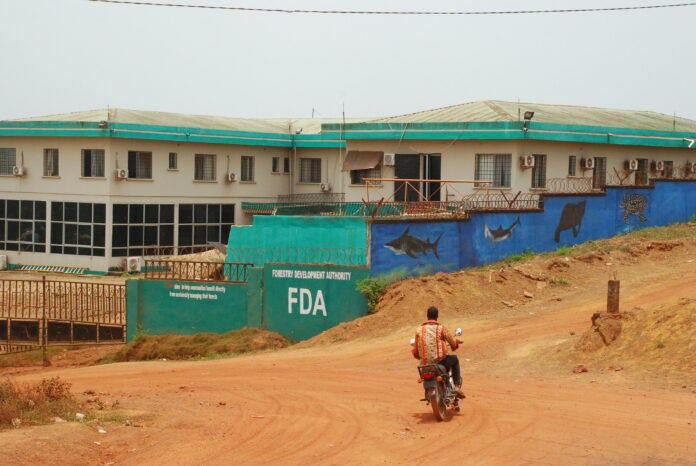
Under the Community Rights Law…, locals own and comanage forests adjacent to their communities alongside the Forestry Development Authority (FDA). The law is a breakaway from the past, where only the government and companies had a say in forestry. It guarantees locals’ right to forestland and prohibits unauthorized entry and use of forest resources.
The Sixteenth Judicial Circuit Court in Bopolu, Gbarpolu County, from where the case was transferred to Tubmanburg, Bomi County. The DayLight/Dougba McCay
Before going to court, Korninga informed Bea Mountain of its ownership of the forest and Bea Mounting’s alleged illegal actions. The two parties agreed that the company would pay the community US$165,000 for the damages and other things.
Ruth Varney, a representative of the Forestry Development Authority (FDA) in the western region, had compiled a report on the alleged damages with the company’s funds, court documents show.
But Bea Mountain pulled out of the arrangement, which also included Keyah Saah, the Superintendent of Gbarpolu County. Angered by that, Korninga filed a US$4.3 million lawsuit against the company at the 16th Judicial Circuit Court in Bopolu, Gbarpolu County.
Bea Mountain’s defense team asked the court to dismiss the case. Its lawyers argued that locals did not have the right to sue the company and that it had legal mining licenses to operate in that area.
The three medium-scale mines in question are located in the same region as the Korninga B Community Forest. The licenses of two of the mines are held by MNG Gold, a company owned by Mehmet Nazif Günal, the Turkish billionaire who also owns Bea Mountain. The license for the other is held by Gbarpolu Mining Corporation, a Liberian-owned firm.
Prosecution lawyers led by Atty. Alston Armah asked the court not to grant the defense lawyers’ petition. Prosecution lawyers argued that Korninga had the authority to file the lawsuit. They added that the mining licenses were not owned by Bea Mountain.
The court in Bopolu agreed with Korninga and denied Bea Mountain’s petition, and the case proceeded. However, it was transferred to the 11th Judicial Circuit Court in Tubmanburg, Bomi County after another petition by defense lawyers.
Bea Mountain has proposed to give Korninga B US$100,000, and other things as a settlement in a lawsuit against it. The DayLight/Charles Gbayor
There, prosecution lawyers told the court Bea Mountain broke the Community Rights Law… “The destruction of the forest with no knowledge of the legal community forest is causing [the community] pain, suffering, mental anguish and distress,” one court filing read.
Lawyers of Bea Mountain counterargued that the company and a partner legally obtained the three mining licenses it operates in that region. They said the Korninga forest leadership did not have the authority to sue the company, only its ancestral land leadership had. They said the investigation conducted by Varney was not legal or binding because she was not authorized to do so.
The court heard testimony from Yanquoi Dolo, the head of the FDA’s legal department. “The FDA did not communicate any official assessment report involving Korninga B Community Forest,” Dolo told the jurors.
Following final arguments, the six-man jury handed down a unanimous verdict against Bea Mountain in October last year. The jurors held Bea Mountain liable for US$1,311,401.21 in special damages and US$3 million in general damages.
Three days after the ruling, the company filed a petition for a new trial, citing inconsistencies in witnesses’ testimonies and that the jurors ignored some of their evidence.
Prosecution lawyers argued that documentary evidence and testimonials were sufficient to have the company liable for the damages. They said the jurors’ guilty verdict matched the evidence produced during the trial.
But, this time, the court ruled in favor of Bea Mounting, ordering a retrial. Judge Ciapha Carey said the inconsistencies favored the company as well as the fact not all the trees in question were scaled.
Unsatisfied with the ruling, lawyers representing Korninga B petitioned the Supreme Court for a review of the case. The high court affirmed Carey’s ruling for a new trial.
Mulbah said Korninga was awaiting a retrial.
“We are asking international partners, NGOs to help the community people in our case with Bea Mountain,” Mulbah said. “Bea Mountain feel that they have money… but the law is there.
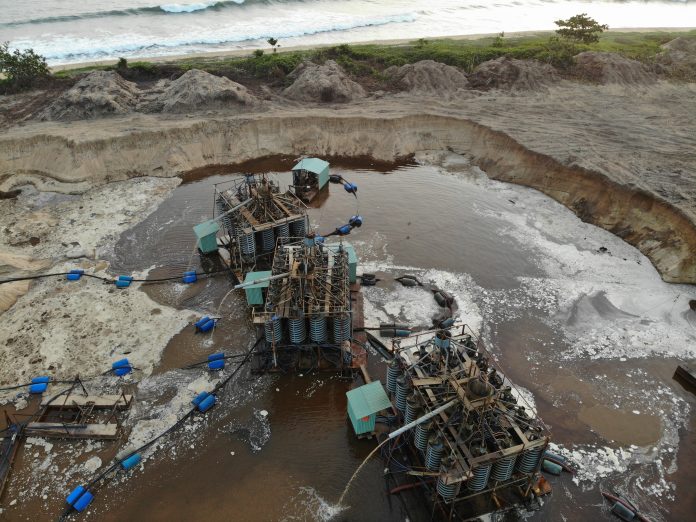
Top: Jatoken Mining Inc. is one of several mining companies that have been awarded licenses to mine zircon sand in Liberia. Drone photograph by Derick Snyder
By Emmanuel Sherman and Tenneh Kieta
BUCHANAN, Grand Bassa County – Large holes and sand piles lie on the beachfront, not too far from the graves of some of the forefathers of Liberia, including Stephen Allan Benson, Liberia’s second president. Water seeps into the pits as the sunray hardens the sand piles like termite mounds.
Be not deceived for they are not a sign of renovation works on the final resting place of the pioneers. They are evidence of an illegal mining operation that once threatened the existence of this historic graveyard and its quiet, seaside neighborhood.
Last August, Jatoken Mining Incorporated, a majority-Chinese-owned company, arrived in Upper Buchanan with its machines. They began mining zircon sand, a mineral used in the ceramics and electronics industries. Locals call it black sand.
Locals were shocked. The representative of the Ministry of Mines and Energy, and local authority had not informed them about Jatoken’s activities. Moreover, it is a violation to mine in a graveyard.
“When they [first] came they said they wanted to do prospecting on the beach because we have black sand,” recalled Joe Russell, the town chief of the Upper Buchanan community. “When they came again, they did not consult me and began digging.”
News of the operation claimed the attention of Dr. Laurence Bropleh, then a presidential advisor, who hails from that area. Bropleh helped stop Jatoken’s mineworkers. “They can seek other places to go,” Bropleh told The DayLight. “We are protecting the serenity and historicity of our place.”
The police and Emmanuel O. Sherman (no relation to the reporter), then the Deputy Minister for Operations at the Ministry of Mines, investigated the matter. A Chinese woman only identified as Caroline presented a mining license, according to Bropleh and other residents.
Sherman reviewed the document and told her it was fake, according to Bropleh, Eddie Williams, a representative of the Office of the Superintendent of Grand Bassa County, and other people. The police then drove the miners away.
The DayLight was not able to obtain a copy of the license in question. However, the newspaper photographed large mining pits, sand piles and earthmovers impressions Jatoken left behind, scarring Upper Buchanan’s pristine, grassy seafront.
Jatoken has never obtained a license to operate in Grand Bassa County, records of the Ministry of Mines show. All of its licenses are for Montserrado and Sinoe, according to the records.
The ministry’s records suggest that none of Jatoken’s zircon licenses has been surrendered, canceled, suspended, or placed under review as of February 3, 2024. An online repository run by the ministry tracks the statuses of licenses. The fact there is no entry in the system for Jatoken in Bassa proves the one Jatoken presented was fake.
When contacted, Sherman declined The DayLight an interview, forwarding the newspaper to Emmanuel Swen, then Assistant Minister for Mines. Swen said he did not have any idea about the issue and could not speak on it.
By law, the Ministry of Mines should have pressed charges against Jatoken. Forging a mining license is an offense under the Minerals and Mining Law of Liberia. Violators face between a US$1,000 and US$2,000 fine or a prison term of two to three months. However, the ministry rarely prosecutes anyone for a mining violation. The DayLight reported last year that Jatoken was ineligible to do business in Liberia due to its illegal papers but authorities took no action. Other illegal activities in River Cess, Montserrado and Nimba last year—one involving Minister of Justice-designate Cooper Kruah—suffered the same fate.
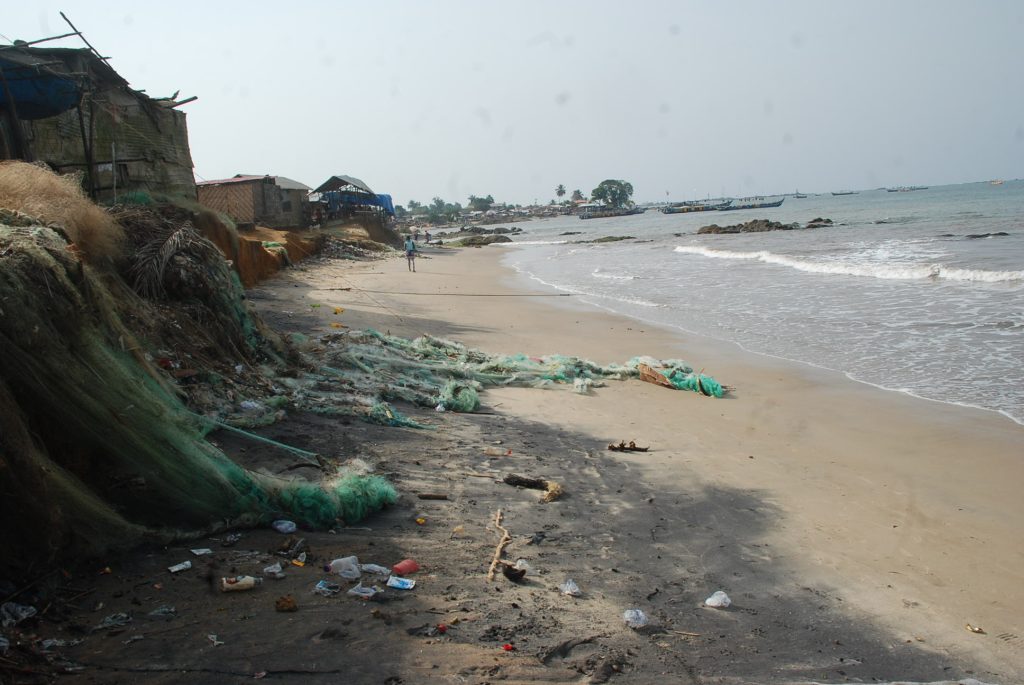
Official records show that Jatoken is one of the companies awarded zircon licenses across the country. That violates a 2012 moratorium on beach sand mining imposed to ease coastal erosion countrywide, with Buchanan the epicenter. The city has lost entire communities to violent waves scientists say are an impact of climate change. So far, Upper Buchanan has been spared and residents hope it stays that way.
“We are protecting Upper Buchanan. We are protecting Liberia,” Bropleh said.
“My house may go. I may be able to afford to build another house but what about the rest [of the people] and all the rich history?” He added.
Illegal company
The DayLight’s initial investigation on Jatoken found it amended its article of incorporation twice but failed to register the changes with the Liberia Business Registry. To prevent money laundering, terrorism financing and other crimes, the Business Association Law requires companies to register all changes in their legal documents.
Impact of sea erosion, Gbalaweh town, Kokowein, Buchanan, Grand Bassa The Daylight/Emmanuel Sherman
The investigation also found that Jatoken may have amended its article of incorporation without the consent of one of its owners, Tibelrosa Tarponweh, the former Margibi lawmaker.
Tarponweh and Jianjun Haung, a Chinese national, established the company in 2014, named after Tarponweh’s hometown in River Gee. The former Margibi lawmaker has 15 percent of the company’s shares and 85 percent of shares for the Jianjun, according to Jatoken’s article of incorporation with the business registry.
On July 3, 2019, Jatoken illegally amended its legal documents and transferred Tarponweh shares to another person. It did another unlawful amendment on September 29, 2021, its tax history shows.
But the former lawmaker said that he was unaware of those amendments. Tarponweh claimed that his signature on the company’s resolution to remove him as a shareholder was forged.
Swen did not dismiss Tarponweh’s accusation at the time. He promised to launch an investigation once Tarponweh filed a complaint with the ministry, though The DayLight provided evidence of the Jatoken’s disqualification.
In March last year, Tarponweh said he would lodge a complaint with the ministry and sue Jatoken for alleged forgery. He repeated that again in a phone interview with The DayLight last week. “Now that the elections are over I am ready to pursue my case,” Tarponweh said.
Effort to contact the Chinese woman only identified as Caroline, who is Jatoken’s manager, proved futile. She evaded several attempts by The DayLight for an interview, and did not respond to WhatsApp messages and a number of phone calls. It was The DayLight’s second failed attempt in a year to speak to a representative of Jatoken over a report on the company’s illegal activities.
Funding for this story was provided by the United States Embassy in Monrovia. The DayLight maintained editorial independence the story’s content.
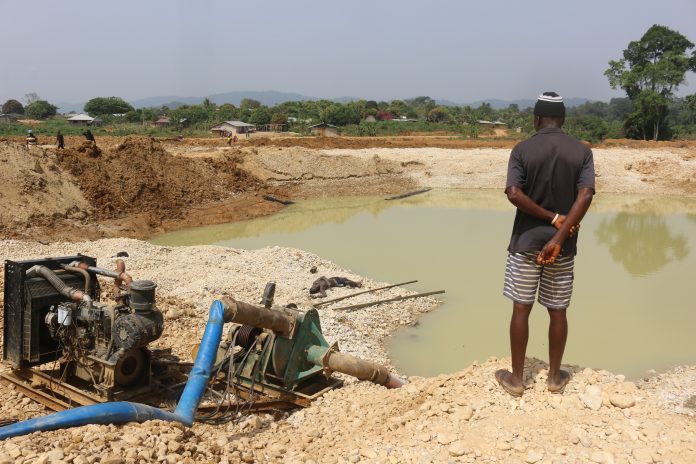
Top: A townsman looks at the body of Prince Hali, a 20-something-year-old artisanal mineworker who drowned in a mining pit in Belle Yalla over the weekend. The DayLight/James Harding Giahyue
By Esau J. Farr and Charles Gbayor
BELLE YALLA – A man believed to be in his 20s has drowned in a huge mining water in Gbarpolu County.
Prince Hali, an artisanal mineworker, drowned in a mining pit in Belle Yalla over the weekend. A 15-townsman jury found no foul play in Hali’s death.
“We are told that he went to wash himself and drowned,” Vincent Abban, Gbarpolu County’s chief investigator, told The DayLight. “From what I have seen, there was no foul play and the body is intact.”
Eyewitnesses said Hali and other miners had gone to bathe in the mine pit water late afternoon last Friday. The other miners watched in horror as their colleague disappeared into the water.
“We saw the other man running coming and told us that since [Hali] fell into the water he hadn’t been seen,” said Samuel Cole, a friend of Hali.
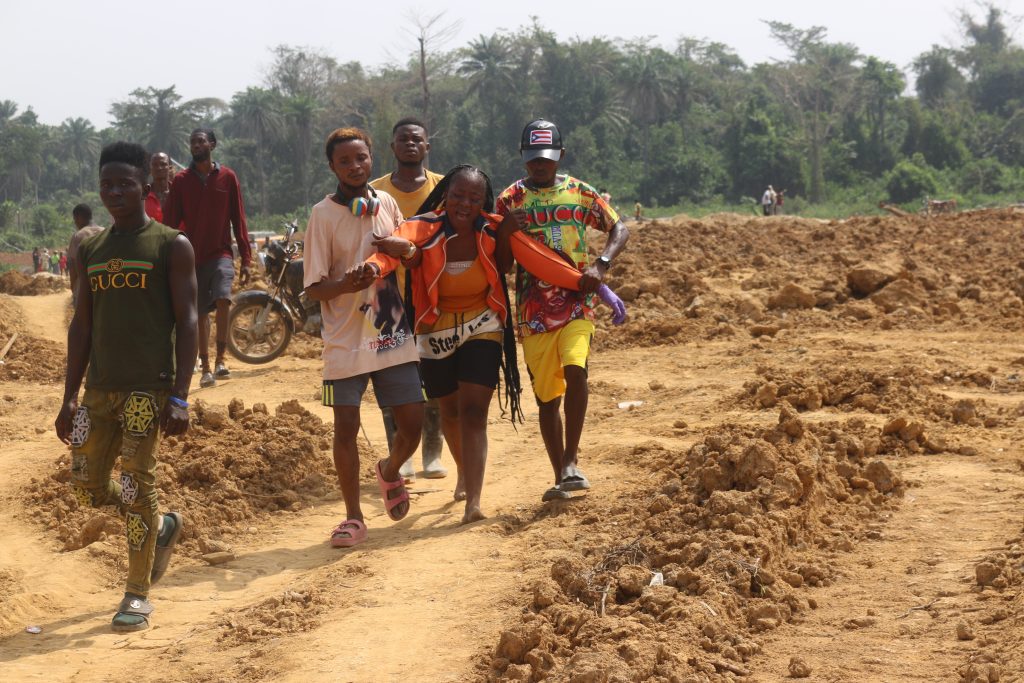
A relative of Prince Hali, a mineworker who drowned in a mining pit in Bella Yalla, is helped from the scene after his body was discovered on Saturday. The DayLight/James Harding Giahyue
A search party comprising the police, townsmen and members of Belle Yalla’s community watch team took a day to find Hali’s body. Volunteers had to pump out water from the pit to find his body at the bottom of the pit water.
One of Hali’s relatives wept a river as the search party discovered her brother’s corpse and was helped away from the scene. “I came to visit you and this is how you welcome me,” the woman could be heard crying as she was led away.
The mining pit in which he drowned was left behind by the Randell and Oretha Doe Multipurpose Company, a firm operating in that region. The company had diverted the Manneh Creek, the major source of water for Belle Yalla’s 3,600 people, for a medium-scale mine.
The company’s operations have changed the way of life here, with water scarce most of the year, Peter Flomo, the commissioner of the township. As a result, people have turned to the pit to wash and bath, he added.
Randell Doe, an executive of the company, did not immediately respond to queries. The DayLight will update this story once he does.
Pallbearers carried Hali’s body high on a platform to his grave following a brief funeral ritual. He was buried Saturday, just a stone’s throw from the ill-fated mine pit by the local tradition.
Funding for this story was provided by the United States Embassy in Monrovia. The DayLight maintained editorial independence over the story’s content.
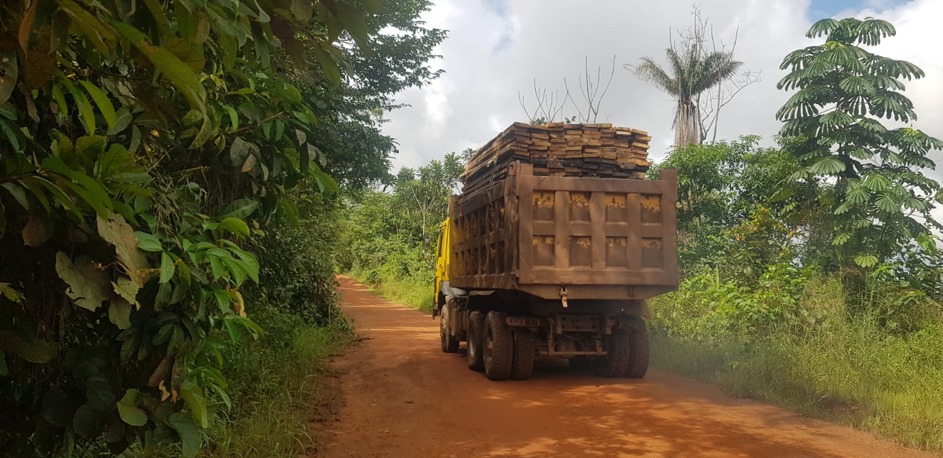
Top: The Commissioner of Gbarma Alfred O. Bah illegally imposed L$500 on trucks transporting planks from Gbarpolu County. The police may have taken advantage of Bah’s wood truck restriction to allegedly solicit a bribe from transporters. The DayLight/James Harding Giahyue
By James Harding Giahyue and Tenneh Keita
GBARMA DISTRICT, Gbarpolu – Three or four years ago, Alfred Bah, the Commissioner of Gbarma District, decided to collect money for trucks transporting wood from the western county.
“When I took office, I was informed that the outgoing commissioner used to at least talk to the [wood dealers] … for district development,” Bah recalled in an interview at his office. “Whether I could do the same, I said ‘yes.’ For me, what I will do I will call the [wood dealers for] a meeting.’”
The meeting was held and the parties agreed that trucks carrying wood from Gbarpolu must pay L$500. The money would be used to repair a major stretch of road linking Gbarma to other parts of the county.
That day, Bah added to a list of county officials who misuse their power to exploit wood dealers across the country. The officials do not have the authority to impose a fee on wood or other goods, according to the Local Government Act and the Chainsaw Milling Regulation. The former law restricts such function to county councils, governance bodies which have not yet been formed in most counties, including Gbarpolu. The latter empowers the Forestry Development Authority (FDA) and local communities or private landowners.
This is The DayLight’s third story on the subject after an August investigation exposed the involvement of the Superintendent of Lofa County William Tamba Kamba in the illegal deal. The first implicated a regional collector of the Liberia Revenue Authority (LRA). The series sheds a light on an unregulated subsector of forestry engrossed in corruption and impunity.
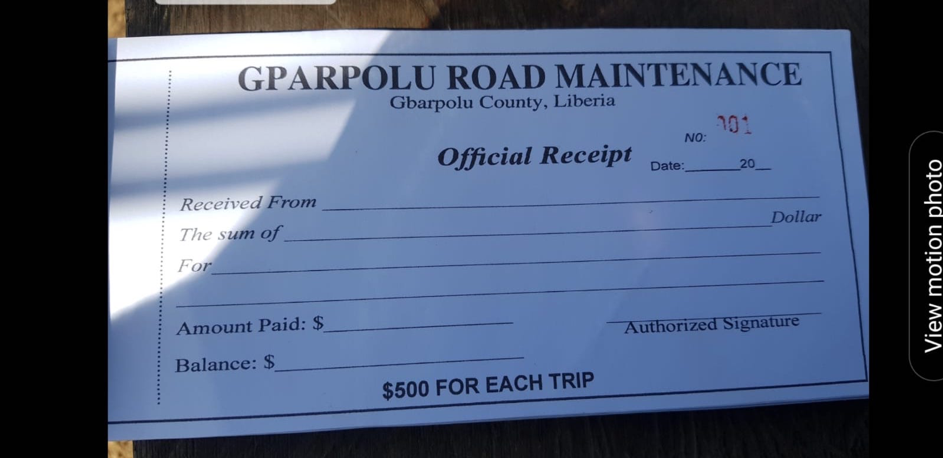
An unissued receipt created by the Commissioner of Gbarma Alfred O. Bah and a representative of local plank producers meant for trucks carrying wood and other goods as part of a so-called scheme to repair a major route in Gbarpolu County.
‘L$500 for each trip’
Varney Freeman, a representative of plank dealers in Gbarpolu, worked with to Bah organize the scheme. They imposed L$500 on each truck carrying wood. A vacant receipt we obtained brandishes: “Gbarpolu Road Maintenance Official Receipt” and “L$500 for each trip.”
Freeman was responsible to make other plank dealers comply, though aware that the fee was illegal. “The [Commissioner] doesn’t have the legal power to impose fees on trucks plying the county’s roads but we are businesspeople,” Freeman said in an interview on his farm in Okai Village in November last year. Gbarpolu is one of the most forested regions in Liberia and a goldmine for many wood dealers. They are known in forestry as chainsaw millers from their use of the handheld device to make planks.
“If we want to fight all the legal things, we will not get our business going,” Freeman added.
So, trucks carrying wood began to pay the fee. A subbranch of the Forestry Development Authority (FDA) at Sawmill on the Bopolu highway collected the fees, according to Bah and Freeman. Rangers at the subbranch corroborated their story.
Bah claims he collected between L$16,000 and US$17,000 only, which was used to repair the road. Gbarpolu Superintendent Keyah Saah dismissed the claim, saying he (Saah) organized the youth to rehabilitate it instead.
The FDA rightfully collects US$0.60 on each plank transported across the country. However, those payments are not turned over to the Liberia Revenue Authority, the agency of the government that collects taxes. There is no public record the FDA accounts for the funds. It took the agency more than a decade to devise a regulation for the subsector yet it is not enforcing it. Such lawlessness makes it easy for Bah’s toll system and other illegalities to succeed.
But Bah’s system soon encountered a problem that would ultimately lead to its end, at least openly. First, some wood truckers refused to pay, arguing they did not take their planks from Gbarma and could not pay the district any toll. Second, there issues about the receipt capturing the entire county rather than just Gbarma. And dealers argued their vehicles were smaller than those of logging companies, several of whom operate in Gbarpolu.
“I insisted that I will not pay the L$1,500,” said Kent Mamay, a plank dealer in the VOA Community. “There was a heated argument between them and myself and at the end of the day they were able to release my truck.”
Amid the pressure, Bah halted the collection last year. He claims Gbarpolu County Assistant Superintendent for Development Joseph Akoi had ordered him to do so to avoid further problem. Akoi denies that, telling The DayLight in an interview in Bopolu he had not heard of a plank toll in Gbarma.
But plank dealers and drivers The DayLight interviewed said they still paid the fee while the system was halted. Varney Tulay, another wood dealer in VOA, said no receipts were being issued this time around.
Gbarpolu County, largely covered with forests, is a workplace for many plank dealers or chainsaw millers. The DayLight/James Harding GiahyueWood truckers protested a toll system established by the Commissioner of Gbarma, Gbarpolu in which they had to pay L$500 to ply a major route in the county. The DayLight/James Harding Giahyue
“Like four to five months ago, they have stopped issuing receipts,” said Tulay in a September interview with The DayLight. “I came a month ago, last month August, and the [Commissioner] toll was paid…” Bah denies Tulay’s claim.
‘Let [all] the vehicles pass’
After the protest, Bah ordered the police detail at Sawmill not to allow any wood truck ply that route during the rainy season last year. He repeated that this year, power a commissioner does not have.
“With [an immediate] order, please stop all heavy equipment, wood trucks and coal trucks from using the main road from Bomi to Gbarpolu,” this year’s communication posted on the wall of the police detail read. It excluded vehicles transporting petroleum and food items.
Bah said his action was not a reaction to the wood truck drivers’ protest but the aspiration of the community. “The citizens are complaining that if people [do] not stop using this road and damaging the road they would demonstrate and I don’t want them to demonstrate,” he said.
Asked why he did not inform the Ministry of Public Works about the road situation and about the illegality of his order, Bah said he did not know how to contact the ministry. “I don’t have the authority now to say I’m going to meet [the] public work minister to say ‘My feeder road is damaged and I want you to go fix it,’” Bah said. “It is not so easy, except where we are call in a workshop maybe I can raise this concern there maybe it can be looked [into].”
Bah might have halted collections but perhaps unscrupulous police officers are allegedly taking advantage of his order to exploit wood dealers. During the day, they pretend to enforce the illegal order but solicited a bribe from wood truckers at night and allow them to pass. Residents of Sawmill, who asked not to be named for fear of retribution, spoke of long queues of trucks that formed up to dusk and disappeared by dawn.
Wood dealers, who backed up the residents’ account, dared to speak out.
“They will demand us that the car can’t go. Then, certain time of the night, they will free us,” Tulay the VOA dealer told The DayLight. “Sometimes we pay L$2,500 at the gate just for the car to go.” Tulay said he reluctantly paid that and other fees and increased the prices of his planks. Furniture-makers we interviewed said they were buying wood at higher prices compared to previous years.
Murphy Collins, the acting police commander at the Sawmill detail, neither denied nor confirm the claim. However, Collins disclosed that officers collected L$600 from trucks passing through the checkpoint, something Tulay and other dealers had mentioned. He said he used the money to run a generator and for other things. “At night, we collect those small money and put it in our coffers to buy gas on a regular basis,” Collins said.
Aware of its turnout, his vehicle restriction has caused, Bah now wants to rescind it. In fact, he may have already chosen the wordings for that communication to Collins.
“Since you don’t want to give me the respect, you’re allowing this act, then let [all] the vehicles pass,” Bah told The DayLight.
“Sometime when you’re a leader [and] you’re not careful how to do things, …your name can [ be spoiled].”
The story was a production of the Community of Forest and Environmental Journalists of Liberia (CoFEJ). It was originally published by the Daily Observer, an editorial partner of The DayLight.
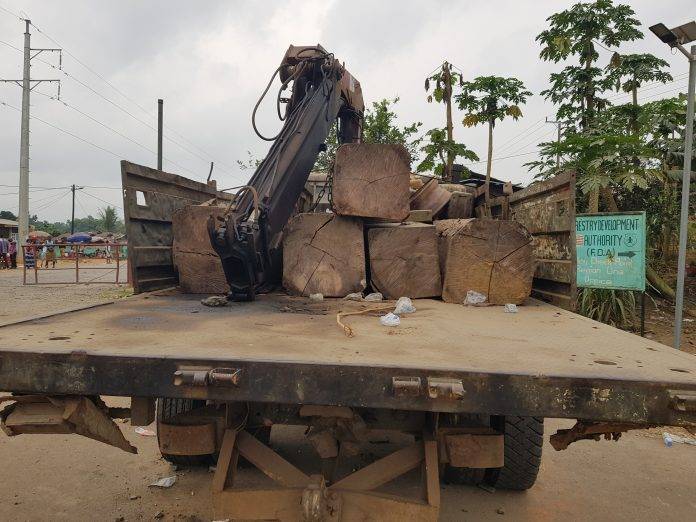
Top: Kpokolo seized at the FDA checkpoint in Klay, Bomi County. A report by U.S.-based Forest Trends launched today says kpokolo threatens Liberia’s rainforests and undermines the country’s climate change efforts. The DayLight/James Harding Giahyue
By James Harding Giahyue
“Kpokolo,” a new form of illegal logging threatens Liberia’s rainforests, provides little benefit for the country and undermines its climate efforts.
Kpokolo harms small-scale loggers, who are the sole suppliers of wood to the domestic markets. Big companies are taking advantage of the illegal trade
The report calls on President-elect Joseph Boakai to take clear steps in banning kpokolo and punish violators of the ban
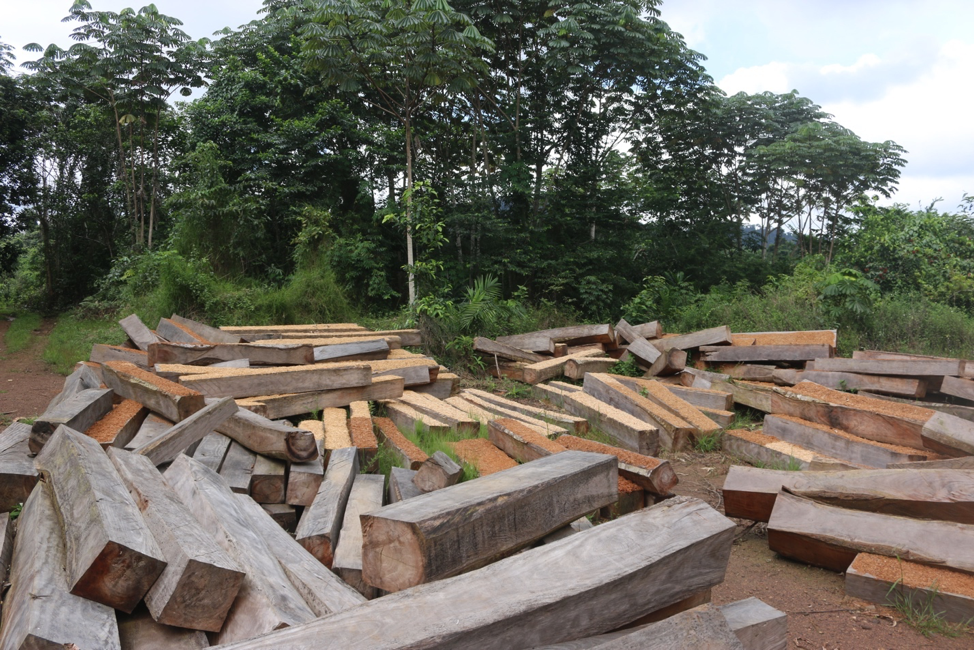
MONROVIA – Thick, four-cornered and expensive timber produced illegally across the country and smuggled in containers, are a threat to Liberia’s forests, and undermine its efforts to combat climate change, a report launched today by the US-based Forest Trends, has found.
The report—“‘Kpokolo’: A New Threat to Liberia Forest”—found that block wood or kpokolo, as it is commonly called, has no legal basis and harms small-scale loggers, rural communities and the country. It calls for a ban imposed on the illegal logging earlier this year to be made clear and official.
“The illegal exploitation takes advantages of weaknesses in enforcement, corrupting officials and compromising processes…,” Arthur Blundell one of the report’s two coauthors, told The DayLight.
“The newly elected president should take immediate steps to halt this illegal exploitation by confirming an official ban of kpokolo, including devoting resources for the enforcement of the prohibition,” Blundell added.
Based on interviews and media reports—including from The DayLight—the report suggested that kpokolo might have begun in the 2010s. It operates within the plank subindustry. However, the size of planks, which are two inches thick, differs sharply from kpokolo, which can be up to 12 inches thick, the report said.
Between October and December last year, researchers interviewed 267 community dwellers, chainsaw operators and wood dealers in eight counties for the kpokolo report. It is an update to a 2016 report on the wood market in Liberia.
The Forestry Development Authority (FDA) did not immediately respond to questions for comments on the report. The agency had, at least officially, sanctioned the illegal operation, collecting fees from operators to transport the wood.
‘Economic sabotage’
The report did not find sufficient evidence on the scale of kpokolo but found enough cases where the new form of illegal logging posed a threat to the country. It said kpokolo undermined Liberia’s climate change efforts, and the protection of the country’s forest, West Africa’s largest remaining rainforest. Liberia has pledged to the United Nations to reduce deforestation by 50 percent by 2030 among other commitments.
The coauthors of the report called for the entire industry to rally against kpokolo.
“Without such a whole-sector approach, Liberia risks allowing illegal logging to undermine not just [sustainable forest management] but governance in rural areas more broadly as kpokolo has a corrupting influence on local authorities and community leaders,” Blundell said.
The report gathered evidence that large companies were exploiting the kpokolo situation to “squeeze out artisanal operators who supply the local wood markets.”
Operators, known in the industry as chainsaw millers, perhaps need to promote a recently adopted regulation to limit kpokolo, the report suggested.
Though chainsaw milling has been largely unregulated since its emergence in the 2000s, the subindustry has been allowed to supply much-needed wood to the domestic markets. One FDA report dubs it a “necessary evil.”
Squared timbers, commonly called “Kpokolo” illegally harvested in Grand Bassa County. The DayLight/James Harding Giahyue
People researchers interviewed said companies were exporting the wood to Ukraine before its war with Russia. Researchers learned that kpokolo timber were being exported for railroad ties, which matched the dimensions of the illegal wood.
The report quoted people stating companies were smuggling kpokolo through containers, one of them Akewa Group of Companies, a Nigerian-owned firm that has violated nearly every forestry law. There is a mention of Askon Liberia General Trading Inc., which was debarred from forestry over its illegal operations, with its Turkish owners arrested in May. Akewa did not respond to questions over its alleged involvement in kpokolo.
In February, three months before the ban, the FDA had announced that it had banned kpokolo. In June Liberia also discussed the ban at an annual forestry meeting with the European Union.
Those steps were not enough and that kpokolo could still be ongoing as operators could claim they are unaware of the ban, according to the report. Forest Trends recommends that President-elect Joseph Boakai makes a detailed announcement of the ban, capturing legal instruments supporting the ban, the definition of kpokolo, and penalties for violating it.
“If the ban is not carefully detailed and widely disseminated, it is unlikely to be effective in the face of powerful business forces involved,” said Kristin Canby, a senior director of Forest Trends’ Forest Trade and Finance Initiative that led the report.
“The ban must be followed by a clear demonstration of enforcement,” Canby said in a press release.
David Young, the other coauthor of the report said violators of the ban should be punished in line with forestry laws and regulations, “including economic sabotage for complicit officials.
“As part of a renewed commitment by the FDA under the new administration, enforcement should include punishing kpokolo operators and buyers of their wood, as well as the corrupt officials that allowed the illegal exploitation,” Young told The DayLight.
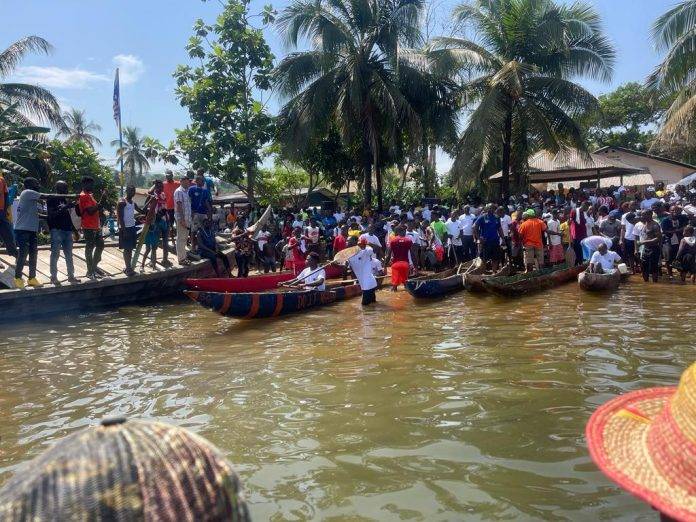
Top: Boats prepare for a competition in Robertsport to mark the 50th anniversary of Liberia’s relationship with the European Union. The DayLight/Esau Farr
By Esau J. Farr
The European Union (EU) has said it would continue to invest in Liberia’s agriculture, fisheries and forestry sectors both the bloc and the country celebrate 50 years of relations.
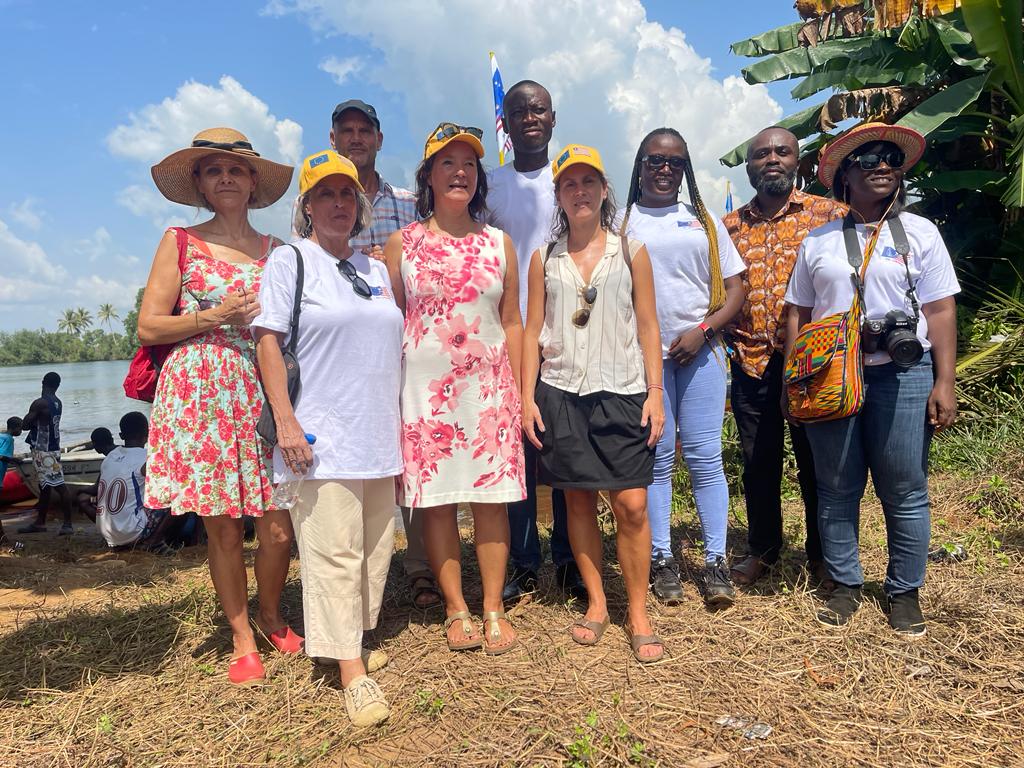
“We continue to stand ready to support Liberia’s priorities for sustainable and inclusive development, peace and security and a world where there is peace and security,” said Nona Deprez, the head of the EU Delegation in Liberia at an anniversary event in Robertsport, Grand Cape Mount County recently.
“The European Union is looking forward to working with the government of Liberia in all efforts to resolve its full implementation to increase trade between our regions, ECOWAS and the EU, particularly in agriculture, fisheries and forestry products,” Deprez told the anniversary audience.
The EU’s relations with Liberia go as far back as 1973. During this period, the EU has invested millions in Liberia’s agriculture, fisheries, and forestry.
The sectors are crucial to Liberia’s economy but have been poorly managed over the years.
“You need to develop the economy so, you need to make sure that when you develop economically, you don’t have to deplete your resources. If you deplete your resources, that means development will not be sustainable,” Deprez added.
Martus Bangalu, the deputy national authorizing officer of the Ministry of Finance and Development Planning, said the support of the EU to the fisheries sector of the country must be laudable by all. She urged the leadership and members of the fishing communities in Grand Cape Mount to hold together for progress and development.
“The Fisheries sector has huge potential that we must all top into. Despite of the numerous projects the EU has in Liberia, [it] chose to celebrate with the fisheries sector today; that shows how important this sector is,” Madam Bangalu told members of the fishing communities there.
Lake Piso in Robertsport, Grand Cape Mount County, was chosen as the venue for the anniversary celebrations of the EU-Liberia partnership in collaboration with the Environmental Justice Foundation (EJF) and the fishing communities. Started in 2019, EJF is rolling out the implementation of a four-year fisheries project in Grand Cape Mount, Margibi, Grand Bassa and Grand Kru, sponsored by the EU.
The head of the European Union Delegation to Liberia Nona Deprez, third from the front, and her entourage at the event. The DayLight/Esau Farr.
“We are working with the government of Liberia to ensure that its developmental agenda is achieved,” said Cephas Asare, EJF’s West Africa regional manager in an interview with The DayLight.
“The collaborative management association is meant to bring the participation of resource users and the community to engage and to support the fishery management that the National Fisheries and Aquaculture Authority (NaFAA) is supposed to do,” Asare added.
The celebrations ended with a boat race amongst the three regions of the fishing communities in the western Liberian county. Robertsport’s Kru-Town won the race.
Top: Blue Carbon of the United Arab Emirates, which hosts the ongoing Climate Summit in Dubai, wants over 1 million hectares of Liberia’s rainforests. The DayLight/Jaames Harding Giahyue
By Gio Ferrarius special for The DayLight
From 30 November, the COP28 climate conference will be held in Dubai. The host country the United Arab Emirates has taken an advance on several massive carbon credit contracts in the run-up to the event.
Negotiations are underway in five countries (Liberia, Tanzania, Zambia, Zimbabwe, and Kenya) to generate carbon credits from a total of 25 million hectares of forest (mostly tropical rainforest) that are expected to bring in billions of dollars.
That sounds spectacular, but who benefits from it? Is it the Africans, the Arabs, or is it nature?
The UAE is promising an investment of $50 billion to make the plans come through, and that could do the job, you would think.
In July of this year, a first contract was submitted for approval in Liberia, covering 1.1 million hectares of tropical rainforest. However, after protests from quite a few NGOs, the project was put on hold. What is the problem?
Well ahead of the contract, in March 2023, the Liberian government already signed a memorandum of understanding with Blue Carbon LLC, a company led by Sheikh Ahmed Dalmook al Maktoum, a member of the royal family of the United Arab Emirates. The Sheikh also runs the family holding company, which manages several businesses, particularly in energy, oil and gas and infrastructure.
It is no secret that the UAE is one of the largest oil traders in the world. So, there is plenty of opportunity for offsetting emission gasses against carbon credits. The economic importance is obvious, but simultaneously greenwashing is lurking, according to climate campaigners.
At first glance, a no-brainer for Liberia and the other African countries. The rich UAE, pumping billions into the economies of these poverty-stricken countries through carbon credits to help kickstart economic activity through infrastructure and employment projects.
But there are many things wrong with the contract that was submitted to the Liberian government. There are problems with the process that has been followed, the organizational context and the terms of the contract.
A fugitive Tuscan diplomat
The Liberian government decided to do business directly with the company, and not involve the communities in the negotiations. This was done on the initiative of the Italian telecommunications entrepreneur Samuele Landi, who is a member of the board of Blue Carbon and also the general counsul for the UAE in Liberia.
Before leaving for Dubai in 2008, Landi was CEO and major shareholder of an Italian telecom company Eutelia, a merger company of PlugIt, which he founded in the late 1990s, and mainly focused on “value-added telecom services” (erotics, horoscopes, weather reports).
Samuele Landi
Eutelia had big plans, and acquired the heavily loss-making Italian branch of the Dutch Getronics, as well as the Bull branch on the peninsula, only to succumb to its expansionism.
In that process, Landi, with his management board and some family members, embezzled tens of millions, according to a verdict against him in 2020. The accusations comprised Landi’s involvement with Liberia, which goes back to that very same period when he diverted assets to the amount of 8.4 million euros to NETCOM Liberia, in which Eutelia held a 36.5% stake. The amount was written off in Eutelia’s books but never repaid. Netcom was a Liberian startup, of which the valuation was questioned by Eutelia’s auditors, court records show.
Landi was sentenced to nine years in prison and has been a fugitive in Italy ever since. He lives and works in Dubai, where, at the time of the demise of Eutelia, he was busy with a tender for a substantial telecom contract in Qatar.
Landi did not respond to queries for comments, but in an interview with Climate Home News, he said he had referred the case to the European Court of Human Rights, claiming it was an unfair trial.
Contempt for the original inhabitants
Liberia has only one large city, the capital Monrovia, with almost 700 thousand inhabitants (including the surrounding urbanizations of about a million). After that, there are twelve cities with between ten and fifty thousand inhabitants: another 300 thousand inhabitants. The rest (almost five million Liberians) live in thousands of hamlets and villages spread over – mainly – rainforest in the 15 counties. The local population (outside the cities) lives mainly on what nature offers them, apart from some modest commercial activity.
There is hardly any infrastructure and few paved roads. Traveling is a real challenge, especially in the hinterland. Furthermore, no, or inadequate electricity supply, and a lousy telecommunications network.
The fragmented topography of the country translates into equally fragmented land ownership. The lion’s share of the territory is owned by local communities. So, Blue Carbon will have to deal with the leadership of these communities, because the landowners are the rightsholder in this kind of contract.
Apart from this, there’s a lot to say about the contract proposed to Liberia and the process that was followed. Following two consecutive civil wars, fueled by the marginalization of rural people, mismanagement and corruption, Liberia adopted several laws to protect the nation in the future.
Most of those laws were passed under the rule of Nobel Peace Prize winner President Sirleaf, in the period from 2006 onwards. An important provision throughout these new rules is that projects of a certain size must be put out to tender in competition. Another rule is that concessions for the use of territories can only be granted with the express consent of the indigenous population affected, who are in most cases local communities.
In February 2023 – in defiance of these rules – a letter of intent was signed, and in July, the Liberian government of president and football legend George Weah and the company of the Royals in Dubai attempted to rush the agreement through parliament. And all this without any form of consultation with the landowners.
A project without a plan
This makes the proposed agreements at least illegitimate, and probably illegal. And that’s not all. The purpose of this type of contract is that the local population explicitly benefits from it and is also compensated in some way for the loss of income – and other opportunities to provide for their own livelihood. Sadly, not one single concrete action is stipulated in the contract. Not for the construction of infrastructure, a road network, schools, hospitals, clean water and electricity supply, and a communication network. None of that.
There is also no provision for the creation of local employment through small-scale business or industry, ecologically responsible agriculture, or sustainable forest exploitation. Nothing at all is specified.
And it doesn’t end. The size of the investment that the Arabs will make is not determined in the contract. Billions? Yes, but how much, and who manages it?
In the few words that the contract devotes to the organization of the operation, it becomes clear that it’s really a bit of pleasantness between the Liberian state and the company from Dubai. In the end, the local population, who own the land, have no say in how the money is spent.
A one-sided contract
Moreover, the Arabs have generously favored themselves in determining the distribution key for the income from Carbon Credits. No less than seventy percent of the proceeds disappear to the Sheikh and his companions. The Liberians have to do with thirty percent, and in the end, no more than twelve percent ends up with the local population. A very unusual construction.
In the voluntary market, it is normal for the proceeds to go predominantly to the landowner. They must submit a proper plan to a certifying organization in advance, and the most important elements in this are project descriptions for nature conservation and area development that benefit the local population.
The landowner usually pays a commission percentage to an intermediary (10 percent is a normal number), who sells the harvested carbon credits into the market. Next to that, the owner often subcontracts a technical advisor/contractor for the execution of the project.
Not so with the Arabs, everything is in one hand, the hand of the Sheikh.
And what if the results of the project turn out disappointing? Well, there’s no consequence. There is no control mechanism built in, except for annual accounts that have to be submitted, and if the Liberians were dissatisfied at all, they would still be stuck with the Arabs for at least 10 years.
In short, Liberia is handing over the future development of its hinterland entirely to the United Arab Emirates and does not impose any conditions. Should Blue Carbon fail, the Liberians will have nothing to fall back on. Not an inconceivable scenario, since the company does not clarify what expertise it brings to the table, or what exactly it will deliver.
Meanwhile, the money warehouse in Dubai is flowing over, while nephews Huey, Dewey, and Louie are enjoying themselves in their new hobby land.
Petrodollars for the rainforest
And now a new phase. Liberia is targeting carbon credits. Actually, the deal was already done. 50 billion for poverty-stricken countries in Africa. Good thing there were critical readers…
At COP28, the upcoming contracts will nevertheless be loudly applauded.
Uncle Scrooge has sketched a fantastic prospect, an unprecedented heap of money, which unfortunately largely flows directly back to himself.
And that in exchange for the autonomy of the Liberians who completely relinquish the perspective of their rural areas. Admittedly, carbon-deals might contribute to mitigating CO2 emissions, and potentially simultaneously benefit poorer countries.
This mechanism obviously only works under the provision of fairness and transparency. This deal brings nothing to the Liberians, and its contribution to climate and nature is dubious, to say the least.
Top: The Forestry Development Authority (FDA) has failed numerous times to punish forestry violators. The DayLight/James Harding Giahyue
By Ralitsa N. Massah
MONROVIA – On Monday, The DayLight published an investigation revealing the illegalities of a logging company named Delta Timber Corporation. The report shows how the Forestry Development Authority (FDA) approved Delta’s contract for a community forest in Sinoe despite a regulation disqualifying its owner, a well-documented wartime logger.
Apart from the illegal approval of Delta’s contract, the story also highlights how the FDA failed to penalize Delta for a string of unlawful activities—illegal logging, abandonment of logs, and prolonged indebtedness to local communities.
However, illegal operations are characteristic of the forestry sector and happen with impunity. Here are seven other times that cases of illegal logging have gone unpunished
Leaked Video Exposes FDA Ranger’s Illegal Logging Operations
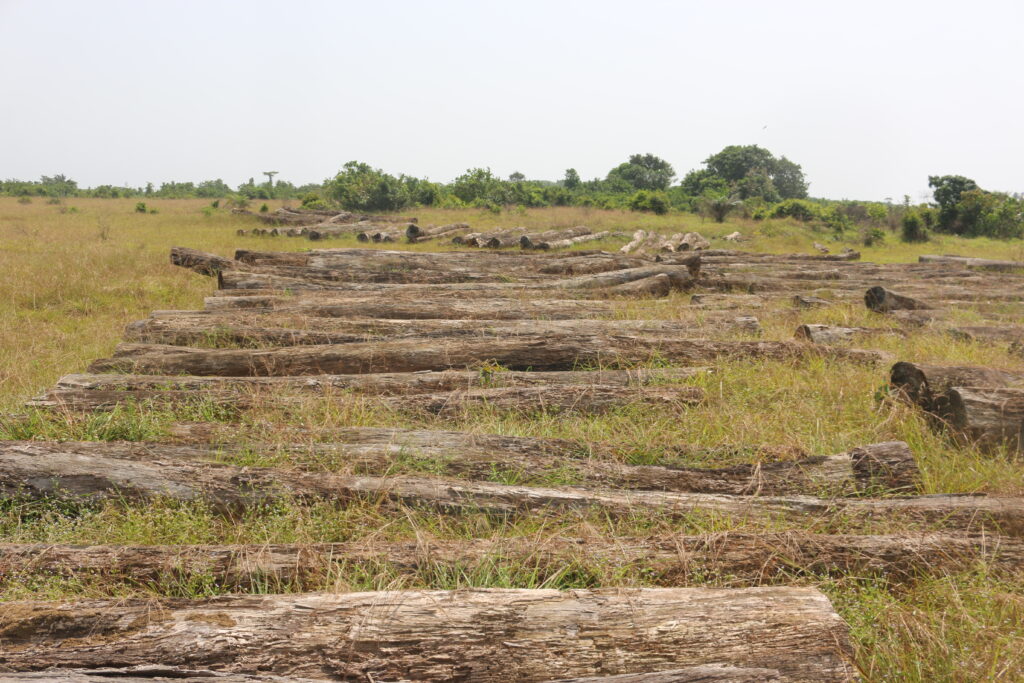
In August last year, leaked videos and pictures exposed the illegal logging operation of Varney Marshall, a ranger of the Forestry Development Authority. The video shows an open field of more than a thousand timbers and exposed Marshall’s illegal logging operations, which led to his dismissal.
Marshall was arrested and jailed in an unrelated case—and has not been indicted—but has faced no punishment for his illegal logging operation. He is a candidate for the Congress for Democratic Change (CDC) in District Two, Bomi County. He has not been sued for economic sabotage, the crime when an FDA staff conducts commercial logging activities.
FDA Fails To Punish Firm For Chain Of Illegal Logging
The Masayaha Logging Company used illegal deals with locals and harvested about 641 cubic meters of expensive, ironwood out of the Worr Community Forest in Grand Bassa, its contract area. The forest covers 35,337 hectares in Compound Number One “B” but the company traveled about 100 kilometers to the Doe Clan in Compound Number One “A” to harvest first-class logs. Harvesting out of contract area is a grave violation in forestry yet the company received no known penalty.
Company Cuts About US$2M Logs Outside Concession
Sing Africa Plantation Liberia Limited illegally harvested probably 5,693 logs or 32,576 cubic meters of logs in the Bluyeama Community Forest in the Zorzor District on Lofa’s border with Gbarpolu. The harvest took place in a part of the forest not included in its contract with the community. It is worth an estimated US$2.2 million. The company was also involved in the unlawful transportation of logs, a violation of the Regulation on Confiscated Logs, Timber and Timber Products.
Akewa: The Nigerian Company Breaking Liberia’s Logging Laws Unpunished
Akewa Group of Companies, a Nigerian-owned logging company, has repeatedly broken Liberian forestry laws for over a decade. The company has carried on illegal logging in Grand Bassa, Margibi, and Grand Cape Mount.
Except for a US$1,000 fine, Akewa has not been punished in line with the gravity of its offenses.
Rotten logs at the Port of Greenville, Sinoe County, owned by Delta Timber Corporation (DTC). The DayLight/James Harding Giahyue
Minister Breaks Laws With Shares In Mining and Logging Company
Cllr. Cooper Kruah held on to his five percent shares in Universal Forestry Corporation (UFC), a company actively mining and logging in Nimba, while he served as Minister of Posts and Telecommunications. That is a violation of the laws governing the mining and logging industries as well as the Liberian Constitution and the Code of Conduct for Public Officials.
The FDA breached the Regulation on Bidder Qualifications by approving UFC’s contract with Kruah as one of the company shareholders. It failed to take any actions against the company after its illegalities were unearthed. It remained that way until Kruah was dismissed in March in an unrelated incident.
Deputy Foreign Minister Runs An Illegal Logging Company
Tetra Enterprise Inc. is a logging company run and likely owned by Thelma Comfort Duncan Sawyer, the Deputy Foreign Minister for Administration, according to letters and her lawyer.That violates the Liberian Constitution, the Code of Conduct for Public Officials and the National Forestry Reform Law.
Tetra has bearer shares that are held by an unregistered individual, which Liberia’s Business Association Law prohibits. The Company has abandoned 28,039.6 cubic meters of logs and, as of March, it owed locals US$70,574.93.
The company began work in Garwin in the absence of a new agreement, which is against the Community Rights Law of 2009 with Respect to Forest Lands that created community forestry.
Another Company Illegally Cuts 550 Logs in River Cess
The African Wood & Lumber Company illegally harvested 550 logs in the Gbarsaw and Dorbor Community Forest, a violation of the National Forestry Reform Law and the Code of Harvesting Practices. The company had signed a five-year agreement with Gbarsaw & Dorbor Community Forest in 2019 but did not obtain the FDA’s approval to harvest logs. The offense warrants a range of penalties, including a prison term, a fine and cancelation of the company’s contract.
This story was a production of the Community of Forest and Environmental Journalists of Liberia (CoFEJ).
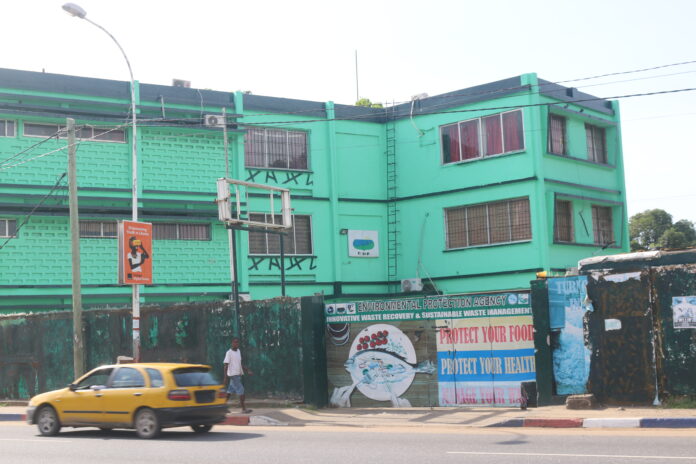
The headquarters of the Environmental Protection Agency of Liberia in Sinkor. The DayLight/Mark B. Newa
By Esau J. Farr
MONROVIA – The Environment Protection Agency (EPA) has disapproved of carbon credit negotiations between an American-owned company BlueEarth Capital and rural communities following an investigation by The DayLight that exposed irregularities with the deal.
“[The EPA] has thus issued an immediate resolute call to all communities involved in discussions with the company (BlueEarth) to cease all engagements without delay or risk drastic actions,” said the agency in a statement over the weekend.
“EPA’s involvement and approval are non-negotiable pre-requisites in carbon credit deals in Liberia,” it added.
The agency further expressed “profound dismay” over the ongoing illegal carbon negotiations between BlueEarth Capital and residents of Ziadue Clan, River Cess County.
The release came on the back of a DayLight story on BlueEarth’s proposed MoU with Ziadue to save carbon credits on more than 55,000 hectares of forestland.
The DayLight reported a number of illegalities associated with the proposed deal.
The investigation showed BlueEarth induced community leaders to consent to the deal by underwriting their transportation and food costs.
It proved that ordinary townspeople and some community leaders were still unaware of the deal despite emerging in March, a violation of locals’ right to free, prior and informed consent (FPIC). (FPIC is guaranteed in the Community Rights Law, the Land Rights Act, and the United Nations Declaration on the Rights of Indigenous Peoples)
The deal sought over 55,000 hectares, more than 8,000 hectares of the uncontracted area Ziadue has.
It was illegally intended to last for 25 years, 10 more than the legal duration of a community forest contract, based on the Community Rights Law.
EPA, one of the agencies responsible for regulating the carbon industry, said it was caught unaware by The DayLight’s investigation.
BlueEarth Capital intended to capture carbon credits in more than 55,000 hectares of forestland in Ziadue Clan, Central River Cess District in River Cess County. The DayLight/Carlucci Cooper
“Their intent is to exploit these forests for carbon harvesting and subsequent trading of carbon credits on the international market,” it said. BlueEarth has also engaged communities in Nimba, Grand Cape Mount and Gbarpolu.
Ziadue Clan’s land leadership said they would now focus on getting its ancestral land deed, a process it has almost completed.
“We are customary people. What we are running after now is our confirmatory survey to get a deed from the Liberia Land Authority (LLA),” said Emmanuel Roberts, the chairman of the Ziadue’s community land development management committee (CLDMC).
“If we have anything to do with BlueEarth Capital, it will not be hidden from the national government, civil society organizations and our consultant.”
Augustine Jarrett, BlueEarth’s American owner and former presidential adviser, did not answer questions for comments on the matter. However, he defended his institution in a statement on Monday evening.
“We are deeply committed to the principles of transparency, integrity, and community engagement,” Jarrett said.