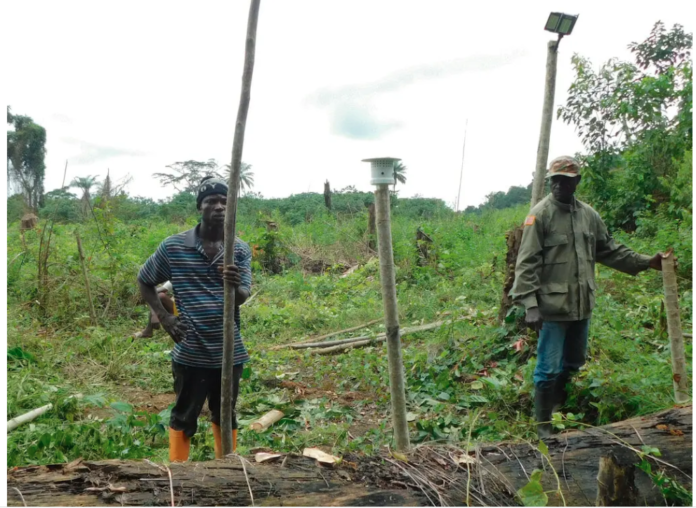
Top: Men install BuzzBoxes at a farm. Picture credit: Elephant Research and Conservation
By Mark B. Newa
MONROVIA – For years, villagers mainly in northwestern and southeastern Liberia have lost their crops to invading elephant herds. This makes it difficult for farmers to feed their families and meet other needs.
Now, conservationists working in Liberia have found that a device armed with the sound of honeybees can repel elephants. The scientists from the Elephant Research and Conservation (ELRECO) tested the audio device in Gbanjala, a town in Gola-Konneh District, Grand Cape Mount County.
Video footageposted on YouTube shows an elephant stopping to eat when it hears the buzz of insects placed in the mounted device. In a few seconds, the animal folded its trunk, hurriedly took a few steps backward and raced away.
“It is the first time we test this device now in West Africa, seeing that it really works to have this evidence that it really works,” Dr. Tina Vogt, ELRECO’s technical director, told The DayLight in an interview.
“At the moment we [are] extending the testing phase so we work together with some Liberian entrepreneurs to improve a bit on the censor, the mechanism, the release mechanism,” Vogt added.
ELRECO, a German nonprofit based in Liberia, is currently testing the device in Liberia. It is collaborating with Save the Elephants (STE) to deploy the BuzzBox. It costs around $100, the New York Times reported. STE is a UK-registered charity based in Nairobi, Kenya.
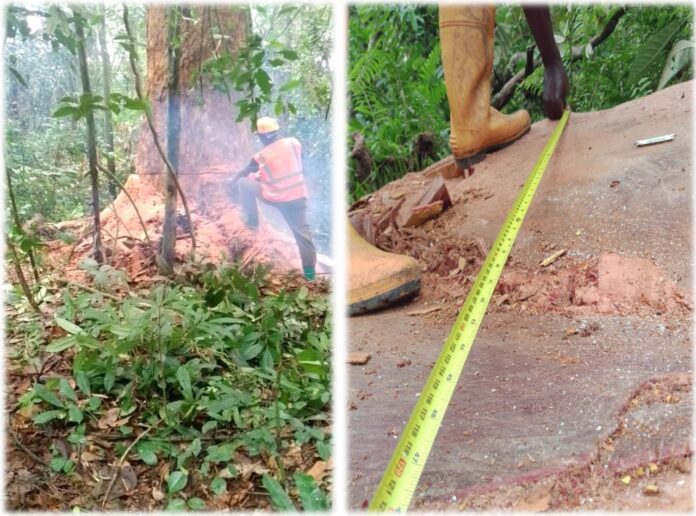
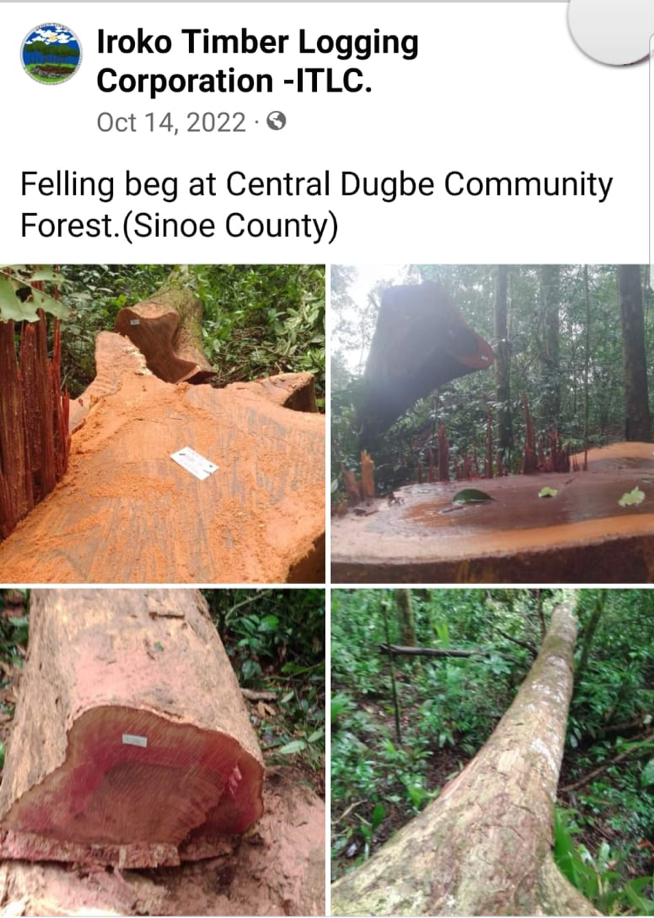
Top: A collage showing Iroko harvesting activities in October 2022. Picture credit: Iroko Timber and Logging Corporation
By Emmanuel Sherman
KARQUEKPO, Sinoe County – The Forestry Development Authority (FDA) has approved a contract for Iroko Timber and Logging Corporation, a new Nigerian-owned company, to operate the Central Dugbe River Community Forest. The company began logging in the fourth quarter of last year, according to its website and Facebook page.
But there is a problem with Iroko’s Dugbe River deal and operations in the 13,193-hectare forest. Timothy Odebunmi, Iroko’s majority shareholder, is not eligible to conduct logging activities in Liberia over the dishonesty of another company he co-owns.
That firm, Akewa Group of Companies, falsified the tax clearance of a mining company called Tiger Quarry to bid for the Gola Konneh Community Forest in Grand Cape Mount County in 2019. At the time, Akewa paid US$1,000 as a fine for the forgery, a violation of the Revenue Code. Odebunmi holds 50 percent of Iroko’s shares and 20 percent of Akewa’s, according to the articles of incorporation of both firms at the Liberia Business Registry. Iroko’s other shareholders are Samson Odebunmi (45 percent) and Akinsiku Arinkan (5 percent). Abigail Funke Odebunmi (60 percent) and Kenneth Amazeika (20 percent) complete the list of Akewa’s shareholders.
Odebunmi’s co-ownership of Akewa, Iroko, which he co-founded in 2021, should have disqualified the Iroko’s bid for Central Dugbe River. The Regulation on Bidders Qualifications bars individuals whose companies have been convicted or penalized for theft, embezzlement, bribery, tax evasion, false swearing, or forgery. With Akewa having paid a fine for forgery, Odebunmi should not have gotten another logging contract until 2024, according to the regulation.
Akewa with Odebunmi as a shareholder has violated a horde of provisions of forestry laws and regulations. One of the oldest active logging companies, Akewa long line of violations includes its involvement in forestry’s worst post-conflict scandal, in which the FDA criminally awarded 2.5 million hectares of forests to it and other companies. It has a track record of prolonged indebtedness to communities. Currently, it is in an out-of-court settlement with the Beyan Poye Community Forest regarding benefits.
Iroko’s Woes Amid FDA’s Failure
Iroko’s agreement with Central Dugbe River adds to the FDA’s records of failure to enforce forestry legal frameworks. Before then, the FDA had failed to disqualify Akewa over fake tax clearance, which also constitutes perjury under the regulation. It remains Akewa’s only active logging operation, with the Beyan Poye legal issues and the cancelation of a logging contract the company illegally held in Grand Bassa County.
“We prevented Akewa from doing further business until they could provide [their] tax clearance,” said Managing Director Mike Doryen in an interview with The DayLight in June last year. “They rectified it and they paid a fine and that’s how we resumed business with them.” The Bidders Qualification Regulation requires the FDA to disqualify companies that commit forgery and perjury. It did not respond to emailed inquiries for comments.
A screenshot of Iroko’s website page showing logs the company harvested in October 2022 and only transported to another location in February
Assessing the qualification of companies is an important provision of forest management in Liberia. It mandates the FDA to investigate the character of companies and individuals, their financial capacities, and their record of legal compliance.
Iroko’s ineligibility has started to show in its operation. It has abandoned an unspecified number of logs it harvested in October last year. Photographs and a video posted to the company’s website and Facebook page show some of the logs in the forest. Akin George, a representative of the company, confirmed the harvesting in a mobile interview in March.
Logs do not remain where they were harvested for more than one month and two weeks upon harvest, according to the Regulation on Abandoned Logs, Timber and Timber Products. The logs in question have remained in the forest far beyond that statutory period.
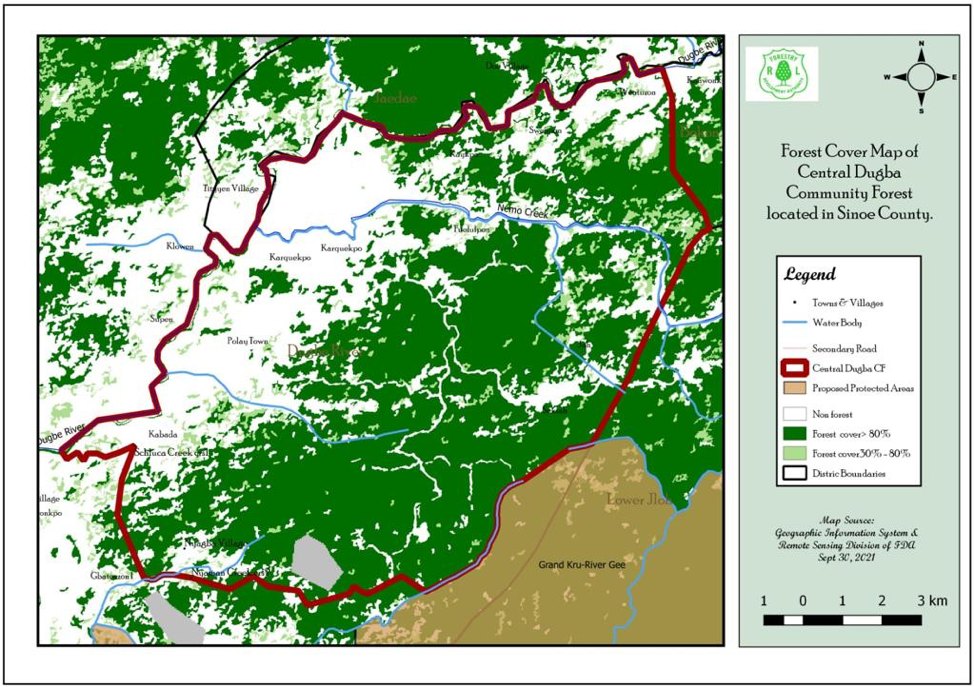
George said the company was taking the logs from where they were harvested to another location in the forest. Bartee Togba, the head of the Central Dugbe River’s leadership, said the same. Togba said Iroko began to transfer the logs in late February, some four months after it felled the trees. The forest is a portion of 39,000 hectares and includes a proposed protected area between Grand Kru and Sinoe.
The Dugbe River Community Forest map. Credit: Forestry Development Authority (FDA)
Iroko’s logs add to thousands of abandoned logs across the country, with the FDA taking no known public actions. The abandoned logs regulation mandates the agency to investigate, seize the logs and petition a court to auction them. Penalties for the offense include fines and forfeiture of the contract.
The total volume of the logs, in question, is essential for Iroko to pay the community’s benefits. Last year April, the community signed a 15-year commercial use contract with Iroko Timber Logging Corporation. It promised to build two elementary schools, handpumps, guesthouses and a clinic.
Efforts to establish contact with Timothy Odebunmi did not materialize. There is no trace of his phone number, email address or WhatsApp. In January, George promised to get Timothy Odebunmi to speak to the issue but failed to do so.
George evaded several attempts for an interview on the situation on behalf of the company. The DayLight reached out to George through phone calls and Facebook messages and WhatsApp text messages but to no avail.
The story was a production of the Community of Forest and Environmental Journalists of Liberia (CoFEJ).
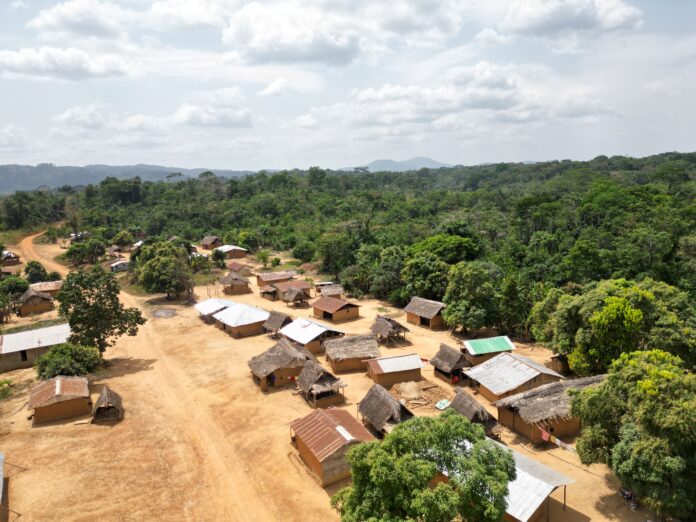
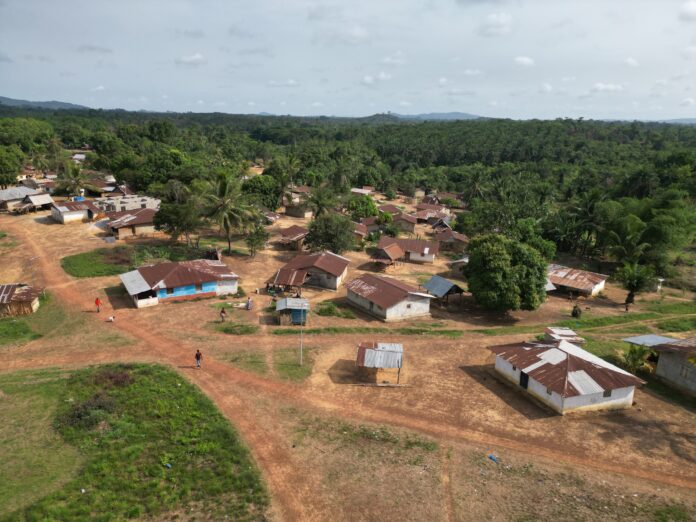
Top: A drone shot of Kpelle Village, one of the communities affected by Akewa’s operations in the Gola Konneh Community Forest. The DayLight/James Harding Giahyue
By Emmanuel Sherman
MONROVIA – In 2019, Akewa Group of companies, a Nigerian firm operating in Margibi and Grand Bassa County at the time, forged another company’s document to acquire a new logging contract. The Liberia Revenue Authority investigated and found Akewa guilty of forgery. However, it remained unclear what punishment it took against the company.
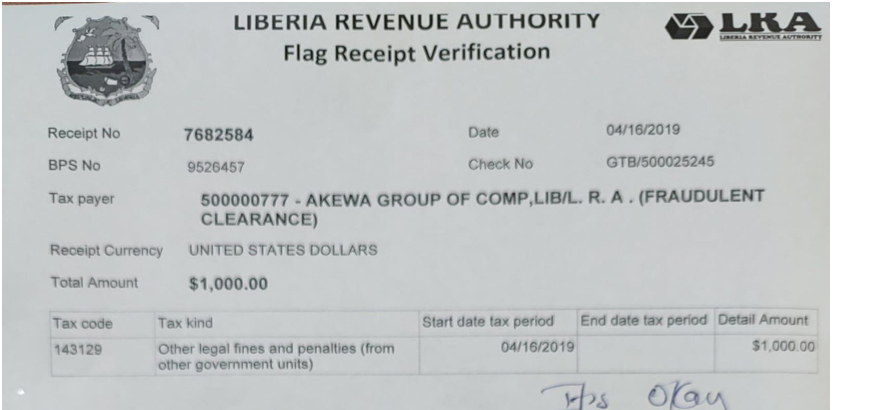
Now, it has emerged Akewa paid a US$1,000 fine for falsifying a tax clearance of Tiger Quarry, a mining firm, according to the receipt of the payment. The DayLight had requested the document in a follow-up to an investigation report it published last year.
“The LRA professional ethics division (PED) conducted a full-scale investigation into the matter. The PED… recommended that Akewa Group of Companies pays the legitimate fine of US$1,000 in consonance with the Liberia Revenue Law,” said Kaihenneh Sengbeh, LRA’s head of communications. Akewa made the payment on April 16, roughly one month after the scandal. The receipt categorizes the payment under “fraudulent clearance” penalty.
Akewa had presented the fake document to acquire the Gola Konneh Community Forest, a 49,179-hectare of forestland in the Gola Konneh District of Grand Cape Mount County.
Akewa Group of Companies paid a US$1,000 fine for forging a tax clearance belonging to another company.
The Forestry Development Authority (FDA) approved Akewa’s bid, breaking Liberian laws, including the Regulation on Bidder Qualifications. It bars a company or its affiliate who has been convicted or penalized in the last five years over forgery, bribery and other morality-related offenses.
FDA Managing Director Mike Doryen wrongly justified the agency’s decision in an interview with The DayLight mid-last year. “We prevented Akewa from doing further business until they could provide [their] tax clearance. They rectified it and they paid a fine and that’s how we resumed business with them,” Doryen said at the time.
Liberian laws require harsh punishments for forgery. Under the National Forestry Reform Law, a person faces a 12-month prison term for the offense or a US$10,000 fine, or both. That person faces up to five years in prison under the Penal Code for lying under oath.
Akewa is one of the forestry’s most delinquent companies. In 2012, Akewa participated in the Private Use Permit (PUP) Scandal. The FDA awarded an estimated 2.5 million hectares of forestlands to fraudulent logging companies in forestry’s biggest postwar scandal. It had received a contract meant for only Liberians three years earlier.
Akewa is currently in a settlement with Beyan Poye Community Forest of Margibi County for the cancellation of its contract with locals. Three Nigerians co-owned the company: Abigail Funke Odebunmi (60 percent) Kenneth Amazeika (20 percent) and Timothy Odebunmi (20 percent).
This story was a production of the Community of Forest and Environmental Journalists (CoFEJ).
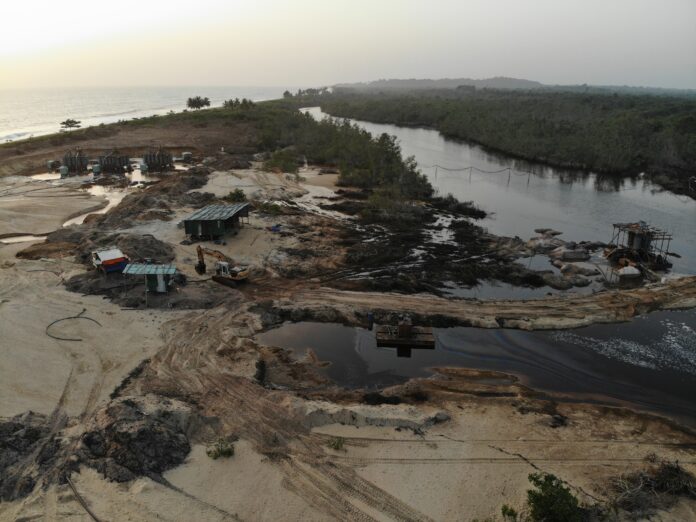
Top: A drone shot of a zircon sand mine in Greenville, Sinoe. The DayLight/Derick Snyder
By James Harding Giahyue and Gerald C. Koinyeneh
MONROVIA; GREENVILLE – In late January, Representative Tibelrosa Tarponweh of Margibi County District Number One accusedLiberia Mineral Export Inc. of violating a suspension of its mining operations in Marshall, Margibi County.
“This is causing [a] serious environmental hazard for our people,” Tarponweh told members of the House of Representatives at the time, requesting the body summoned the Minister of Mines and Energy Gesler Murray. “What we want is our people must be protected, irrespective of our individual financial interests. This company is operating illegally.” The House’s joint committee on mines, energy and environment, and judiciary is investigating the matter.
But an investigation by The DayLight found Tarponweh, too, co-owns a mining company with a Chinese national in Sinoe County. The lawmaker holds 15 percent shares in Jatoken Mining Inc., according to the company’s article of incorporation at the Liberia Business Registry. Tarponweh is also the firm’s registered agent, an individual who serves as a point of contact. Jianjun Huang, a Chinese national, holds the remaining 85 percent of the company’s shares.
Named after Tarponweh’s hometown in River Gee, Jatoken runs a semi-industrial-scare or a class B mine in the Sanquian District, records of the Ministry of Mines and Energy show. It also holds a gold dealership license and has held other licenses after Tarponweh became a lawmaker in 2017.
Interestingly, Jotoken mines zircon sand, the same mineral the Liberia Mineral Export is extracting in Margibi, which drew Tarponweh’s criticism. Moreover, Jatoken’s mine falls within Liberia Mineral Export’s 151-square-kilometer gold exploration license area, stretching from Butaw all the way to Sanquain along Bafful Bay. Both firms are two of at least four mining zircon sand, a black mineral used in the ceramics and electronics industries. STT Heavy Mineral Resources Ltd and Tetra Mineral Resources Limited complete the quadruple, based on the ministry’s online, public records.
Tarponweh and Jianjun established Jatoken in May 2014, about the same time Tarponweh famously advocated for the rights of communities adjacent to a facility where Ebola victims were being cremated. That helped spur his ascendency to the House of Representatives, defeating 20 other candidates in a tight Margibi District Number Two race in 2017.
In an interview, Tarponweh claimed he did not know Jatoken was still operating after his election to the National Legislature.
“Your enquiry has opened up another investigation: I have just established that Mr. Jianjun Huang, who has 85 percent shares has been operating the company without my knowledge,” Tarponweh told The DayLight.
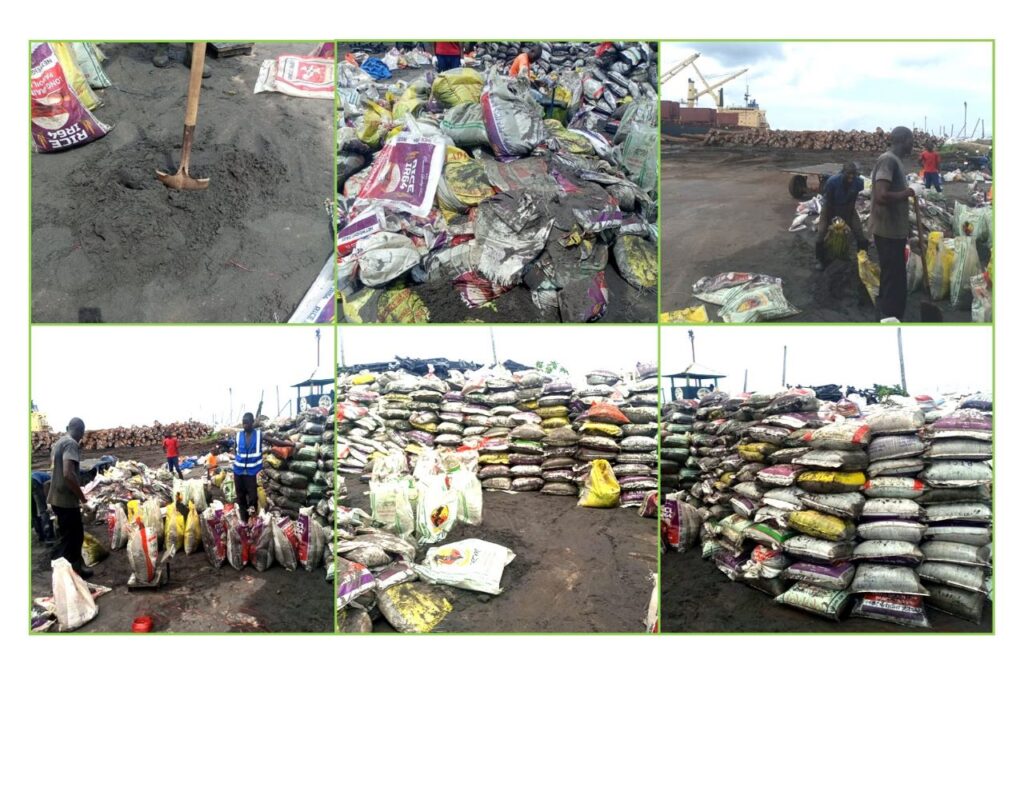
A collage of pictures showing Jatoken bagging zircon sand at the Port of Buchanan, Grand Bassa County. The DayLight/Johnson Buchanan
The ministry said Jatoken filed a new article of incorporation that removed Tarponweh as its shareholder just after he became a lawmaker. The document and the tax payment records show Tarponweh was replaced by Abdullah Mohammed on July 3, 2019.
“They brought a board resolution amending the shares distribution and their article of incorporation. They brought that with their business registration certificate,” said Assistant Minister for Mines Emmanuel Swen in a phone interview.
“With that, Tarponweh shares were transferred to another person. That shareholder resolution that they brought, Tarponweh name is on it with his signature affixed,” Swen added.
Tarponweh denies he signed any paper, accusing Jianjun of forging his signature. “My lawyer has taken charge of the situation. The action of Jianjun Huang is criminal. My name has been used to generate thousands of dollars,” Tarponweh said.
Swen said the Ministry of Mines would investigate if the Margibi legislator lodged a complaint. “If Tarponweh is not the one who signed, there is still a room,” Swen told The DayLight when asked about Tarponweh’s accusation. “He must [inform the ministry] that… his signature was forged. Then the ministry can act.”
‘Loopholes’
Jatoken did not register the change to its legal documents at the Liberia Business Registry, based on the Business Association Act. The law requires firms to enroll their legal documents within the registry and get a business registration certificate. It helps the government combat everything from conflict of interest and money laundering to tax evasion and terrorist financing.
Apart from the 2019 illegal amendment, Jatoken amended its article of incorporation once more on September 29, 2021, according to its tax payment record. Again, it did not file that change with the business registry. The Ministries of Mines and Foreign Affairs did not grant The DayLight’s request for a copy of that document.
Swen conceded that the ministry could have averted the Jotoken scandal had they checked with the Liberia Business Registry before honoring changes to Jatoken’s legal documents. The mining law requires the Ministry of Mines and Energy to verify the validity of firms’ documents before granting them mining rights.
“We have not been contacting the Liberia Business Registry to further investigate these documents,” Swen added. “We learn from some things that happened. You know the governance process is such that as you encounter one thing, you put into place measures to close the loopholes.”
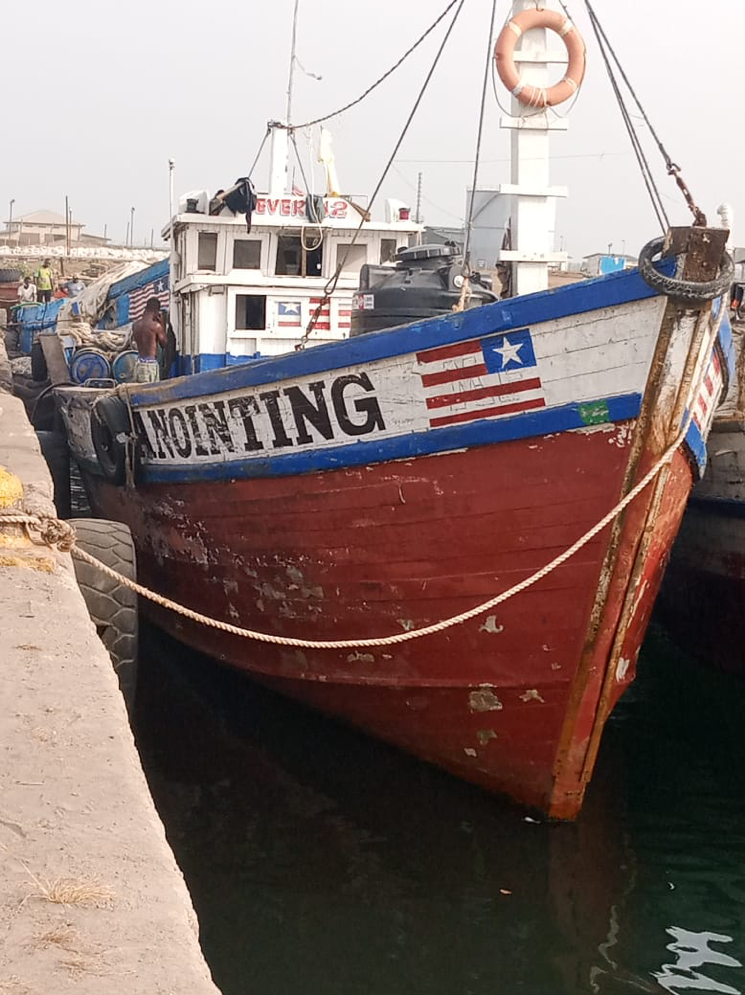
“Anointing” is one of the boats that transport Jatoken’s zircon sand from Sinoe to the Port of Buchanan. The DayLight/Johnson Buchanan
Signature forged or not, the ministry awarded Jatoken a class B license on September 18, 2018, according to official records. That was nine months into Tarponweh’s legislative term and one year seven months before Jatoken unlawfully made changes to its shareholding. The mining law requires government officials with shares in companies to surrender their stakes or place them in a blind trust before assuming office. A blind trust controls public shares to avoid conflicts of interest.
Moreover, in his interview with The DayLight, Tarponweh claimed Jatoken was not mining zircon sand before he became a lawmaker. That claim is not backed by facts. Jatoken obtained a zircon sand prospecting license in 2015, the ministry’s official records show. The ministry awarded it a class B mining license for the mineral the following year and later archived it.
But Tarponweh’s shares are not Jatoken’s only eligibility issues. Foreign nationals must reside in Liberia and obtain resident and work permits in order to hold majority shares in a class B company, according to the mining law. Jianjun, Jatoken’s majority shareholder, has never obtained a resident or a work permit, the company’s tax payment records show. None of Jatoken’s foreign workers or representatives has obtained a work permit in nearly 10 years of the company’s existence. By law, the ministry should check companies’ owners, staff’s work and resident statuses, and financial history among other things, before awarding class B licenses.
It was unclear how much volume of zircon sand Jatoken has produced. However, between 2020 and 2022 the company paid just US$48,000 in mining-related fees, Liberia Revenue Authority (LRA) records show.
Our reporter who visited Jatoken’s mine in January saw a trail of equipment, including earthmovers and wheelbarrows. Sandbars and holes and mounds of zircon sand adorned the area. Workers bagged the mineral and transported it to Buchanan, Grand Bassa via boats. Some of the boats that transport the mineral are “Anointing,” “God Knows” and “Iron State.”
Photographs taken at the Port of Buchanan show men uploading 25-kilogram bags with zircon sand. One port source said workers pack 50 bags of the mineral in a single container. Another source said workers transport scores of containers with the mineral to the Freeport of Monrovia weekly.
Jatoken did not return questions for comments on this story. We contacted three of the company’s representatives between February 26 and early this week. Earlier this month, a female representative promised to comment once she returned to Monrovia from Sinoe. She stopped responding to calls and WhatsApp messages ever since.
[Mark Newa and Johnson Buchanan contributed to this story]
Funding for the story was provided by the Green Livelihood Alliance (GLA 2.0) through the Sustainable Development Institute (SDI). The DayLight maintained complete editorial independence over the story’s content.
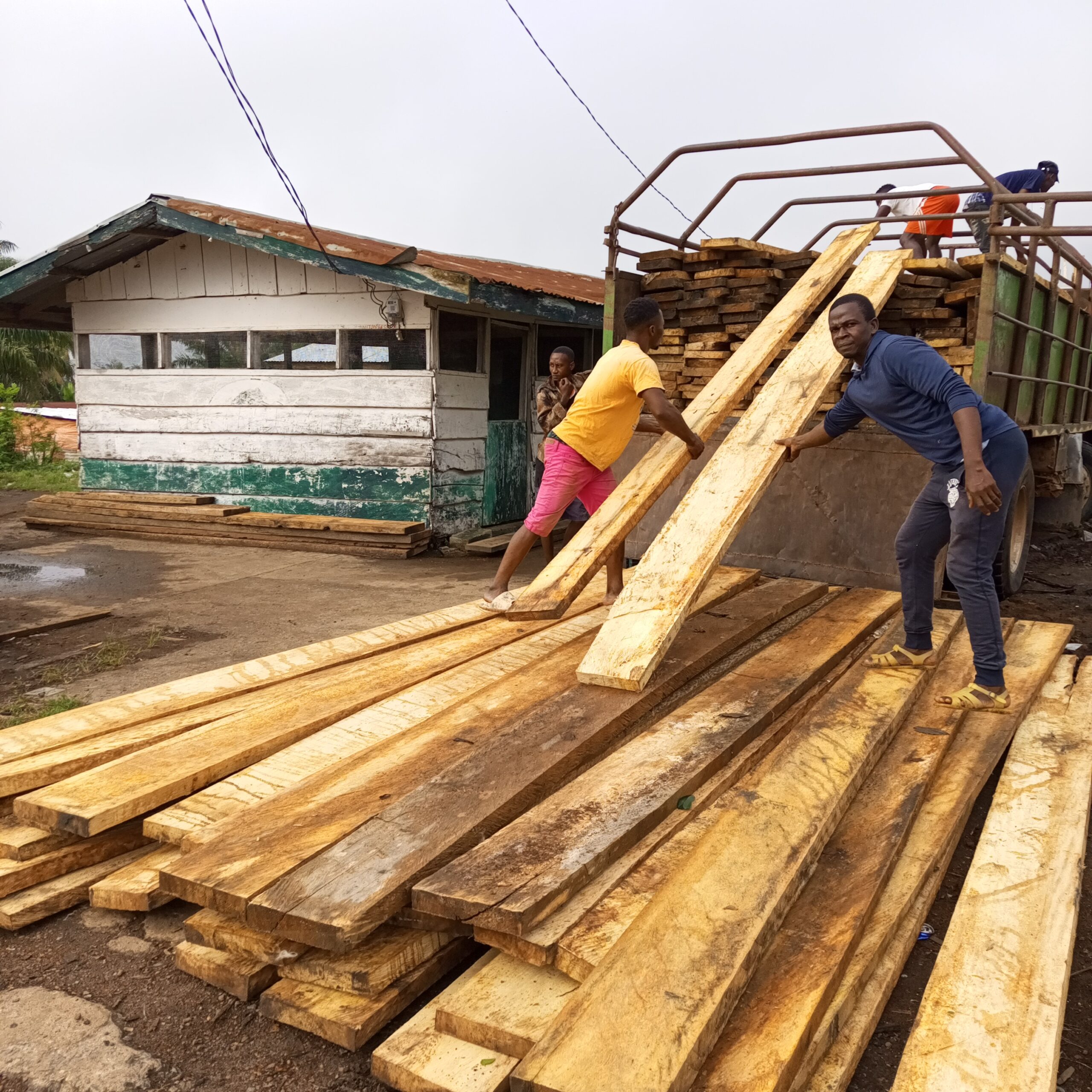
Top: A truck offloads Askon Liberian General Trading Inc.’s planks on Gompa Wood Field in Ganta on November 11, 2022. The DayLight/Gabriel M. Dixon
By Mark B. Newa
Askon Liberia General Trading Inc., a Turkish-owned forestry company, runs at least one illegal logging operation between Ganta and Sanniquellie in Nimba County. It smuggles timber out of Liberia in containers, making use of online business platforms and social media
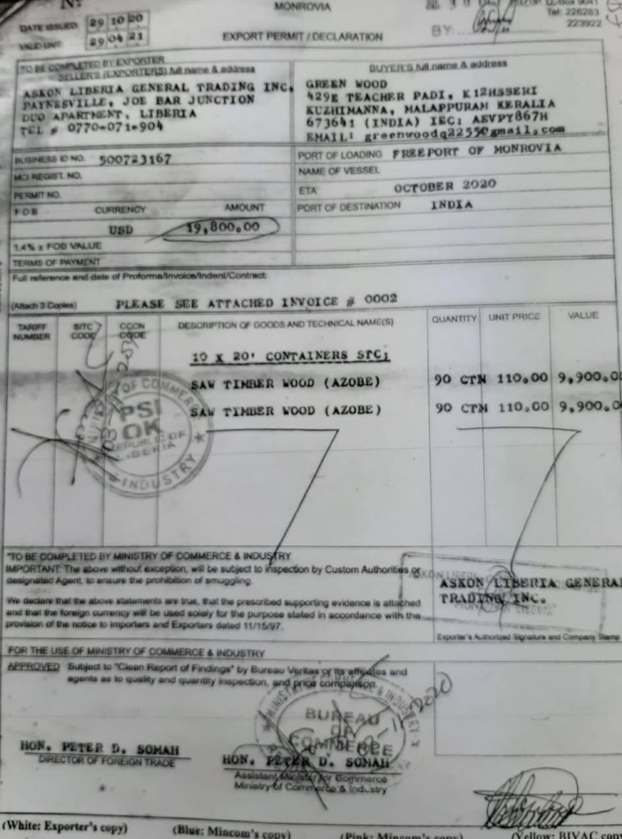
Assistant Minister for Trade Peter Somah aided the company in smuggling expensive wood to India that cost over US$19,000, according to an illegal export permit The DayLight obtained. The money did not go into the Liberian government coffers, according to official records
Askon also trades planks on the local market in Ganta, a business meant solely for Liberians
Local Authorities shut down Askon’s operation in November 2022 over community benefits
The rangers of the Forestry Development Authority not far from Askon’s worksite claimed they were not aware of its operations
ZULUYEE, Nimba – Last November, local authorities ordered a Turkish company to halt its logging operations in a forest between Ganta and Sanniquellie.
The Office of the Superintendent in Sanniquellie said Askon Liberia General Trading Incorporated did not have a logging contract and did not pay benefits to communities adjacent to the Garr-Mongbain Community Forest. Askon had come to Zuluyee in 2020, harvesting valuable redwood. The decision of county authorities followed some two years of residents’ anger over the company’s operations and suspicion it was illegally harvesting.
“The company did not come to us here,” said Faliku Kromah, a liaison and political affairs officer in the Superintendent’s office. “They passed the other way and went to do their thing in the forest.”
The local authorities were right. Askon does not have a legitimate contract to log in Liberia. It runs an illegal logging cabal that involves four Turkish nationals and several Liberians, including an official of the Ministry of Commerce and Industry. That is according to Askon’s legal documents, official tax payment records, an illegal export permit and pictures from social media.
In addition to breaking forestry laws and regulations, Askon violated immigration and labor statutes, depriving Liberia of much-needed revenue, the tax records show.
‘See you soon… Turkey’
Askon began with a series of visits by a Liberian named Sylvester Suah to Turkey between November 2015 and December 2016, based on Suah’s Facebook page. Suah, a native of Nimba, held several meetings with his hosts and returned to Liberia. “See you soon, Istanbul, Turkey. Monrovia Liberia here we come…,” a December 1, 2015 post reads. “This is our own way of saying goodbye to each other my friend and business partner.”
By November 2017, Askon was established. It is owned by three Turks of the same family—Hasan Uzan (80 percent), Yeter Uzan (10 percent), and Faith Uzan (five percent)— according to the company’s article of incorporation. The remaining five percent of its shares are outstanding. The document was amended on September 14, 2020, but has not been enrolled at the Liberian Business Registry, a breach of the Business Association Act.
In a WhatsApp message to The DayLight late last year, Suah appeared to justify Askon’s illegal dealings. “I brought those people to Liberia for us to do bigger business but our country people in authority have their own way of delaying people’s progress,” Suah said while in Ghana to get a visa for another visit to Turkey. “That’s [why] you see it is starting that local way… to see how we will be treated before we can… expand.”
Sylvester Suah takes a selfie with four Turkish men in Istanbul, Turkey on November 24, 2015. That was Suah’s first trip that was instrumental to the establishment of Askon Liberia General Trading Inc., a company conducting illegal logging activities in Nimba. Photo credit: Facebook/Sylvester Suah
Askon’s operations in Nimba go back to 2019 when it signed an agreement with the Gba Community Forest in the Sanniquellie area. Askon agreed to pay US$35 per cubic meter of the logs it harvested on a 45-acre plot of land in that area, according to the agreement. It was unclear what happened thereafter, as there are no official records of it, except for a USAID report.
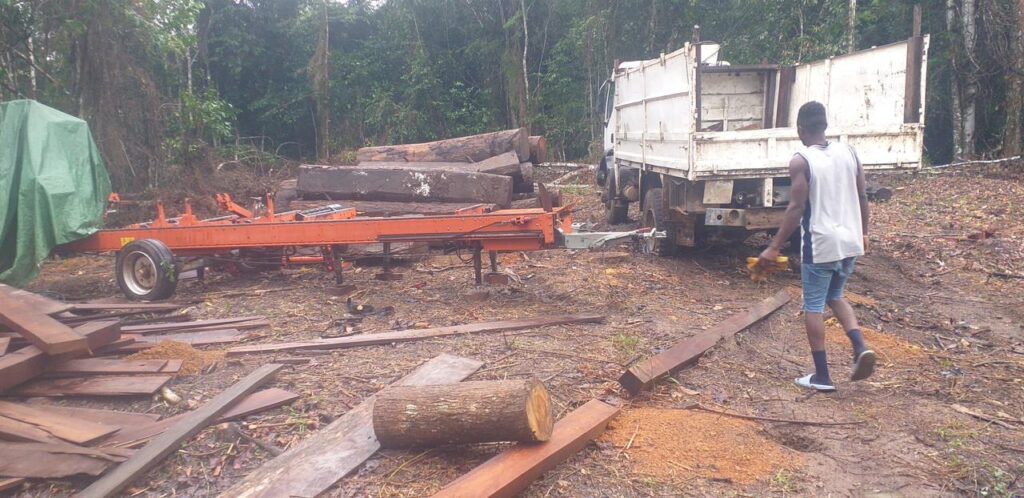
Today, Askon operates in Zuluyee, in the Yarpea and Garr-Mongbain forest region between Ganta and Sanniquellie. At its campsite, our reporter saw chainsaws, mobile sawmills, a 30-horsepower diesel tractor, several trucks and a bulldozer. Its workforce is between 10 and 50 workers, according to Lesprom, a Russia-based wood-trading platform on which the company trades. The region and the rest of Nimba account for 315,000 hectares of tree cover loss between 2001 and 2021. Only Bong County lost more (363,000 hectares), according to Global Forest Watch, which monitors forests across the world.
“The company is using a mobile saw that clears a large portion of bush and trees in seconds,” one chainsaw operator said, asking not to be named.
“The company is cutting trees all over here. All the trees will soon finish from here,” a community leader added under the same condition.
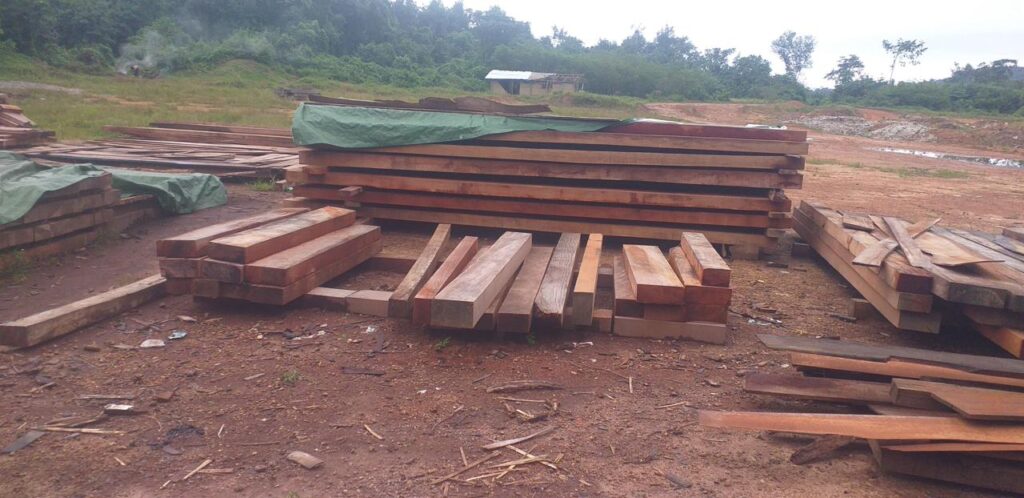
Five other people buttressed the operator and community leader. Photographs our reporter took show planks and thick, sawn timbers, commonly called “Kpokolo” at Askon’s campsite. Also called block wood, the Forestry Development Authority (FDA) recently banned kpokolo, as it became synonymous with illegal exports.
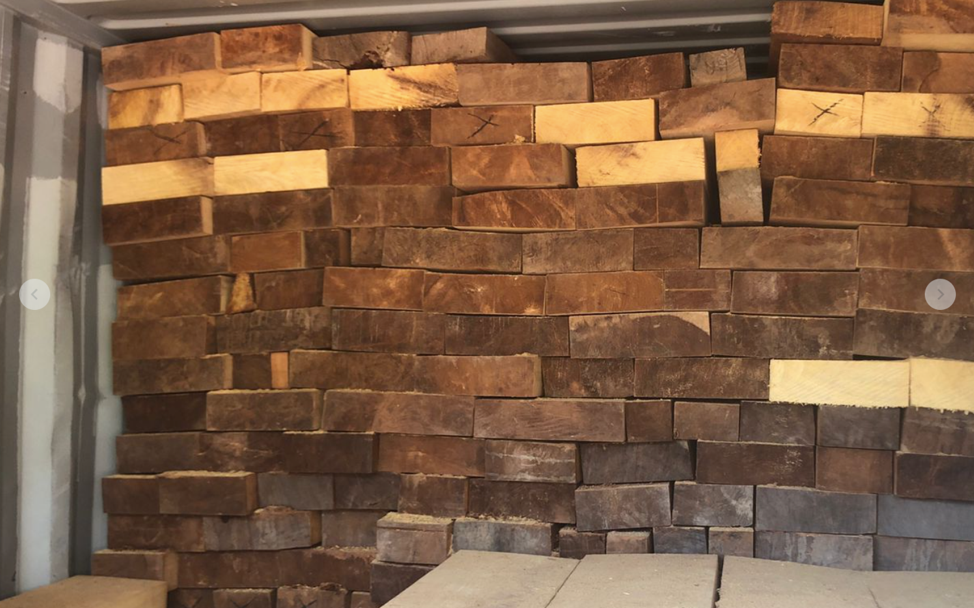
Pictures Hasan Uzan posted to his WhatsApp profile suggest kpokolo activities. One picture showcases squared timbers made from expensive wood stacked in containers and on wooden platforms. Another picture shows men uploading timber into a container truck. And one shows a variety of tree species with different colors. The profile reads: “Tropical timber center Askon sawmill, Monrovia, Liberia.”
Askon has exported different species of processed timber that are shipped to Asia and Europe, according to Global Wood Trade Network, a leading marketplace for timber and wood products. Askon’s LinkedIn account also identifies it as an export and import company, and it trades on other online marketplaces.
Peter Somah, Assistant Minister for Trade at the Ministry of Commerce awarded an illegal permit to Askon leading the Turkish company to ship two containers of timber to India in 2020. Picture credit: Facebook/Peter D. Somah
Illegal Permit
A permit The DayLight obtained shows Askon exported two 20-foot containers of ekki wood in October 2020 at US$9,900 each. Ekki wood or Azobe is a durable redwood used in shipbuilding and outdoor construction. It sold for US$293 a cubic meter on the international market that year, according to the International Timber Trade Organization. Askon sold the consignment to Green Wood, a firm in India, according to the document. Efforts to get comments from the company were unsuccessful.
There are other legality woes. Hasan Uzan is a resident of the Police Academy in Paynesville, according to Askon’s legal documents. However, Askon’s tax payment records show that he and Umit Gungor, a fellow Turkish national, have never obtained a resident or work permit. (Gungor came to Liberia on January 25, last year) That is a violation of the Aliens and Nationality Law and the Decent Work Act. Work and resident permits are prerequisites to conducting commercial logging in Liberia.
Assistant Minister for Trade at the Ministry of Commerce Peter Somah, signed the illegal document. Somah awarded the permit outside of Liberia’s timber-tracking system called LiberTrace. National Forestry Reform Law and Regulation on the Establishment of a Chain of Custody System bars trading timber outside LiberTrace. A pillar of Liberia’s forestry reform, the system tracks timbers from their sources to their final destinations, verifying legal requirements. It is a foothold of the country’s international timber trade, following decades of civil wars and mismanagement.
“No person shall import, transport, process, or export unless the timber is accurately enrolled in the chain of custody,” the law provides.
“Holders of forest resource licenses comply with all legal requirements facilitating the accurate assessment and remittance of forest charges and keeping illegal logs of the domestic and illegal markets,” according to the regulation.
Furthermore, the US$19,800 Askon paid for the two containers did not go to the Liberia Revenue Authority (LRA) as required by law, according to Askon’s tax payment record.
The Somah-issued Askon permit is unlawful, as it lacks features legal permits contain. It has no tracking barcodes and is not signed by the FDA’s legality verification department (LVD) and SGS, a Swiss firm that created the system. And it is not rubberstamped by the Managing Director of the FDA Mike Doryen.
In an interview with The DayLight, Somah sidestepped questions about the illegality of the permit, providing a lecture on trade instead. Then he displayed a file of papers he said were permits he had approved. Similarly, efforts to have him address a set of emailed follow-up questions four months later proved unsuccessful.
A screenshot of a container of sawn timber or kpokolo from the WhatsApp profile of Hasan Uzan, an illegal Turkish logger.Assistant Minister of Commerce Peter Somah awarded an illegal export permit to Askon Liberia General Trading
Illicit activities have rocked the forestry sector in the last three years or so. A recent Associated Press investigation found that Liberian officials appeared to collude with illegal loggers to export timber. Citing diplomatic documents, the report said Liberia may have a “parallel system” to the legal channel for timber exports. In January, a court indicted a former police chief, a customs officer, and three rangers over an illegal export deal. The policeman had been dismissed before the indictment.
FDA rangers—George Gaye, a ranger assigned at the Ganta checkpoint, and Bah Kromah assigned at the Guinea border—said they were not aware of Askon’s operations.
“The lack of mobility is hindering my operation as I am not able to patrol or visit nearby forest communities,” Bah Kromah told The DayLight in September last year. However, Askon’s operation site is just a 15-minute drive from Ganta and is an open secret in that region.
‘I need my money’
The villagers, too, said they were initially not aware of Askon’s harvesting their trees. “When we heard about this, we quickly called them to bring their equipment back to town,” recalled James Tokpah, an elder in Garr-Mongbain.
Thereafter, the villagers demanded Askon sign an agreement with them, according to several townspeople The DayLight interviewed. In the end, the illegal loggers promised to pay the community US$1,500 for every 1,000 pieces of timber, which Askon did not pay. That sparked anger, leaving local authorities to shut down its operations late last year.
By November, Askon’s world was crumbling down. In addition to the villagers, it owed its workers and petroleum dealers, according to Hasan Uzan. One of the workers said, “I need my money to pay my school fees and rent.”
Suah declined to make further comments on the story, despite accepting an interview months earlier. He lunged into The DayLight for protecting the interest of the international community, and not companies. “When I am ready, I will write my own story,” he said at his home in Ganta.
A mobile sawmilling machine producing illegal block wood in the forest. The DayLight/Gerald KoiyennehAskon’s campsite and some of its sawn timber or kpokolo. The DayLight/ Gerald Koiyenneh
Hasan Uzan, Askon’s majority shareholder, denied exporting timbers with the permit when The DayLight tracked him down in Zuluyee. He refused to make further comments, referring our reporter to Suah, who he claimed was Askon’s owner.
On November 11, last year, The DayLight witnessed a truck Askon owns or hired offload planks for sale on the Gompa Wood Field in Ganta. One of the dealers, who preferred anonymity, said that the company frequently sold planks there. That breaks the Chainsaw Milling Regulation, which prohibits foreign nationals from selling planks in Liberia.
[Gerald C. Koinyeneh contributed to this story.]
The story was a production of the Community of Forest and Environmental Journalists of Liberia (CoFEJ).
Top: A drone shot of Compound Number Two in Marblee Clan, Grand Bassa County. The DayLight/James Harding Giahyue
By Esau Farr
COMPOUND NUMBER TWO, Grand Bassa County – Between 2019 and last year, Marblee Clan completed most of the steps in legalizing its customary land ownership, failing to harmonize boundaries with its neighbors.
Now, it has an opportunity to solve that problem and receive a deed following the launch of a new project over the weekend. The “Keeping the Promise” project targets Marblee and 38 other communities across eight counties. Parley Liberia, a Bong County-based NGO, Sustainable Development Institute (SDI), and the Foundation for Community Initiatives (FCI) will assist the communities. The International Land and Forest Tenure Facility provided US$3.56 million for the three-year project.
“We want you to get your land deed,” Dr. Raymond Samndong, Tenure Facility’s lead campaigner for Liberia, told a short ceremony in Compound Number Two, Grand Bassa County. “If you don’t have land, you don’t have an identity.”
“Communities need their deeds and that is the focus of this project,” said Gregory Kitt of Parley Liberia, the NGO directing the project.
Marblee Clan stopped at the boundary harmonization stage over disputes with Karblee and Gogowein, its western and eastern neighbors, respectively. Its dispute with Karblee Clan is over an area covering 2, 057 hectares of land, while the disputed land with Gogowein spans 264 hectares.
Under the Land Rights Act, communities must cut their boundaries with their neighbors. After that, the law requires the Liberia Land Authority (LLA) to conduct an official survey to grant their deeds.
Alexander Cole, FCI’s land rights campaigner, told The DayLight the NGO was talking to the Liberia Land Authority to assist in resolving Marblee’s land disputes. Cole said they would train members of the clan’s governance body known as the community land development and management committee (CLDMC).
Bendu Darsure, a women representative of the community stated that “The coming of the project into our community has made some of us know our rights to properties, especially land.”
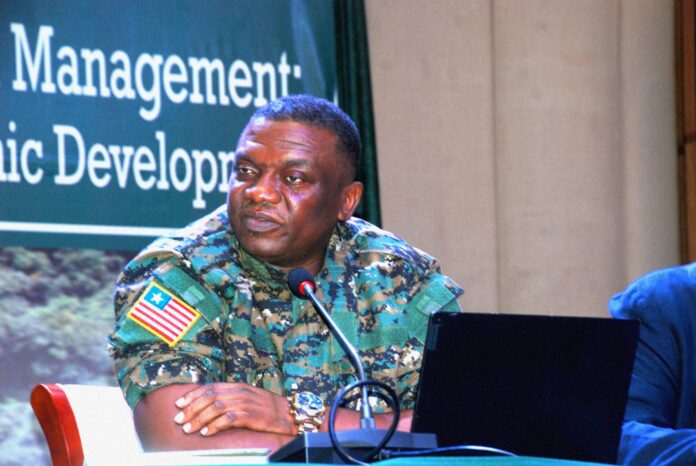
Top: The Managing Director of the Forestry Development Authority (FDA) Mike Doryen blamed villagers for illegal logging. However, Doryen awarded an unlawful permit, according to a document The DayLight has obtained. The DayLight/Mark B. Newa
By James Harding Giahyue
MONROVIA – commenting at an international forest and climate conference in January, the Managing Director of the Forestry Development Authority (FDA) Mike Doryen blamed loggers and villagers for certain illegal forestry activities.
“These communities are undermining our efforts to deal with violations,” Doryen told delegates at the event.
“People go in the communities and take money from other people to harvest and transport timber to town, harvesting double board-foot outside what is required by law. It is illegal logging,” Doryen added. He meant compact, squared woods, smuggled in containers, which has rocked the logging industry to its core. The industry calls it “kpokolo.”
Ironically, an export permit the FDA awarded to a company years back, obtained by The DayLight, suggests Doryen himself is an architect of the illegal trade.
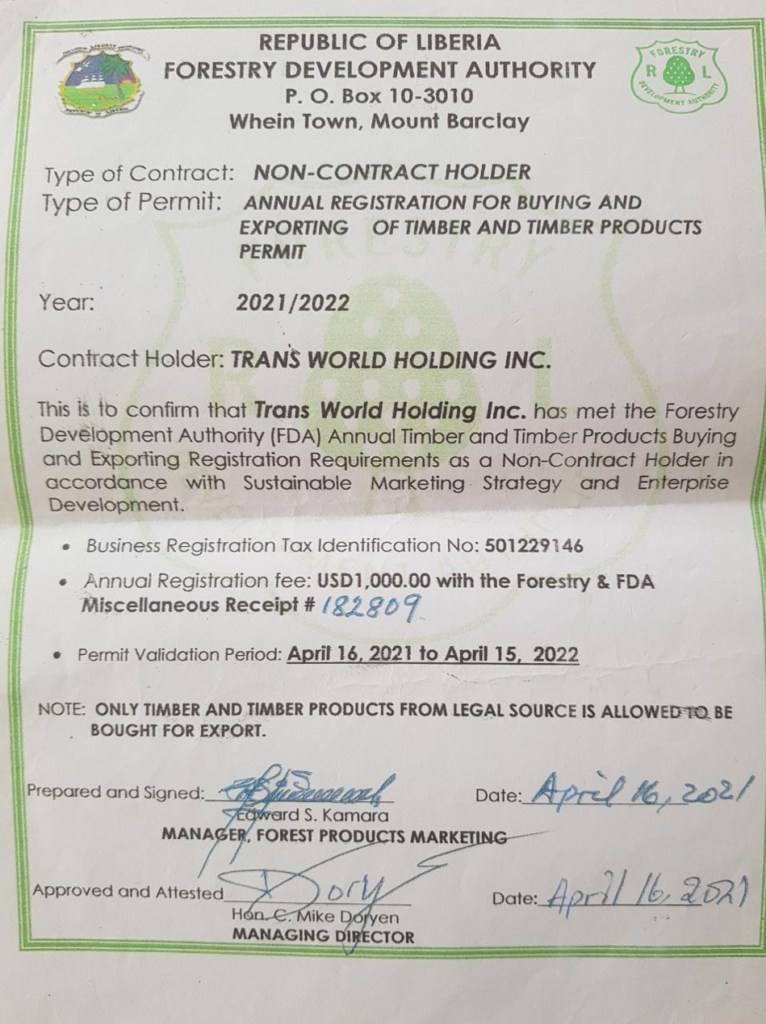
Doryen and Edward Kamara, the FDA’s manager for forest product marketing and revenue forecast, issued the permit to Trans World Holdings Inc. outside the legal channel to export timber.
“This is to confirm that Trans World Holding Inc. has met the Forestry Development Authority annual timber and timber products buying and exporting registration requirements as a non-contract holder in accordance with sustainable marketing strategy and the enterprise development,” read the document, signed only by the two men, in April 2021.
The permit shows a stark variance from the ones created by the FDA chain of custody system called LiberTrace. For instance, the document was valid for a year, unlike legal permits that are issued on a shipment-by-shipment basis. It contains at least one human error, something the legal permits are free of. It is the same as a permit Doryen awarded to an Ivorian-owned firm named Porgal, exposed in an investigation last year. The LiberTrace system is Liberia’s sole safeguard for the trading of legal timber on the international market.
The Trans World permit Doryen approved goes against the National Forestry Reform Law and Regulation on the Establishment of a Chain of Custody System. The law says, “No person shall import, transport, process, or export unless the timber is accurately enrolled in the chain of custody.” That ensures “Holders of forest resource licenses comply with all legal requirements facilitating the accurate assessment and remittance of forest charges and keeping illegal logs of the domestic and illegal markets,” according to the regulation.
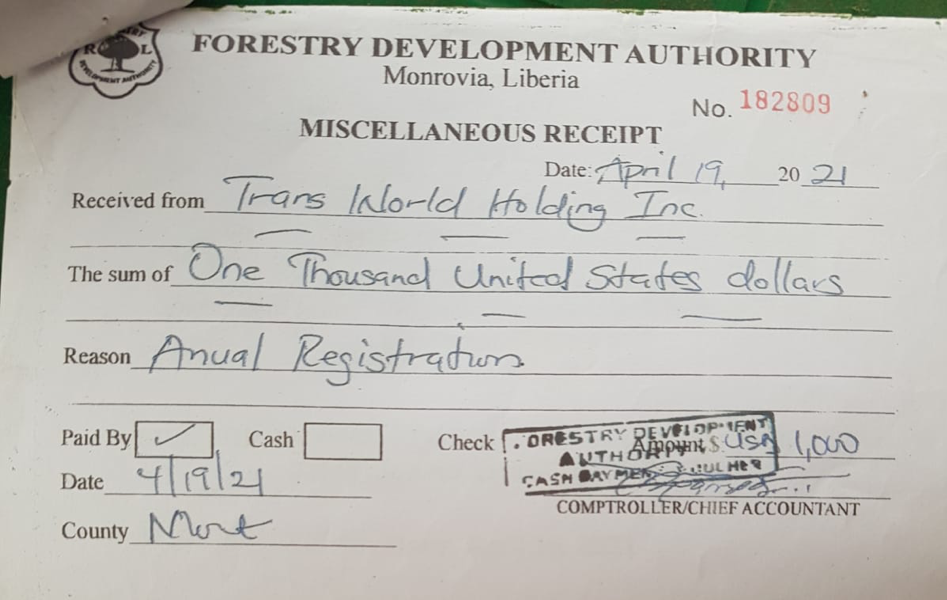
Trans World paid US$1,000 for the permit, based on the receipt of the payment, obtained by The DayLight. There was no record the company paid the fee to the Liberia Revenue Authority, the government’s agency that collects taxes. Also, the Liberia Extractive Industry Transparency Initiative (LEITI) did not capture the payment as the law requires. Instead, it made the payment in an FDA account at the Liberia Bank for Development and Investment (LBDI), controlled by Doryen.
The permit authorized Trans World to purchase only legally sourced timbers. However, FDA checkpoints, under Doryen’s direct control have issued receipts for tolls businesses pay to transport kpokolo. There is no record rangers verified the sources of those woods before issuing receipts, Known as waybills in forestry.
The FDA Managing Director Mike Doryen awarded this permit to Trans World Holding Inc. to export timber outside the agency’s legal system. The money the company paid went to an account at a commercial bank controlled by Doryen.Trans World Holdings Inc. obtained its permit to buy and export timber before paying for the document. The payment was not made to the Liberia Revenue Authority as mandated by law.
Waybills
Ziama Kpoto, one of Trans World’s owners, claimed he received several waybills to transport wood from different parts of the country. Kpoto presented two waybills, including one from a kpokolo trader in Nimba. The other shows rangers received L$90,820 for 100 pieces of kpokolo of a first-class species called Iroko, and 130 planks. The kpokolo timbers measured six inches high, 10 inches wide and nine feet long. The transaction occurred on February 27, 2020, in Saclepea, Nimba County, according to that waybill. However, Kpoto did not show any waybills related to the permit he received from Doryen.
Like a dozen waybills The DayLight has obtained, the Saclepea document is unlawful. By the chain of custody regulation, companies make waybill payments within LiberTrace system, not by rangers. Legally, the FDA should issue them in books of ten waybills, with US$150 per book. They must have an identification number, show the route of the transport, and contain the final destination of the timbers. Also, they must have the total volume, not just the sum of individual timbers as it is with kpokolo waybills.
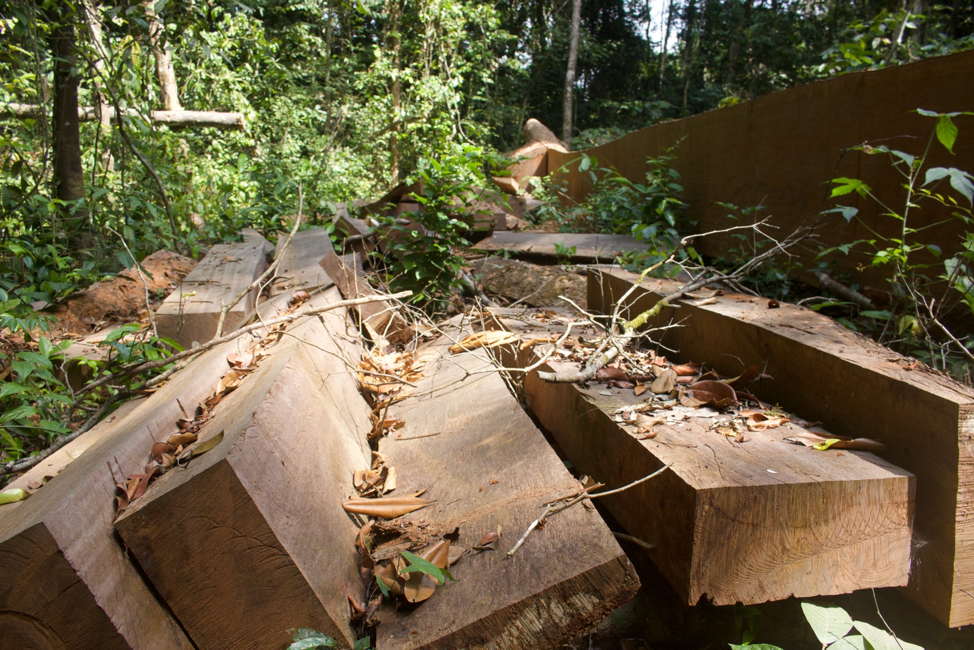
A kpokolo operation site in Gbaryama, Gbarpolu County. The DayLight/James Harding Giahyue
‘We’re not illegal loggers’
Kpokolo operations have rocked the forestry sector, especially in the last three years, with Nimba, Gbarpolu and Grand Cape Mount County hubs. Kpokolo operators The DayLight interviewed put their number between 60,000 and 80,000 countrywide, including everything from tree finders to transporters.
Kpoto was adamant kpokolo loggers operate outside of the law, saying their permits and waybills legitimize the trade. He claimed Doryen and Kamara misled them.
“[Kamara] is not telling us the right thing. We have [met him]… to tell us what to do,” Kpoto said in an interview with The DayLight. “You gave us a document. When we go to work and come you say the chain of custody. What should we do?
“Up to now, he has not given the idea. He only collects money from us. So, you can’t call us illegal loggers,” Kpoto added. His comments echoed ones he had made on posts on The DayLight’s Facebook. He presented some documents related to kpokolo productions in communities in Gbarpolu, one dating back to 2018. He said Trans World did not export any timber under the permit, a claim The DayLight could not independently verify.
A pile of Kpokolo in Kolahun, Lofa County. The DayLight/James Harding Giahyue
Kamara dismissed Kpoto’s “misconceptions.”
“Mr. Kpoto was never registered and issued an annual permit/certificate to harvest logs or buy logs from chainsaw milling operations for export,” said Kamara, who announced a ban on kpokolo Wednesday, February 15.
Kamara claimed the FDA had issued “tens of these documents” to businesses across the country. He did not state how the FDA intended to prevent illegal timber trade having issued the permits outside of LiberTrace. And he also did not say why the FDA did not make payments for the permits and waybills to the LRA, or published them.
“We appreciate you all and we understand the anxiousness as [you] endeavor to satisfy [your] funding sources by running away with any story without understanding the rationale,” Kamara said, though he was responding to interview questions.
Doryen did not respond to a set of emailed questions. But the FDA has repeatedly accused The DayLight of “paid journalism deployed by our detractors to paint the FDA ugly in the eyes of the public.” On World Forest Day last week, Doryen accused partners of “double-standard games” for supporting “black hands” in the media.
This story was a production of the Community of Forest and Environmental Journalists of Liberia (CoFEJ).
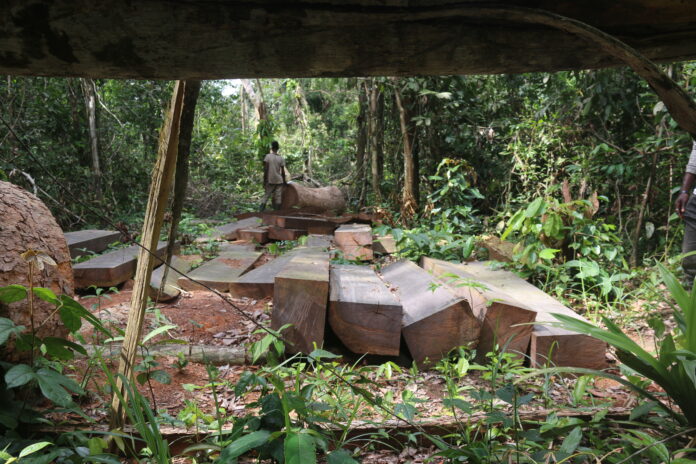
Top: Illegal timber production has increased in recent years amid the FDA’s issuance of permits outside the legal system. The DayLight/James Harding Giahyue
By James Harding Giahyue
MONROVIA – The Forestry Development Authority said it has issued “tens” of export permits outside Liberia’s log-tracking system.
“Tens of these documents have been issued to businesses that have expressed intent to get involved in trading timber and non-timber forest products in Liberia,” said Edward Kamara, the FDA’s manager for forest product marketing and revenue forecast. The DayLight has requested access to all of the permits, a right guaranteed forestry legal frameworks, the Liberian Constitution and the Freedom of Information Act.
Kamara was replying to emailed queries from The DayLight on one of the permits. The DayLight had addressed the email to Managing Director Mike Doryen, copying senior managers.
The FDA issued the permits Kamara referenced outside the chain of custody system or LiberTrace. By law, the FDA must issue all permits within LiberTrace.
“No person shall import, transport, process, or export unless the timber is accurately enrolled in the chain of custody,” according to the National Forestry Reform Law.
A pivotal part of Liberia’s international timber trade, LiberTrace traces the sources of the logs to their final destinations. The computerized system checks the legality of timber, including contracts, transports and payments. LiberTrace’s permits contain barcodes, and companies acquire them on a shipment-by-shipment basis.
Edward Kamara, FDA’s manager for forest product marketing and revenue forecast, is an architect of export permits awarded outside Liberia’s log-tracking system, whose funds are not remitted into the coffers of the government. The DayLight/James Harding Giahyue
From the ones published so far, the permits warn their holders to trade only timber from legal sources. William Pewu, the technical manager for the FDA’s commercial department, argued that the caveat was sufficient to deter any wrongdoing.
“This means a permit holder of such a category is acquiring forest products from companies already captured within the chain of custody (CoC) system and by extension LiberTrace.”
But the strategy has not worked. Holders of the documents have engaged in illegal logging activities, particularly in the last three years. The most infamous is the production of squared timber called “kpokolo.” Last month, Kamara said the FDA had banned kpokolo. However, it is yet to officially publish the ban.
The rise of illegal activities has not gone unnoticed by the outside world. Recently, the Associated Press reported Liberia may possess a “parallel” system for the export of illegal timbers. Citing diplomatic sources, the report said officials, including from the FDA, were colluding with illegal loggers to ship stolen timbers. It referenced a letter signed by Doryen permitting a shipment outside the legal system. A previous report quoted an international investigation that blamed the FDA for Liberia’s forestry violations.
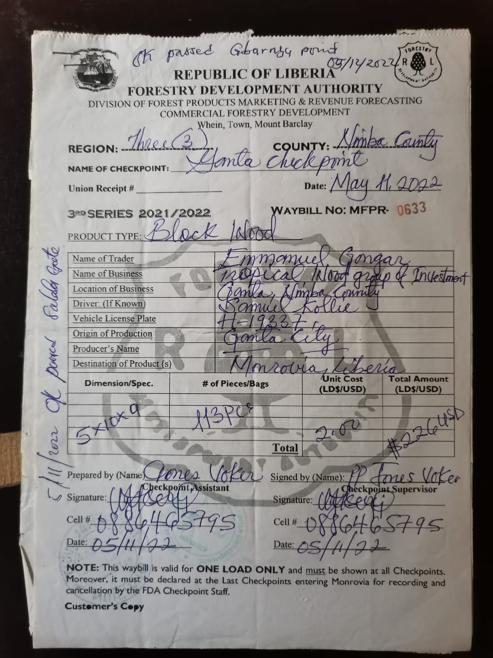
This receipt shows Emmanuel Gongor of Tropical Wood Group of Investment paid the FDA US$226 to transport 113 pieces of kpokolo, also called block wood, on May 11, 2022. No records show the fees were paid into the government’s official coffers as mandated by law. FDA awarded Tropical Wood its permit in October 2017 which expired in October of the following year.
Another issue about the permits is that holders do not make payments to the Liberia Revenue Authority (LRA). Instead, they pay in accounts at commercial banks, controlled by Doryen. Last year, The DayLight reported payments made by Liberian and Ivorian-owned businesses went into unofficial accounts.
Also, there are no records of payments for the transport of timbers related to the permit. They pay at checkpoints across the country against the Regulation on the Establishment of a Chain of Custody System. The DayLight has published some of the receipts of these illicit transactions known in forestry as waybills.
Kamara, however, claimed it was legal to award the permits outside LiberTrace. “Look into the [National Forestry Reform Law] of 2006 and see where the FDA gets its authority besides the general objectives and the mandates for which the Forestry Development Authority was established,” Kamara said. “We appreciate you all and we understand the anxiousness as we endeavor to satisfy our funding sources by running away with any story without understanding the rationale.”
Karmara and Pewu did not say why the FDA awarded the documents outside the system in the first place. They also did not answer questions about payments made into unofficial accounts. Kamara promised to respond at a later date but backtracked at a recent event in Grand Bassa County.
This story was produced by the Community of Forest and Environmental Journalists of Liberia (CoFEJ).
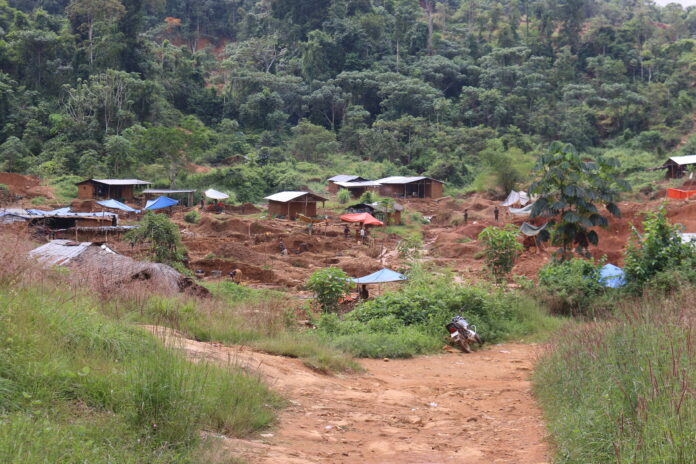
Top: An artisanal mine in Wayjue, Grand Cape Mount County on November 20, 2019. The DayLight/James Harding Giahyue
By James Harding Giahyue
MONROVIA – The United States has pointed out health, safety, and environmental problems that occurred last year in Liberia’s extractive industries, criticizing the Liberian government for human casualties and the lack of accountability in the sectors.
“Hazardous occupations were especially dangerous in the informal sector, such as illegal fishing, logging, and mining, where the lack of regulation and remediation contributed to fatalities and obscured accountability,” the U.S. State Department’s annual report, released Monday, said.
“The government did not keep records of industrial accidents, but evidence pointed to mining, construction, forestry, fishing, and agriculture as the most dangerous sectors,” it added.
The report said businesspeople exploited unsafe and unregulated artisanal mines. It added widespread illegal mining activities resulted “in the deaths of several persons every year, and that “No official entity provided social protections for informal-sector workers.”
It said workers added earnings from subsistent farming, artisanal mining and other informal businesses to their pay from the formal sector.
Corruption
Officially known as the annual Country Reports on Human Rights Practices, the U.S. State Department has released the publications, which cover 198 states, for the last five decades. It gauges countries’ political, civil rights and workers’ rights under the Universal Declaration of Human Rights and other international instruments.
The report shined a light on land and other natural resources-related conflicts in rural Liberia and cited a media report of alleged sexual harassment at the Maryland Oil Palm Plantation.
It spoke of “significant” human rights abuses in the country from “obstruction” of press freedom and “serious” problem with the Judiciary to unlawful killings and the lack of accountability in the country.
“There were numerous reports of government corruption during the year,” the report said. It mentioned the resignations of Minister of State for Presidential Affairs Nathaniel McGill, Solicitor General and Chief Prosecutor Sayma Syrenius Cephus, and National Port Authority Managing Director Bill Twehway, who were sanctioned by the U.S. Treasury Department in August.
“Officials frequently engaged in corrupt practices with impunity.”
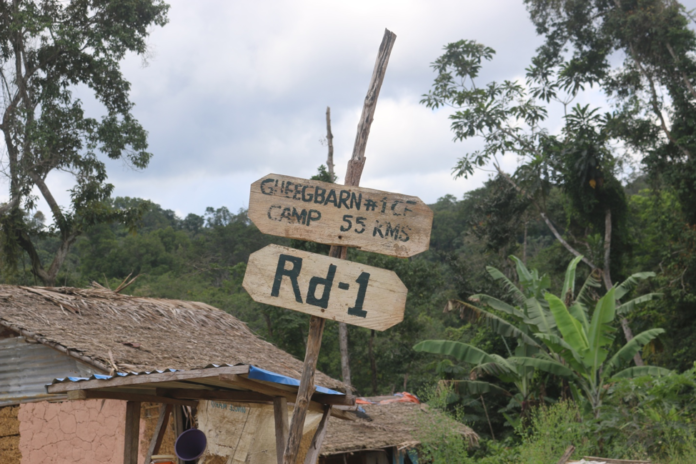
Top: A signboard at a logging company’s camp in the Gheebarn #1 Community Forest in Compound Number Two, Grand Bassa County. The DayLight/James Harding Giahyue
By James Harding Giahyue
COMPOUND NUMBER TWO, Grand Bassa County – Five ambassadors organized an exchange among locals, a logging company and the Forestry Development Authority (FDA) to get the gist of the challenges of community forestry.
It took one and a half hours for the envoys from the European Union, Sweden, France, Germany and Ireland to get what they were looking for. Leaders of the Gheegbarn Community Forest and West Africa Development Incorporated (WAFDI)—and the FDA—presented a perfect picture of one of forestry’s most problematic contracts. Each of the three actors took open aims at one another, as they entertained questions from the ambassadors.
The ambassadors on the visit were Laurent Delahousse of the European Union, Urban Sjöström of Sweden, Jacob Haselhuber of Germany, Michael Roux of France, and Gerard Considine of Ireland. The spouses of the five men also graced the occasion.
Larry Tuning, a member of Gheegbarn’s community forest leadership, started with WAFDI’s unfulfilled required projects in their December 2018 agreement. He criticized the company for not paving farm-to-market roads, erecting schools clinics and handpumps, and underwriting the costs of quarterly meetings. He, however, praised the company for meeting scholarship, land rental and log-harvesting payments.
Asked whether he would recommend commercial logging in community forestry, Tuning’s response was obvious. “It is hard for me to tell my friends to say ‘Get into it,’ because I [am] facing too many problems,” Tuning added as staff of WAFDI, sitting opposite looked on. “Instead of going into logging if had the support I would go into conservation.” Community forestry is a crucial part of Liberian forestry, giving rural communities the right to comanage their forests.
‘Let them go’
Tuning continued for several minutes, tearing into WAFDI on labor issues. He said the company had contravened a clause in their agreement, which mandates it to employ 60 percent of its workforce from the community. Dugbormar Kwekeh, another member of the community leadership buttressed his comments—and in a dramatic fashion, too.
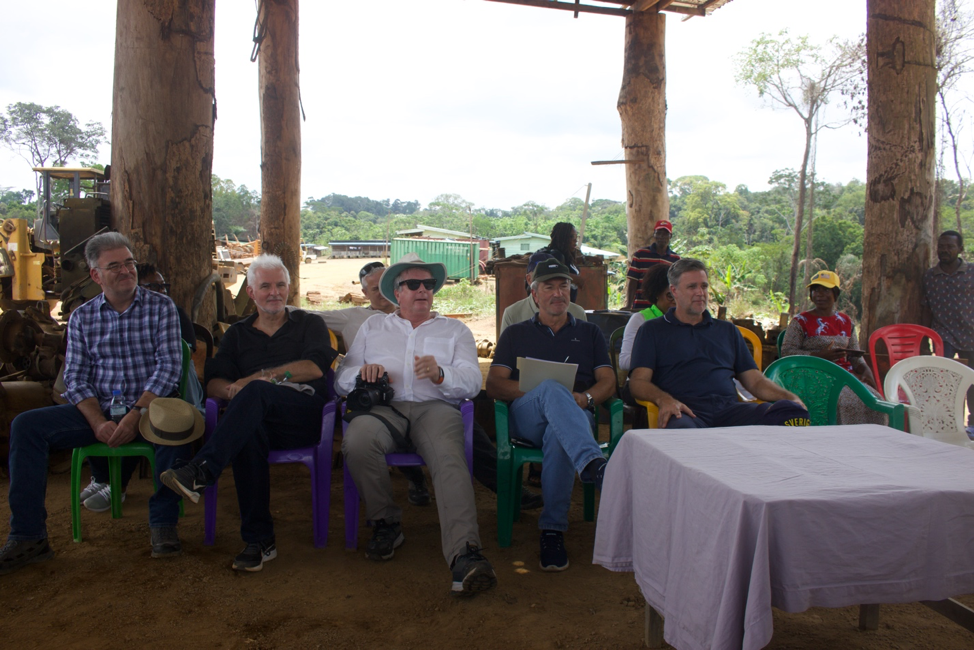
(R-L) Urban Sjöström, Ambassador of Sweden; Jacob Haselhuber, Ambassador of Germany; Laurent Delahousse, Head of the European Union Delegation; Michael Roux, Ambassador of France; and Gerard Considine, Ambassador of Ireland. The five envoys listen to leaders of the Gheebarn #1 Community Forest in Compound Number Two, Grand Bassa at an information and fact-finding tour of the west-central county on March 9, 2023. The DayLight/James Harding Giahyue
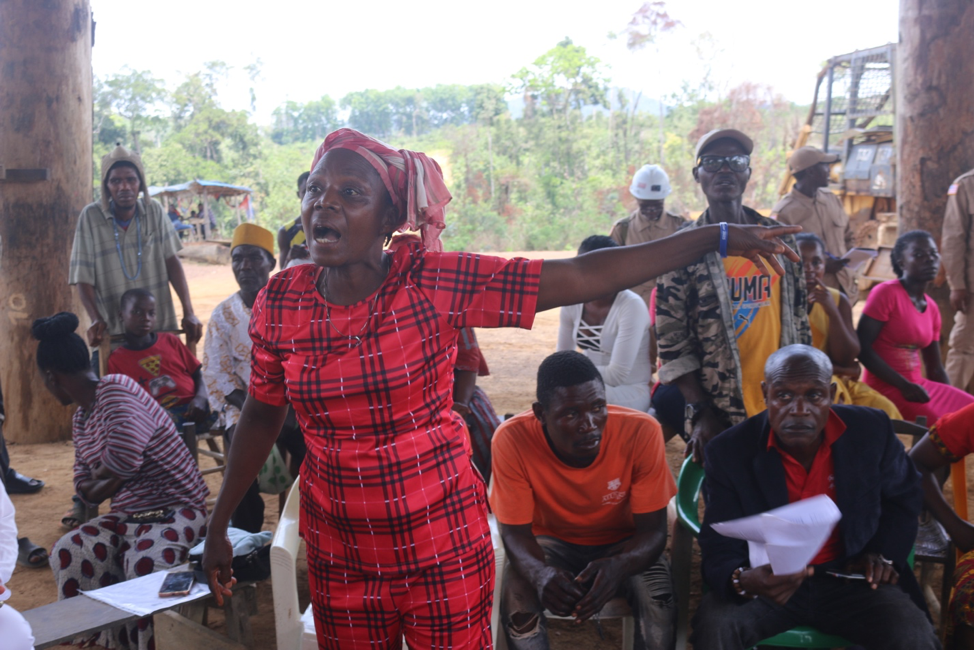
“They are just extracting our logs and there is nothing we are benefiting from,” Kwekeh said in Bassa through an interpreter. Gesturing as she went along, with an audible voice, she expressed frustration and fury. “The company came to subject us to poverty. “Let them go from here. Another company can take us from poverty.”
Gualberto Ojo, a Filipino who represented WAFDI in the meeting, denied preventing locals from farming. In fact, he accused them of farming on a portion of the 26,363 hectares of forestland they contracted to the company in Compound Number Two, Grand Bassa County.
“The company cannot stop the community people from farming; is not for us to say that it is the source of living,” said Ojo. “Most part of the forest is all farming activities, so because of this and other reasons the forest is not really productive.
Dugbormar Kwekeh, a member of Gheegbarn #1 Community Forest tells European envoys about challenges with commercial logging in that part of Liberia. On the far left is Larry Tuning, the secretary of the community forest. The DayLight/James Harding Giahyue
Pit-sawing
Before responding to Kwekeh’s comments, Ojo took a well-timed swipe at Tuning, who is a chainsaw miller. Tuning’s mention of pit-sawing had led to indistinct muttering among FDA representatives at the meeting. Also called pit-sawing, chainsaw milling began after the Second Liberian Civil War (1999-2003), and efforts to regulate the sub-sector have failed so far. It has wreaked havoc in forests across the country. Ojo, said, that included Gheegbarn #1.
“Pit-sawing is one major challenge; it has taken over the forest,” Ojo said, who said he first spotted the illegal activities in 2020. He said WAFDI had told the FDA about it. “People are doing pit-sawing all in the forest now.”
Human settlements and factors affecting the global logging industry were other issues, according to Ojo. A company representative said there were people from the neighboring Bong County living in the forest, and that the coronavirus and the ongoing U.S.-China trade war.
“During that four years the market on round logs collapsed totally,” Ojo told the diplomats.
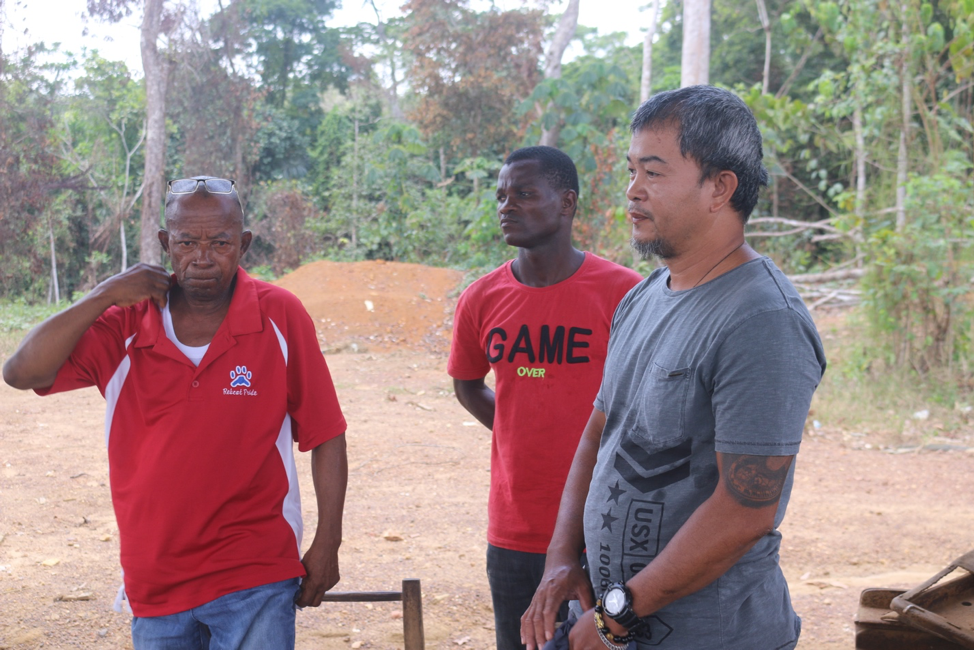
Workers of the West African Forest Development Investment (WAFDI) an information and fact-finding event organized by European ambassadors. The DayLight/James Harding Giahyue
‘We were like turtles’
Then entered the FDA, represented by Deputy Managing Director for Operations Joseph Tally and a host of top-level managers. There was an announcement from Weedor Gray, the technical manager of the community forestry department for periodic reports from communities. And more questions came.
“Have you ever come to the FDA to request for harvesting or export data?” Gertrude Nyaley, the technical manager for the legality verification department, asked Tuning. Nyaley’s rhetorical question was a response to Tuning’s earlier reply to an envoy about WAFDI’s production and export records. Tuning had said the community did not get the documents, and only accepted fees the company paid. Production records, in particular, are crucial in calculating harvesting payments, known in the industry as cubic meter fees.
Nyaley further pressed Tuning whether he and Gheegbarn’s leadership had informed the townspeople of a US$18,000 WAFDI paid. That question caused a stir among villagers at the event. Tuning encountered a rebuke from a local named Sylvester Williams, who had suggested community benefits were being misused. William disagreed with Tuning that the leadership supported villagers’ farming activities, bursting into a peal of frenzied laughter. Tuning said Williams was busy with his motorcycle taxi and was unaware of community matters. That pushed the community forestry drama to its highest peak. In a phone interview with The DayLight on Sunday, Tuning denied misapplying the fund, saying the leadership had already informed the community about the payment.
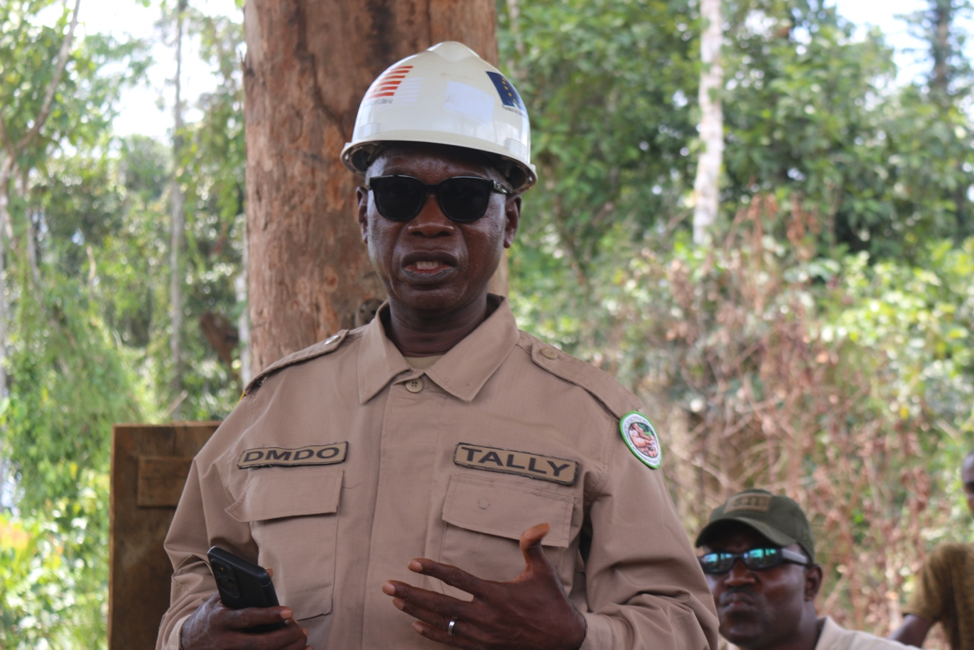
Tally, dressed in khaki uniform like all the managers of the FDA, thanked the European ambassadors for the event. “We were like turtles, and you put fire on our backs,” he said.
Joseph Tally, the deputy managing director of the Forestry Development Authority (FDA) speaks at the event. The DayLight/James Harding Giahyue
Tally’s comments were a reference to criticisms of the rise in forestry violations and the trade of illegal timber. Both the national and international media have published reports of logging wrongdoings, involving the FDA. It was a major issue at last month’s forest and climate forum, where Liberia reassured its commitment to combat illegal logging and climate change in its pursuit of climate financing.
But talking about the correction of past wrongdoings, Gheegbarn #1 was the right place for Tally and his team. Last year, a Ministry of Justice investigation found the FDA awarded WAFDI excess forest blocks. The report, seen by The DayLight, cut the deal between the company and the community from 15 to seven years. Several senior managers were replaced in the fallout of the scandal. The parties have signed a new agreement.
Conservation
Delahousse said the delegation had not come to condemn any of the actors. “This was not a trial of the company. This is a fact-finding information mission, and for us, it was very important to be here and to hear all the various stakeholders,” said Delahousse.
Delahousse said he learned that community forestry was “complicated,” a “bit of a bobble,” and lacked transparency. He urged communities to consider conservation programs instead. Of the dozens of community forests, only a few have a conservation management program. Others have scrapped it to accommodate mining.
“We need to work also on seeing how conservation can be an alternative for some communities,” Delahousse said. “Maybe they can make more money from conservation.”
After the meeting, the ambassadors and their entourage toured a portion of Gheegbarn Community Forest with the FDA. The visit ended with a trip to the log yard of Kisvan in Buchanan, which operates in the Central Morweh Community Forest in River Cess.
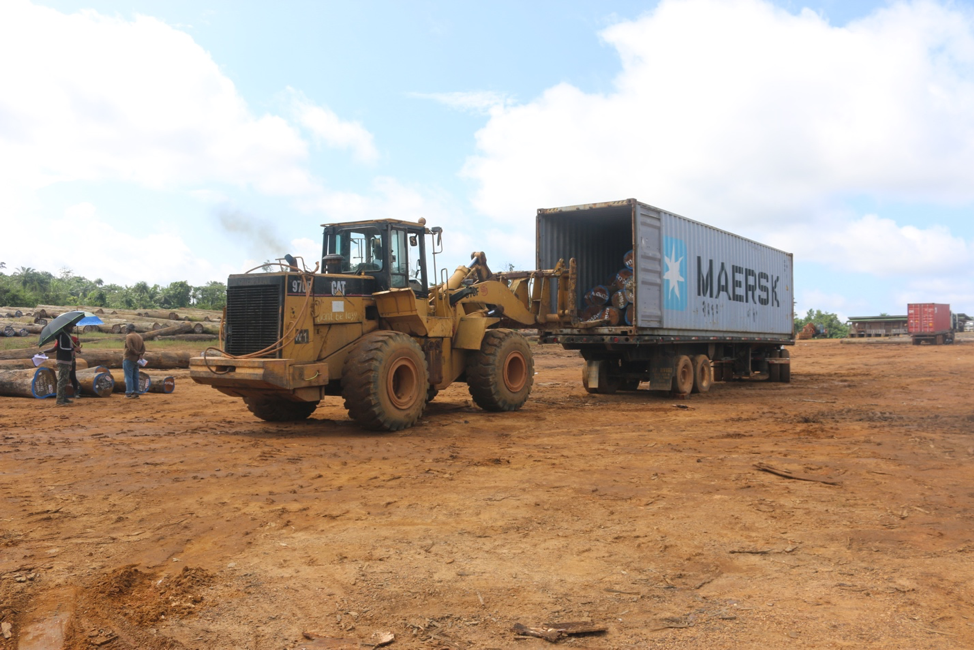
Workers of WAFDI load logs into a container at the company’s log yard in Compound Number Two, Grand Bassa County in September 2022. The DayLight/James Harding Giahyue