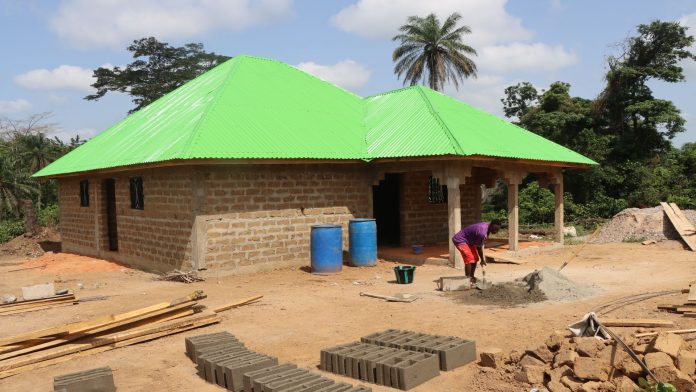
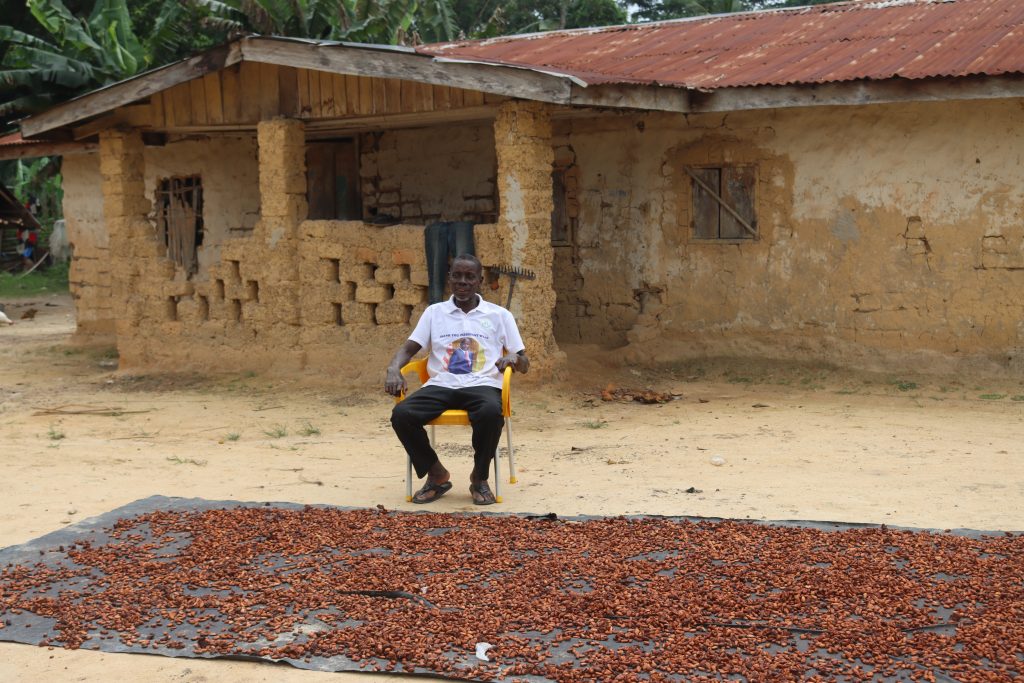
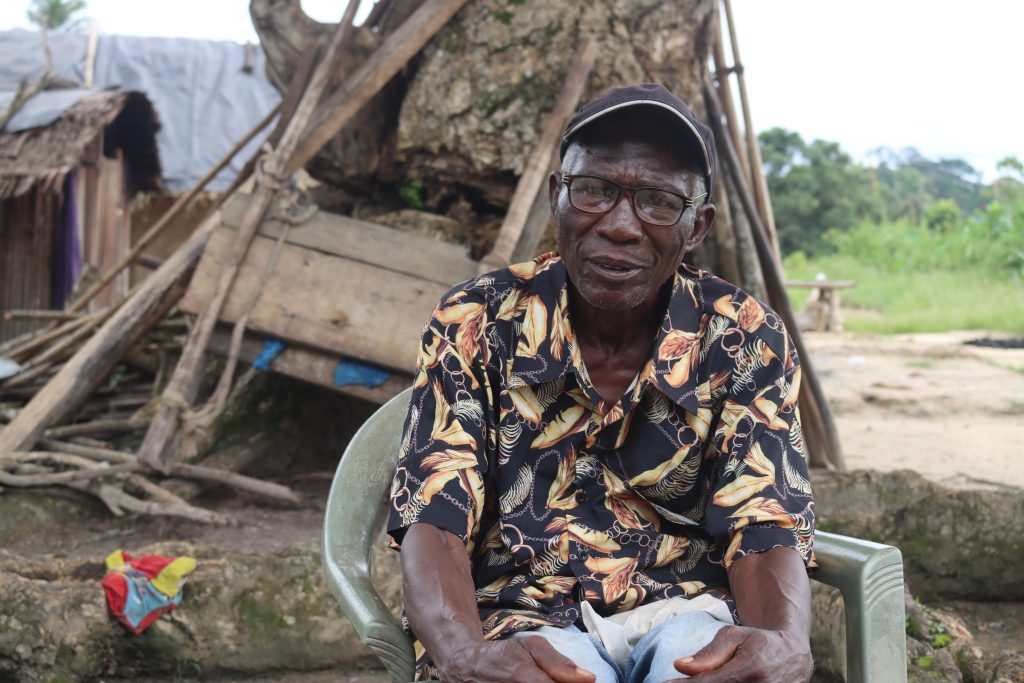
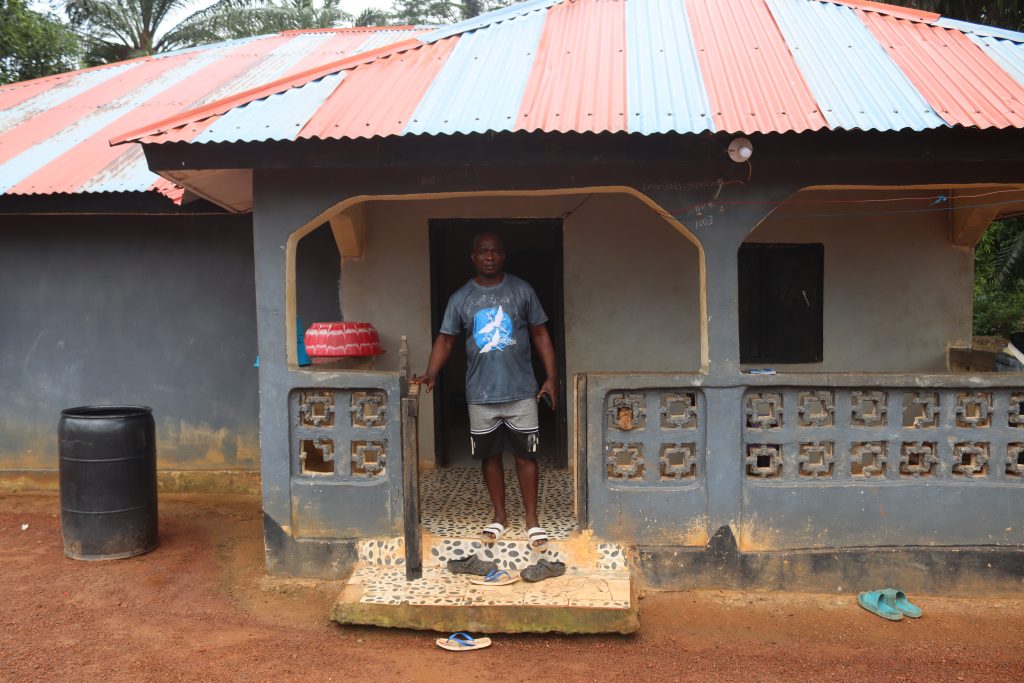
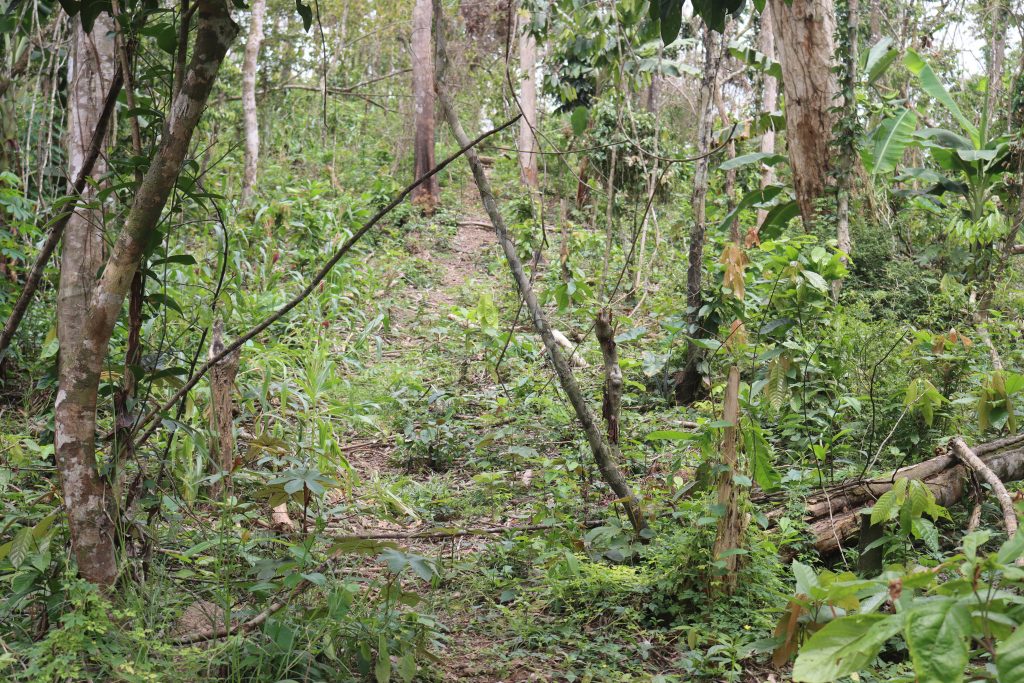
A house in Salayea, Lofa County being constructed by a community forest loan scheme
Top: Nenee David’s house under construction in Telemu Town, which she funded with the loan she received from the Salayea Community Forest. The DayLight/Harry Browne
By Esau J. Farr
SALAYEA TOWN, Lofa County – Before joining the Salayea Community Forest’s savings club, Krubo Tokpah sold pastry in a transparent bucket for a year. Now she uses the loan to sell used clothing, which she uses to feed her children and send them to school.
“This program has made me have money all the time,” says Tokpah. “I can’t be a beggar again.”
Tokpah is the chairlady of the village saving and loan association in Salayea town, one of six communities adjacent to the Salayea forest. The loan scheme is helping to stop locals from using the 8,270-hectare forest in the Salayea District of Lofa County.
In 2022, Salayea Community Forest introduced the loan program to empower women and make them financially independent. Five women’s groups of 25 people each began the loan program, which now has over 250 beneficiaries across the district.
Palladium Group Liberia, a British NGO, trained townspeople and provided special boxes to save the money. Townspeople are prohibited from farming, mining, or building homes in the forest. However, people are allowed to garden in areas outside the primary forest, including swamps and marshes.
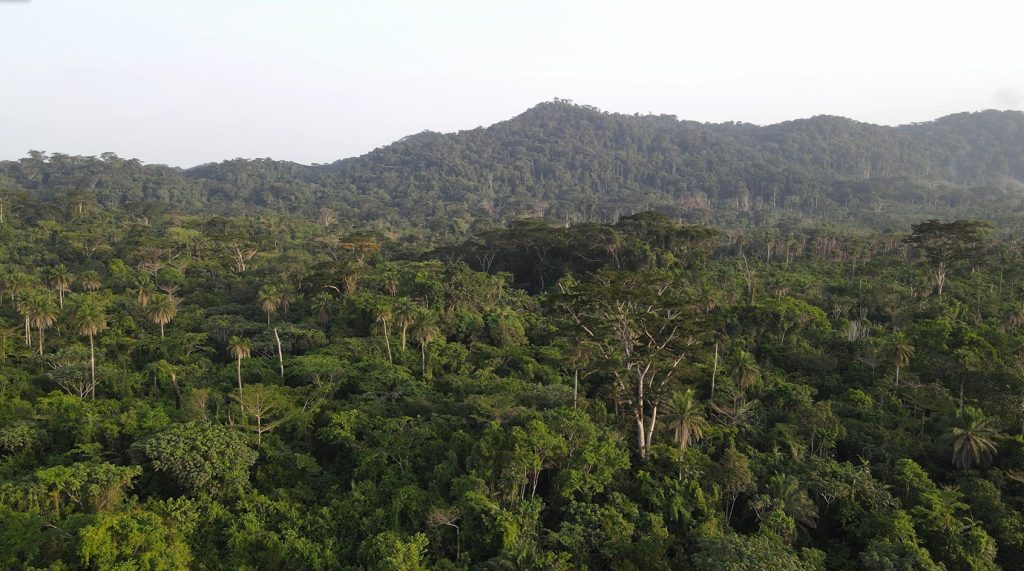
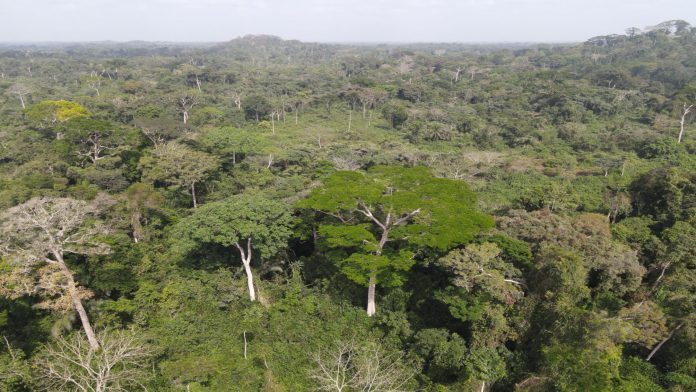
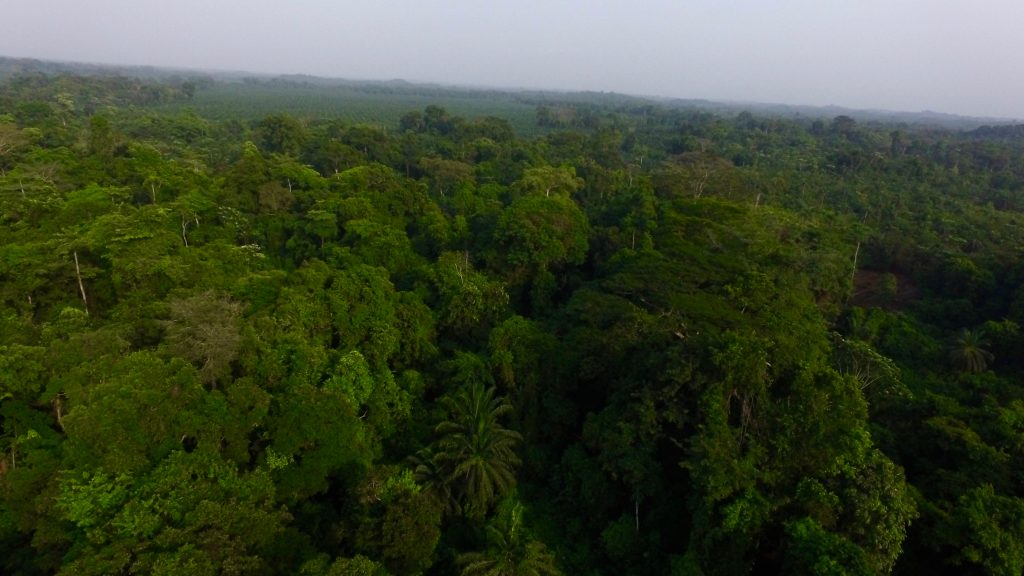
A drone photo of the Salayea Community Forest. The DayLight/Samuel Jabba
“The loan program and the other alternative livelihood programs are all helping to protect our forest,” says Yassah Mulbah, the head of the Salayea Community Forest. “It helps keep our forest from being destroyed,” adds Mulbah.
Before the loan program, unauthorized occupants mined and farmed in the Salayea forest. The loan program is now reversing that course.
“Two months ago, we did our infantry in the bush; we did not see any new farming nor a hunter in the forest,” says Garmen Flomo, a Salayea forest leader in Beyan Town. “There were animals that we did not see at first when we entered the forest.”
The scheme is one of several strategies the Salayea Community Forest is applying to stop illegal activities and reduce locals’ dependence on the forest. The other programs include animal farming, cocoa cultivation, guesthouse management and woodwork. Two Sinoe communities—Wehjad and Jaedae—are implementing a similar project to protect their forests.
Transformation
Beneficiaries of the loan scheme say the project is paying off for them.
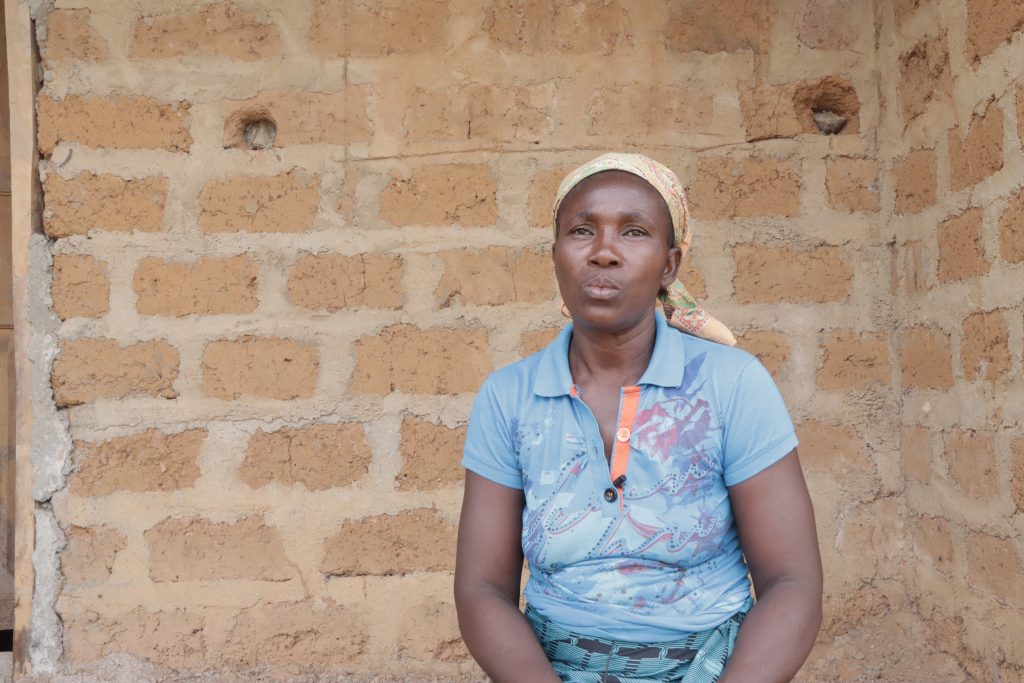
“I am happy for this program to come to us… because it is transforming our lives,” says Mamie Kollie, a Telemu Town resident. “From my savings, I am helping my husband to build this new house I am sitting under.” Situated on a hill in the center of Telemu Town, Kollie and her husband had zinced their new home. The house is built of bricks made of brown mud and cement.
Like Kollie, Nenee David, another Telemu Town resident, is constructing a three-bedroom house.
“We used some of the money that we got from the village saving loan to build our house,” said Madam David. “I used part of that money to buy different kinds of goods….”
Besides construction, businesses are improving every year. Members of the loan program expect to save at least L$3,000,000 (US$16,666) this year.
Mamie Kollie being interviewed at her new house in Telemu Town. The DayLight/Harry Browne
Businesses have moved from lower to higher levels since the introduction of the program. Like Krubo Tokpah and Garmen Flomo, both from Salayea Town, have moved from selling locally prepared bread to selling used clothes. Korto Flomo in Gorlu Town and other members of the Beyan Town program have swapped the table market for a shop.
Yassah Mulbah, Chief Officer of the Salayea Community Forest, is grateful.
“It has reduced most of the burdens on the women, and we want more support to increase beneficiaries.”
This was a production of the Community of Forest and Environmental Journalists of Liberia.
Top: A drone picture of a forest in Grand Gedeh County. The DayLight/Samuel Jabba
By Varney Kamara
POUH TOWN – Local cocoa farmers in Grand Gedeh County manipulated signatures in an appeal letter to President Joseph Boakai, rejecting boundaries between their communities and the Kwa Proposed Protected Area, a DayLight investigation found. The investigation established that the letter was based on falsehoods, as some had already agreed to the proposed park’s boundaries.
Late last month, farmers from the Gbarzon District wrote to President Joseph Boakai, claiming forestry authorities did not seek their consent before cutting the boundaries. They allege that they signed no MoU and there was no guarantee they would have access to their farmlands. They had been intimidated, their properties destroyed, and forest rangers made unauthorized entry into their communities.
For this reason, the farmers want the proposed park’s boundaries pushed to 10 kilometers. President Boakai then ordered an immediate investigation into the matter. Official talks took place last weekend as part of the presidential inquest.
Covering 172,200 hectares, the Kwa Proposed Protected Area lies between River Cess, Sinoe, and Grand Gedeh Counties. It is part of Liberia’s efforts to protect 30 percent of its forests and contributes to the country’s climate commitments.
An ‘error’
The DayLight reviewed the appeal letter, interviewed some of its signatories, and found inconsistencies. Reporters found that although the letter to the President lists 16 signatures, only 15 people actually signed it. Abednego Zweh, a farmer from Pouh Town, where most of the appealing farmers live, signed twice.
George Totaye, another Pouh Town farmer, said he did not sign the letter.
“I personally cannot remember signing any petition. I cannot remember signing that communication,” said Totaye. “My farm does not extend on that side. I am not close to the park. I am not part of them.”
Zweh insists Totaye signed the letter, but listing 16 signatories instead of 15 was an “error.”
Routy Beh, a cocoa farmer in Pouh Town, sits behind his half-dried cocoa beans. The DayLight/Varney KamaraGarretson Seo, one of the cocoa farmers, grants an interview with The DayLight in Pouh Town. The DayLight/Varney KamaraDixon Roberts, General Town Chief of Tojallah, is one of 15 cocoa farmers who wrote to President Joseph Boakai. The DayLight/Varney Kamara
Several of the 15 cocoa farmers who wrote the appeal to President Boakai had consented to Kwa in 2023. They told The DayLight they hosted between two and 10 Burkinabés. Dixon Roberts (six Burkinabés) of Tojallah signed. Tommy Yarkpawolo (two) and Garretson Seo (10) of Goluay signed.
There were other inconsistencies regarding the farmers’ appeal, though. Last year, the communities signed a boundary harmonization agreement with the FDA and partners, confirming the 2023 boundary. Then early this year, the clans that host the communities signed agreements with the Liberia Land Authority, confirming the boundaries.
The DayLight also noted one more issue. Pouh Town, where the majority of the farmers live, is not among the communities adjacent to the proposed park. It is 19 kilometers away.
The farmers admitted signing the consent forms. However, they claimed they were unaware of any boundary demarcation.
“We agreed for the park to be created, but we never agreed on any boundary issue, and we did not take part in any boundary demarcation exercise,” said Yarkpawolo, who has a three-hectare cocoa farm in Gaye Town.
“During our previous meetings with the FDA and the Wild Chimpanzee Foundation, we agreed that they would come back to us when they get ready to cut the lines. But, to our surprise, we only saw them destroying our crops,” added Yarkpawolo. His comments reflect the general view of farmers The DayLight interviewed, including those who did not sign the letter to Boakai.
But the facts contradict the farmers’ comments. The documents they signed show that they agreed to the boundaries, among other things.
“Our town confirms that since 2020 the FDA, LLA and partners have been holding community consultations and meetings to keep us informed. Our town confirms that as part of the boundary harmonization process, the boundary line was trekked by designated community members, local authorities, and relevant institutions, and all grievances were resolved,” read the consent document Yarkpawolo and other townspeople signed in Goluay.
A cocoa farm in Gbaryea Town in Gbarzon District, Grand Gedeh County. The DayLight/Varney Kamara
Apart from the consent form, other documents disprove the farmers’ comments.
As recently as May, community land leaders and clan chiefs signed a boundary agreement with the Liberia Land Authority for the proposed park. In the document, the farmers “fully acknowledged” the proposed Kwa Park and agreed on its “official boundaries.” Also, there is no record of any farmer raising any qualms when authorities published notices about the proposed park between June and August 2023.
Wild Chimpanzee Foundation, an NGO that works with the FDA to establish Kwa, refuted the farmers’ claim.
“From our side, the consent forms were signed by the rightful community representatives in 2023,” said Dr Annika Hillers, Country Director of Wild Chimpanzee Foundation. “The consent forms were about the establishment of the park, the confirmation of the [consent] process, the harmonized boundary, and also, communities committed not to do any farming and other activities inside the proposed park.”
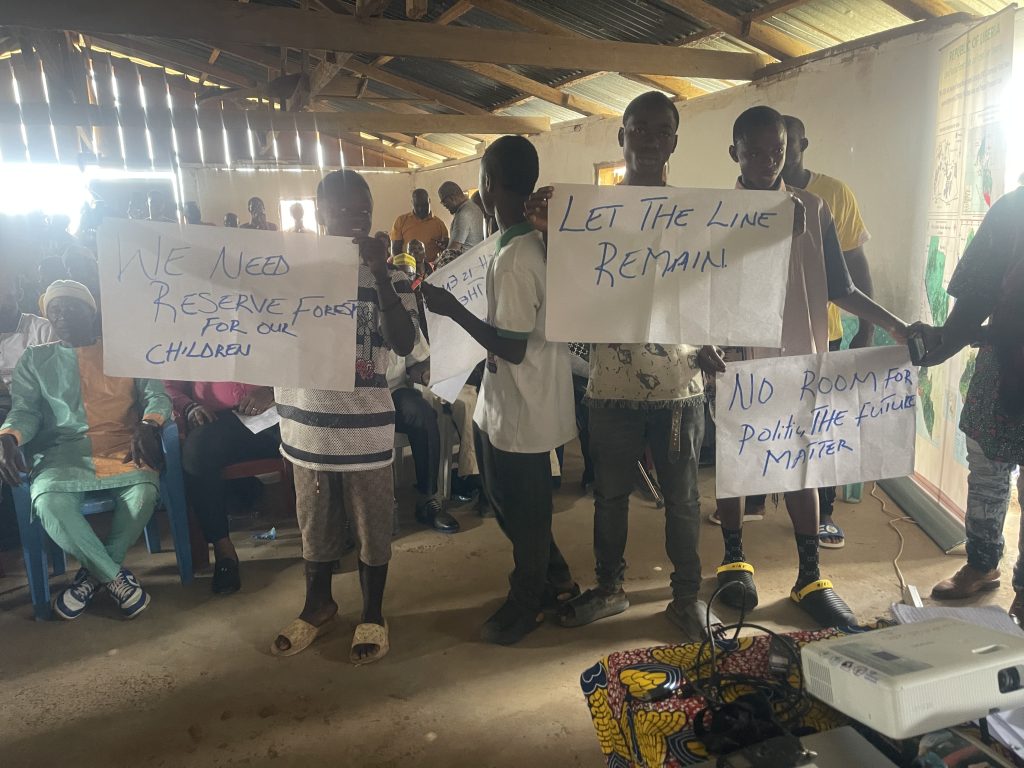
Some youths agree on the current boundaries. “We need reserved forests for our children,” and “Enough is enough,” adorned their posters.
One farmer somehow conceded.
“I think we made a mistake from the beginning as a community,” said Dixon Poya, who lives and farms in Pouh Town. “When the people came with this discussion on the park issue, we were too quick to agree. We should have studied all other conditions that we are raising now.
“In my mind, we should accept what is happening. We can only appeal to the government to have some consideration and redraw the boundary back a little bit,” added Poya.
Under pressure
Dr Hillers also denies allegations of human rights abuses. “We are 100 percent sure that these allegations are false and that neither FDA nor any other law enforcement entity ever violated human rights or did anything not in line with Liberian laws,” she added.
The FDA did not respond to DayLight’s queries while the government investigates the issue. However, the FDA resurveyed the area and found that over 14,000 hectares of the proposed park have been clear-cut for cocoa cultivation.
Over the years, the park has shrunk from 236,246 hectares to 172,200 hectares due to competing mining and logging interests. The farmers’ boundary appeal comes amid cocoa-fueled, nationwide deforestation. Between 2000 and 2020, Liberia lost approximately 2.52 million hectares of tree cover, with cocoa responsible for about 15 percent of that, according to a 2024 report.
Local people smuggle in Burkinabe migrants from neighboring Ivory Coast into Liberia to plant cocoa. An estimated 140,000 Burkinabes have migrated to Liberia in Grand Gedeh and River Gee, according to the Liberia Refugee Repatriation and Resettlement Commission. This cocoa rush has also resulted in encroachments on community forests and logging concessions, leaving deadly land conflicts in its wake.
Chiefs and elders meet for the Kwa Proposed Protected Area
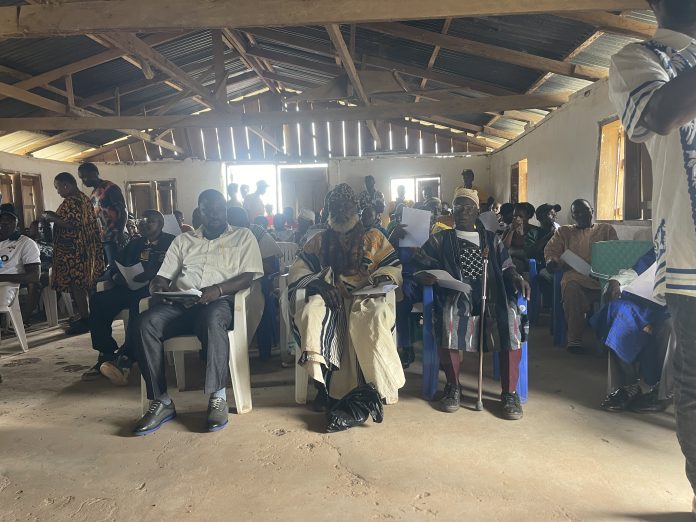
Top: Some participants at the meeting in Gaye Town. The DayLight/Esau J. Farr
By Esau J. Farr
GAYE TOWN – Cocoa farmers in Grand Gedeh County have requested that boundaries between the Kwa Proposed Protected Area and their communities be extended.
The communities lie between 3.8 and 19 kilometers from Kwa, which covers 172,200 hectares across Grand Gedeh, River Cess and Sinoe. However, they want the boundary lines to be 10 kilometers further away so they can access more farmlands.
“We can guarantee you that when this boundary line is passed, you don’t need to pay people to protect the park. We ourselves will protect the forest,” said Abednego Zweh, Chairman of Grand Gedeh’s farmers. Zweh spoke at a recent meeting to resolve a dispute with the Forestry Development Authority (FDA) and partners in Gaye Town, Gbarzon District.
“If our request is not honored by the President, we will still appeal,” he added.
The meeting was part of an investigation President Joseph Boakai ordered last month following the farmers’ appeal for his intervention.
In their letter to President Boakai, the farmers claimed that they did not consent to the proposed park’s boundaries. They accused authorities of abusing their rights, allegations authorities deny.
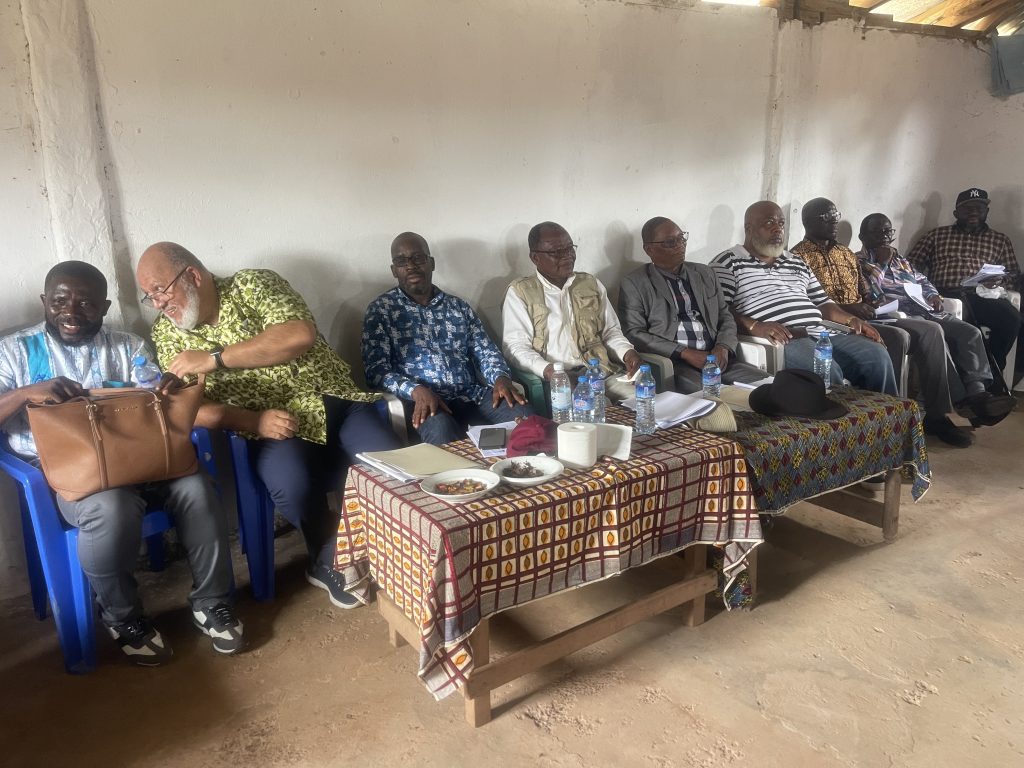
FDA boss Rudolph Merab chats with Grand Gedeh lawmaker Jacob Debee. Lawmaker Jeremiah Sokan and Thomas Yaya and other county authorities at the meeting. The DayLight/Esau J. Farr
The farmers said they participated in meetings, but were unaware of any boundary arrangements.
Clement Tweh, the program manager of Wild Chimpanzee Foundation—an NGO that works with the FDA to establish Kwa—dismissed those claims. Tweh said the farmers signed consent and boundary documents.
“We don’t want a handful of individuals who have farms and are not the actual representatives of the communities to benefit, rather than the entire community,” said Tweh. The DayLight independently reviewed the documents to verify his claims.
‘Let the boundaries remain’
Interestingly, a group of concerned youths of Gbarzon District disagreed with the farmers. Led by Leo Wilson Jahyee, the youths carried placards, brandishing inscriptions: “Let the boundaries remain,” “We need reserved forests for our children,” and “Enough is enough.”
“We believe that forests should be managed, be cared for and the boundary line should remain,” Jahyee said.
The group accused the farmers of wanting to expand their cocoa farms with the help of Burkinabe migrants they host. Several of the farmers The DayLight interviewed had at least two Burkinabe migrants. About 140,000 Burkinabe migrants are in Grand Gedeh and River Gee, according to the Liberia Refugee, Repatriation and Resettlement Commission (LRRRC).
Members of the concerned youths of Gbao District at the Gaye Town meeting. The DayLight/Esau J. Farr
Cocoa farming is fast depleting Grand Gedeh’s forest. Local farmers have encroached on logging concessions, community forests, and the proposed park. From 2002 to last year, Gbarzon lost 46,000 hectares, or 14 percent of its primary forest, according to the Global Forest Watch, an app that tracks deforestation.
Following presentations from the opposing sides, the FDA Managing Director Rudolph Merab told locals they would hear from him following a meeting with President Boakai.
“I could have concluded [this matter] right now and made a decision, but unfortunately, I cannot do that because you have also written the President,” said Merab. “I cannot make a decision without consulting him.”
At the end of the meeting, the farmers agreed not to extend their farms until they hear from the FDA. Meanwhile, the regulator has mandated forest rangers to halt all operations in the disputed areas, pending the President’s decision.
Top: Some members of the club met at their meeting in Diyankpo Town, and a staff member of the Integrated Development Learning visited to take records. Photo credit: Tina S. Mehnpaine
By Tina S. Mehnpaine
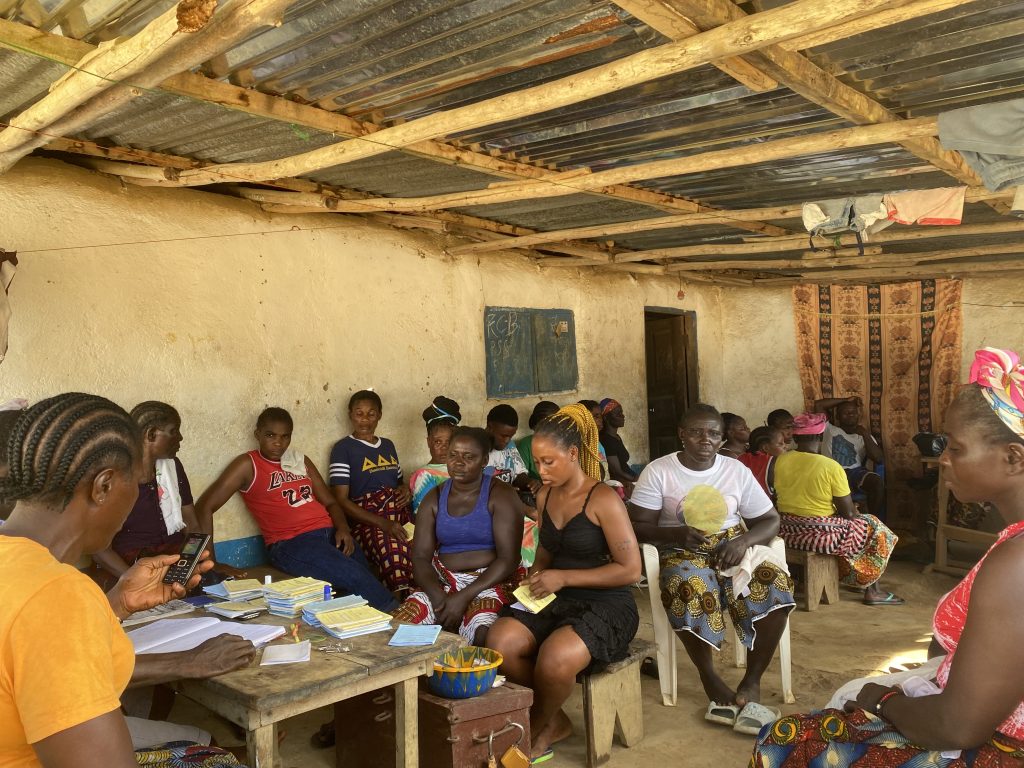
NAJOR TOWN – Maybel Payne walks steadily along a dirt path, a tub of harvested chili peppers balanced on her head. She is hurrying, not to the market, but to a meeting that has become one of the most important parts of life in this small farming town.
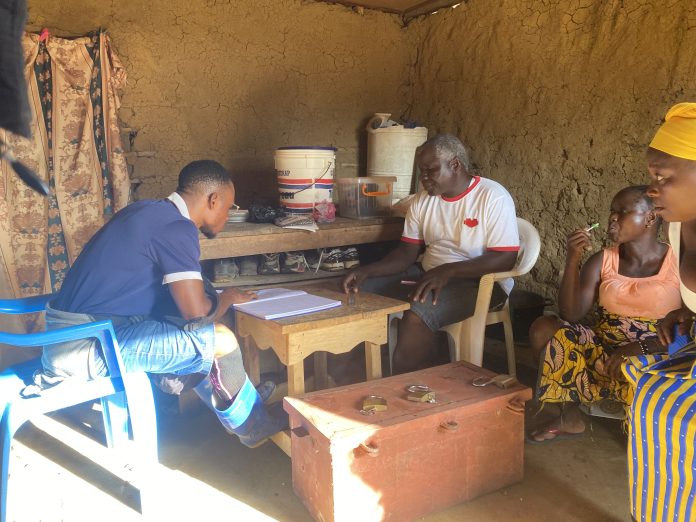
Payne is the box keeper for Najor’s Village Savings and Loan Association (VSLA), known locally as a money club. She is the first to arrive, carrying the metal box that holds the group’s savings and records.
For most of her life, Payne farmed the way many people here do. She harvested, sold what she could, and used the money almost immediately for food, school costs, medicine, transport, and other basic needs. Saving was not part of the routine, partly because there was no bank nearby and partly because the money rarely lasted long enough.
Now, through the club, she and other townspeople save, borrow, and invest under a new conservation program. They can take a loan for their farms or use their savings in times of emergency. Daily life in Najor is shaped by distance, poverty and the forest. The town has no school, clinic, police station or electricity. Mobile network here is weak, and the road is difficult, especially during the rainy season. Motorbikes are often the only transport, and even those are not always available.
“It is helping us to stand on our own,” Payne says. “This savings club is good for us,” says Payne, a mother of nine. “We can now save and support our farms.”
Najor is one of 10 communities covering 7,131 hectares of forest being protected through the payment for stewardship, a project supported by the Irish government and implemented by Integrated Development Learning, a Margibi-based NGO. The project is an area-based payment initiative, though plans are underway to scale to result-based payment. Beneficiary communities have received $21,392 for protecting the forest. The ten communities are situated within the Jeadea and Wedjah districts. For this reporting, we also visited Jarwee, Soloe, Gboyee, Gartee, Flahn, Konwonkpo and Diyankpo.
Maybel Payne sits in a rattan chair in Najor town. Photo credit: Tina S. Mehnpaine
The savings clubs were introduced in 2022 as a livelihood support, giving residents a way to build income, strengthen small businesses, and reduce dependence on forest resources. IDL provided training, metal boxes, padlocks, wall clocks, and stationery.
In an email, Bahnavileh Jones, who leads IDL’s small-business grant and savings programs, says linking conservation with savings is necessary because many projects fail to create sustainable income after donors leave.
“They also promote alternative livelihoods by enabling members to invest in small businesses, improved farming, or livestock,” Jones tells me. “VSLA funds can support environmentally friendly practices like agroforestry and sustainable farming.” He adds that access to savings and small loans can reduce pressure on forests by giving families other ways to meet urgent needs.
In communities like Najor, those needs are constant. Roads worsen with heavy rainfall. Sick people must travel to other towns for treatment. Children must leave the community to attend school. Farmers depend on cassava, pepper, beans and other crops, but getting produce to market remains costly.
For Payne, the change started in 2025 when the program reached Najor. After earning L$8,000 from her harvest, she bought two shares in the club totaling L$1,200.
“The L$8,000 was plenty,” she recalls. “As soon as I got my money, I took out L$5,000. My children in Greenville are going to school, and I bought their physical education uniforms.”
Liberia’s forests are a precious jewel in the world, holding more than 40 percent of the Upper Guinea rainforests, West Africa’s largest remaining forests, home to endangered species. But for decades, these forests have been lost to illegal logging, farming, and deforestation.
Saah A. David, Jr., former National Program Coordinator of the Liberia Forest Sector Project, a defunct US$150 million national initiative to combat deforestation, supports paying communities to keep their forests standing. Najor’s forest is particularly important because it borders Sapo National Park, Liberia’s largest protected area and the country’s only national park. Program and project
“Payment for standing forests has been a dream of our people and the world at large. Making it a reality is a dream come true,” says David, who says he was hired to work as a consultant for the payment for stewardship in the first two years. “The communities are excited. Working with them on meaningful/impactful projects with their money remains a little challenge.”
The loan scheme has expanded beyond Najor. It is now active in 43 communities in the southeast, benefiting 2,207 people—1,623 women and 585 men.
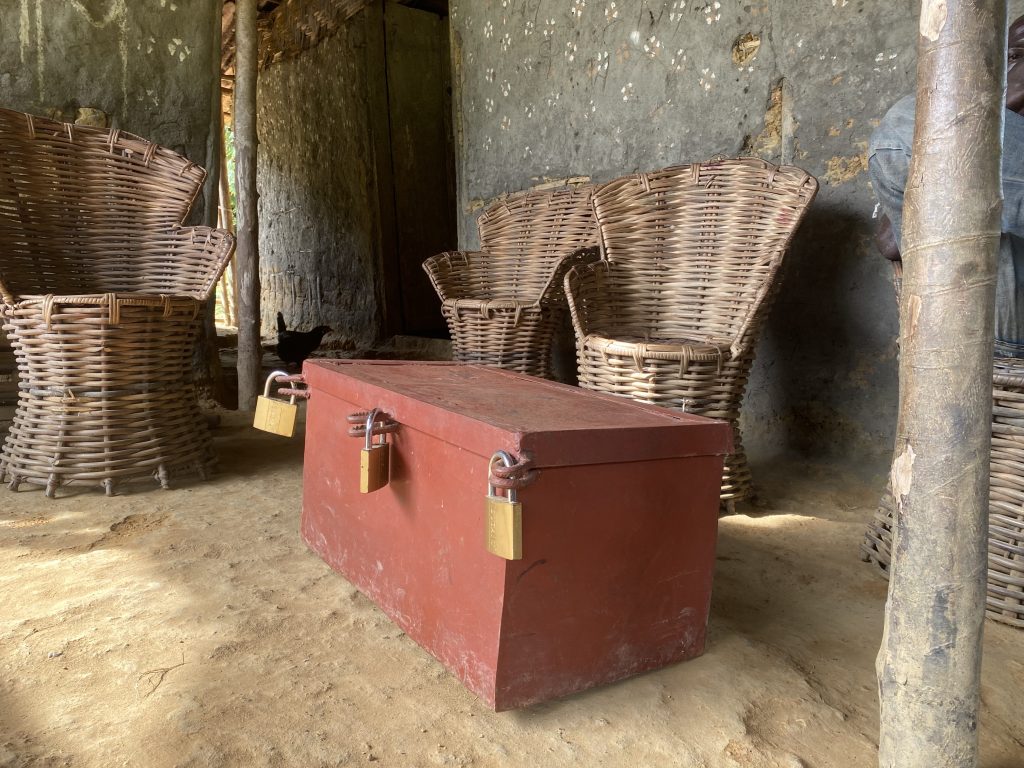
The clubs are owned and managed by the communities themselves. In each group, one person keeps the box, while three other people keep separate keys. The box can only be opened when all key holders, members, and leadership are present, and transactions are conducted in the presence of the full group. Money counters, a chairlady, and a chairman help manage the process.
“It is open to everybody; nobody can cheat,” says Oretha Swen from Jorwee Town.
In Jorwee, farming remains the main source of livelihood. Many residents produce gari, a processed cassava product. In the past, they grated cassava by hand and dried it for days. IDL later donated a processing mill to the savings club. Members pay a small fee to use the machine, and that money helps cover maintenance and repairs.
Other forms of support are also tied to the clubs. Some communities received motorbikes under a revolving scheme. A member receives a motorbike and makes installment payments until the full cost of 250,000 Liberian dollars is paid. Ownership then transfers to the member, and the group uses the money to buy a new motorbike for another member.
After each new motorbike is purchased, any remaining balance is divided between community development and the loan group. The group’s share is later distributed among members as part of interest earned at the end of the savings cycle.
Members of the club at their Sunday meeting in Konwonkpo. Photo credit: Tina S. Mehnpaine
But the support does not solve every problem. Yatta Flahn, chairlady of Diayanpo Town, says the motorbike brought relief, but finding a reliable rider has been difficult.
“So we’re still keeping the bike,” she said.
IDL has also provided small business grants to club members who save regularly and repay loans on time. Jones says 148 members, including 123 women and 25 men, have received grants totaling L$6,436,820 (over US$35,700).
The grants help members expand existing businesses. First-cycle grants range from about L$35,000 to L$50,000. If members repay within three to four months with a five percent interest, they may qualify for a second round of US$75,000 to L$80,000. A third round of US$100,000 or more may follow, depending on the borrower’s business proposal and repayment record.
The club serves as guarantor. If one member fails to repay, no other member in that club can access another grant until the balance is cleared. The system is meant to build discipline and collective accountability.
For some residents, the club’s value goes beyond money. In farming communities, where people spend most of the day on their farms, meetings provide a rare opportunity.
“Most especially, it puts people together to discuss our town,” said Patrick Nimely of Flahn Town.
Nimely said the club has helped residents talk about conflicts, farming needs, and community development. IDL also donated seedlings, which farmers can plant and later replant on their own farms. Members, too, contribute 50 Liberian dollars to a social fund, which can be used when members are sick, getting married, or facing other needs.
Still, transportation remains one of the biggest barriers. Oretha Shepard from Jarwee Town, who received a small grant, says high transport costs reduce farmers’ earnings from gari and crops. A trip from Greenville can cost L$1,500.
The metal box used in the village loan scheme has three locks, kept by two individuals who live separately. It cannot be opened in the absence of the two other keepers or the group. Photo credit: Tina Mehnpaine
“The transportation is too much, so we can’t see anything inside,” she laments.
Security is another concern. In towns without police, the metal savings box can become a target. Renee N. Gibson, program manager for the Rural Integrated Center for Community Empowerment (RICCE), recalls one incident in which a thief stole a money box while villagers were away farming. The community later found the box, but the money was gone.
“What we’ve done now is transition to much larger, heavy-duty metal boxes,” Gibson said. “They are built so heavily that even two people cannot easily move them.”
For Payne, the box still represents something larger than cash. It is a sign that a town long lacking banks, roads, and basic services has found a way to save together, borrow together and plan together. The money club has become a small but practical form of security.
This story was a production of the Community of Forest and Environmental Journalists of Liberia (CoFEJ).
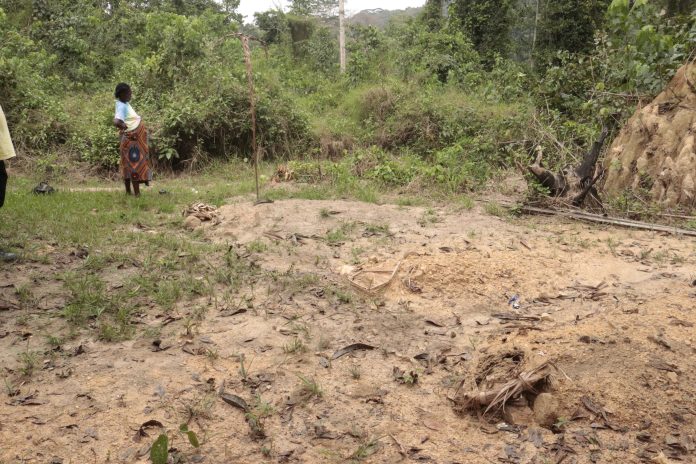
Top: The graves of three miners only identified as Bassa Boy, Timiya and Tamba on Success Camp in Massawo Town, Lofa County. The DayLight/Samuel Jabba
By T. Prince Mulbah
SUCCESS CAMP – In November 2024, a man, only identified as Mackey Boy or Bassa Boy, drowned in a mining pit in a forest in Lofa County. Bassa Boy, in his mid-30s, disappeared in an abandoned mining pit on that fateful Saturday morning.
A search party found his lifeless body the next day in Success Camp, a goldfield in Massawo Town in Lofa County’s Zorzor District. Eyewitnesses—fellow miners and townspeople—said the doomed miner was moving gravel a mining company had piled up when he met his death. He was buried the following day.
Bassa Boy is one of several unidentified miners who died in mining pits abandoned by an illegal operation conducted by J.M. Mining Incorporated, a Chinese-Liberian company, and were buried in the mines they dug. J.M. Mining had operated the mine for nearly a year after its license had expired.
The Ministry of Mines and Energy records show that J.M. Mining’s gold prospecting license was issued in May 2022 and expired in November 2023. However, the company continued to operate up to September 2024. That same year, the EPA fined it US$95,000 for operating without a permit in Gbarpolu County.
“J.M. Mining’s ugly work they did here is killing people’s children,” said Junior Wolewu, Massawo’s Town Chief. “We don’t have any information about their families.”
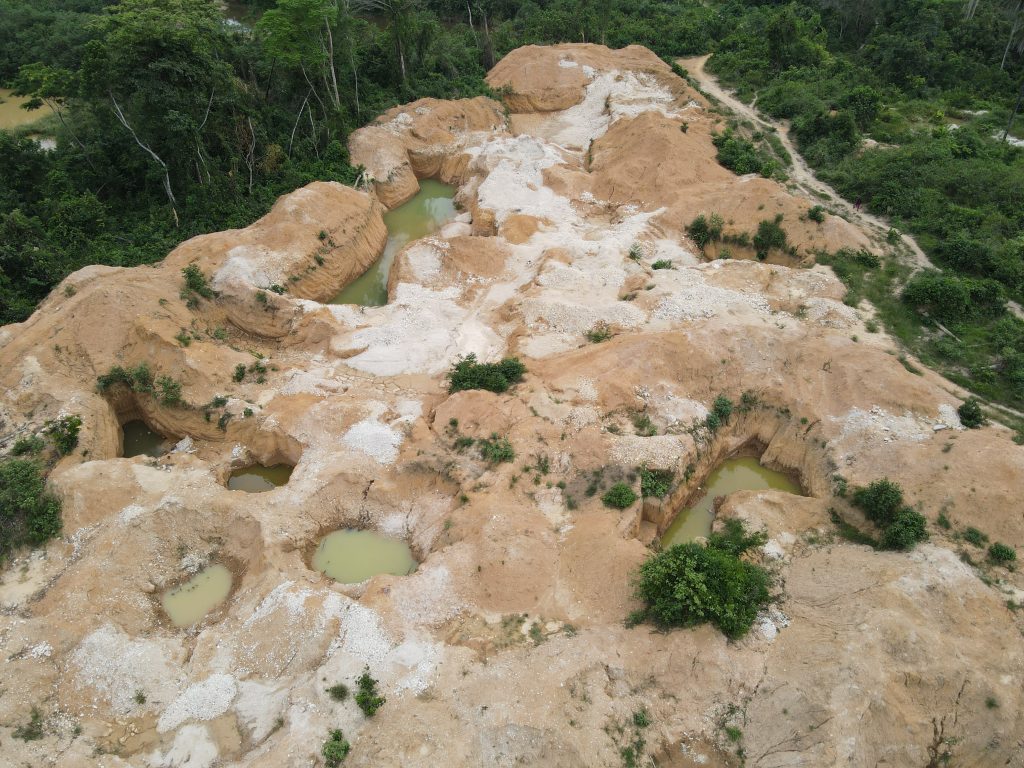
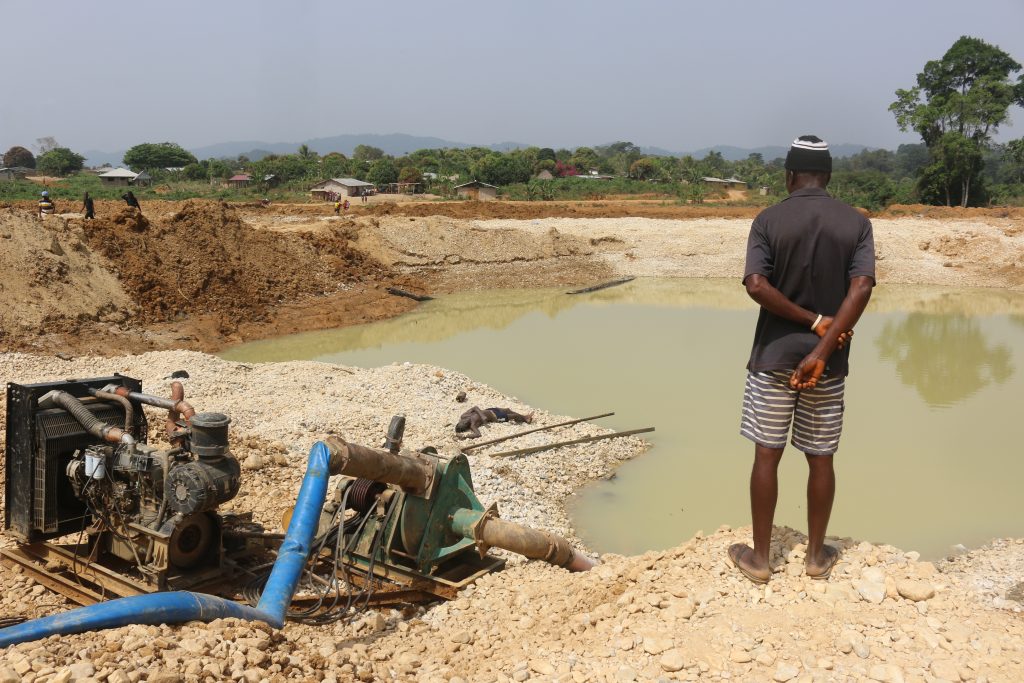
Reporters documented several holes J.M. Mining Company dug and failed to refill. The once-thick, forested area has been transformed into a hollow-out wasteland of open, giant-sized pits.
‘People really cried’
Bassa Boy’s grave lies a few minutes’ walk away from the pit in which his life ended. Next to his grave are those of two miners, only identified as Tamba and Timaya. The three were unlicensed miners, or “gold boys,” who followed abandoned mining trails. Gold boys either utilize abandoned pits or dig their own, in a relentless hunt for gold. Like rogue companies, they are responsible for degrading the landscape of the countryside and polluting watercourses that communities use for drinking.
Abandoned mining pits on Success Camp in Massawo Town, Lofa County, where several miners died. The DayLight/Samuel Jabba
Short, bright in complexion, and 30-something, Bassa Boy arrived at Success Camp a few years ago. He always wore a beanie like the ones sported by the late American singer-songwriter Marvin Gaye.
“I was not here that Saturday. When I came, they informed me that he had left in the water. People really cried, including me,” recalled Agnes Gibson, a townsperson.
The grave next to Bassa Boy’s is the final resting place of a miner who went by the alias Timaya. Nicknamed after the popular Nigerian Afrobeat star Timaya, he was an average-height young man. One evening, while he and two others were working, he fell into a pit. His friends sought help but were unsuccessful and watched painfully as he drowned.
The third victim, Tamba, a black and tall man who also repaired mining equipment at Success Camp, died late last year. A pile of loose gravel had fallen on him while operating an earthmover. He had his residence in Massawo Town and was a regular “gold boy” contractor between mines, townspeople said.
“All the gold boys don’t stay long in one place. They can come to hustle and go at any time,” Gibson said.
Reporters witnessed firsthand victims’ graves with red earth piled over them. No stones were placed around the graves, like in the traditional rural way. Only wreaths made of palm leaves and sawgrass were placed at the head of the graves.
Massawo locals are sympathetic towards the strangers who came to make ends meet and ended up being buried here. In rural communities, drowning and other natural accidents are believed to be a bad omen, even worse with unnamed victims. To vanquish the misfortune, they are buried outside regular graveyards.
“All three of them, nobody has seen any of their families since they died. When they (miners) come here, they don’t call their real names, so it is difficult for their families to know when they died, Gibson told reporters at the gravesite.
“We feel bad,” she added.
Reporters documented another graveyard on Success Camp, which hosts a lone grave. It is the final resting place of a miner only identified as Prince. It lies about a 15-minute walk from the graveyard, where Bassa Boy, Timaya, and Tamba were buried.
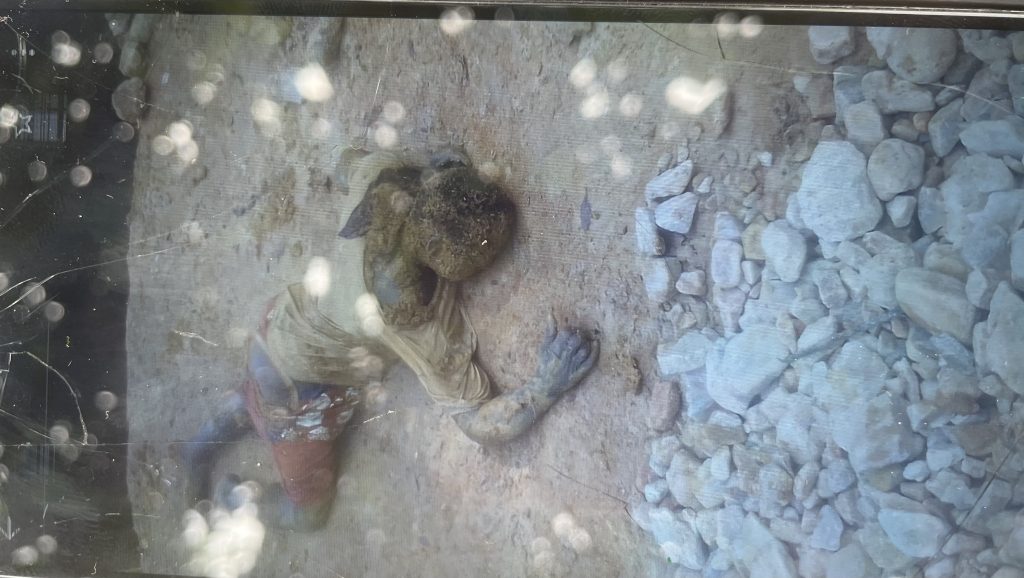
The body of an unfortunate miner, only identified as Prince after it was recovered from a mining pit in Massawo, Lofa County. Picture credit: Town Chief Junior Wolewu
Prince met his death due to a mining accident on this New Year’s Eve. Dirt fell into a pit he was digging at night, killing him. The deceased’s friend, who was the only other person there, was unable to rescue him. The sheer depth of the pit and the weight of the gravel overwhelmed the one-man rescue party, according to Wolewu.
“A 15-man jury examined his body, and police came from Salayea to see the body. From there, we buried him in the same mine,” added Wolewu. Pictures captured by townspeople, The DayLight obtained, show the unfortunate Prince lying on a makeshift, wooden stretcher just before his burial.
Papay Kpannah, the fifth—and only identified—miner, died in 2021 or 2022 elsewhere in Kpeteyea Town, Salayea District, where Golden Trip Group Limited, another company owned by Randy Scott, operated. Kpannah was a citizen of Kpeteyea but spent almost all his life in Monrovia. He had returned home in search of a job. His grave lies on the outskirts of Kpetayea, at the edge of a cocoa farm, marked with a stone circle.
Golden Trip was established in April 2018, with 75 percent shares for Chinese national Chein Haibin and the rest for Scott. It started operations in Kpeteyea by May 2020. In 2024, the Ministry of Mines and Energy placed its license on hold and later canceled it for noncompliance, about two years after Kpannah’s death.
Like the other victims, dirt from the top of a Golden Trip pit in which he was working fell on Kpannah. George Vesselee, the late Kpannah’s relative, said there were excavator bucket impressions on his body. It was unclear whether the machine operator tried to rescue him.
“He was working with the Chinese man that Golden Trip assigned to the excavator. What we heard was they were only two—he and the excavator operator. When the excavator removed the dirt, there was a piece of rock he went to pick… and the dirt… fell on him,” narrated Vesselee.
“When I received the information [of the accident], I came in and saw that he was still alive. They tried rushing him to the hospital, but he died along the road between Gorlu and Gbongay Town,” added Vesselee.
Failure to restore the land
The Liberian Minerals and Mining Law requires miners to restore the disturbed environment after operations. It calls for miners to report deaths and injuries, consistent with the Decent Work Act.
However, that provision is not being enforced, leading to deaths from mines countrywide. In 2019, about 40 miners were buried alive in Tappita, Nimba County, in the worst mining accident in postwar Liberia. In 2024, several miners died in a mine collapse in River Cess County. Earlier that year, a mineworker drowned in an open pit in Belle Yalla, Gbarpolu County.
In 2024, a mineworker drowned in an abandoned mining pit in Belle Yalla, Gbarpolu County. The DayLight/James Harding Giahyue
Scott denies that miners died on any of his companies’ gold mines.
“It is not to my knowledge. Nobody died in the mine,” Scott told The DayLight in a phone interview. “You know how many years nobody worked down there? You know when we left that place? How will you be asking about three years ago?”
“Why will you blame me for something I know nothing about? I don’t know about holes, pits, or whatever you call them. I was the manager of J.M. Mining, and I don’t even know how that contract ended with the Massawo people, so I can’t take the blame for people’s deaths in the gold mine,” added Scott.
He also dismisses evidence that his companies abandoned mining pits in which four of the five miners died. He said his companies could not dig pits while they were working on mountains.
“Who can cover a mountain?” Scott asked rhetorically. “Is a mountain a hole?”
Though both Massawo and Kpeteyea are hilly communities, the videos and pictures reporters captured show large holes in the areas where J.M. Mining and Golden Trip operated. Some of the pits measure over 12 feet deep, with a network of pipes supplying water from a nearby river to the hilly mines.
[Samuel Jabba contributed to this story]
This content is produced by DayLight with support from the Embassy of Ireland through Integrity Watch Liberia. The DayLight maintained editorial independence over its content, which does not reflect the position of the Embassy of Ireland or Integrity Watch Liberia.
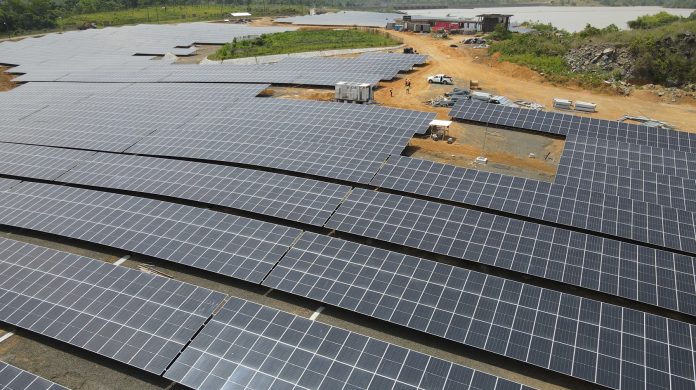
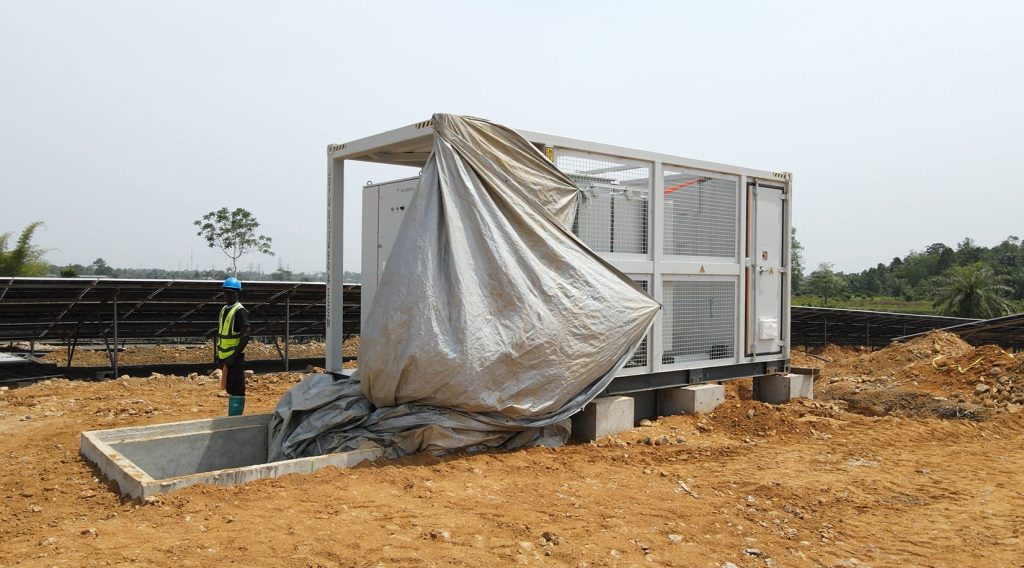
Top: A partial view of the solar farm in Mount Coffee, Montserrado County. The DayLight/Samuel T. Jabba
By Mark N. Mengonfia
BENTOL, Montserrado – Under the scorching sun in Mount Coffee, Lower Montserrado County, rows of nearly 40,000 solar panels stretch across rocky ground. Liberia’s first-ever solar farm is part of efforts to reduce carbon emissions, strengthen electricity supply, and transition toward renewable energy.
The facility’s 40,000 solar panels produce 710 watts each, along with 52 inverters connected to stations and substations that transfer electricity into the national grid. Crushed rocks spread across the facility help trap and redistribute heat energy to support power generation efficiency.
The 20-megawatt facility, funded by the World Bank under its Regional Emergency Solar Intervention (RESPITE) project, is expected to increase Liberia’s energy generation capacity by 15 percent, while reducing the country’s dependence on heavy fuel and diesel-powered electricity generation.
“I think we have a great opportunity to improve our energy capacity and the economy. All we need is to muster the courage and work hard for it to happen,” said Dominic Gono, RESPITE’s project manager.
Construction of the solar farm began in October 2024. Initially estimated at US$15.8 million, the project cost later increased by US$5.7 million because of additional operational and infrastructure expenses.
The first phase of the project complements Liberia’s hydroelectric power generation, supplying solar energy to Montserrado County and surrounding communities, particularly during the dry season when water levels at the Mount Coffee hydropower plant usually decline. It is already supplying electricity to the national grid, even as construction continues, Gono said.
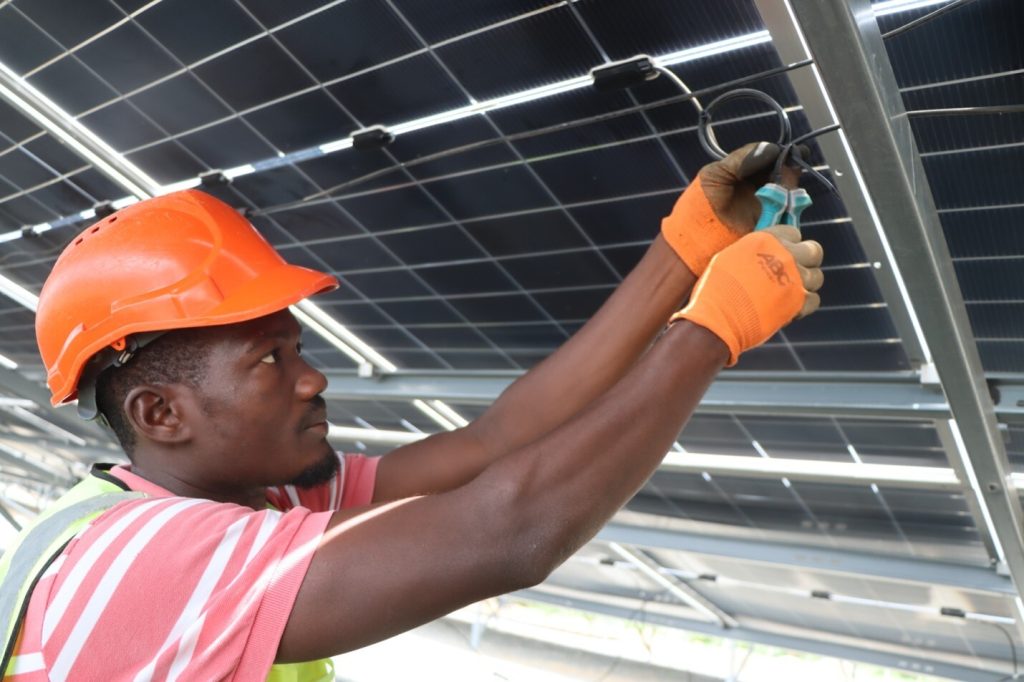
A technician installs solar panels at the Mount Coffee Solar Plant. The DayLight/ Harry Browne
It is also intended to enhance economic growth in Montserrado, an urban settlement with nearly 2 million people.
Ophelia Vah is a resident of the Mount Coffee community, a petty trader who sells water and beverages. She believes that solar energy would help them once it starts to power the national grid, mainly during the dry seasons.
“When the solar energy becomes stable, it will be a blessing to us and to Liberians in general because we will not be suffering from the heat,” she said. “With the coming of the solar system, we are hopeful the situation will change.”
The World Bank has described the Mount Coffee solar project as a significant public-private partnership capable of strengthening Liberia’s energy sector and accelerating economic growth.
Pascal Donohoe, a World Bank official, said the initiative demonstrates the type of energy investment the institution intends to support in Liberia.
“This project will serve as an example of the type of initiative and partnership that the World Bank Group aims to support in Liberia’s power generation sector,” Donohoe said, per the Liberia Electricity Corporation.
Liberia’s climate gains thus far
Valued at over US$21 million, it is also seen as a major step toward helping Liberia fulfill its international climate commitments.
Liberia has a moderate emission rate of 4.3 tonnes per capita per year, a level consistent with the climate action requirement, according to Global Climate Change data. Despite the country’s low emissions, it made commitments to the international community, or Nationally Determined Contributions (NDCs). It has committed to add 150 megawatts of clean energy to its national energy plant.
“If we want to implement our NDC, we have to go to renewable energy. That’s why that Mount Coffee project is important, but not only that project; we have smaller projects like the one at EPA,” said Dr. Emmanuel Yarkpawolo, the Executive Director of the EPA.
Emissions caused by fossil fuels—in coal, oil/gas and other things—hurt the climate and are by far the largest contributor to global climate change, accounting for around 68 percent of global greenhouse gas emissions. Scientists say greenhouse gas emissions blanket the earth, trap the sun’s heat and, subsequently, warm up and change the climate.
Another view of the Montserrado solar plant. The DayLight/Samuel T. Jabba
Liberia’s contribution to climate change is negligible, but, like other African countries, it bears the brunt of climate change, such as changes in rainfall, crop failure and coastal erosion. The country needs US$2.5-3 billion to fulfill its climate pledges, but it requires more financing and technology.
“Renewable energy is very important to Liberia and the global community,” Yarkpawolo said. “The traditional way of generating power through fossil fuels has been detrimental to environmental sustainability.”
Top: Dennis Broh of Nitrian Community files a complaint against GVL with the EPA as SDI’s Sampson Williams looks on. The DayLight/Harry Browne.
By Esau J. Farr
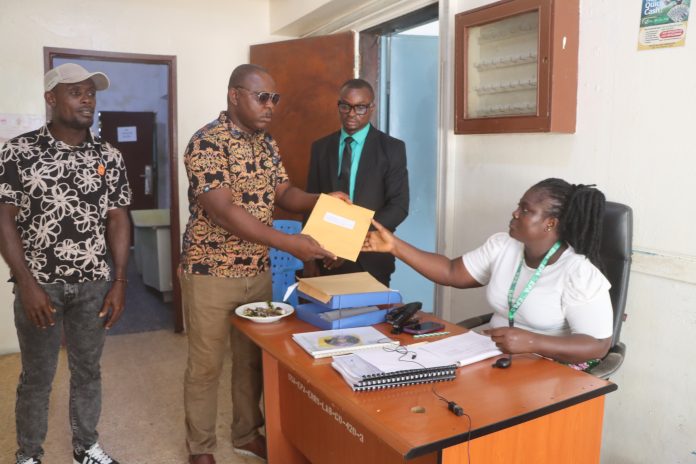
MONROVIA – The Nitrain Community Forest in Sinoe County has filed a complaint against Golden Veroleum Liberia (GVL) over alleged land grab and human rights abuses. Margibi-based NGO Sustainable Development Institute (SDI) filed the complaint on behalf of the community with the Environmental Protection Agency (EPA) in Monrovia recently.
“The Liberian government should ensure GVL restores the forests it has destroyed and provides measurable compensation for lands taken from communities without their consent,” said Dennis Broh, a Nitrain leader. “The forests of Liberia should benefit the people, not a company that treats the people and environment with contempt.”
The complaint alleges that GVL’s operations may violate several Liberian environmental laws. It called on the EPA to investigate and hold the company accountable. It accuses GVL of encroaching on Nitrain’s land, which it alleges violates the Land Rights Act and other laws.
In 2018, the Roundtable on Sustainable Palm Oil (RSPO) found GVL guilty of land grabs and other rights abuses in Sinoe. The RSPO mandated the Malaysian oil company to renegotiate with affected communities, but that has not happened.
Established in 2011, Nitrain Community Forest covers 958 hectares in Sinoe County. The DayLight/Derick Snyder
Like RSPO, the High Carbon Stock Approach, which focuses on deforestation and climate change, confirmed in 2021 that GVL cleared 1,000 hectares of forestland in Nitrain without locals’ consent. It mandated GVL to restore the cleared forest area, but GVL has failed to do so, according to the complaint.
Nitrain said it was tired of waiting for international watchdogs to speak on its behalf. Now was the time to take action nationally. However, the community urged the EPA to collaborate with the RSPO and the HCSA in redressing the matter.
“It’s no secret that GVL has destroyed Liberia’s rich forests, grabbed land from communities, and failed to deliver on its promises…,” said James Otto, a lead campaigner at SDI.
“Despite being ordered to restore 1,000 hectares of forests it destroyed, GVL has not complied,” added Otto.
GVL signed an agreement with the Liberian government in 2010 for 220,000 hectares of land for 65 years. The Indonesian palm oil company has the largest palm oil plantation in Liberia. Allegations of land grab and human rights abuses have marred its operations. GVL did not reply to queries for comments in this story.
Top: “Gold boys” operating in a mining pit deep into the forest in Salayea, Lofa County. The DayLight/ Samuel T. Jabba
By Samuel T. Jabba
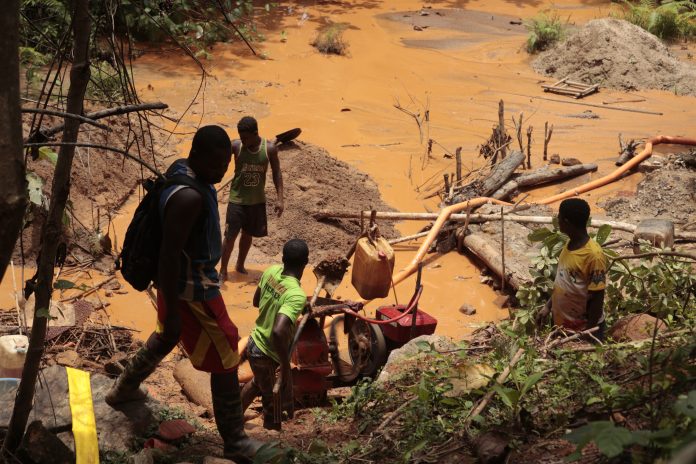
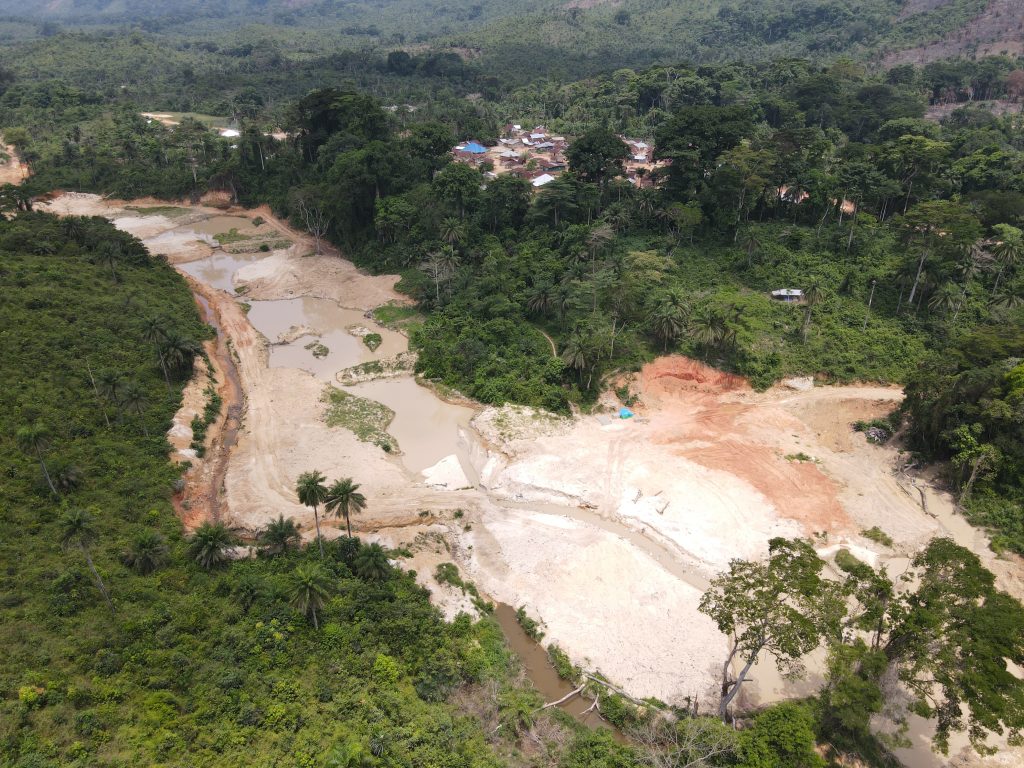
BETIBA, Lofa County — Illegal miners are destroying the Wologisi Proposed Protected Area, clearing the mountainous forests, polluting watercourses beneath it, and carving huge pits into the landscape in an unrelenting hunt for gold.
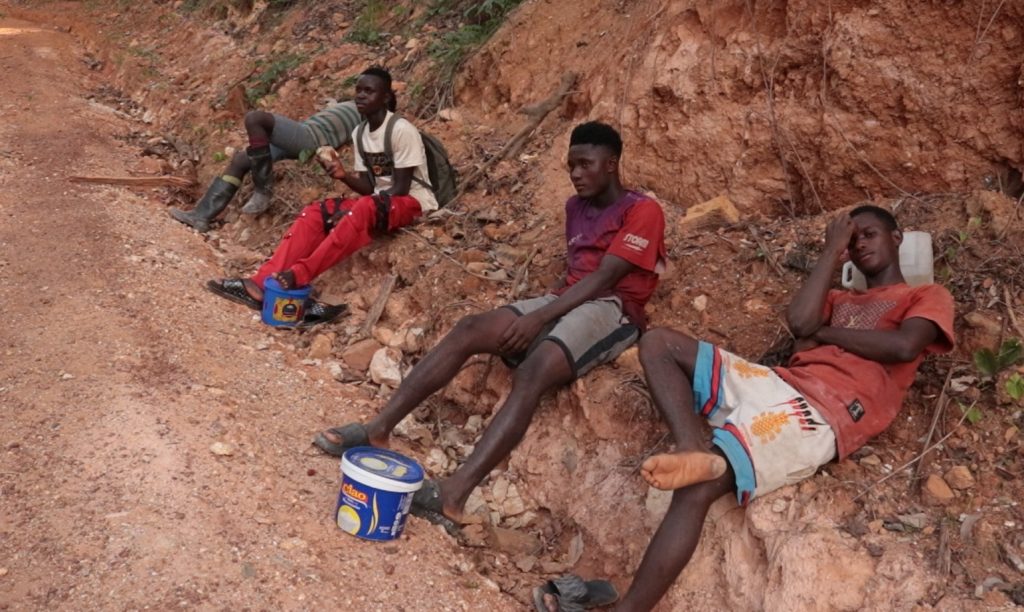
Amid the ongoing gold rush, unlicensed miners, known here as “gold boys,” say it is their only means for survival.
“The one that encourages me is because I’m getting my living from there,” said James Jallah, a 23-year-old gold boy and sixth-grade dropout. “I will not sit down, and be suffering, and there’s no work for me to do. I should go to the forest that has money.”
For the illicit miners, the Wologizi Protected Park is their fortress. They say they make a lot of money. Some of them own businesses and have built houses.
The illicit miners blame their situation on a lack of opportunity.
“We are mining in plenty of areas here. We get Betiba, we get Darbu, LISCO, Karza, all of them in this same zone. All those places are mining areas. We get more field here to hustle. That is, a lazy man can’t eat, so if I work a day, when God blesses me, I can buy you anything you want,” Sampson Fayiah
The Wologizi Proposed Protected Area is one of nine forests the Liberian government has designated as a reserve. Zigzagging the Wologizi Mountain, and measuring 99,538 hectares, it is home to various endangered species, including monkeys and chimpanzees. It is a part of a US$9 million project that aims to preserve the forest and enhance the use of its natural resources.
Despite these efforts, Wologizi faces a growing threat of deforestation and forest degradation. In 2025, Voinjama, which hosts the forest, lost 3,100 hectares of natural forest, according to Global Forest Watch, an online deforestation-tracking application.
Reporters witnessed this firsthand. Just at the edge of the forest, on a hill three to five minutes from Betiba, a large town beneath the Wologizi forest, lies a site locals call Umaru Field. A hub for gold boys, it hosts numerous illicit mining operations that involve forest clear-cutting, land degradation and pollution.
The illicit miners carved huge open pits into the earth, where they dig for gold. After washing the mineral, muddy water forms a polluted pond that flows into nearby streams locals depend on for drinking, fishing, and washing. Drone footage revealed a network of countless pits or “bogeyman holes,” as the gold boys call them in reference to the danger they pose to people.
When DayLight reporters asked how to address the water pollution, they said a company in the area is responsible for it. They said that they even have to carry drinking water with them to the fields, and that they expect farmers to do the same.
“The water is not giving me money, so how will I stop? What I want is money. “If money can come, that one,” I will stop the work, Jallah said.
For residents of nearby communities, the damage is already being felt, especially in Betiba. Once clear and promising, streams have turned murky, while the encroaching mining pits and felled trees threaten farmlands near the forest.
Picture of “gold boys” cooling off at a roadside after work in Betiba, Lofa County. The DayLight/Samuel T. Jabba
To curb these activities, the community land leadership set up a team to monitor mining activities in the region and apprehend illicit miners. The team visits various mines and contacts other communities on the issue.
“We are appealing to the government to put a stop to the illegal mining activities here,” said Yassa Smith Kullie, the Betiba’s land leader. “The Illegal mining is too much in our community. People have two to three mining fields, but when you ask them for documents, they will not show you any.”
Kullie’s claims are backed by evidence. Records from the Ministry of Mines and Energy show only four licenses in that region for two companies. Mining without a license in Liberia is punishable by a fine, a prison term, or both, upon conviction.
Drone image showing a muddy runoff in Kiliwu, Lofa County. The DayLight/Samuel T. Jabba
But not everyone in Betiba disapproves of the illicit mining. Some residents get their livelihoods from illegal activities. They no longer travel to Voinjama or other long distances to the market. To them, life with the miners is better than without them.
Betiba is a city in the middle of the forest. Businesspeople set up a market in the town hall located at the heart of the town. Clothes on sale hung on the wall, while household materials and foodstuffs filled tables. New houses built by gold boys adorned the town. Two small entertainment centers sell cold drinks and beverages. There is a local electricity facility with wires running through the town.
“We cannot have all this forest standing while people are suffering. We are poor farmers. We need help to make a living,” Sonie Supo, a leader in Betiba. “If the government wants us to protect the forest and doesn’t allow people to mine in it, let them give us US$50,000.”
Kullie, Betiba’s land leader, said that poverty could not justify illegal mining and environmental harm.
“If we continue to look at poverty and always behave this way,” Kullie said, “they will destroy all of our land, and when the resources are destroyed, they will leave the area empty.”
This story was produced by The DayLight with support from the Embassy of Ireland through Integrity Watch Liberia. The DayLight maintained editorial independence over its content, which does not reflect the position of the Embassy of Ireland or Integrity Watch Liberia.
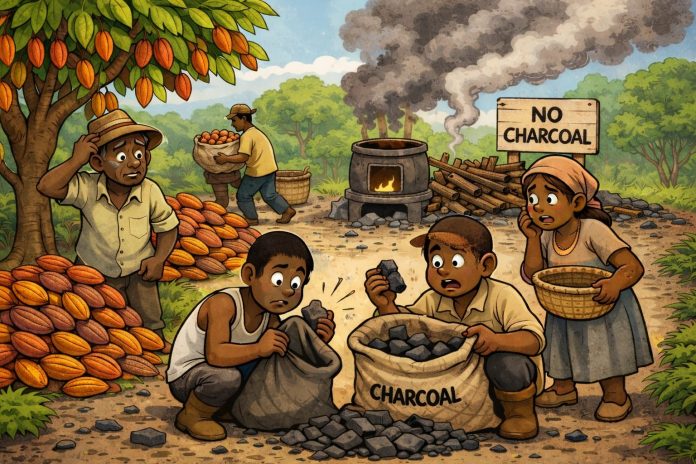
An AI-generated visual depiction of the charcoal crisis in Grand Gedeh County. The DayLight/Samuel T. Jabba
By Samuel T. Jabba
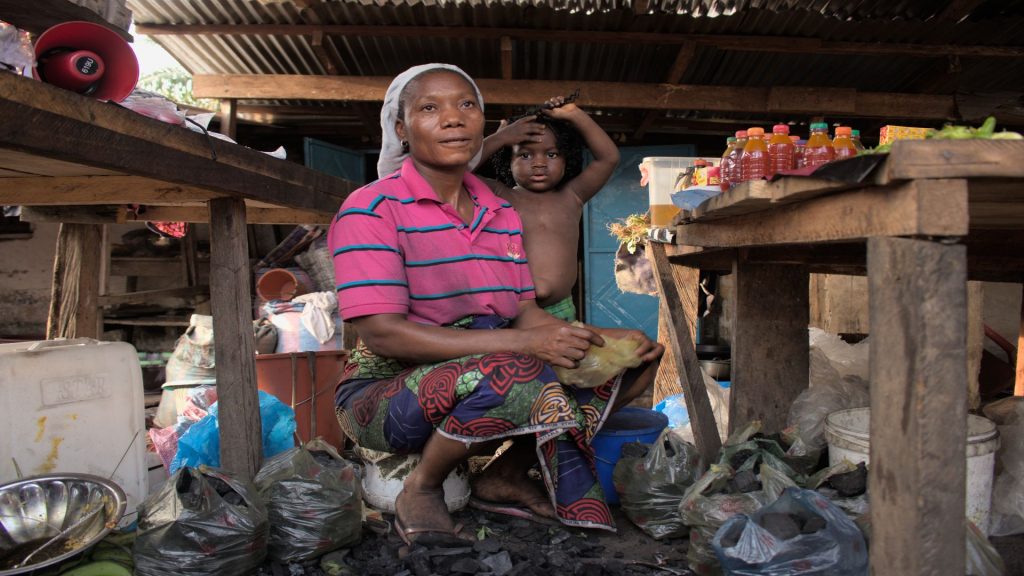
ZWEDRU, Grand Gedeh County – At any time five years ago, Josephine Nyenkor’s charcoal warehouse would be filled. She would have to stand on one bag of charcoal to reach the next.
Today, there is no charcoal in the warehouse, a concrete structure located in Zwedru’s main market. Several large bags filled with empty bags stand on the wall, and folded tarpaulins lie on the blackened floor.
“It’s just by the grace of God I am surviving. Selling charcoal is my only means for survival,” says Nyenkor, 41, who has sold charcoal for nearly two decades here.
“Charcoal used to give better profit but not [any longer],” she adds.
Nyenkor’s struggle reflects the impacts of the shortage of charcoal in Grand Gedeh County. For the first time, charcoal is in short supply, driving the commodity’s prices high. This is happening as Burkinabé migrants and local landlords are clearing the southeastern region’s vast forests to plant cocoa, forcing charcoal producers deeper into the forest.
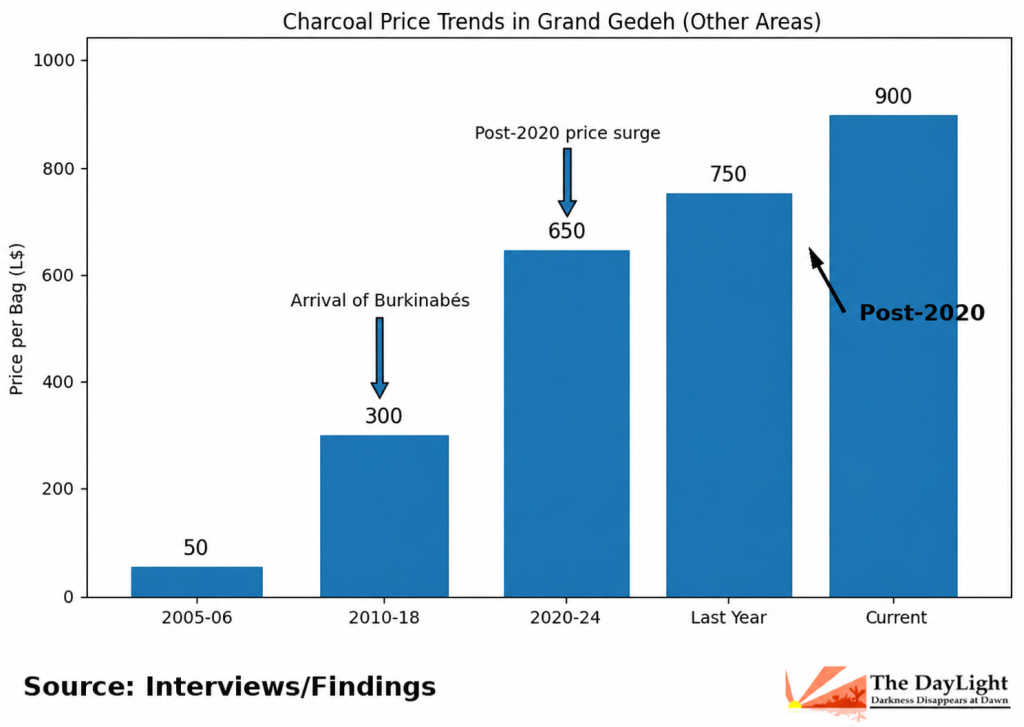
“In 2005 and 2006, we were buying a bag of charcoal for L$50. Today, charcoal is L$900, because of the deforestation,” says Marcus Toe, the executive director of One Health Advocacy Network. Toe works with local communities on health and the environment.
“Because the bush is being burned, you have to walk a far distance to get trees. So, the people who get them make them very expensive,” he added.
Burkinabés began migrating to Liberia from the neighboring Ivory Coast in the 2010s in search of farmlands. Once here, they entered an agreement with locals, who provided them with land. Immigration authorities recorded 55,000 Burkinabe migrants, with 48,000 in Grand Gedeh County alone.
Across Liberia, charcoal remains the leading cooking fuel and contributes to deforestation. Demand for it reached a record high in 2018, an estimated 337,000 metric tons valued at approximately US$46 million, according to a report by the Liberia Forest Sector Project.
Once a wholesaler, Josephine Nyenkor is bagging charcoal in a makeshift kitchen in front of her warehouse at the Zwedru market. The DayLight/ Samuel Jabba
However, cocoa cultivation has a larger impact on the forest. A 2024 study found that 15 percent of the deforestation in Liberia from 2001 to 2024 was driven by cocoa. During this time, Grand Gedeh lost 59,000 hectares of primary forest, according to Global Forest Watch, an online deforestation-tracking application.
Charcoal producers say Burkinabés aren’t giving them access to the forest, so they can’t produce the quantities they used to. They have to hire motorbikes to transfer charcoal from deep inside the forest, since cars cannot access the roads.
Margaret Ziahyee, a charcoal seller who shares the same warehouse with Nyenkor, confirmed this information.
“We will soon start using stoves to cook, because it is very hard to find trees to burn charcoal,” says Ziahyee. As she spoke, Daylight reporters saw a charcoal seller offload eight bags of the commodity from a motorbike at the front of her warehouse.
A chart breakdown of charcoal prices over the years in Grand Gedeh County. The DayLight/Samuel T. Jabba
‘Zero to hero’
Across Grand Gedeh, the price of charcoal has risen to its highest ever. Between 2005 and 2006, a bag of charcoal was sold for only L$50. From 2010 to 2018, with the arrival of the Burkinabés, a bag was sold for at L$300 to L$450. Then prices soared to L$650 by 2020. Last year, the price climbed to L$750 and L$800. Currently, a bag costs L$900, the same as in Monrovia.
Due to the energy crisis, community dwellers switched to stoves. Townsfolk are now crossing to the Ivory Coast to buy stoves.
“My sister, who has a tea shop, has one and is using it already. To even find charcoal is not easy. Even I myself parked my coal pots because there’s no coal, and the small we have is very expensive. I’m using wood now. In a few times from now, I will send for my own stove.” Alice Doe, a resident of Boundary Town, said in an interview.
Konobo is the leading supplier of charcoal to Zwedru, thanks to its vast forest, according to Toe. Charcoal burning was less expensive, and producers had less work in finding mature and suitable trees. Charcoal producers found it easy to find trees and haul their chunks.
But now, it is the fastest-deforested region in the county. Producers travel beyond cocoa farms to fell trees and spend more money on chainsaw operators and haulers.
Amid the crisis, charcoal is losing ground to cocoa farming because of the less work associated with cultivating the crop.
“At least the cocoa business that came here is helping some of us, from zero level to hero,” says Alice Doe, another former charcoal producer and now a cocoa farmer from Boundary Town in Konobo district.
“Yes, before we used to just go into the forest and start felling trees. But now, you can’t just go into the forest and start felling trees. You will damage someone’s cocoa farm. So, everything is under restrictions because of the cocoa farms,” said Doe.
Civil Society Independent Forest Monitors provided the funding for this story. The DayLight maintained editorial independence over its content.
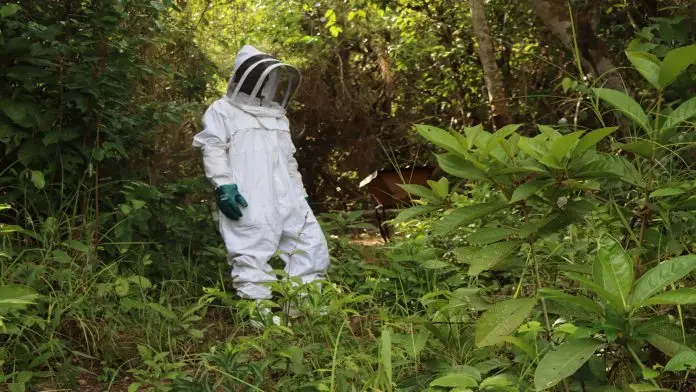
Titus Morlu, a beekeeper in Beyan Town, Salayea, visits one of his beehives. The DayLight/Harry N. Browne
By Esau J. Farr
SALAYEA, Lofa County – Back in the days, Titus Morlu hunted deer, raccoons and pythons. But in 2024, he put down his gun and trap and became a beekeeper.
Morlu no longer has to walk long distances at night to hunt animals, and he does not worry about contracting any diseases from his prey. He keeps bees in Beyan Town, in Lofa’s Salayea District, bordering Bong County, and expects his first harvest soon.
“For now, some of us have no interest in going to the forest to hunt or look for honey because we have [honey] right behind our vineyards,” says Morlu.
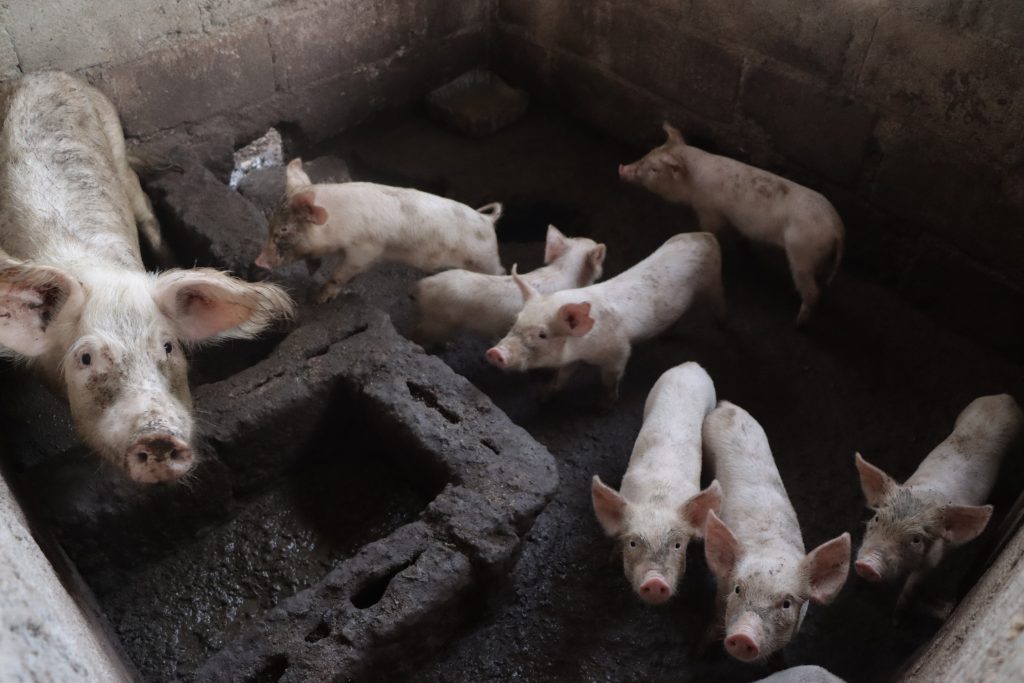
Like Morlu, Wolobah Nuapolor hunted in the Salayea forest for decades. When he learned of an opportunity to raise pigs rather than hunt deer and squirrels, he jumped on it. He now has 12 pigs.
The beekeeping and piggery projects are two of several programs the Salayea Community Forest is undertaking to provide alternative, sustainable livelihood opportunities for townspeople, aimed at reducing their reliance on the forest and protecting it. It also includes a wood shop, cocoa farming, village loan scheme, and guesthouse management.
A pigpen at a farm in Salayea Town, Lofa County. The DayLight/Harry N. Browne
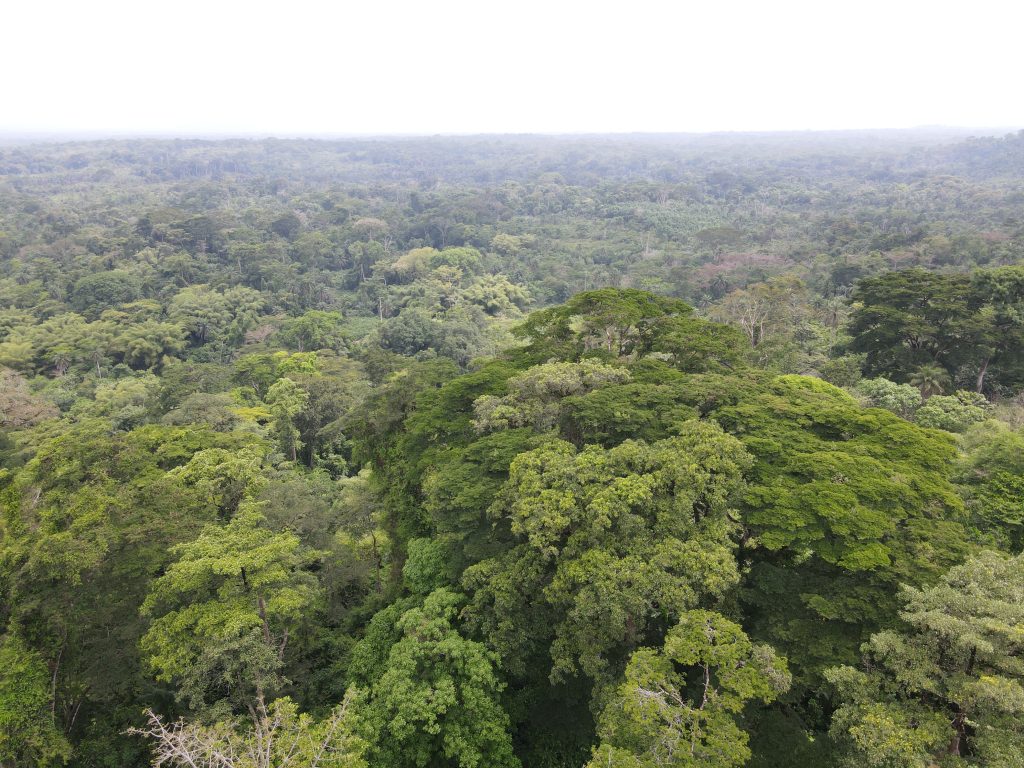
Established in 2016, the Salayea Community Forest is an 8,270-hectare conservation forest with rich biodiversity. The livelihood programs have impacted the forests at different levels. There is no more forest farming, as many have turned to lowland farming, animal raising and local businesses. Organizers say the project is intended to cut deforestation and forest-induced emissions.
“We are doing beekeeping, cocoa farming, village savings and loan program, and piggery in the six affected communities to fight against all forms of illegal activities in our forest,” says Yassah Mulbah, Salayea Community Forest’s chief officer.
“The village saving loan has empowered the women within the six affected communities in Salayea. They no longer receive credit from outsiders like in the past; their children are no longer being sent out of school for fees.”
A drone shot shows a partial view of the Salayea Community Forest. The DayLight/Samuel T. Jabba
‘A part of me’
In 2023 and 2024, Palladium Group, a UK-based NGO, trained people from the six communities that own the forest in different areas for two weeks. Beneficiaries of the piggery training received two pairs of pigs to begin their farming, while beekeeping trainees got beehives.
A team of DayLight reporters, which visited Telemu and Beyan Towns, observed that the beehives were ready for harvest.
Beekeepers in Salayea have chosen next month to harvest their beehives, all of which have colonized. The beekeepers want the community forest to help find buyers for their honey. One beekeeper told reporters that a liter of natural honey is sold for L$1,200 (US$6.66) in the area.
“I have decided to have my own beehives, about seven or eight, to help send my children to school and to help my family,” said John Tokpah, a former forest farmer-turned-beekeeper in Telemu Town, who has spent a year in the program.
“This (beekeeping) will be a part of me. I will not let it go from me.”
The piggery program is a little faster than the beekeeping program. It has already begun providing income for beneficiaries.
The piggery program recruited more than a dozen people, including women in Beyan, Telemu, and Salayea Towns. It started with 12 pairs of pigs, which have now multiplied. Currently, there are 18 pigs at three functional pig farms.
The Salayea pig farm has been sold at least three times. Proceeds from those sales have been added to the community forest’s savings of over L$400,000 (US$2,222), according to Mulbah.
“We have been using some of the pigs for other programs here in Salayea,” says Wolobah Nuapolor, a piggery manager. “Even last week, we killed some and sold it and the money was put into the community forest’s account.”
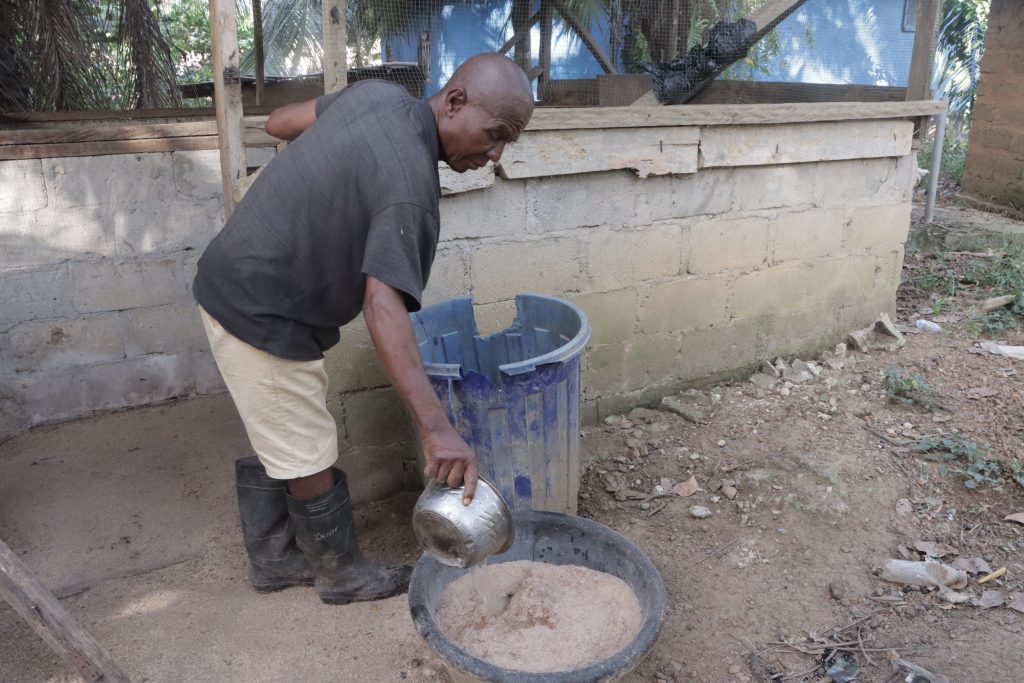
Wolobah Nuapolor, a piggery manager in Salayea, prepares food for pigs. The DayLight/Esau J. Farr
“When these pigs are plentiful here, our men will not be hunting in the forest,” says Nenei David, a pig farmer in Telemu.
In the next five years, Mulbah, Salayea’s chief officer, wants the community to be independent of the forest. Illegal activities in the forest have reduced since 2024, she says. This, however, was propelled by a string of legal victories against illegal occupants—farmers, miners and loggers.
“These livelihood programs will make Salayea Community Forest financially strong and put an end to illegal forest activities in the years ahead,” Mulbah says.
The story was a production of the Community of Forest and Environmental Journalists of Liberia (CoFEJ).