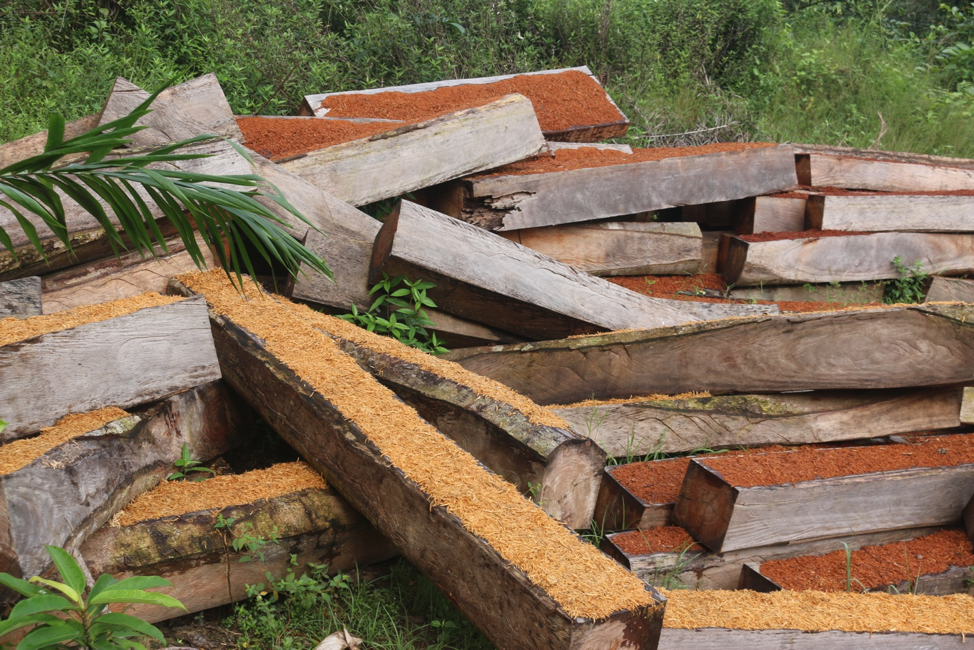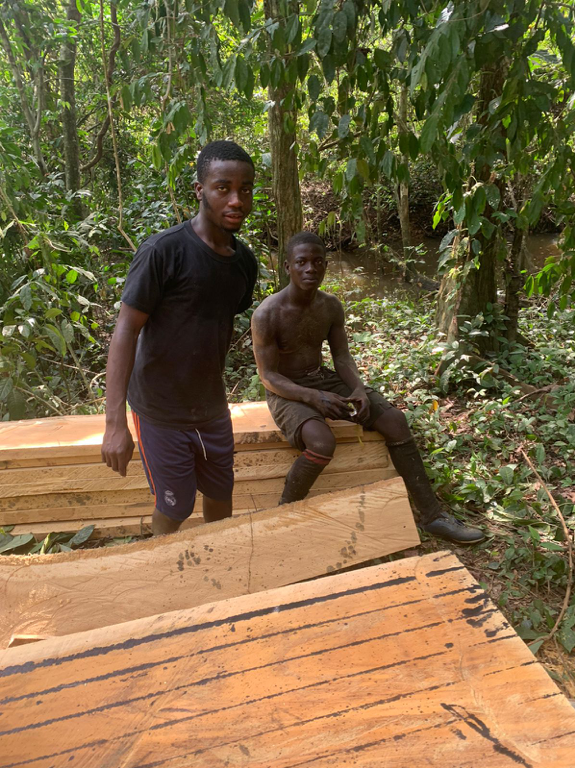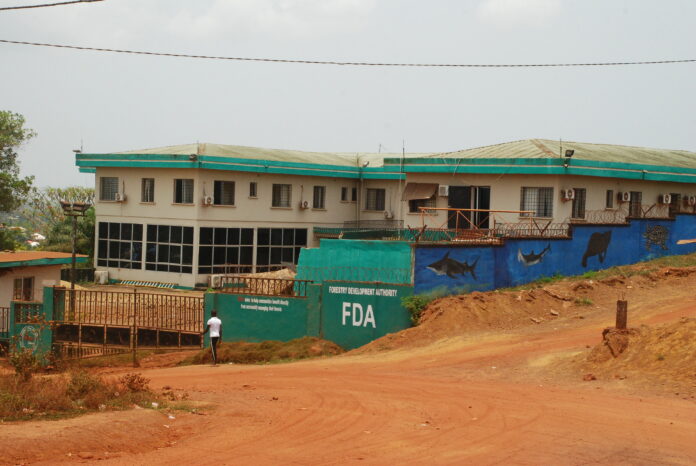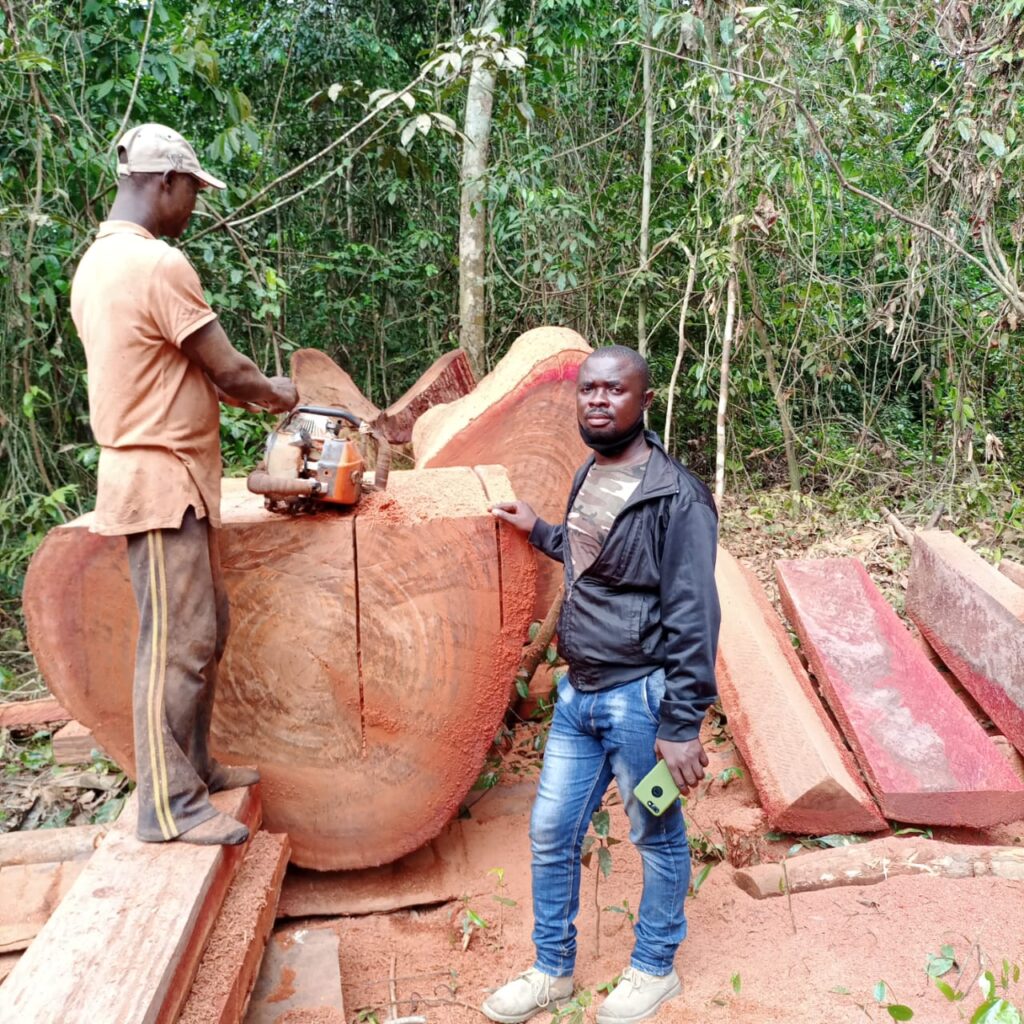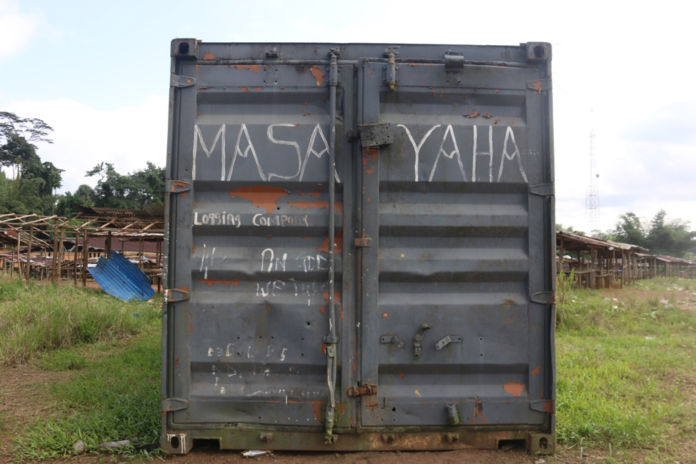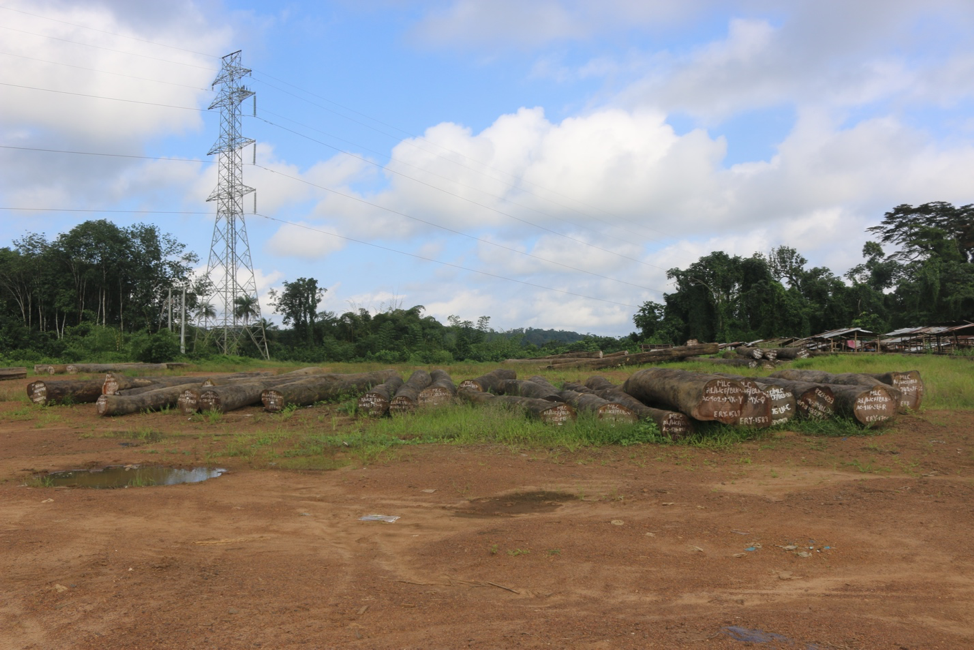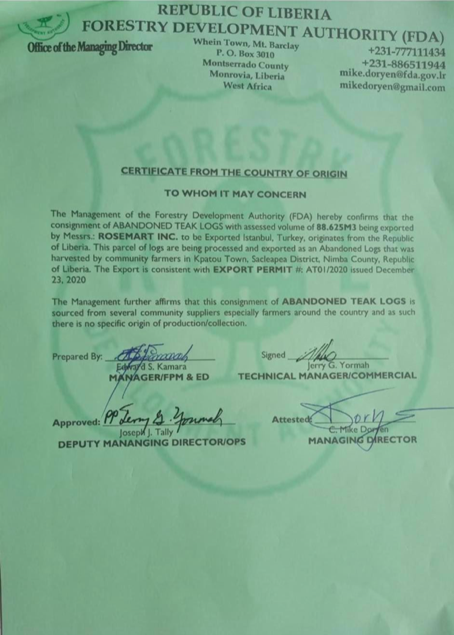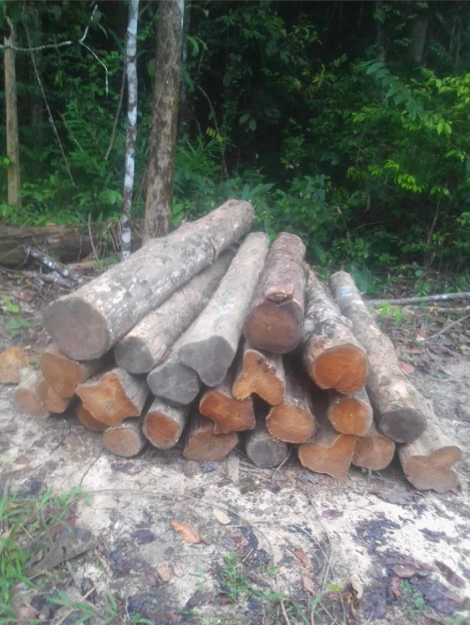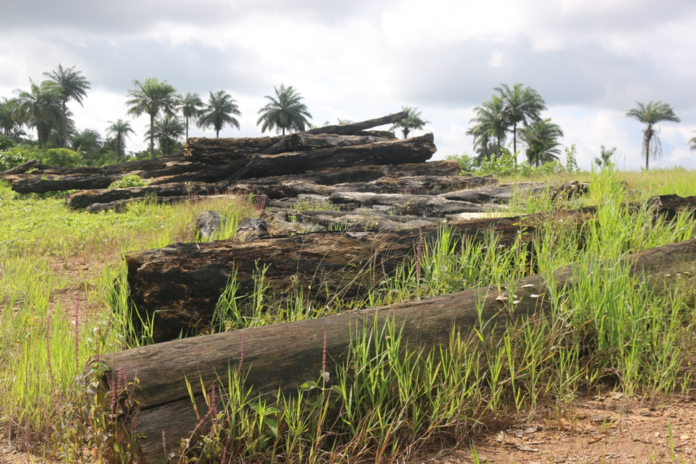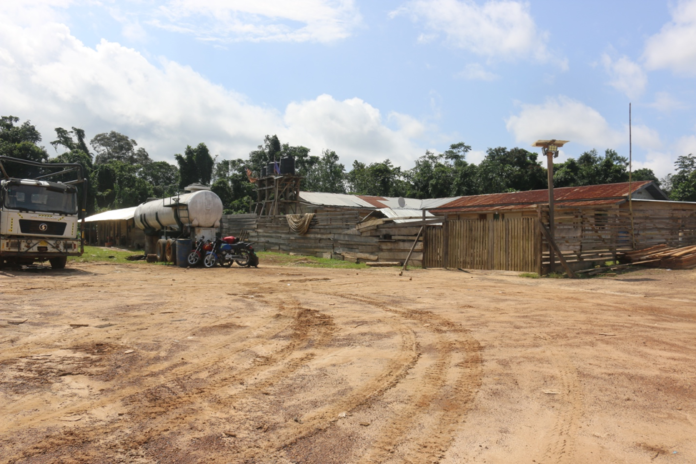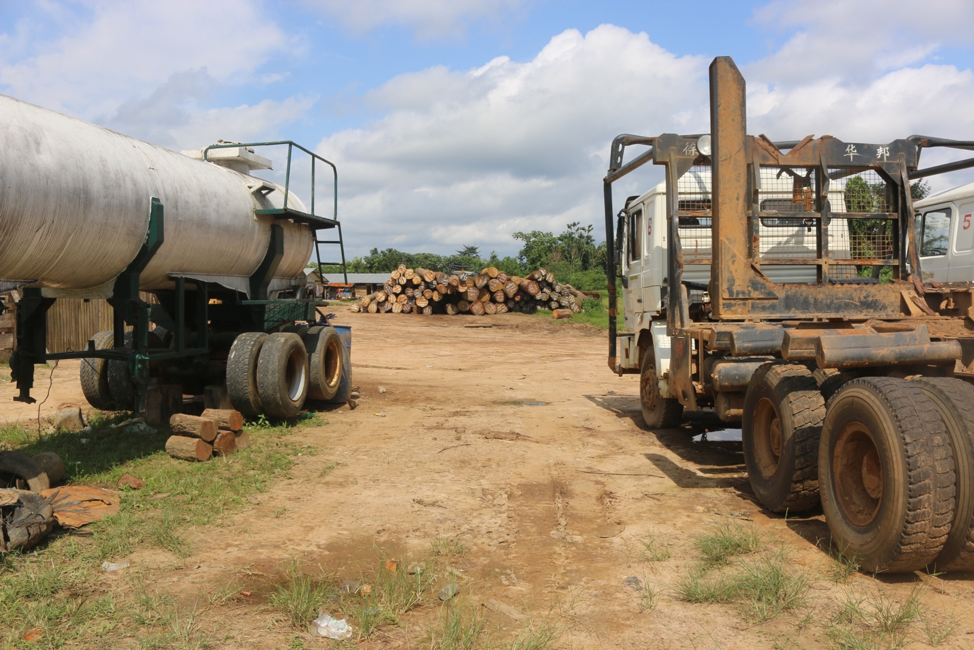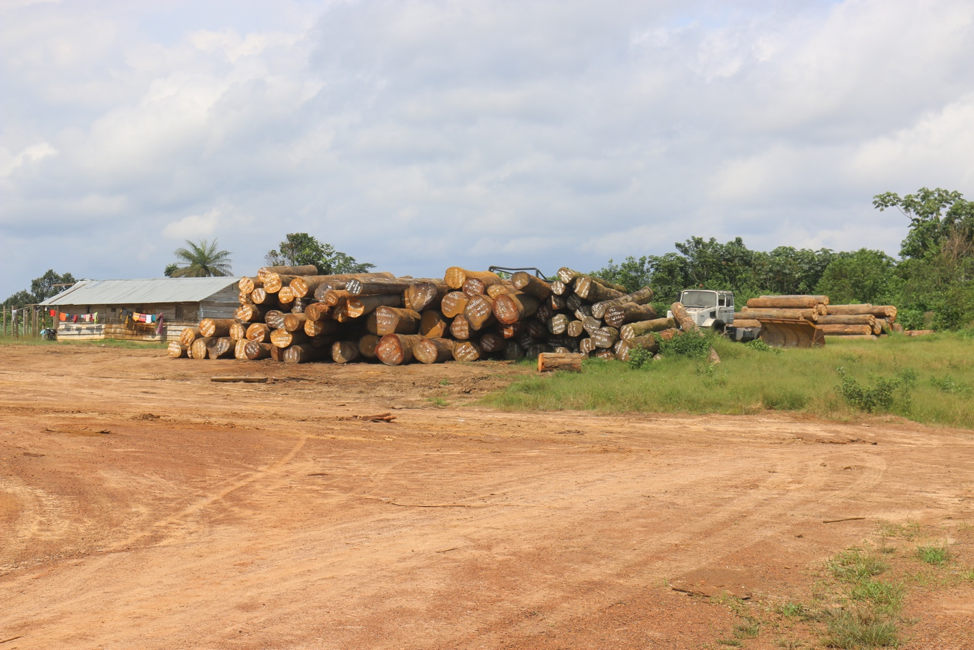
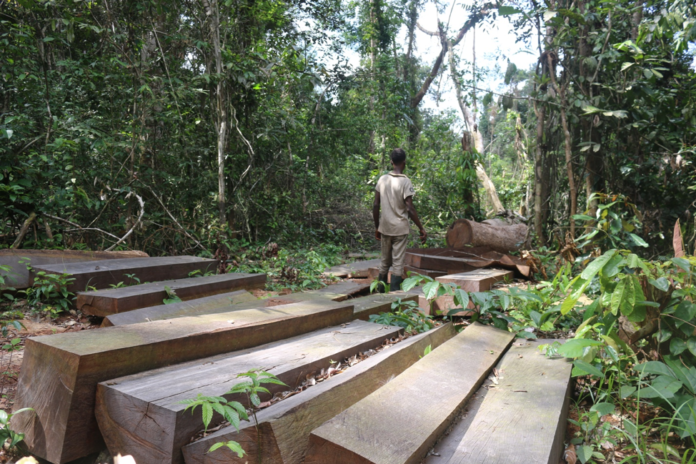
Top: Burned and decayed logs that were abandoned by African Wood and Lumber Company in Compound Number Two, Grand Bassa County. The DayLight/James Harding Giahyue
By Mark Newa
MONROVIA – The Liberian media may have lost up to an estimated US$63,250 over the failure of the Forestry Development Agency (FDA) to auction logs, timber and timber products abandoned by concession companies, according to an investigation by The DayLight.
Nearly every logging company in the country has abandoned logs—Masayaha, International Consultant Capital and Sing Africa Plantation Liberia Limited, just to name a few. They can be found in large and small-scale concessions, plantations and community forests across the country. Some are being used for firewood, charcoal, planks and defecation. Others have even been used as an insurance bonds in a lawsuit.
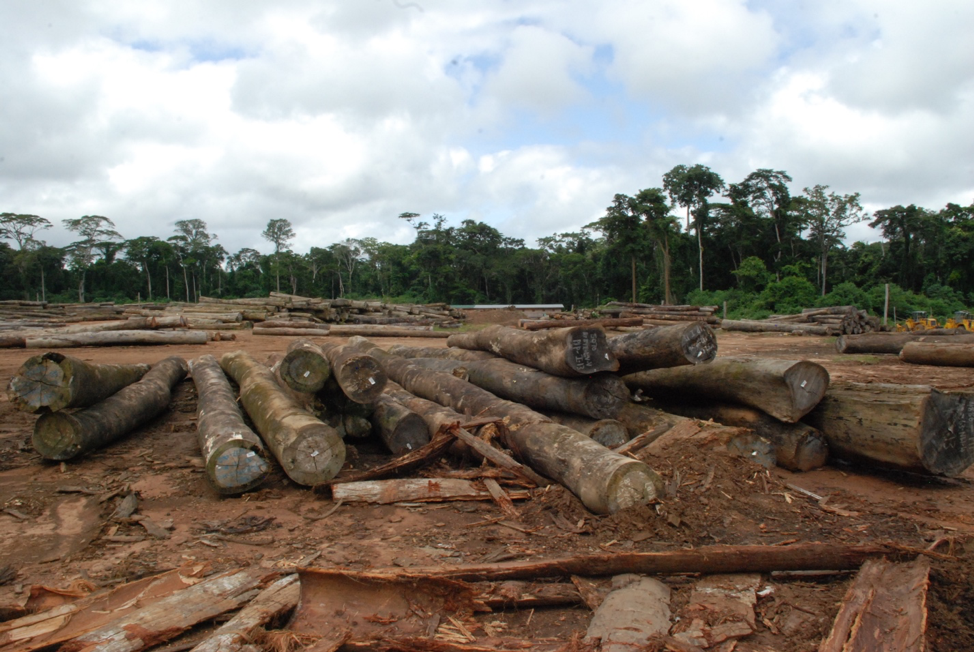
“Logging companies have left [a] huge quantity of assorted round logs unattended or abandoned at various bush landings and log yards over the years…,” an August 2020 FDA report, covering River Cess, Grand Bassa and Nimba, said. A bush landing is where logs are piled after felling, while they are stored in log yards to be transported for export.
“Valuable time species are continuously being harvested by logging companies without first securing sales contracts, only to leave those logs unattended,” the FDA investigators said at the time.
The Regulation on Abandoned Logs, Timber and Timber Products prescribes penalties for the offense, ranging from fines to forfeiture of forest licenses. But the FDA has not punished any companies or individuals amid plenty of evidence.
Under the regulation, logs are considered abandoned when they are unattended between 15 and 180 working days, depending on their location. It was created in 2017 to replace a previous one, which narrowed the definition of abandonment to logs outside contract areas and without tracking numbers. It was the country’s response to the demands of the global timber market for legal and sustainable logs.
The current regulation mandates the FDA to make a number of radio announcements and publications in newspapers—from a notice of abandonment to a public auction and to the declaration of the winner of the auction. So far, not a single one has been done in the five years of the regulation.
To arrive at the estimated total loss, The DayLight used US$100 for the average cost of a quarter-page newspaper publication and US$5 for a radio announcement, based on our analysis of advertisement rates. We multiplied those costs by the 22 newspaper publications and 66 radio announcements required by the regulation. And then we added the two products. That gave us US$2,530 the income for the media on a single auctioning process. Then we multiplied that by 25 incidents of abandoned logs, judging from the cases we have flagged, those reported by the FDA itself and others, to get the US$63,250.
But there is a possibility that some of these cases would not have made it to public auctioning, as some of the logs had decayed and some could have been redeemed and there could have been no bidder. In the case of redemption, the media would have generated just US$2,500 from all 25 processes. And if no company bided for the woods in all the cases, the media would have generated US$45,750.
The amount could help cash-strapped media institutions meet challenges that have undermined the fourth estate’s role as watchdogs, and promote things like free speech and giving voice to victims of human rights abuses.
How the media benefits
Some of the logs Sing Africa Plantation Liberia Limited abandoned at its sawmill in Zorzor, Lofa County. The DayLight/James Harding Giahyue
When the FDA is notified of suspicion of abandoned logs, the regulation requires it to investigate for seven working days and inform the company or the community leadership of the forest. Logs left in the forest are considered abandoned after 15 working days, and 180 for the ones in log yards.
If a company or community claims the logs, then the FDA must publish administrative fees it incurred during its investigation—including transportation, storage, and the cost of the publication, for example.
But if no one claims the logs, the agency is required to publish a notification of abandonment in a newspaper for five days and announce the same on local and national radio stations for 14 days.
Once it finds out that the logs are abandoned, it must announce its findings on national and local radio stations for another 14 days.
If a claimant does not come forward or prove they own the logs, the FDA must publish a notice of abandonment in a newspaper for five days.
Thereafter, the FDA is mandated to seek a court order to auction the logs. When that petition is granted, it is required to publish an auction notice in a newspaper at least once for five days. It must run that same announcement for the same period on national and local radio stations.
The last round of mandatory publication is the announcement of the result of the auction for seven days in a newspaper.
Top: Masayaha’s camp in Saul Town, Grand Bassa County. The DayLight/Emmanuel Sherman
By Emmanuel Sherman
Editor’s Note: This is the third part of a series on a string of illegal activities by Masayaha Logging Company, which operates in Grand Bassa County.
SAUL TOWN, Grand Bassa County – Villagers affected by the operations of Masayaha Logging Company in Compound Number One B have halted the Lebanese firm’s work, demanding it pays some of the benefits owed them.
Masayaha owes the 25 towns and villages affected by its operations for use of their land, logs it has harvested, and scholarships.
“We will not allow any log to leave until they do what they supposed to do,” said Garsaweh Harris, the community leader who led the protest over the Worr Community Forest.
“I told them, I have four big cows and they are there protecting the forest no one can go there,” Harris said, hinting at the use of bushmasters, commonplace in traditional settings.
Ali Harkous, Masayaha’s owner and CEO, did not return questions we posed to him via WhatsApp for comments on the matter.
Magna, the initial contract-holder signed a 15-year agreement with the Worr Community Forest, covering 33, 337 hectares in 2019. It seemingly subcontracted the forest to Masayaha. In total, it owes the villagers US$34,025.767, according to The DayLight’s analysis of the company’s official records, and the community’s leadership. Magna’s owner and CEO Morley Kamara declined to speak on Masayaha’s operations.
The villagers demand payments of the fees and dozens of mandatory projects.
“We told the company that the scholarship issue was very important because the children are not in school,” said Alvin Fiske, the head of the community’s leadership. “Parents are coming to ask for their children’s tuition.”
Masayaha has performed even worse with projects than it has defaulted on payments. It has failed to pave and build a number of roads and bridges, handpumps, clinics and schools in affected towns and villages.
“The company will make promises and will not do it, this is the problem we have with them,” Fiske said, adding the majority of the company’s projects have not been completed.
“They built… a school opposite their office, which is not completed. They built one handpump in Saul town and one in Bettoe Town and that is about all.”
Logs Masayaha harvested from the Worr Community Forest. The DayLight/James Harding Giahyue
The agreement has been very controversial, with a string of illegal logging activities since. The FDA has failed to enforce forestry laws and regulations, approving the company’s harvesting each year.
Between 2020 and last year, Masayaha cut trees outside its contract area, according to the FDA and Société Générale deSurveillance or SGS, a Swiss firm, which created Liberia’s log-tracking system. The DayLight interviewed chiefs and elders who helped the company illegally harvest ekki woods outside its contract area. We visited Masayaha’s illegal felling sites, with felled trees, leftover logs, and earthmovers’ trails still visible.
FDA permitted Masayaha to ship logs that could have included the stolen, ironwoods, export records show. Between 2020 and last year, it exported 365 logs, 360 of them ekki woods.
“We did not have a problem going outside but why use our name and we are not befitting anything from it? That is our problem,” says Fiske.
Regulation on Confiscated Logs, Timber and Timber Products provides that FDA should seek a court order to confiscate and auction the illegally harvested logs Masayaha cut outside its contract area. It should fine the company two times for the first offense, and four times for repeated offense, the prevailing international price of the volume of logs it harvested in 2020 and 2021 respectively.
While Masayaha cut trees outside its contract area, it abandoned 595 logs it felled within the area, according to our count of the company’s production and export records. We counted 200 logs in an open field near the Bokay Town market on the Monrovia-Buchanan highway.
FDA has not taken any actions. The DayLight followed up at the Circuit Court in upper Buchanan, Grand Bassa, the county in which the illegal logging was done, the agency has not sought a court order to confiscate Masayaha’s illegally harvested logs.
Under the Regulation on Abandoned Logs, Timber and Timber Products, logs are deserted if they are left unattended for between 15 to 180 working days, depending on their location. FDA has also not acted, as there has been no petition at the circuit court in Buchanan nor announcement of abandoned logs at any radio station in the county, things the regulation demands.
Joseph Tally, FDA deputy managing director for operations, did not respond to questions sent to him via email on the protest action against Masayaha by the community.
Masayaha owes communities affected by its logging operations thousands of United States dollars. The DayLight/James Harding Giahyue
In Saul Town, the villagers halted Masayaha’s operations, stopping three trucks loaded with logs from being transported out of the community. It took a team of anti-riot police to end the daylong demonstration.
This reporter visited the scene of the riot last Monday and met the protesters under a palaver hut discussing their next course. Some appeared disgruntled, raging with anger.
“They got so angry. Imagine I got a problem with my heart but I walk [a long] distance to join the protest,” said Sarah Harris, a resident of one of the affected towns.
The community and the company had a meeting on Wednesday but did not resolve the problem in full according to Harris.
Masayaha pleaded to transport its logs, promising to build five bridges, according to Harris, but he and the other protesters said they would only negotiate with the company after the construction.
“We don’t have money to take the company to court,” said Harris. “This is the only power we have.”
This Story is a production of the Community of Forest and Environmental Journalists of Liberia (CoFEJ).
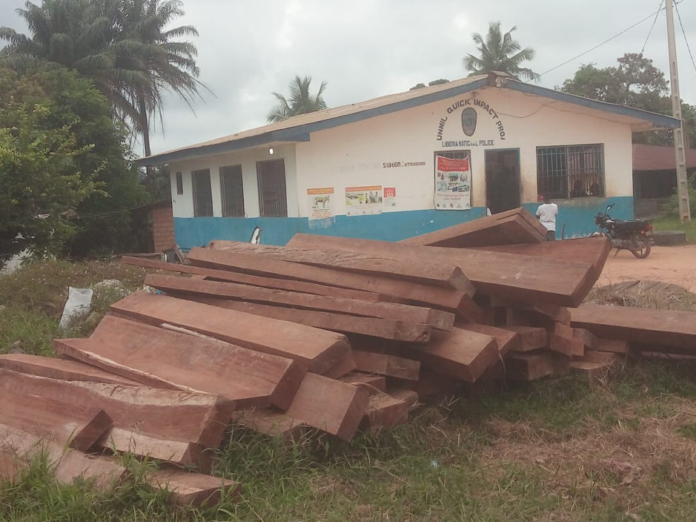
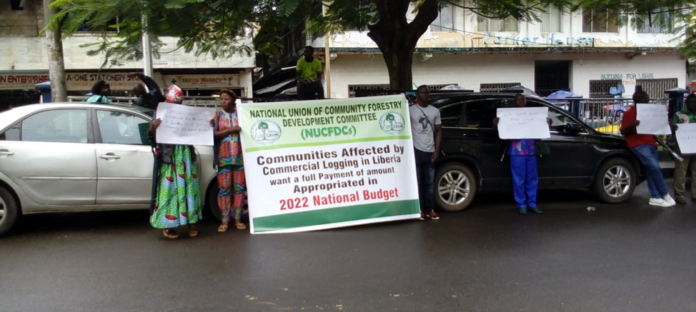
Top: Members of the communities affected by logging concessions protest before the Ministry of Finance and Development Planning in Monrovia. Daily Observer/Tina Mehnpaine
MONROVIA – Communities affected by logging concessions across Liberia have staged a sit-in action in demand of over US$5 million in land rental the government of Liberia owed them, the second year in a role for such protest.
The protesters gathered before the Ministry of Finance and Development Planning with placards. The group consisted of the leaders of logging-affected towns and villages under the banner of the National Union of Community Forest Development Committee (NUCFDC).
By law, 30 percent of land rental fees the government collects from companies should go to communities. The fee is the product of the total size of the concession, US$2.50 for large-scale forest management contracts (FMCs), and US$1.25 for small timber sale contracts (TSCs). However, the payments have not been regular since 2017.
“Our people are affected every day by these companies and the only way to give us some relief is by paying us our percentage. So we demand our benefit, ” said Andrew Zelemen, the national facilitator of the NUCFDC.
Zelemen added that the protest would continue if the government fails to provide the money allotted in the budget was not paid by the end of the year. NUCFDC represents logging communities from Lofa, Gbarpolu, River Cess, Nimba, Grand Gedeh, Sinoe, River Gee, Grand Kru and Maryland. Grand Bassa, Grand Cape Mount and Gbarpolu counties complete the list.
Those debts amounted to US$5.5 million between 2007 and 2019, according to a report by Forest Trends, an American NGO promoting sustainable forest management.
Last year, the government paid US$200,000 after the communities protested. It allotted US$2.7 million in the current National Budget for the payment but barely three months before the end of the fiscal term, it has only paid US$500,000.
Janga Kowo, the Comptroller General of Liberia, said on OK FM Thursday that the government would pay another US$1.5 million.
A recent report published by the National Benefit Sharing Trust Board shows that delayed payments have stalled projects in communities.
“Political commitment is weak despite some positive actions taken by the government in responses to pressure from stakeholders,” the report said.
This story was produced in collaboration with the Daily Observer.
Top: Othello Teah, “the regular caller” who has become an illegal logger. The DayLight/James Harding Giahyue
By James Harding Giahyue
COMPOUND NUMBER TWO, Grand Bassa County – A man who calls on nearly all talk shows in Buchanan, Grand Bassa County, is involved in an illegal logging business with at least one villager and the proprietor of the port city’s most famous woodshops, an investigation by The DayLight has found.
Othello Teah, the regular caller, produces timber, commonly called “kpokolo,” a form of illegal logging that is ravaging Liberia’s forests and undermining authorities’ quest to increase logging revenues.
This reporter saw 25 pieces of thick, square woods by the roadside in Boyeah’s Town in Compound Number Two ripped by Teah. Joe Jarvis Boyeah, a villager who he hired, told The DayLight the deal was between Teah and an unnamed farmer.
That information was corroborated by other townspeople we interviewed, including Joshua Gbar.
“The town doesn’t have a share in it,” Gbar said, adding that was the first of such operation in that area.
Teah admitted he runs the operation without a permit and first conducted it in 2019. However, he argued that he did not need FDA’s approval to produce the timber, which he wrongly considered planks.
“Any log that is placed in a dimension is pit-sawing. Two by two is a dimension. Two by five is a dimension. I know,” Teah, revered for his strong stance on issues in Grand Bassa’s radioland, said.
Some of the timbers Othello Teah illegally harvested in Boyeah Town, Grand Bassa County. The DayLight/James Harding Giahyue
Chanda Cole, Teah’s partner who is the proprietor of the Cole Joe Wood Work Shop in Buchanan—one of the oldest in the city—backs him. He said the timber was dahoma wood, a durable hardwood used in construction and boatbuilding.
“We don’t do permits from the government to buy and sell wood. We get a thing called business registration from [the Ministry] of Commerce,” Cole wrongly claimed. The ministry does not issue business certificates, the Liberia Business Registry does.
But apart from that, the operation of Teah and Cole violates forestry laws and regulations in several ways.
First, there is a difference between timber, which the pair is producing, and planks, which they falsely claim to be making, according to the Regulation on Establishing a Chain of Custody System. It sets the standard for sourcing, transporting, and exporting wood. It defines “timber is a sawn wood or log,” while planks or lumbers are the “products” of pit-sawn or chain-sawn woods.
Second, chainsaw millers are only permitted to produce planks, which are way lighter and smaller than the timber Teah had produced in Boyeah Town.
Third, chain-sawn woods can only be sourced from a concession area, authorized private forestland, and an approved community forest, not from an ordinary farmer.
And, in fact, chainsaw milling is illegal, as there is no current regulation for it after a previous one was dropped years back. It is being permitted to support construction works in Liberia since logging companies do not supply the local market. A regulation for the subsector has been drafted and is being reviewed by the Board of Directors of the FDA.
Inconsistency
Both Teah and Cole contradicted themselves on why they are harvesting the timber in Boyeah Town.
When we initially phoned Teah, he claimed that the woods were meant for the construction of a bridge in Compound Number Three. That was exactly what Joe Jarvis Boyeah told us. Later in an interview, Teah flipped that he was supplying a company. But when quizzed further, he said he was actually supplying Cole’s woodshop. That was the first time in days of discussions that he mentioned he had a business partner other than the farmer and Boyeah.
Cole continued Teah’s inconsistency. Teah had called him to convince this reporter that their business was not illegal. He, too, first claimed that the woods were meant for a company.
“We use it on the bridge, we use it on the machine to balance on it to work,” Cole said in an interview at his workshop. But he somersaulted as the interview progressed, claiming they were meant for his shop. One of the practices in chainsaw milling is that the wood must be sawn into planks in the forest, not elsewhere.
“Don’t change anything here, it’s pit-sawing,” Cole said. “Anything from two-inch up is timber.”
This investigation comes less than two weeks after The DayLight exposed a similar illegal operation in the Compound Number One area, conducted by a woman named Binta Bility. That report came after leaked videos and pictures of Varney Marshall, an FDA ranger showed he ran well-organized kpokolo operations, believed to be in Gbarpolu County.
Timbers that were illegally harvested in an operation conducted by Othello Teah, a “regular caller” in Grand Bassa. The DayLight/James Harding Giahyue
Zahn Dehydugar contributed to this report.
The story was produced by the Community of Forest and Environmental Journalists (CoFEJ).
Top: A tree, locals said, was felled by Masayaha Logging Company outside the Worr Community Forest. The DayLight/James Harding Giahyue
By Emmanuel Sherman
Editor’s Note: This is the first of a series on illegal logging activities by Masayaha Logging Company, which works in Grand Bassa County.
TARR TOWN, Grand Bassa County – Mid-last year, Masayaha Logging Company asked chiefs and elders of Doe Clan in Compound Number One to harvest expensive logs in their forest in order to build roads, handpumps and a townhall in that community. But the company wanted the deal kept a secret.
The villagers agreed with the terms, adding a fee of US$5 on each cubic meter of red hardwood used for railroad ties and bridges.
“We told them to connect the road from Tarr Town to Kpana Town because the people there are suffering,” recalled Daniel Tarr, one of the elders who brokered the deal. The next month, Masayaha begin felling some 641 cubic meters of the red ironwood, according to the locals’ record of the harvesting.
“The company wanted some ekki [woods],” added Junior Gueh, a townsman who also works for the company and helped craft the deal.
But the deal was illegal, as the forest adjacent Tarr Town is outside the Worr Community Forest Masayaha legally operates. It is one among a string of illegal operations the Lebanese-own firm has run in that region in the last two years, involving five towns. It has been documented that Forestry Development Authority (FDA) has taken no required actions against the company.
Masayaha has a 15-year agreement to operate the Worr Community Forest. Magna Logging Corporation, owned by Liberian businessman Moley Kamara, originally holds the contract for the forest but appears to have subcontracted it to Masayaha. The forest covers 35,337 hectares in Compound Number One B but the company traveled about 100 kilometers to the Doe Clan in Compound Number One A to harvest first-class logs. It said there were not many of that species trees in the Worr Community Forest, according to several villagers we interviewed.
An operator moves logs illegally harvested by Masayaha Logging Company in Garkpa Charlie Town, Grand Bassa County. Picture credit: Stephen Toomay
Mary Beeweh, an elderly woman in Zolah Town, told The DayLight the company harvested logs in the forest there in 2020. Beeweh said Ali Harkous, Masayaha’s CEO visited the town. Her description of a bald, bearded Lebanese man matches Harkous’ figure.
Masayaha also felled an unspecified number of logs in Lolo Town last year, according to residents. We told them ‘If you fix our two bridges here, we will give you the logs [you] want,” said Solomon Kpolon, an elder of that town. “The first was 17 logs but the second one they took it overnight we did not know about it.” This reporter saw some of the logs the villagers said Masayaha felled in the forest not far from the town.
In Vorlorgor, a village next to Tarr Town, villagers seized the company’s machines after it felled 17 trees, according to John Garbleejay, an administrator of that town. They later allowed illicit activities to go on after the company promised to pave the main route that leads into the community, Garbleejay said.
Harvesting outside a contract area is a grave violation in forestry. A company’s penalties for such an offense include a fine in United States Dollars upon conviction by a court.
There is evidence that the FDA has known of Masayaha’s illegal logging deals from its first known offense in 2020 but ignored them. The agency conducted an inquest in August that year on several logging violations in Grand Bassa, River Cess and Nimba, those of Masayaha. Investigators recommended an “appropriate action” against it but that has yet to happen.
And that, too, was not the first time the FDA heard about Masayaha’s violations and failed to act. Several months earlier in 2020, Reuben Barnie, one of the villagers, informed FDA about the incident. Barnie had spotted a Masayaha truck transporting logs from Kweezah, the home of the descendants of people who were evicted from the land Firestone occupies today. Knowledgeable of the company’s contract area, Barnie raised an alarm.
Records of Masayaha’s illegal logging in Garkpa Charlie Town were taken by Matthew Gaywheon, a villager. The DayLight/James Harding Giahyue
“We are calling your attention to please come in our district to carry on an investigation so as to stop future embarrassment,” Barnie wrote in a May letter last year. He took to a local radio station and engaged the company. He then followed up with numerous phone calls to Joseph Tally, FDA’s deputy managing director for operations, whose recordings Barnie gave to The DayLight.
“Barnie how you doing?” Tally can be heard in one of the recordings.
“Yes, we still keeping our fingers crossed for the verdict,” Barnie responds, referencing a previous conversation in which Tally promised to take action against the company.
“Keeping your finger crossed for what?”
“For the verdict. The people went to do the investigation.”
“I told you we have already suspended the people activities.”
Société Générale de Surveillance (SGS), a Switzerland-based firm that developed Liberia’s log-tracking system or LiberTrace, also reported the illegal operation. The development of the system was crucial to forestry reform, as importing countries such as the European Union and Great Britain demanded legal timbers. It is now turned over the majority of its responsibilities to the FDA’s legality verification department (LVD).
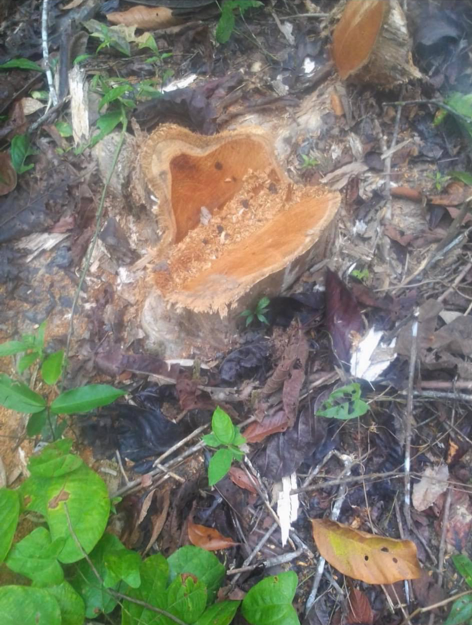
A stump of the trees Masayaha illegally felled in not far from Lolo Town in Compound Number One, Grand Bassa County. The DayLight/James Harding Giahyue
Like Barnie, Stephen Toomey, one of the residents of that area, reported the case to the FDA. This reporter witnessed Toomay raise the issue in a Worr Community Forest meeting in October last year. Joseph Kpainay, an FDA ranger assigned in the region, then asked him to file an official complaint with the agency’s regional office in Buchanan. Toomay did it days after the meeting but got no response. Kpainay acknowledged receipt of Toomay’s letter.
“The concerned citizens of the affected communities are therefore calling on your good office to promptly investigate, intervene and promptly provide an appropriate solution…,” Toomay’s letter read.
News of the illegal logging Masayaha carried out last year made it to FDA’s headquarters in Paynesville. In August, the same month as the illegal felling, SGS reported on the incident.
“During the month, some felling out of CFMA Worr concession was seen again !!!,” SGS said in a report. It also criticized the FDA for approving the company’s harvesting plan that year without a required five-year plan, a breach of the Code of Harvesting Practices and Standard Operation Procedure.
“Surely, because no action was taken from the felling out of concession at… Worr reported by SGS a year ago, that illegality is still going over there.”
But amid SGS’ report and Barnie’s advocacy, FDA permitted Masayaha to export logs that could have included the stolen woods. Between 2020 and last year, Masayaha exported 365 logs, 360 of them ekki woods, according to official shipment records. In fact, it approved three of the company’s shipments about the time of the Garkpa Charlie Town illegal logging, according to the SGS report.
In normal forestry practices, the FDA is supposed to trace every log the company harvests back to its stump to make sure the logs were legally sourced before they are transported.
Also amid the mountain of evidence against Masayaha, FDA should have sought court orders to confiscate and auction them. It should have also fined the company two times and four times the prevailing international price of the volume of logs it harvested in Kweezah and Garkpa Charlie Town, respectively, according to the Regulation on Confiscated Logs, Timbers and Timber Products. The current price set by the FDA ekki woods is US$210. The company could have been slapped with a 12-month prison term if convicted by a court.
Two logs Masayaha illegally harvested in Garkpa Charlie Town in Compound Number One, Grand Bassa County. The DayLight/James Harding Giahyue
Barnie called Tally, furious that the logs had made it out of the community and the company had not been fined for the violation. “Those logs are at the Port [of Buchanan] and are taken from where they have no concession. I’ve been calling some eight, nine months ago on the issue in Number One Compound. Now the people are carrying the logs,” Barnie can be heard in the recording, threatening to protest at the port to stop the shipment.
It was unclear how many logs Masayaha harvested in all its illegal operations. Neither SGS nor the FDA provided that information. However, the villagers’ records of last year’s felling seen by The DayLight put that number to 641 cubic meters. The elders had designated Mathew Gaywheon, a townsman, to represent them during the operation. If Masayaha had been convicted for its 2020 illegal harvesting and the one last year, it could have paid over half of the million United States dollars for a second offense.
There were signs of the operation in the area. We saw stumps of the felled trees. The elders of the town said a short piece of log lying adjacent to the palaver hut under which we conducted interviews was a remnant of the operation. A number of logs were still at the site of an open field, where villagers said Masayaha’s workers piled up the woods. Earthmovers’ trails adorned the site, despite a year of downpour.
The area matched the one in the pictures Toomay shared with us of the unlawful operation in Garkpa Charlie Town. One of the pictures shows a Masayaha vehicle parked next to the thatched kitchen where we conducted some of our interviews. Others reveal the company transporting some of the logs with official identification tags, indicating they had been registered into the FDA’s database.
The FDA did not grant The DayLight an interview on the matter. We emailed the agency earlier this month and received a response last week from Tally, who scheduled the interview for Tuesday. However, he did not turn out at the time of the interview he had set. Cllr. Yanquoi Dolo, the head of FDA’s legal department, declined to speak on the matter.
Kamara, the CEO of Magna, also declined to speak on the matter.
Harkous did not respond to queries sent him via WhatsApp for comments on his company’s illegalities.
Some of the elders of Tarr Town signed an illegal agreement with Masayaha Logging Company to illegally harvest logs in their community. The DayLight/James Harding Giahyue
This Story is a production of the Community of Forest and Environmental Journalists of Liberia (CoFEJ).
Top: A pile of thick, square timbers, commonly called “Kpokolo” illegally harvested by Binta Bility. The DayLight/James Harding Giahyue
By James Harding Giahyue
Editor’s Note: This is the first of a two-part series, which exposes an illegal logging operation.
COMPOUND NUMBER ONE, Grand Bassa County – Two hundred and sixty pieces of thick, square timbers lay by a roadside in Zoegar Town, one of 18 sections in the Doe Clan. Twenty-five more are scattered in the forest.
The woods were harvested in two former logging concessions in Compound Number One, Grand Bassa. They are the products of an illegal logging operation being conducted by a businesswoman named Binta Bility, an investigation by The DayLight found.
“The pile of [timber]… is for one Binta Bility,” said Volygar Garblah, the Chief Elder of that region. Garblah said she had asked to harvest red hardwoods in two former concession areas and he and other chiefs worked out a payment scheme with her.
“Sometimes the sticks are from two or three sections in Doe Clan. When she went to Fubahn, the people charged her, from Kpelleh Town way they charged her also, and men were used to haul the timber from there,” Garblah said, adding Zoegar Town and Dumue Town were also involved in the illegal activities.
The operation she runs is commonly called “Kpokolo,” a new form of illegal logging across the country, which targets expensive hardwoods that are smuggled out of the country in containers. The woods are used for railroad tiles and bridges.
Bility denies any wrongdoing. But dozens of interviews with chiefs, elders motorcycle-taxi drivers, and the illicit loggers point to her.
Felling trees without a permit or from an illegal source is a grave offense in forestry. She faces a huge fine and a prison term if convicted by a court.
‘My Daughter’
Bility started working in the Compound Number One area in 2020 with planks but decided to switch to timber last year, according to Garblah. He said he had known Bility since she helped him pay for his medical bill some time ago.
“She is my daughter. She said, ‘Please give me a place to pack my logs, and after that, I will come for us to talk,’” Garblah told The DayLight. After our talk, then, I later talked with the section people.” He said they did not have a written agreement with her.
Binta Bility runs illegal logging operations in Compound Number One, Grand Bassa County. Picture credit: Facebook/Binta Bility
An orange and green 1996 MAN truck was parked at Gbarblah’s home with an improvised wheelbarrow, commonly called push-push in its trunk. Its license plate reads “C3742.”
“The car is for Binta but she left it with me,” Garblah said.
The forest where Bility operates was known in the logging industry as Timber Sale Contract Area Two and Timber Sale Contract Area Three. They were operated by Renaissance Group Incorporated and Akewa Group of Companies, respectively, before being canceled last year along with eight similar contracts following years of failure and illegitimacy.
Harrison Togbah, who identified himself as one of the forerunners of the illegal operation, said there were 17 workers, including some townsmen. He added that Bility gave the team pictures of the hardwoods to cut and that they had worked for six months.
“That’s the first consignment wasting outside there,” he said in reference to the woods on the road to Zoegar Town. “We made the arrangement that out of 200 pieces [of timber], she will be able to give me US$700.”
Togbah showed our reporters Bility’s mobile phone number he saved as “Boss Lady.” Togbah and Bility had communicated 36 times, according to Togbah’s call history. The number on his phone matched the one our reporters had used to contact her earlier on.
Massa Sawo, Togbah’s supervisor, confirmed she is their boss. Sawo declined to take further questions when quizzed on the illegality of their activities. “Ask Binta herself,” he said and hung up the phone.
‘Just Sample’
The people in Lolo Town showed they were as fond of Bility as those in Zoegar Town. A woman, who did not give her name, called Bility “my ma,” when our reporter showed her the picture Bility uses as her Facebook profile. Other residents, including Solomon Kpolon, an elder of Lolo Town, also identified Bility as the woman in the picture.
We visited the illegal logging site near the Worr River, a good distance from Lolo town. It was an old camp Bility had set up for her chainsaw milling operation, according to the townspeople we interviewed. There were an abandoned, makeshift warehouse still locked and an apartment camp house. Cassava, potato and pineapple thrived among the invading, wet bush. Leftover woods dotted the area. Twenty-six timbers measuring seven feet long and 10 inches wide are next to a felled tree.
“The kpokolo in the bush… are samples. [She asked us to do the sample so that] if someone she can bring the person here to see it,” said Stephen Bull, who said he headed the operation at that site and had known Bility since 2020. He even called out her number offhand.
Bull added that it took up to 15 men to place the woods in the push-push our reporters saw in the back of the truck at Garblah’s house. Thereafter, the vehicle takes the illegal timbers to the central location in Zoegar Town, according to Bull.
We found a phone number written with charcoal on the plank wall of the warehouse at the camp belonging to Kantee Zabeh. Zabeh, who said he was 20 years old, claimed to be Bility’s son in a phone interview. He gave her address as 21st Street, something Togbah had earlier told our reporters.
Timbers that were illegally harvested by Binta Bility in a forest in Grand Bassa County. The DayLight/James Harding Giahyue
Garblah said the woods were meant to be exported. “Bility told me that the place she usually sells the timber is where the fighting is taking place in Europe, so this is why the woods have not gone yet and [are] still packing over there.”
By law, chainsaw milling is illegal but is permitted because the woods are supplied to the local market. The FDA has a system where fees are collected at various checkpoints, while it formulates a regulation for that kind of logging.
But kpokolo is illegal. Such timbers are exported outside of the official system that tracks woods from harvest to shipment, a crucial principle of Liberia’s forestry reform. Bility is not registered in that system known in the industry as LiberTrace, according to Gertrude Nyaley, the technical manager of FDA’s legality verification department (LVD). The DayLight had made a formal inquiry on the businesswoman’s status.
This investigation comes more than two weeks since leaked videos and pictures revealed similar operations run by an FDA ranger, who has now been suspended. The agency has alarmed over the smuggling of wood in containers, which it says makes it difficult to track down.
Bility denies she runs unlawful activities in Compound Number One. She challenged the fact the villagers revealed she was the mastermind of the illegal harvesting. “Stop disturbing my line but you are free to report whatever you [want] to,” she said in a WhatsApp chat. “I know I’m not doing any illegal logging.
“Good luck, dear,” she added.
“I just can’t stop laughing,” she said in another WhatsApp chat with several laughing emojis.
A man measures the diameter of a tree illegally harvested by loggers hired by Binta Bility in Compound Number One, Grand Bassa County. The DayLight/James Harding Giahyue
Bility still carries on with her operations. In our second round of interviews with Garblah, he told The DayLight she called him and asked whether he had spoken with us. A motorcycle-taxi driver, who did not want to be named for fear of reprisal, also said she dropped off a worker in the area on Sunday.
When told that Bility denies working in that part of the country, Bull gave a wry smile. “For her to deny that she is not working here is not right,” he said.
A person who does not hold a contract but harvests logs carries a fine for three times the value of species of timber at the prevailing price set by the FDA, according to the Regulation on Confiscated Logs, Timbers and Timber Products. The current price for ekki woods is US$210.
The vehicle being used by Binta Bility to transport illegally harvested logs in Compound Number One, Grand Bassa County. The DayLight/Mark Newa
CORRECTION: This story deletes the word “legally” in the twelve paragraph for consistency.
Mark Newa, Emmanuel Sherman, Gerald Koinyeneh and an unnamed motorcyclist-taxi driver contributed to this report.
The story is a production of the Community of Forest and Environmental Journalists of Liberia (CoFEJ).
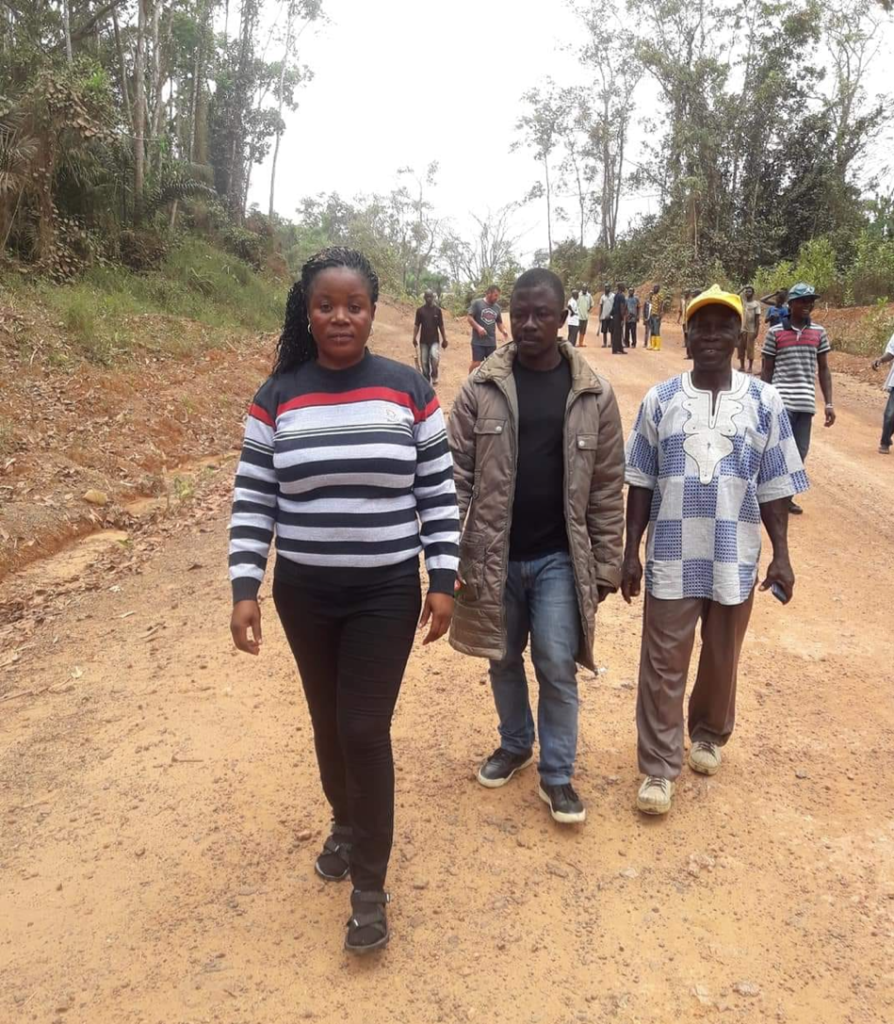
Top: Rotten logs in the Gola Konneh District, Grand Cape Mount County. The DayLight/James Harding Giahyue
By Varney Kamara
ZIMMIDANDAI – A Liberian-owned company has left an unspecified number of logs in a logging concession area in Grand Cape Mount County, community leaders have said.
In 2009, Bulgar & Vincent Timber Company cut trees in a logging concession in the Porkpa District—known in the logging industry as Timber Sale Contract Area 10 (TSC A-10). However, in 2015, it pulled out of the area, leaving the woods to rot, according to Dao Sheriff, a member of the community’s leadership of the forest in an interview in a town called Zimmidandai.
“Most of the logs B&V harvested here were left in the bush,” said Sheriff. “After the 2014 Ebola outbreak, the company returned and cut several logs in 2015, and left this place in the same 2015.”
Sheriff did not say the exact quantity of woods B&V harvested. The company also had some logs in its log yard in the Po River area, according to a July 2017 handwritten letter to the FDA, seen by The DayLight. We could not independently verify the information, as the road to the forest was inaccessible due to years of abandonment and perennial rainfall.
B&V blames the government for the abandonment of the logs.
“We left logs there because the government failed to fix the road. We did not take them out because of this condition,” said Emmanuel Vincent, the CEO of the company, in a phone interview.” “It is the government that failed to do what it is supposed to do.”
That claim is incorrect. It was actually the company’s responsibility to “recondition and maintain roads adjacent [to] the contract area,” according to the agreement.
In June, the FDA announced the auctioning of abandoned logs across the country, including those in TSC A10. “The exercise will continue in the northern region and then go down south and western part,” said Mike Doryan, FDA’s Managing Director.
While that exercise has yet to be carried out, it does not apply here legally. Having been harvested in 2015, the FDA cannot obtain a court order to auction the woods under the current Regulation on Abandoned Logs, Timbers and Timber Products. The regulation in place when the harvesting was done narrowed the definition of abandonment as only trees cut outside concession and lack tracking number. The current regulation was formulated in 2017 after the previous one proved ineffective in curbing the waste of forest resources.
Legal issues aside, there is no evidence that the FDA has done anything about deserted logs nationwide. The DayLight has investigated several incidents of abandoned logs in this region, the Gola Konneh District next door, and elsewhere in Grand Bassa, Lofa and Nimba. Doryen’s claim to auction the woods in June was unlawful as it takes months of legal formalities to do so.
‘They…damaged our forest’
The agreement between B&V mandates the company to pay US$1 per cubic meter of logs it harvested and US$1.25 for land rental fees. It was required to build schools, clinics, handpumps, and latrines for villagers but it did not deliver them. Its only project, a USD$4,018 guesthouse in Zimmidandai, has not been completed, according to a report released on Wednesday by the National Benefit Sharing Trust Board (NBSTB), which secures communities’ benefits and oversees their expenditure.
Vincent admits being indebted to the community but blames the Ebola epidemic and the coronavirus pandemic. “We lost heavily in that area,” Vincent said. “We left most of our heavy machines in there. Besides, the government restrained our operation because of the outbreaks. How could we have sold logs to pay benefits? We were practically closed down.” The FDA did not return queries for comment on Vincent’s claim but health authorities imposed some restrictions to contain both outbreaks.
It was unclear how much the company owes because the government has not remitted all the money logging companies have paid them for communities. TSC A10 received US$460 last year as part of the overdue payment and could receive twice that sum from the US$401,000 the government paid to communities recently.
Zimmidandai in Porkpa District, Grand Cape Mount County. The DayLight/James Harding
By the way, that has not changed the gloom aura logging arouses in Zimmidandai. After years of failure, the government of Liberia finally canceled all 11 TSCs across the country, leaving thousands of United States dollars owed them unpaid and projects unconducted.
The FDA promised to work with the National Union of Community Forest Development Committee (NUCFDC) to address fees owed TSCs. Doryen reechoed that in our interview in June. However, the two entities have not done any work since the meeting, according to Andrew Zelemen, the national facilitator of the group.
“They came and damaged our forest and left us with no development,” Sheriff said. “Now, the government has canceled TSCs, and they are gone. All I can say to you is that we are inside it.”
Top: The Ministry of Finance and Development Planning. The DayLight/Harry Browne
By Emmanuel Sherman
MONROVIA – The Government of Liberia has paid communities affected by forest concessions US$401,000 for their portion of land rental fees collected from logging companies. However, it still owes the communities US$2.3 million, with barely four months left in the budget year.
The Ministry of Finance and Development Planning (MFDP) paid the amount to the National Benefit Sharing Trust Board (NBSTB) in Liberian and United States dollars on Tuesday, according to Nora Bowier.
“We are glad the payment was made,” said Bowier, who heads NBSTB that oversees communities’ expenditure of the payment. By law, communities are entitled to 30 percent of land rental fees companies pay the government. The fee is the product of the total size of the concession and US$2.50 for forest management contracts (FMCs), large-scale concessions and US$1.25 for timber sale contracts (TSCs), smaller ones.
“The process was challenging.” She said the institution had engaged the Ministry of Finance to make sure the balance of the money is paid before the fiscal year ends.
Last year, 23 communities protested at the ministry for more than US$5.5 million the government owed them in land rental. The government initially paid US$200,000 it had promised the villagers to end their protest.
It then allotted US$2,749,000 to this year’s national budget. That amount was reduced to US$500,000 in June. However, only US$401,000 was paid.
“We think that it is something that the government has taken lightly in our view or in my view,” Said Andrew Zelemen, of the National Union of Community Forest Development Committee (NUCFDC), which represents the interest of communities and led the protest said. “It worries us and it is our concern.”
Zelemen there would be a protest if the balance of the money allotted in the budget is not paid by the end of the year.
“If the government does not pay the US$2.3 million from now to December, the communities will not allow logging companies to operate in their forests,” Zelemen said.
Janga Kowo, the Comptroller General of Liberia, did not answer calls placed to him nor responded to text and WhatsApp messages.
The government has collected US$27.7 million from loggers but has only paid US$2.6 million to rural communities since the 2015/2016 fiscal year, according to a report by Forest Trends, a US-based nongovernmental organization that promotes sustainable use of forests and conservation.
That is a violation of the National Forestry Reform Law of 2006, which mandates it to transfer 30 percent of land rental fees logging companies pay to communities for development purposes.
Varney Marshall (right) poses for a picture while a chainsaw miller works at Marshall’s illegal logging site in Gbarpolu County. Picture credit: WhatsApp/Varney Marshall
By James Harding Giahyue
KLAY, Bomi County – A leaked video of a ranger of the Forestry Development Authority (FDA) shot by himself and photographs probably taken by his accomplices have revealed his illegal logging operations.
Varney Marshall, who is assigned at the Klay checkpoint in Bomi County, can be heard ranting in the one-minute-58-second video furious that one of his accomplices was trying to cheat him.
“Look at the woods Abe called 600 pieces. Look at the woods he [has] now hauled. I will wait for him until he comes here,” he can be heard saying at the beginning of the film.
He then turns his mobile phone around an open field of more than a thousand timbers.
“You see it, you see the woods? I am doing this video to send it to my woman straight. You see it, you see the wood?
“He’s here doing Gobachop. That’s here his dismissal will come from. You see the distances the woods [are]? Is that 600 pieces here?” “Gobachop” means black market in Liberian parlance. It was coined in reference to the late Russian leader Mikhail Gorbachev, whose leadership led to the demise of the former Soviet Union.
“You want to steal from me?” Marshall says in the recording.
The leaked video exposed Varnery Marshall, the FDA ranger who runs illegal logging operations.
The video and pictures are believed to be taken at different locations in the forest in Gbarpolu County. Some reveal a sea of timbers scattered on an open field. Some show wood parked in containers. Others reveal Marshall’s accomplices, sitting on top of a mountain of woods, standing near a gigantic tree and posing for a photo with their new chainsaws and gear. Several of the pictures featured Marshall himself modeling next to a chainsaw operator as he saw a huge log.
Marshall had sent the recordings and pictures to a source as a pitch for both men to partner in an illegal logging business. “We need to talk, brother,” Marshall tells the source in the WhatsApp message on August 16 at 8 p.m. His message does not get a reply. The source said he shared the message with The DayLight to prove he was also a victim, not just an actor of the unlawful activity.
The leak comes barely a week after the FDA said it has observed that several illegal timber products are being exported without a trace. It said smugglers were hiding wood in containers. “FDA checkpoint and Free Port of Monrovia staff members are instructed to open all sealed containers from forested areas to verify content and ensure that the FDA duly issued conveying permit documents,” the statement said.
The agency suspended Marshall and Edward Kollie Jallah, another ranger assigned at the Klay checkpoint, over the leaked video and their alleged roles in the transport of illegal woods that involved a police commander and other individuals, according to Cllr. Yanquoi Dolo, the head of the FDA legal team.
“Both Marshall and Jallah are suspended with directives that they report to Monrovia for investigation. They are expected to report to headquarters tomorrow. Their supervisor has been notified,” Dolo told The DayLight.
Marshall and Jallah did not answer phone calls placed to them. They did not reply to WhatsApp messages well.
A container is being uploaded at an illegal logging site run by FDA ranger Varney Marshall. WhatsApp/Varney MarshallWoods loaded in a container that Varney Marshall harvested in a forest believed to be in Gbarpolu. WhatsApp/Varney MarshallA pile of woods Varney Marshall, an FDA ranger, illegally harvested in a forest believed to be in Gbarpolu County. WhatsApp/Varney MarshallA pile of woods Varney Marshall, an FDA ranger, illegally harvested in a forest believed to be in Gbarpolu County. WhatsApp/Varney MarshallSome of Varney Marshall’s accomplices pose with new chainsaws and gears. WhatsApp/Varney MarshallWoods Varney Marshall illegally harvestedTwo illegal loggers who work with Varney Marshall. WhatsApp/Varney MarshallWoods Varney Marshall harvested illegally. WhatsApp/Varney Marshall A mountain of timbers Varney Marshall, an FDA ranger, illegally harvested. WhatsApp/Varney Marshall
CORRECTIONS: This version of the story deleted the repeated phrase “means black market.” It also corrects “woods” for wood in the fifth paragraph.
“My thing was to ensure that I attract potential investors to Liberia,” Anderson told The DayLight in a phone interview.
Anderson said he contacted Augustine Dunbar, one of his friends, who took him to Weimu, a village in the Bopolu District of Gbarpolu County. Dunbar then introduced him to villagers there, Anderson said. Within months, the logs were ready for transport.
At that point, Anderson contacted Dawoda Sesay, the commander of police deports in the Paynesville area known as Zone Five, to help arrange the transport. Sesay hired three container trucks to move the logs, promising to pay them either US$1,000 or US$900, according to Sesay himself and the truck owners.
Last month, the trucks arrived at Anderson’s logging site, were loaded with logs, and took off. But rangers of the Forestry Development Authority (FDA) halted the transport. Two trucks were arrested at the Klay checkpoint on the Bomi highway and the one at Sawmill on the Tubmanburg-Bopolu highway.
The rangers found out that Anderson and Sesay did not obtain approval from the FDA to transport the logs. The Klay trucks were immediately impounded at the FDA regional office in Tubmanburg. The one at Sawmill was held exactly there. After weeks of investigation, the rangers later discovered Anderson and Sesay were running an illegal logging operation, one of the severest offenses in the forestry sector.
The FDA has sued Sesay and the owners of two of the trucks over the illicit operation.
“The FDA sees the actions of Mr. Sesay and the owners of the truck as a gross violation of the National Forestry Reform Law,” Cllr. Yanquoi Dolo, the head of FDA’s legal department, told The DayLight in an email. “The Managing Director of the FDA, Hon. C. Mike Doryen has frowned on this gross illegality and has requested that sternest of action against the violators consistent with the laws governing the forestry sector.” The lawsuit comes as reports of illegal shipments of timbers and timber products are on the increase.
An investigation by The DayLight has found more details of the illicit activities, following our initial report of the seizure of the logs two weeks ago.
Ex-diplomat Richmond Anderson. Facebook/Richmond Anderson
Commander of Zone Five police deports Dawoda Sesay. Facebook/Dawoda M. Sesay
‘Sample’
Before you engage in logging activities in Liberia, you must have a company, registered at the Liberian Business Registry and then apply at the FDA. The agency will vet your company, including its capacity to operate and your criminal record. Once your business meets all of the criteria, it is prequalified to do logging in Liberia. Thereafter, you will have to seek a contract with the FDA or an agreement with a community, subject to the agency’s approval. That goes with the transport of woods.
That was not the case with Anderson. “I have not done logging before, don’t know the different species of logs. I have no idea, it was my first time,” Anderson told us in the phone interview.
Anderson said Dunbar introduced him to a customs officer at the Freeport of Monrovia he only identified as Peter, who told him it was possible to ship woods without a permit.
He said he had Korean business partners who were interested in exporting first-class logs and had assured him of buying the woods once he delivered them. He added that the woods were a kind of experiment for future deals.
“They (Koreans) want to carry the wood as a sample and then pay later,” Anderson said. “So Sesay agreed to help me with some of the money.”
Some of the logs there were illegally harvested in Gbarpolu in one of the container truckers that were seized by the Forestry Development Authority. The DayLight/Gabriel Dixon
The FDA has indicted Sesay, Shakia Kamara, who owns one of the Klay trucks, and Layee Sheriff, the owner of the one at Sawmill, in separate lawsuits in Bomi and Gbarpolu County, according to court officials. The agency is seeking a US$25,000 fine, a 12-month prison term for the men, and forfeiture of the vehicles, all maximum penalties under forestry laws and regulations. It would indict the owner of the third truck once it gets a name, according to Dolo.
The agency has also asked the courts to allow it to take the logs in line with the Regulation on Confiscated Logs, Timbers and Timber Products. It will need another court order to auction them.
Sesay admits he hired the trucks to transport the woods but said he did not know whether the operation was illegal.
“As police officers, we have our inalienable rights: the right to live, right to survive. So, if my brother came to me and said, ‘Look, I need this assistance,’ then… I made the arrangement… is that something prohibited? Sesay told The DayLight in an interview at his Mount Barclay residence. “Even if I knew what they (truckers) were going to get, that is none of my business. If the transaction was illegal, I was not there to know that it was illegal.
“The good thing there, I didn’t facilitate armed robbery, I didn’t facilitate murder, I didn’t facilitate drugs trafficking, nor human trafficking,” he added.
The owners of the trucks said they were also unaware that the woods were illegally harvested. Sheriff, one of the two trucks’ owners who have been indicted, said Sesay had promised to give them the documents for the wood once they arrived at the site but did not.
The National Port Truckers Association of Liberia said the scandal has “embarrassed” the group. It said it would try to prevent such illegal transport in the future.
“We want to have a memorandum of understanding [with the FDA] because we want to avoid future embarrassment. This is a complete lesson to us now. We know that there is a lot of clandestine activities going on with the transportation of woods,” said Yahaya Kemokai, the secretary general of the association.
The FDA said in a statement last week it has observed that several illegal timber products are being exported without a trace. It said smugglers were hiding woods in containers. “FDA checkpoint and Free Port of Monrovia staff members are instructed to open all sealed containers from forested areas to verify content and ensure that the FDA duly issued conveying permit documents,” the statement said.
The truck that was held at Sawmill, owned by Layee Sheriff, one of the people indicted for alleged illegal logging. The DayLight/Gabriel Dixon
‘On Credit’
The site of Anderson’s logging operations appeared equally illegal. A muddy and rough road branches into the forest at the top of a hill. Remnants of the illegally harvested logs lay around.
It was not clear how much volume of logs was harvested. However, Anderson said they were all Ekki woods, a very expensive species of logs that currently sells for US$210 per cubic meter on the international market. His statement was backed by Dolo, who said, “All the trucks have crossed cut Ekki Logs.”
The illicit loggers felled 17 trees but used 15, according to the villagers we interviewed. “It was 17 trees but they said two were damaged, they had holes in them,” said Emmanuel Massaquoi, one of the villagers.
Anderson and the locals had verbally agreed to cut the 15 trees in exchange for US$2,800 per tree, according to both parties. But it was a long negotiation process that involved half a dozen people.
Anderson and Sesay initially contacted Dunbar, who introduced the pair to a man only identified as Korvah. It was Korvah who actually introduced the pair to Massaquoi. Massaquoi then contacted Fatu Samukai, his mother-in-law, who claims ownership of the forest, Massaquoi told us in the interview. Samukai appointed Massaquoi to represent the village. Then the unlawful deal was sealed.
By law, communities are entitled to benefits from their forest resources but they must first meet FDA requirements. Moreover, said the agreement must be approved by the agency. That was not the case with Weimu, another layer of the illegal activities.
Anderson, Dunbar, Korvah, Massaquoi and Samukai could also be indicted, as the FDA conducts a further investigation into the illicit act, according to Dolo. A person commits an offense if they intentionally or negligently cut trees illegally, according to the regulation on confiscated logs.
“I regret my action. I am just appealing to the commercial and legal departments of FDA,” Anderson said. “I have learned the hard way.”
Korvah declined to comment, we were not successful in tracking down Dunbar, and Samukai was still recovering at the Jallah Lone Hospital in Bopolu at the time of our investigation.
Meanwhile, the case at the 11th Judicial Circuit Court in Tubmanburg begins Tuesday. The DayLight will provide you with details of the proceedings as they unfold.
Henry Gboluma and Mohammed Sheriff contributed to this report.
The story was a production of the Community of Forest and Environmental Journalists (CoFEJ).