
29.2 C
Monrovia
Thursday, May 21, 2026
Home Tags Wologizi Proposed Protected Area

Tag: Wologizi Proposed Protected Area

The ‘Gold Boys’ of Wologizi Park

MG 8532
MG 8532

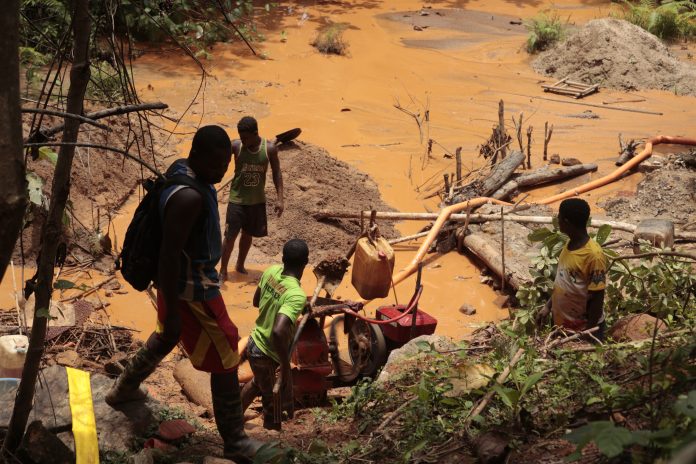
Top: “Gold boys” operating in a mining pit deep into the forest in Salayea, Lofa County. The DayLight/ Samuel T. Jabba


By Samuel T. Jabba


BETIBA, Lofa County — Illegal miners are destroying the Wologisi Proposed Protected Area, clearing the mountainous forests, polluting watercourses beneath it, and carving huge pits into the landscape in an unrelenting hunt for gold.

Amid the ongoing gold rush, unlicensed miners, known here as “gold boys,” say it is their only means for survival.

“The one that encourages me is because I’m getting my living from there,” said James Jallah, a 23-year-old gold boy and sixth-grade dropout. “I will not sit down, and be suffering, and there’s no work for me to do. I should go to the forest that has money.”

For the illicit miners, the Wologizi Protected Park is their fortress. They say they make a lot of money. Some of them own businesses and have built houses.

The illicit miners blame their situation on a lack of opportunity.

“We are mining in plenty of areas here. We get Betiba, we get Darbu, LISCO, Karza, all of them in this same zone. All those places are mining areas. We get more field here to hustle. That is, a lazy man can’t eat, so if I work a day, when God blesses me, I can buy you anything you want,” Sampson Fayiah

The Wologizi Proposed Protected Area is one of nine forests the Liberian government has designated as a reserve. Zigzagging the Wologizi Mountain, and measuring 99,538 hectares, it is home to various endangered species, including monkeys and chimpanzees. It is a part of a US$9 million project that aims to preserve the forest and enhance the use of its natural resources.

Despite these efforts, Wologizi faces a growing threat of deforestation and forest degradation. In 2025, Voinjama, which hosts the forest, lost 3,100 hectares of natural forest, according to Global Forest Watch, an online deforestation-tracking application.

Reporters witnessed this firsthand. Just at the edge of the forest, on a hill three to five minutes from Betiba, a large town beneath the Wologizi forest, lies a site locals call Umaru Field. A hub for gold boys, it hosts numerous illicit mining operations that involve forest clear-cutting, land degradation and pollution. 

The illicit miners carved huge open pits into the earth, where they dig for gold. After washing the mineral, muddy water forms a polluted pond that flows into nearby streams locals depend on for drinking, fishing, and washing. Drone footage revealed a network of countless pits or “bogeyman holes,” as the gold boys call them in reference to the danger they pose to people.

When DayLight reporters asked how to address the water pollution, they said a company in the area is responsible for it. They said that they even have to carry drinking water with them to the fields, and that they expect farmers to do the same.

“The water is not giving me money, so how will I stop? What I want is money. “If money can come, that one,” I will stop the work, Jallah said.

For residents of nearby communities, the damage is already being felt, especially in Betiba. Once clear and promising, streams have turned murky, while the encroaching mining pits and felled trees threaten farmlands near the forest.
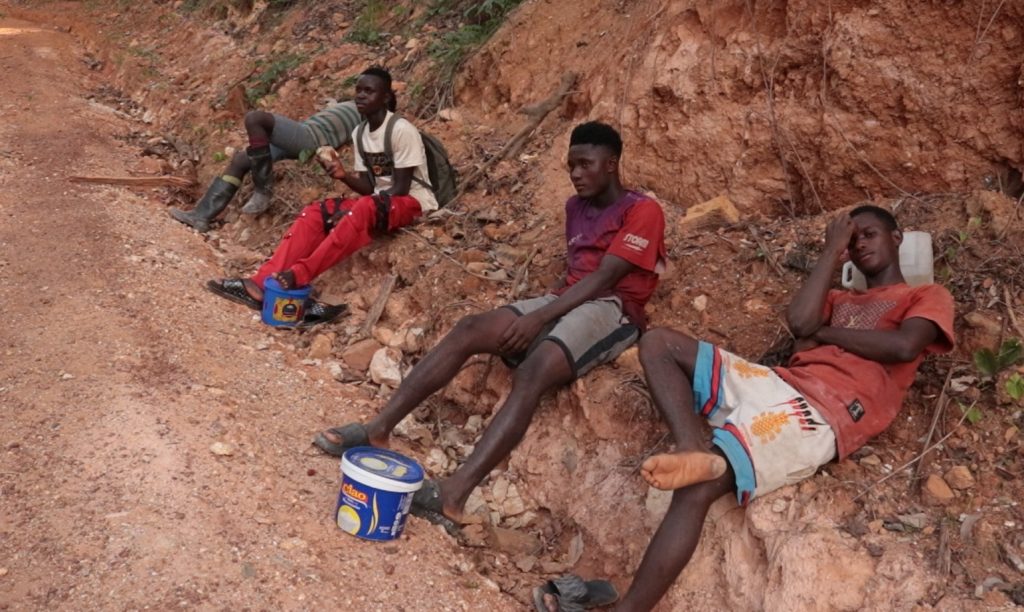
Gold boys
Picture of “gold boys” cooling off at a roadside after work in Betiba, Lofa County. The DayLight/Samuel T. Jabba

To curb these activities, the community land leadership set up a team to monitor mining activities in the region and apprehend illicit miners. The team visits various mines and contacts other communities on the issue.

“We are appealing to the government to put a stop to the illegal mining activities here,” said Yassa Smith Kullie, the Betiba’s land leader. “The Illegal mining is too much in our community. People have two to three mining fields, but when you ask them for documents, they will not show you any.”

Kullie’s claims are backed by evidence. Records from the Ministry of Mines and Energy show only four licenses in that region for two companies. Mining without a license in Liberia is punishable by a fine, a prison term, or both, upon conviction.   
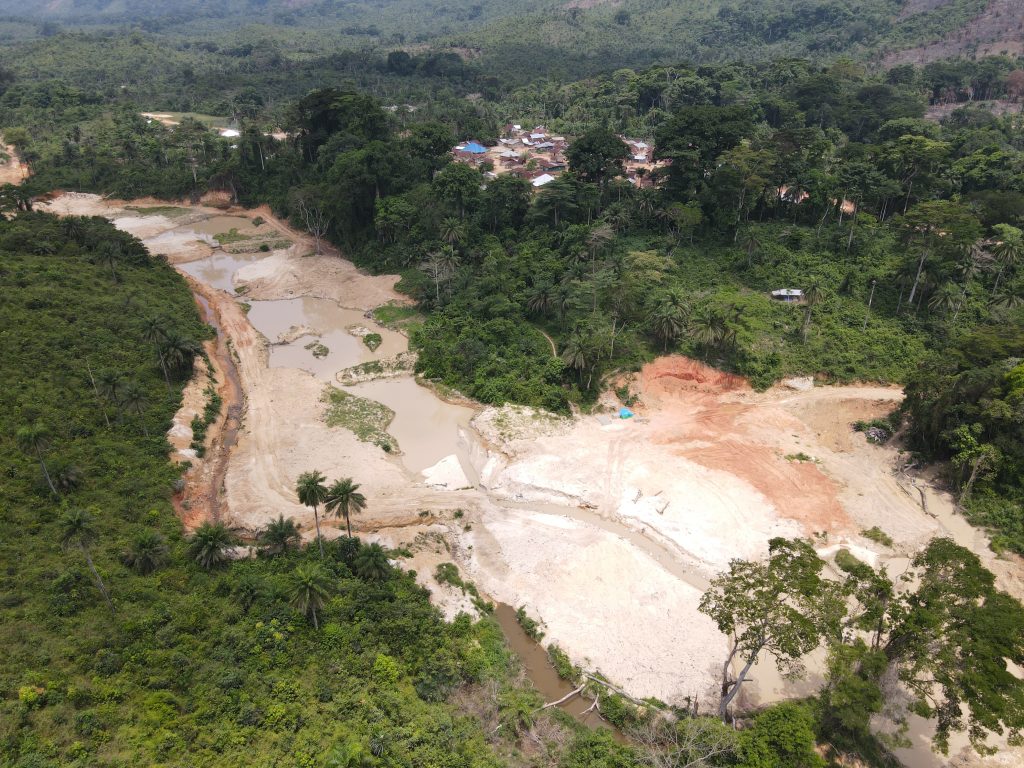
DJI 0248
Drone image showing a muddy runoff in Kiliwu, Lofa County. The DayLight/Samuel T. Jabba

But not everyone in Betiba disapproves of the illicit mining. Some residents get their livelihoods from illegal activities. They no longer travel to Voinjama or other long distances to the market. To them, life with the miners is better than without them.

Betiba is a city in the middle of the forest. Businesspeople set up a market in the town hall located at the heart of the town. Clothes on sale hung on the wall, while household materials and foodstuffs filled tables. New houses built by gold boys adorned the town. Two small entertainment centers sell cold drinks and beverages. There is a local electricity facility with wires running through the town.

“We cannot have all this forest standing while people are suffering. We are poor farmers. We need help to make a living,” Sonie Supo, a leader in Betiba. “If the government wants us to protect the forest and doesn’t allow people to mine in it, let them give us US$50,000.”

Kullie, Betiba’s land leader, said that poverty could not justify illegal mining and environmental harm.  

“If we continue to look at poverty and always behave this way,” Kullie said, “they will destroy all of our land, and when the resources are destroyed, they will leave the area empty.”


This story was produced by The DayLight with support from the Embassy of Ireland through Integrity Watch Liberia. The DayLight maintained editorial independence over its content, which does not reflect the position of the Embassy of Ireland or Integrity Watch Liberia.
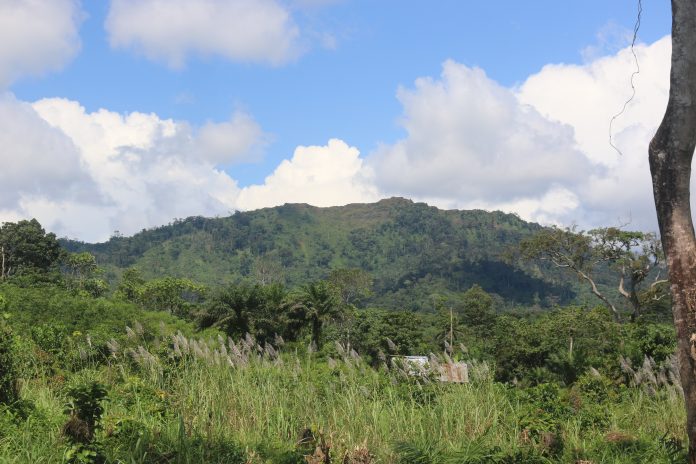
Communities Desire Direct Benefits to Conserve Forests

Top: A view of the Sehyi Ko-doo Community Forest in Nimba County. The DayLight/James Harding Giahyue


By Varney Kamara


GANTA, Nimba County – Local communities are firm on conserving their forests but they want direct benefits from doing so.

“We’ve noticed that not giving funds directly to communities led to too many bureaucracies with limited social and economic impacts on the communities,” said Anthony Sumo, a community leader in the Proposed Wologizi and Wonegizi Protected Areas in Lofa County. The areas are part of the Wologizi-Wonegizi-Ziama belt, extending Guinea and connecting to Sierra Leone, and home to the critically endangered pigmy hippopotamus.

“Every day we hear about the money coming, but not much of how much development it brought to the community. There is a need to change things around.”

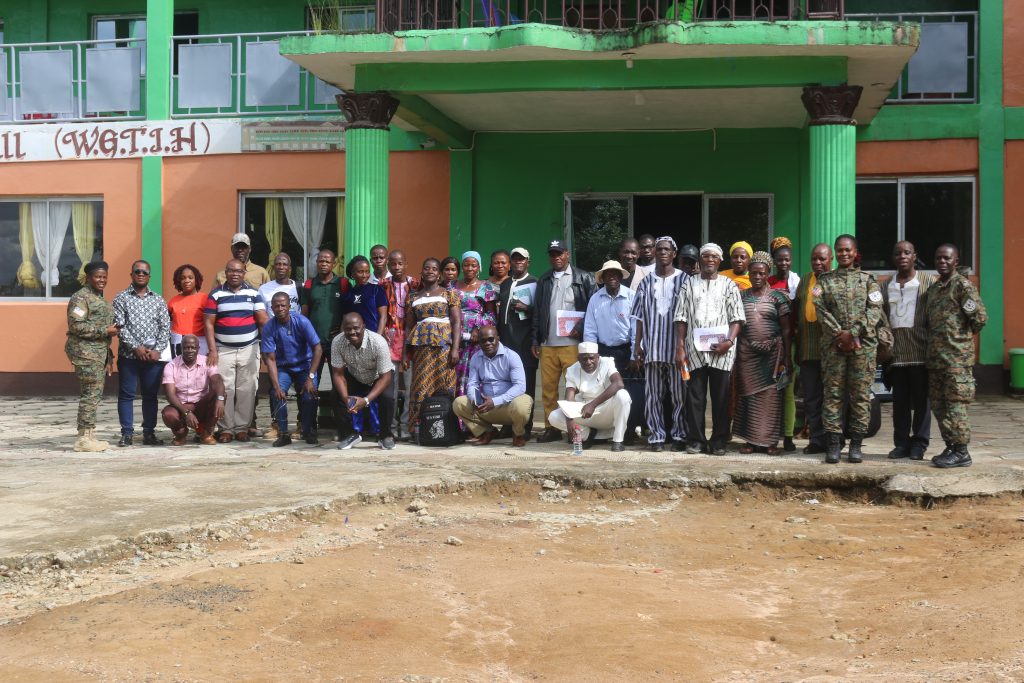
Sumo is one of 41 people from northern and northeastern Liberia who attended a recent meeting in Ganta, Nimba County to identify new ways local people could benefit from keeping their forests standing.

Their views and an emerging report on options Liberia could pursue to generate revenue will be developed into a proposal and turned over to the government and international partners for possible action.

The Community Rights Law… and Land Rights Act grant locals ownership of ancestral territories. Up to 75 percent of Liberia’s land is under customary control, including 1.3 million hectares of community forests and 1 million large-scale logging concessions.

Locals also support Liberia’s commitments to combat climate change, including halving deforestation, restoring a quarter of its degraded forests and reducing gases from forest use.  A host of communities run conservation programs and support protected and proposed protected areas, covering 1.14 million hectares.

Yet those communities have not significantly gained from forest resources over the last one and a half decades.  Failed logging contracts have left debts, abandoned logs and anger countrywide, while communities have struggled to profit from local conservation efforts.

“Any benefits that come from preserving the forests should go directly to the people, instead of passing through multiple organizations or international people,” said Sumo in an interview with The DayLight. “That’s what we have been asking for.”

Those views were echoed by other community leaders in Salayea, Blei, Sehyi Ko-doo and Zor and Gba. 

Robert Mahn, a leader of the Zor Community Forest in the Sanniquellie-Mahn District of Nimba, said direct benefits were necessary for residents to manage and maintain ownership.  The mountainous Zor, Gba and Blei are conservation community forests adjacent to the East Nimba Nature Reserve, an 11,538-hectare forest that is home to chimpanzees and the Nimba toad.  

Over 40 people and rangers from communities and the East Nimba Nature Reserve discussed local people’s benefits from keeping their forest standing. The DayLight/James Harding Giahyue

“I feel that direct funding will boost our CLDMC’s involvement in decision-making, helping us use our benefits more effectively,” said Mahn.

“The people depended on these forests from our ancestral days. Now that you want them to manage and protect it in other ways, you need to provide benefits like soap-making, women’s arts, tailoring, village saving loans, animal raring, and more,” said Yassah Mulbah, the chief officer of the Salayea Authorized Forest Community.

Eight thousand two hundred and seventy hectares Lofa County, Salayea, runs a conservation program, focusing on livelihood projects Mulbah mentioned.

But other attendees, including Grace Kotee, a ranger with the East Nimba Nature Reserve, caution against mismanagement. They referenced an instance in the Korninga A Community Forest in Gbarpolu, where townsmen were tried for allegedly misusing US$76,000.

“We think that providing direct benefits to communities is a good idea but we have a little bit of concern about this. There should be a process or system put in place that will make them to be accountable,” said Kotee.

All parties agreed NGOs were crucial to communities’ conservation efforts. However, most frowned on NGOs implementing projects for communities.  

Ericson Flomo, the chief officer of Sehyi Ko-doo Authorized Community Forest, called on conservation donors and the government to empower communities.  

The community has planted 30,000 indigenous and fruit trees, one of the highest totals in the country. Sehyi Ko-doo has an MoU with ArcelorMittal Liberia in which the company pays a dozen local forest guards a monthly stipend.

“We want to get things done,” Flomo told The DayLight at Sehyi Ko-doo’s border with Gba amid the hooting of chimpanzees. “We just need the right training and resources to succeed.”

Silas Siakor, the Country Manager of Dutch NGO IDH, who was one of the workshop’s facilitators, welcomed the participants’ views.

“By protecting their resources, they can access funds tied to conservation ownership,” said Siakor. “The objective is to identify other sources of economic benefits and revenue that you can use for your own development as a community, as an incentive for you to better manage your forest.

“The idea is to balance conservation with community needs.”

The next discussions will be held in Buchanan, Grand Bassa County. After that, Inclusive Development Consultancy will draft the proposal on how communities can benefit from sustainably managing their forest.  

Podcasts