Home Tags Timber smuggling

Tag: timber smuggling

Shadow Firm Smuggled over US$400K of Timber to Ivory Coast

Shadow Firm Smuggles over US$400K of Timber to Ivory Coast
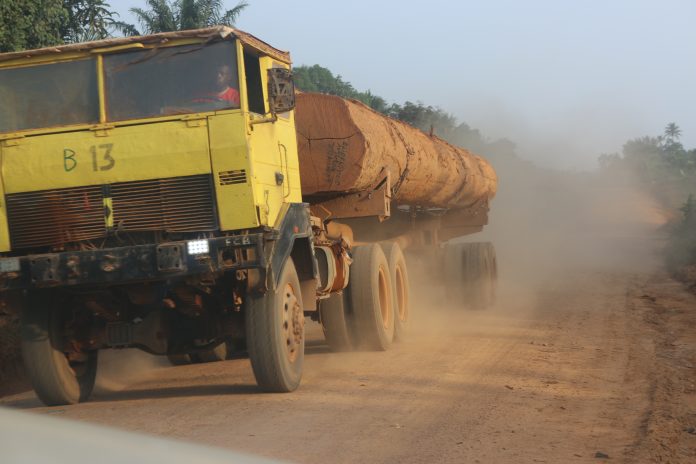
A truck transports logs outside Greenville, Sinoe County in 2023.

Top: A truck transports logs outside Greenville, Sinoe County, on January 3, 2023. The DayLight/James Harding Giahyue


By Varney Kamara


MONROVIA – Horizon Logging Limited, an Israeli-owned logging company with unknown owners, smuggled timber to the Ivory Coast on multiple occasions, valued at US$437,000, A DayLight investigation found.

The two shipments occurred in 2023 and 2024, according to Trademo, a US-based business platform that publishes international trade data. However, those shipments happened outside of LiberTrace, Liberia’s legal timber-trading system.

Of the total value, Horizon shipped US$163,790 in 2023 and  US$273,380 in 2024, the data shows. One of its Ivorian buyers is the Abidjan-based Sdma, which offers sea, air and land transport services.  

A review of all of Horizon’s export records through LiberTrace shows no trace of the Ivorian shipments. Further review of its trading at the Ministry of Commerce & Industry and the Liberia Revenue Authority produced the same result.

Companies can trade outside LiberTrace and still pay export taxes to the LRA due to weak coordination among public entities. However, Horizon did not pay any taxes for its Ivorian shipments, the LRA records show. This means the exports happened outside the entire government system and were smuggled across the eastern borders. The exports were documented because the Ivorian government declared them under international trade protocols.

Exporting logs outside the legal system violates the Regulation on Establishing a Chain of Custody System. The regulation provides that timber is traced from its origins to the final destination. The idea is a centerpiece of forestry reform and Liberia’s timber trade agreement with the European Union, which has decided to terminate the deal over continued violations.

Ivory Coast, likewise, prohibits the illegal importation of timber, according to the country’s regulations on the import and export of forest products. The laws state that entities engaged in the import of forest products must get approval from the Ivoirian Minister of Water and Forests, and documentation of a timber legal origin.

“Illegal timber extraction and shipments create a compounded loss for Liberia. Communities lose legitimate forest benefits, livelihoods and climate resilience, while government loses revenue and potential economic benefits, says Dayugar Johnson, the lead campaigner at the Civil Society Independent Forest Monitor.

“At the community level, illegal logging and exports can deprive forest-dependent communities of social benefits and other revenues that could support schools, health facilities, roads, water systems and livelihoods, undermining their rights, as well as fueling local conflicts.” 

Mystery owners

The illegal shipments are not the company’s only wrongdoing. The DayLight found other issues with Horizon’s ownership. Horizon Minerals BV holds 99 percent of Horizon’s shares, and one Dov Aronvich holds the remaining. However, Horizon Minerals BV does not list its shareholders, a requirement under the Beneficial Ownership Regulation of 2023.

Originating from the Liberia Business Association Act, the regulation requires companies to declare their ultimate beneficial owners or the individuals who own them. It is part of a global scheme to combat financial crimes, including money laundering, terrorist financing, and tax evasion. As part of that fight, the Liberian cabinet approved the establishment of a beneficial ownership registry.
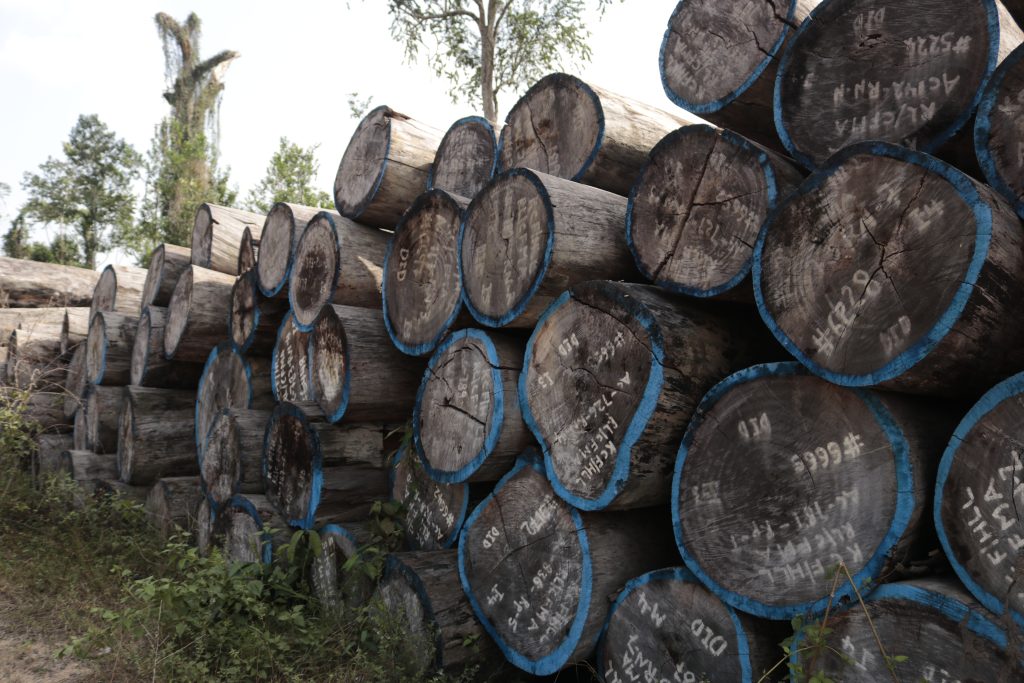
Horizon Logging Limited abandoned several logs in Konobo Community Forest, Grand Gedeh County. DayLight/Samuel Jabba

Horizon has been inactive for two years now, according to its business registration certificate. It deserted a 15-year logging contract with the Konobo Community Forest in Grand Gedeh County. It promised to pay the community, build a school, and erect hand pumps, among others, in exchange for harvesting Konobo’s 49,627-hectare forest. Instead, it left unpaid benefits and several logs in the moggy forest and other locations.

Horizon did not respond to The DayLight’s queries for comments.

Augustus Abram, one of its executives, acknowledged receipt of the newspaper’s queries. Later, he denied it was him, even though the newspaper had contacted him earlier this year about Horizon. The DayLight also called his number on official documents and emailed him, but both attempts failed.

Moreover, The DayLight tried contacting Lev Segev, another Horizon executive, but that effort proved unsuccessful. The newspaper then emailed Jamil Ali Fayad, Horizon’s incorporator, but that too did not materialize.     
Scrap Company Turns to Illegal Timber Trafficking

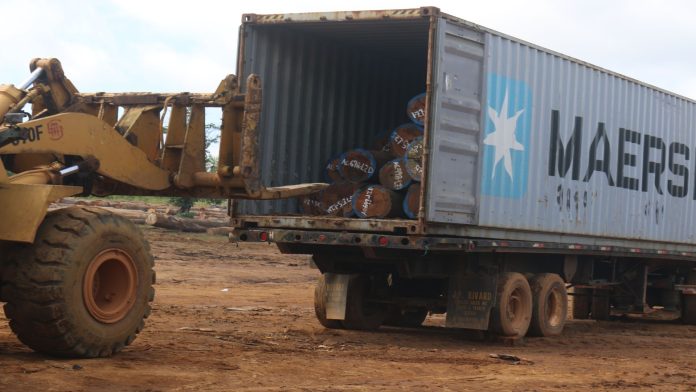
An earthmover uploads timber

Top: A 2022 photo shows an earthmover loading logs into a container in Grand Bassa County. The DayLight/James Harding Giahyue


By Samuel Jabba


MONROVIA – A scrap company on the Japanese Freeway shipped round logs to India outside the legal channel for timber export. Elephant Multipurpose Corporation exported the seven round logs to India in January, according to records of the Ministry of Commerce and Industry.

The shipment was confirmed by Market Insight, an international trade data company and subsidiary of Business Insider, the US-based global financial news giant. It is the only shipment the company, established in 2021, has made. Omkara Overseas, an Indian textile firm, was the buyer.

But records from the Forestry Development Authority (FDA) show that the export occurred outside of LiberTrace, the legal channel for timber trading, known as the Chain of Custody System. The evidence reveals that Elephant Corporation is not registered in the FDA’s system, and has never traded through it. Additionally, Sundeh Albert Blanyon, the FDA’s Deputy Managing Director for Technical Services, confirmed the information.

Forestry Regulation on Establishing a Chain of Custody System requires that timber be shipped through the system so it can be traced from its origins to its final destinations. It guarantees tax payment and community benefit.

Having exported timber outside the system, Elephant Corporation evaded substantial taxes to the government and the community where the timber originated. Taxes include land rental, harvesting, and other fees.

“We have observed a lot of smuggling activities in timber exports. This has not improved businesses and revenue payment to the Government,” says Jonathan Yiah, the lead forest campaigner at the Sustainable Development Institute, a Margibi-based NGO. “Smuggling is bringing a lot of frustration within the affected communities.”

Elephant owners
A collage of Elephant Multipurpose Corporation’s owners. Ismail Y. Sheriff (left) and Ayouba Kamara, via their WhatsApp profiles.

Penalties

Elephant Multipurpose Corporation was founded on October 12, 2021, according to its legal documents at the Liberia Business Registry. Mr. Sheriff has 60 percent shares, and Ayouba Kamara has the remaining ones.

Efforts to interview Sheriff and Kamara did not materialize. However, Mohamed M. Sidibey, an Elephant Corporation executive, claimed that the company had bought the logs at a public auction at the Freeport of Monrovia. He presented no evidence.

The National Port Authority did not confirm or deny the alleged auction. An NPA spokesman said the agency could not say anything about the export because it did not have the identification number of the container in which the logs were exported.

Regardless, the facts contradict the procedure surrounding the alleged auction.

NPA auctions goods that overstay at the ports nationwide. However, it does not have the authority to auction timber. Instead, that authority belongs to the FDA, per the Regulation on Abandoned Logs, Timber and Timber Products. The 2017 regulation requires the FDA to auction unattended logs with a court warrant. Violators face a fine, confiscation of their properties, and imprisonment, but companies exploit poor coordination among government agencies, customs brokers and truckers.

Confronted with the inconsistency, Sidibey shrugged off the likelihood of Elephant Corporation facing any penalties.

“I don’t know about any violation. When they close the company, then we will sit down. I don’t have a problem with the fines or imprisonment; that’s not an issue,” Sidibey said.

Much is unknown about Mr. Kamara’s track record, but his partner is all too familiar.  A 2026 General Auditing Commission report found that Mr. Sheriff and 14 Nimba officials misappropriated US$12 million and L$55 million (US$305,555 today) from the county’s social and county development fund. Mr. Sheriff did not respond to queries for comment on that issue.


This story was a production of the Community of Forest and Environmental Journalists of Liberia.

Lebanese Smuggles Timber and Wins US$500K World Bank Bid

Backup of Chainsaw milling Story

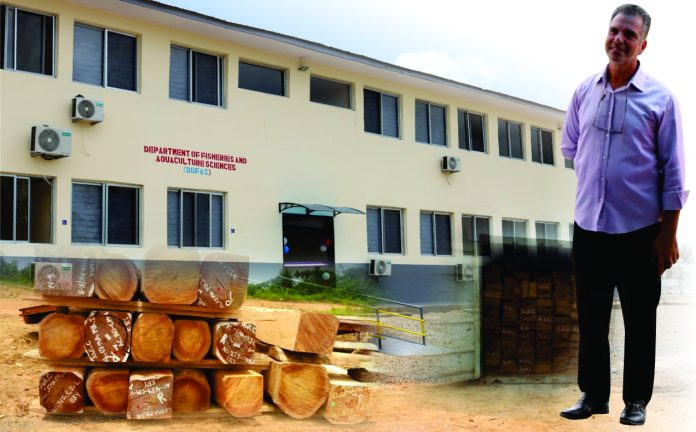
Top: A graphic depicting Lebanese businessperson Moussa Abdul Karim, the University of Liberia’s department of fisheries and aquaculture sciences and timber advertised, and timber blocks Karim advertises on his WhatsApp profile. Graphic by Rebazar Forte and pictures by Franklin Nehyalor


By Varney Kamara


Editor’s Note: This is the first of a two-part series on a Lebanese businessperson’s illegal activities.

  • In 2023, Mak Enterprises won a bid to construct the fisheries department at the University of Liberia, valued at nearly US$500,000, provided by the World Bank.
  • Mak’s owner, Moussa Abdul Karim, smuggles timber, including a US$350,000 consignment, a year before the bid.
  • Between 2017 and 2025, Karim evaded payments for work and resident permits, bringing into question Mak Enterprises’ eligibility for the contract.
  • Official documents identify Karim as a Lebanese. However, Immigration authorities revealed Karim also holds a Guinean passport—another offense.
  • Authorities say they would investigate Karim.

MONROVIA – On March 29, a distinguished crowd gathered at the University of Liberia’s Fendell campus to witness the official handover of its fisheries and aquaculture sciences department. Managed by the National Fisheries and Aquaculture Authority (NaFAA) with support from the World Bank, the state-of-the-art facility features 28 rooms.

The two-story building was constructed by Mak Enterprises Incorporated, a Lebanese-owned real estate company established in April 2017, according to its articles of incorporation and business registration certificate. The company had defeated 20 other bidders to win the bid for the US$498,203.52 contract, intended to improve Liberia’s fisheries sector.

“This facility will serve as a beacon of knowledge, training future generations of fisheries professionals, scientists, and policymakers who will drive the sustainable development of Liberia’s vast marine resources,” Dr. Layli Marpanyan, president of the University of Liberia, told the dedication ceremony.

Perhaps, what no one knew was that Mak Enterprises’ owner, Moussa Abdul Karim, was involved in illegal timber trafficking, tax evasion and money laundering. Karim’s illegal activities have defrauded the Liberian Government of tens of thousands of United States dollars for nearly a decade, a DayLight investigation found.

The findings raise questions as to how Mak Enterprises won the bid to construct the fisheries college when the other bidders failed due to noncompliance. The second part of this series will investigate Karim’s path to clinching the contract, including his company’s tender.

A year before winning the bid,  Karim exported a US$135,000 worth of sawn timber through his second company, Mak Timber Group Liberia Inc. The buyer was Popular Export & Import Company of Bangladesh, according to the Ministry of Commerce & Industry’s records. Mak Timber Group’s tax history shows no payments for timber transport, permit, export and phytosanitary certificate, a Ministry of Agriculture document that certifies that the timber is pest-free for shipment.

Forestry Development Authority (FDA) records show that the export occurred outside LiberTrace, the legal channel through which timber is traded in and out of Liberia. It is a crucial part of Liberia’s timber trade agreement with the European Union, known as the Voluntary Partnership Agreement (VPA). Liberian Timber trade is strictly regulated under the National Forestry Reform Law and the Regulation on Establishing a Chain of Custody System, which requires timber harvest, transport, export, and associated payments to be recorded in LiberTrace.

Experts say Liberia loses about US$1 billion each year due to these illegal financial transactions. In 2023, the US-based Associated Press reported that 70 percent of Liberian timber is perhaps exported outside the legal channel, citing diplomatic sources.

‘Exotic timber’

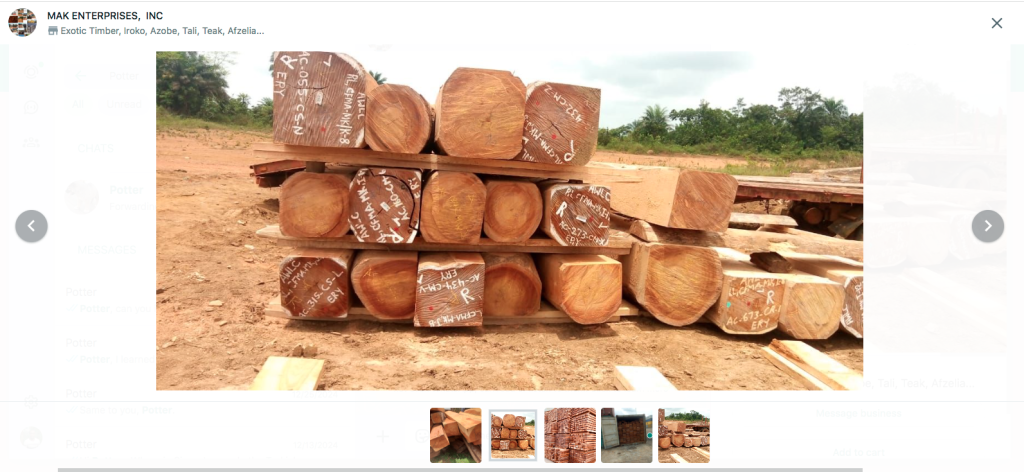
Apart from the lone export, there are no other traces of Karim’s illicit timber trafficking, but social media provides some clues. Pictures of the wood advertised on Karim’s WhatsApp profile show timber blocks, commonly called Kpokolo, in large and medium sizes, bearing a striking resemblance to other documented timber smugglers.

Though Mak Timber Group Liberia Inc. has exported at least once, this screenshot of Moussa Abdul Karim’s WhatsApp profile shows pictures of timber that he likely smuggled out of Liberia from Grand Bassa County

The pictures share the same caption: “exotic timber & services,” under the banner “Mak Enterprises Inc,” a combination of Karim’s wood and construction businesses. In one picture, timber blocks are shown neatly parked in a container. In another, a man stands behind a pile of gigantic timber blocks on an open field.

Most of the timber in the pictures are marked “AWLC” for African Wood & Lumber Company, which has a contract with the Marblee & Karblee Community Forest in Compound Number Two, Grand Bassa County. Cesare Colombo, African Wood & Lumber’s owner, denies having any connection with Karim or his company.

“We don’t know who those people are, we do not have any connection or discussion with them. I just received this information from you and I will take all the necessary action to avoid this kind of problem,” Colombo said in an email reply to The DayLight.

Tax histories of Mak Enterprises, Mak Timber Group and Atlantic Developers & Logistics—Karim’s third company—revealed he evaded more than US$12,000 for work and residents permits between 2017 and 2025. 

The DayLight estimated the value based on official prices: non-Africans pay US$1,000 for a regular work permit, and US$750 for an initial resident permit and US$350 for a renewal. We separately multiplied those figures by nine years, the lifespan of the oldest of Karim’s companies, and added the products. The amount did not include fees that Karim did not pay to the FDA or the Ministry of Agriculture.

Per the work permit regulation, foreign nationals doing business in Liberia must hold valid work permits or risk fines, ranging from $1,000 to $10,000, including sanctions or expulsion.

Similarly, foreigners residing and doing business in Liberia without a resident permit violate the Aliens and Nationality Law. The law obligates non-Liberians to obtain a resident permit, and failure to do so constitutes a violation, whose penalties include fines or deportation.

The Ministry of Labor and the Liberia Immigration Service (LIS) confirmed that they did not have any records of Karim, except for one instance.

“We have checked the system and did not find any payment records there,” said Ralphael Donokolo II, Assistant Minister for Alien Registration and Liberianization at the Ministry of Labor.

In 2021, Karim paid US$150 for a resident permit under Mak Timber Group with a Guinean passport, according to the Liberia Immigration Service. However, the business registration certificates of Mak Enterprises and the other companies indicate that Karim is Lebanese. This was corroborated by a 2016 court case involving Mak Enterprises, where a judge was suspended for one year for soliciting a bribe, only to eventually rule in Karim’s favor.  

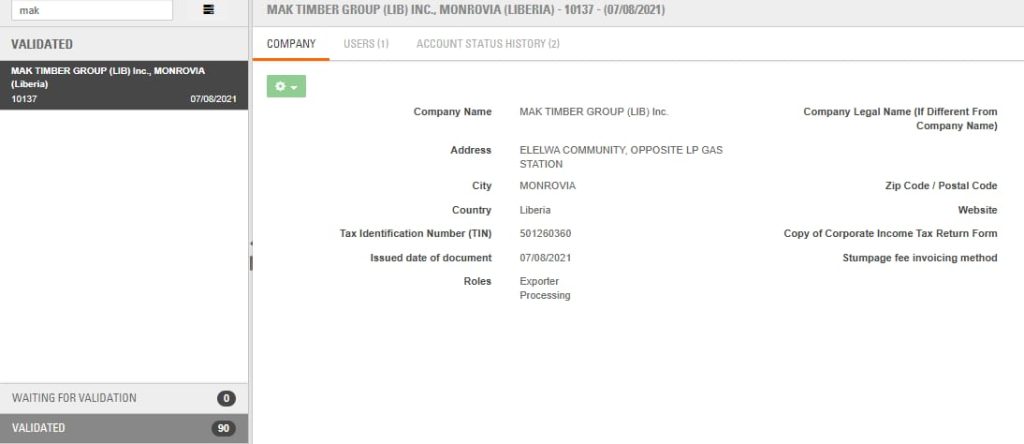
A screenshot of the FDA log-tracking system shows that Mak Timber Group Liberia Inc. shows that the company has never used the system to export timber, proof of his smuggling activities.

By law, Karim is required to provide his “full and true name” and accurate information when applying for visas, resident permits, or other official documents. Using multiple identities constitutes fraud and can lead to expulsion, deportation, and criminal prosecution for violators.  

“You cannot carry two identities in Liberia as an alien,” said Elijah Rufus, Commissioner General-designate of the Liberia Immigration Service, via WhatsApp.

Karim did not respond to queries. He evaded detailed questions The DayLight posed to him through WhatsApp text messages and repeated reminders. Joseph Bennett, his lawyer, did not return the queries either.

Labor and immigration authorities disclosed they were investigating Karim, based on The DayLight’s queries. Donokolo said, “In line with the law, he will be fined USD3,000, plus additional USD1,000 for accepting to work without a valid work permit.”


This story was a production of the Community of Forest and Environmental Journalists of Liberia (CoFEJ).