
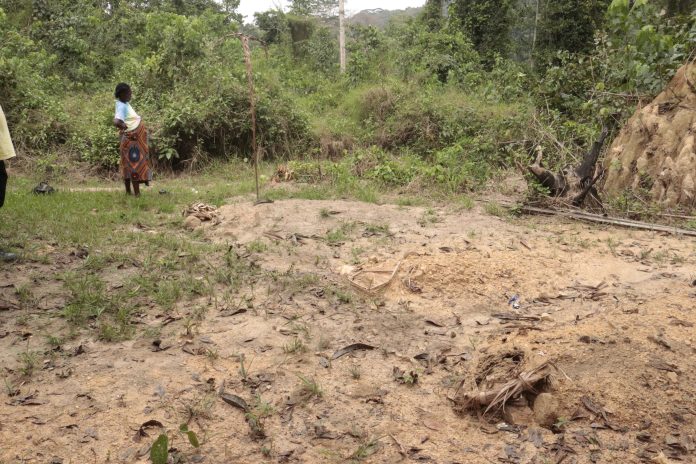
Top: The graves of three miners only identified as Bassa Boy, Timiya and Tamba on Success Camp in Massawo Town, Lofa County. The DayLight/Samuel Jabba
By T. Prince Mulbah
SUCCESS CAMP – In November 2024, a man, only identified as Mackey Boy or Bassa Boy, drowned in a mining pit in a forest in Lofa County. Bassa Boy, in his mid-30s, disappeared in an abandoned mining pit on that fateful Saturday morning.
A search party found his lifeless body the next day in Success Camp, a goldfield in Massawo Town in Lofa County’s Zorzor District. Eyewitnesses—fellow miners and townspeople—said the doomed miner was moving gravel a mining company had piled up when he met his death. He was buried the following day.
Bassa Boy is one of several unidentified miners who died in mining pits abandoned by an illegal operation conducted by J.M. Mining Incorporated, a Chinese-Liberian company, and were buried in the mines they dug. J.M. Mining had operated the mine for nearly a year after its license had expired.
The Ministry of Mines and Energy records show that J.M. Mining’s gold prospecting license was issued in May 2022 and expired in November 2023. However, the company continued to operate up to September 2024. That same year, the EPA fined it US$95,000 for operating without a permit in Gbarpolu County.
“J.M. Mining’s ugly work they did here is killing people’s children,” said Junior Wolewu, Massawo’s Town Chief. “We don’t have any information about their families.”
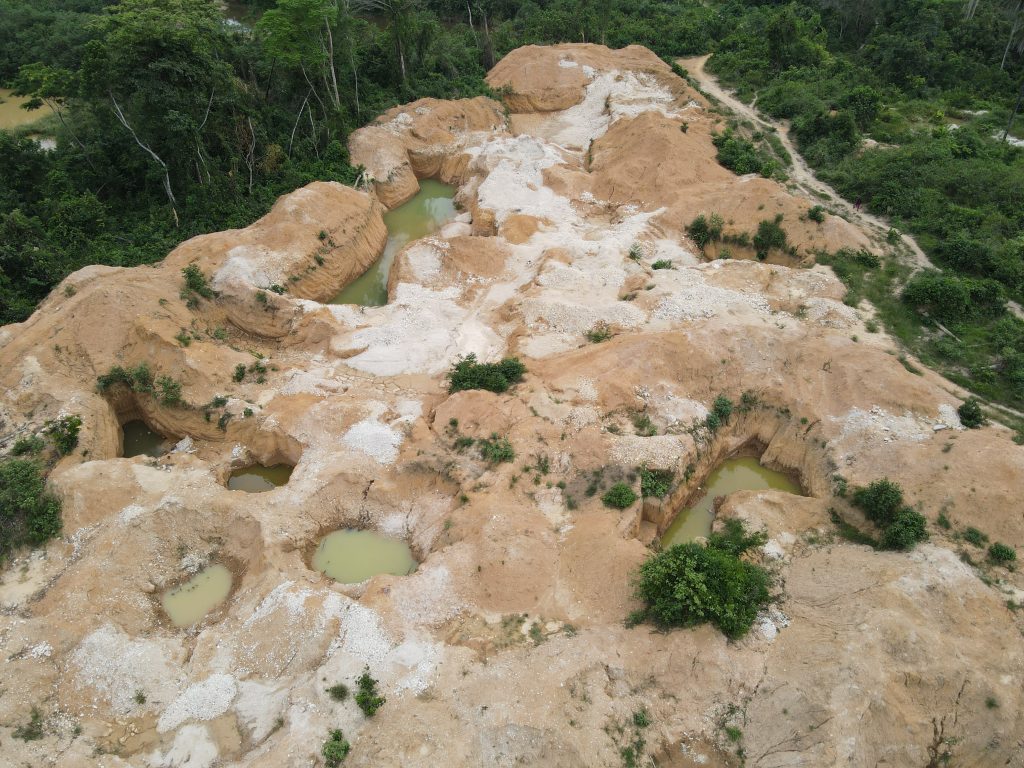
Reporters documented several holes J.M. Mining Company dug and failed to refill. The once-thick, forested area has been transformed into a hollow-out wasteland of open, giant-sized pits.
‘People really cried’
Bassa Boy’s grave lies a few minutes’ walk away from the pit in which his life ended. Next to his grave are those of two miners, only identified as Tamba and Timaya. The three were unlicensed miners, or “gold boys,” who followed abandoned mining trails. Gold boys either utilize abandoned pits or dig their own, in a relentless hunt for gold. Like rogue companies, they are responsible for degrading the landscape of the countryside and polluting watercourses that communities use for drinking.
Short, bright in complexion, and 30-something, Bassa Boy arrived at Success Camp a few years ago. He always wore a beanie like the ones sported by the late American singer-songwriter Marvin Gaye.
“I was not here that Saturday. When I came, they informed me that he had left in the water. People really cried, including me,” recalled Agnes Gibson, a townsperson.
The grave next to Bassa Boy’s is the final resting place of a miner who went by the alias Timaya. Nicknamed after the popular Nigerian Afrobeat star Timaya, he was an average-height young man. One evening, while he and two others were working, he fell into a pit. His friends sought help but were unsuccessful and watched painfully as he drowned.
The third victim, Tamba, a black and tall man who also repaired mining equipment at Success Camp, died late last year. A pile of loose gravel had fallen on him while operating an earthmover. He had his residence in Massawo Town and was a regular “gold boy” contractor between mines, townspeople said.
“All the gold boys don’t stay long in one place. They can come to hustle and go at any time,” Gibson said.
Reporters witnessed firsthand victims’ graves with red earth piled over them. No stones were placed around the graves, like in the traditional rural way. Only wreaths made of palm leaves and sawgrass were placed at the head of the graves.
Massawo locals are sympathetic towards the strangers who came to make ends meet and ended up being buried here. In rural communities, drowning and other natural accidents are believed to be a bad omen, even worse with unnamed victims. To vanquish the misfortune, they are buried outside regular graveyards.
“All three of them, nobody has seen any of their families since they died. When they (miners) come here, they don’t call their real names, so it is difficult for their families to know when they died, Gibson told reporters at the gravesite.
“We feel bad,” she added.
Reporters documented another graveyard on Success Camp, which hosts a lone grave. It is the final resting place of a miner only identified as Prince. It lies about a 15-minute walk from the graveyard, where Bassa Boy, Timaya, and Tamba were buried.
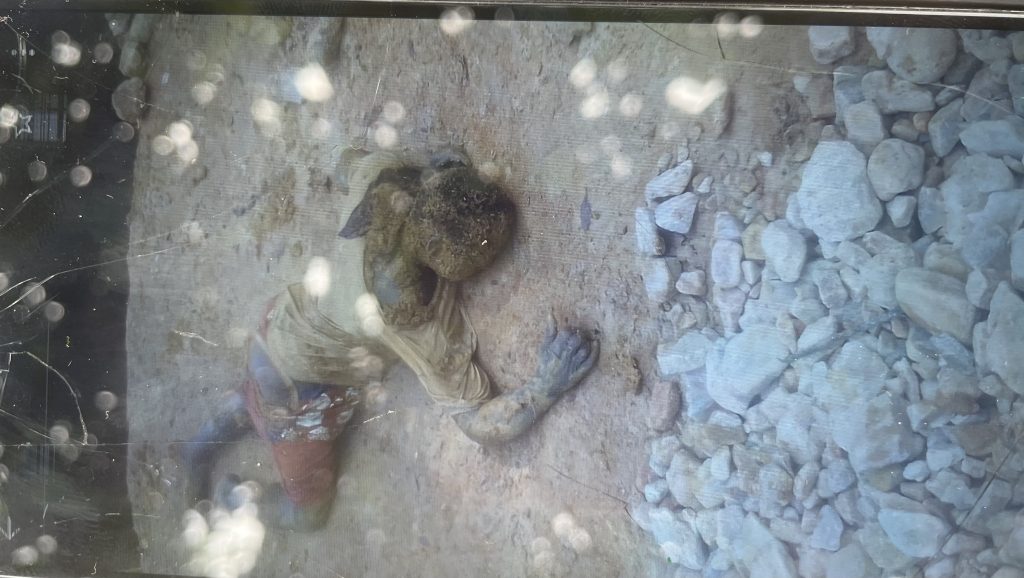
Prince met his death due to a mining accident on this New Year’s Eve. Dirt fell into a pit he was digging at night, killing him. The deceased’s friend, who was the only other person there, was unable to rescue him. The sheer depth of the pit and the weight of the gravel overwhelmed the one-man rescue party, according to Wolewu.
“A 15-man jury examined his body, and police came from Salayea to see the body. From there, we buried him in the same mine,” added Wolewu. Pictures captured by townspeople, The DayLight obtained, show the unfortunate Prince lying on a makeshift, wooden stretcher just before his burial.
Papay Kpannah, the fifth—and only identified—miner, died in 2021 or 2022 elsewhere in Kpeteyea Town, Salayea District, where Golden Trip Group Limited, another company owned by Randy Scott, operated. Kpannah was a citizen of Kpeteyea but spent almost all his life in Monrovia. He had returned home in search of a job. His grave lies on the outskirts of Kpetayea, at the edge of a cocoa farm, marked with a stone circle.
Golden Trip was established in April 2018, with 75 percent shares for Chinese national Chein Haibin and the rest for Scott. It started operations in Kpeteyea by May 2020. In 2024, the Ministry of Mines and Energy placed its license on hold and later canceled it for noncompliance, about two years after Kpannah’s death.
Like the other victims, dirt from the top of a Golden Trip pit in which he was working fell on Kpannah. George Vesselee, the late Kpannah’s relative, said there were excavator bucket impressions on his body. It was unclear whether the machine operator tried to rescue him.
“He was working with the Chinese man that Golden Trip assigned to the excavator. What we heard was they were only two—he and the excavator operator. When the excavator removed the dirt, there was a piece of rock he went to pick… and the dirt… fell on him,” narrated Vesselee.
“When I received the information [of the accident], I came in and saw that he was still alive. They tried rushing him to the hospital, but he died along the road between Gorlu and Gbongay Town,” added Vesselee.
Failure to restore the land
The Liberian Minerals and Mining Law requires miners to restore the disturbed environment after operations. It calls for miners to report deaths and injuries, consistent with the Decent Work Act.
However, that provision is not being enforced, leading to deaths from mines countrywide. In 2019, about 40 miners were buried alive in Tappita, Nimba County, in the worst mining accident in postwar Liberia. In 2024, several miners died in a mine collapse in River Cess County. Earlier that year, a mineworker drowned in an open pit in Belle Yalla, Gbarpolu County.
Scott denies that miners died on any of his companies’ gold mines.
“It is not to my knowledge. Nobody died in the mine,” Scott told The DayLight in a phone interview. “You know how many years nobody worked down there? You know when we left that place? How will you be asking about three years ago?”
“Why will you blame me for something I know nothing about? I don’t know about holes, pits, or whatever you call them. I was the manager of J.M. Mining, and I don’t even know how that contract ended with the Massawo people, so I can’t take the blame for people’s deaths in the gold mine,” added Scott.
He also dismisses evidence that his companies abandoned mining pits in which four of the five miners died. He said his companies could not dig pits while they were working on mountains.
“Who can cover a mountain?” Scott asked rhetorically. “Is a mountain a hole?”
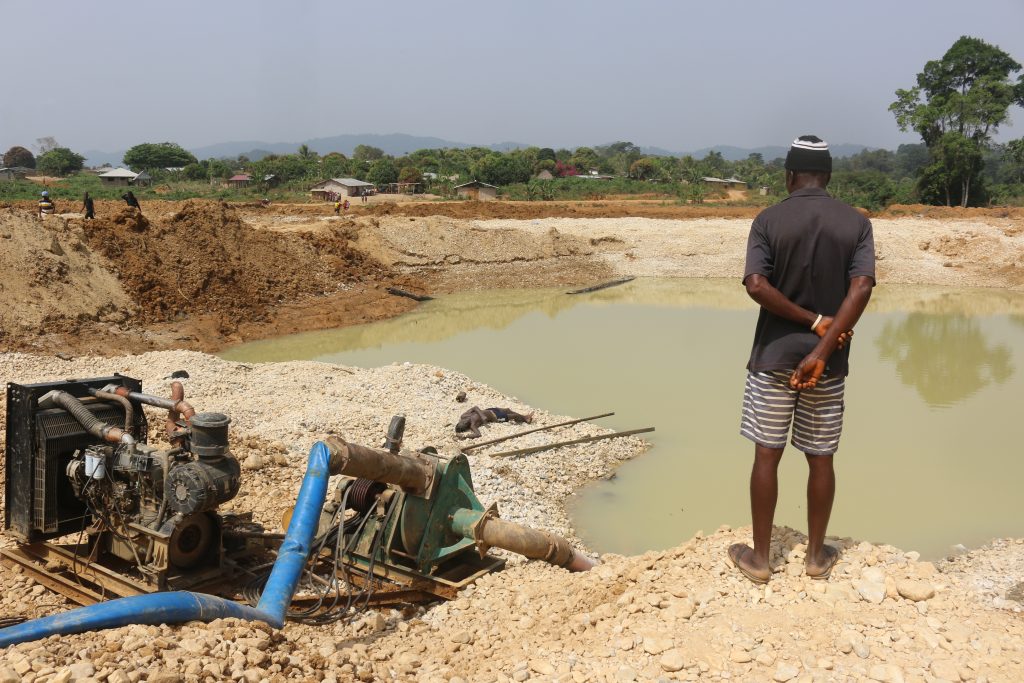
Though both Massawo and Kpeteyea are hilly communities, the videos and pictures reporters captured show large holes in the areas where J.M. Mining and Golden Trip operated. Some of the pits measure over 12 feet deep, with a network of pipes supplying water from a nearby river to the hilly mines.
[Samuel Jabba contributed to this story]
This content is produced by DayLight with support from the Embassy of Ireland through Integrity Watch Liberia. The DayLight maintained editorial independence over its content, which does not reflect the position of the Embassy of Ireland or Integrity Watch Liberia.