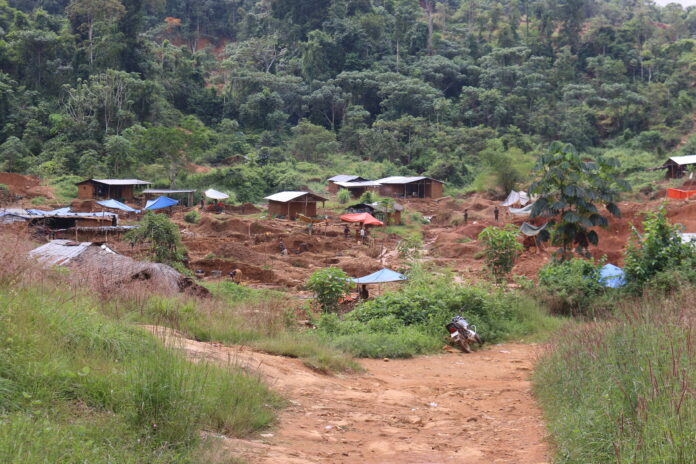
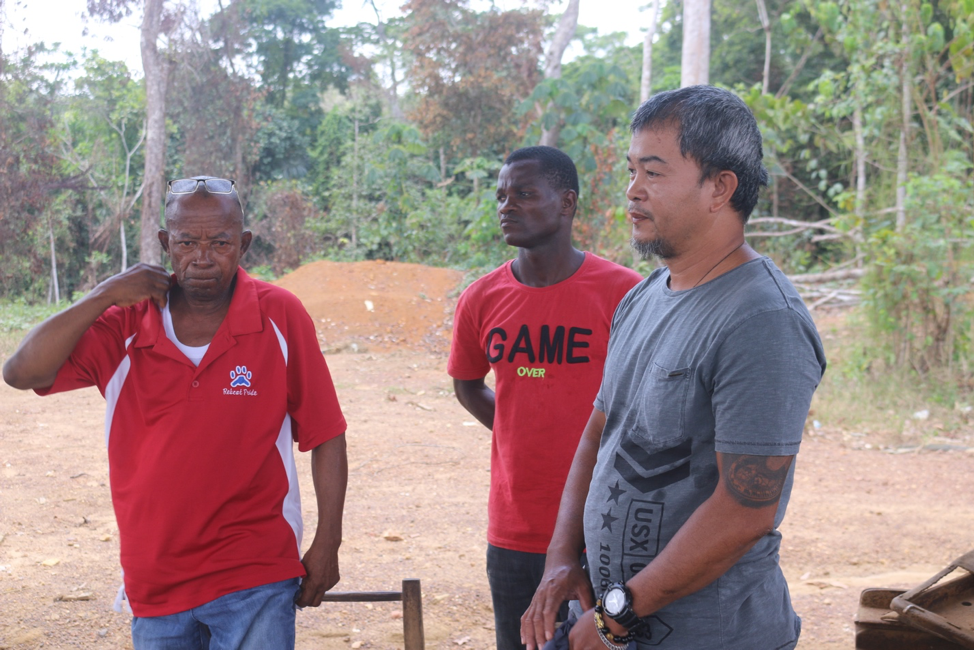
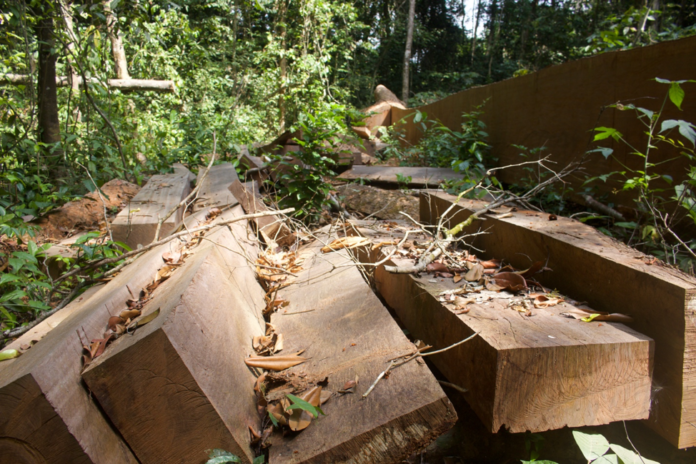
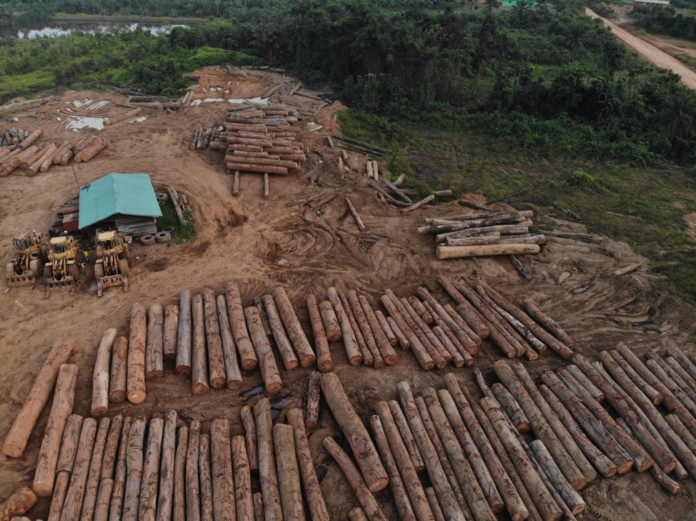
Top: An artisanal mine in Wayjue, Grand Cape Mount County on November 20, 2019. The DayLight/James Harding Giahyue
By James Harding Giahyue
MONROVIA – The United States has pointed out health, safety, and environmental problems that occurred last year in Liberia’s extractive industries, criticizing the Liberian government for human casualties and the lack of accountability in the sectors.
“Hazardous occupations were especially dangerous in the informal sector, such as illegal fishing, logging, and mining, where the lack of regulation and remediation contributed to fatalities and obscured accountability,” the U.S. State Department’s annual report, released Monday, said.
“The government did not keep records of industrial accidents, but evidence pointed to mining, construction, forestry, fishing, and agriculture as the most dangerous sectors,” it added.
The report said businesspeople exploited unsafe and unregulated artisanal mines. It added widespread illegal mining activities resulted “in the deaths of several persons every year, and that “No official entity provided social protections for informal-sector workers.”
It said workers added earnings from subsistent farming, artisanal mining and other informal businesses to their pay from the formal sector.
Corruption
Officially known as the annual Country Reports on Human Rights Practices, the U.S. State Department has released the publications, which cover 198 states, for the last five decades. It gauges countries’ political, civil rights and workers’ rights under the Universal Declaration of Human Rights and other international instruments.
The report shined a light on land and other natural resources-related conflicts in rural Liberia and cited a media report of alleged sexual harassment at the Maryland Oil Palm Plantation.
It spoke of “significant” human rights abuses in the country from “obstruction” of press freedom and “serious” problem with the Judiciary to unlawful killings and the lack of accountability in the country.
“There were numerous reports of government corruption during the year,” the report said. It mentioned the resignations of Minister of State for Presidential Affairs Nathaniel McGill, Solicitor General and Chief Prosecutor Sayma Syrenius Cephus, and National Port Authority Managing Director Bill Twehway, who were sanctioned by the U.S. Treasury Department in August.
“Officials frequently engaged in corrupt practices with impunity.”
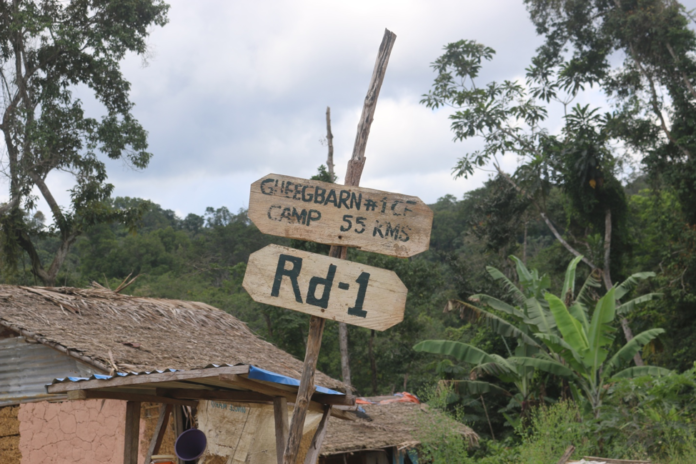
Top: A signboard at a logging company’s camp in the Gheebarn #1 Community Forest in Compound Number Two, Grand Bassa County. The DayLight/James Harding Giahyue
By James Harding Giahyue
COMPOUND NUMBER TWO, Grand Bassa County – Five ambassadors organized an exchange among locals, a logging company and the Forestry Development Authority (FDA) to get the gist of the challenges of community forestry.
It took one and a half hours for the envoys from the European Union, Sweden, France, Germany and Ireland to get what they were looking for. Leaders of the Gheegbarn Community Forest and West Africa Development Incorporated (WAFDI)—and the FDA—presented a perfect picture of one of forestry’s most problematic contracts. Each of the three actors took open aims at one another, as they entertained questions from the ambassadors.
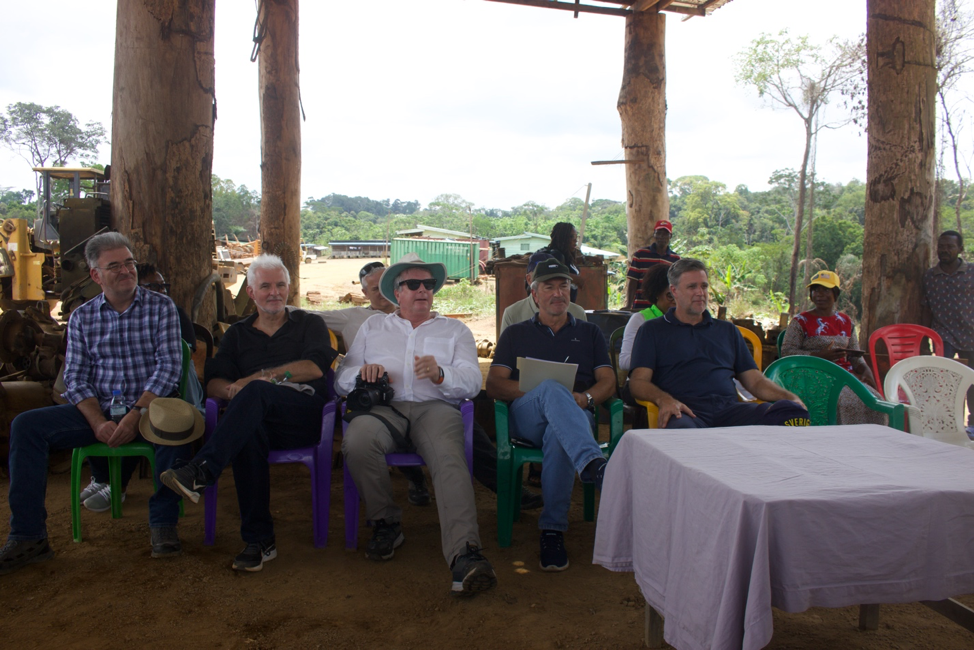
The ambassadors on the visit were Laurent Delahousse of the European Union, Urban Sjöström of Sweden, Jacob Haselhuber of Germany, Michael Roux of France, and Gerard Considine of Ireland. The spouses of the five men also graced the occasion.
Larry Tuning, a member of Gheegbarn’s community forest leadership, started with WAFDI’s unfulfilled required projects in their December 2018 agreement. He criticized the company for not paving farm-to-market roads, erecting schools clinics and handpumps, and underwriting the costs of quarterly meetings. He, however, praised the company for meeting scholarship, land rental and log-harvesting payments.
Asked whether he would recommend commercial logging in community forestry, Tuning’s response was obvious. “It is hard for me to tell my friends to say ‘Get into it,’ because I [am] facing too many problems,” Tuning added as staff of WAFDI, sitting opposite looked on. “Instead of going into logging if had the support I would go into conservation.” Community forestry is a crucial part of Liberian forestry, giving rural communities the right to comanage their forests.
‘Let them go’
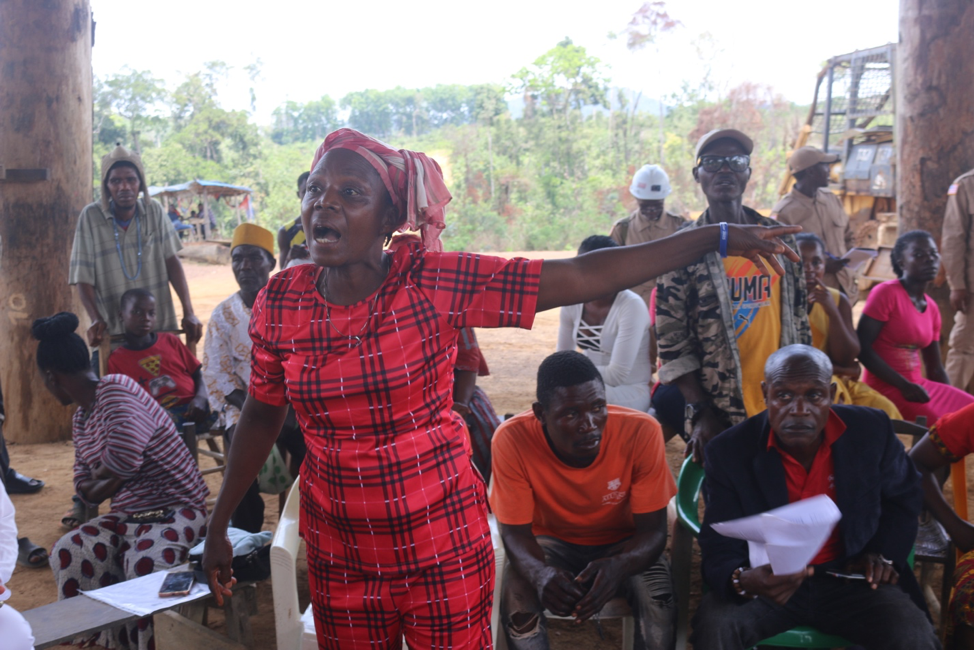
Tuning continued for several minutes, tearing into WAFDI on labor issues. He said the company had contravened a clause in their agreement, which mandates it to employ 60 percent of its workforce from the community. Dugbormar Kwekeh, another member of the community leadership buttressed his comments—and in a dramatic fashion, too.
(R-L) Urban Sjöström, Ambassador of Sweden; Jacob Haselhuber, Ambassador of Germany; Laurent Delahousse, Head of the European Union Delegation; Michael Roux, Ambassador of France; and Gerard Considine, Ambassador of Ireland. The five envoys listen to leaders of the Gheebarn #1 Community Forest in Compound Number Two, Grand Bassa at an information and fact-finding tour of the west-central county on March 9, 2023. The DayLight/James Harding Giahyue
“They are just extracting our logs and there is nothing we are benefiting from,” Kwekeh said in Bassa through an interpreter. Gesturing as she went along, with an audible voice, she expressed frustration and fury. “The company came to subject us to poverty. “Let them go from here. Another company can take us from poverty.”
Gualberto Ojo, a Filipino who represented WAFDI in the meeting, denied preventing locals from farming. In fact, he accused them of farming on a portion of the 26,363 hectares of forestland they contracted to the company in Compound Number Two, Grand Bassa County.
“The company cannot stop the community people from farming; is not for us to say that it is the source of living,” said Ojo. “Most part of the forest is all farming activities, so because of this and other reasons the forest is not really productive.
Dugbormar Kwekeh, a member of Gheegbarn #1 Community Forest tells European envoys about challenges with commercial logging in that part of Liberia. On the far left is Larry Tuning, the secretary of the community forest. The DayLight/James Harding Giahyue
Pit-sawing
Before responding to Kwekeh’s comments, Ojo took a well-timed swipe at Tuning, who is a chainsaw miller. Tuning’s mention of pit-sawing had led to indistinct muttering among FDA representatives at the meeting. Also called pit-sawing, chainsaw milling began after the Second Liberian Civil War (1999-2003), and efforts to regulate the sub-sector have failed so far. It has wreaked havoc in forests across the country. Ojo, said, that included Gheegbarn #1.
“Pit-sawing is one major challenge; it has taken over the forest,” Ojo said, who said he first spotted the illegal activities in 2020. He said WAFDI had told the FDA about it. “People are doing pit-sawing all in the forest now.”
Human settlements and factors affecting the global logging industry were other issues, according to Ojo. A company representative said there were people from the neighboring Bong County living in the forest, and that the coronavirus and the ongoing U.S.-China trade war.
“During that four years the market on round logs collapsed totally,” Ojo told the diplomats.
Workers of the West African Forest Development Investment (WAFDI) an information and fact-finding event organized by European ambassadors. The DayLight/James Harding Giahyue
‘We were like turtles’
Then entered the FDA, represented by Deputy Managing Director for Operations Joseph Tally and a host of top-level managers. There was an announcement from Weedor Gray, the technical manager of the community forestry department for periodic reports from communities. And more questions came.
“Have you ever come to the FDA to request for harvesting or export data?” Gertrude Nyaley, the technical manager for the legality verification department, asked Tuning. Nyaley’s rhetorical question was a response to Tuning’s earlier reply to an envoy about WAFDI’s production and export records. Tuning had said the community did not get the documents, and only accepted fees the company paid. Production records, in particular, are crucial in calculating harvesting payments, known in the industry as cubic meter fees.
Nyaley further pressed Tuning whether he and Gheegbarn’s leadership had informed the townspeople of a US$18,000 WAFDI paid. That question caused a stir among villagers at the event. Tuning encountered a rebuke from a local named Sylvester Williams, who had suggested community benefits were being misused. William disagreed with Tuning that the leadership supported villagers’ farming activities, bursting into a peal of frenzied laughter. Tuning said Williams was busy with his motorcycle taxi and was unaware of community matters. That pushed the community forestry drama to its highest peak. In a phone interview with The DayLight on Sunday, Tuning denied misapplying the fund, saying the leadership had already informed the community about the payment.
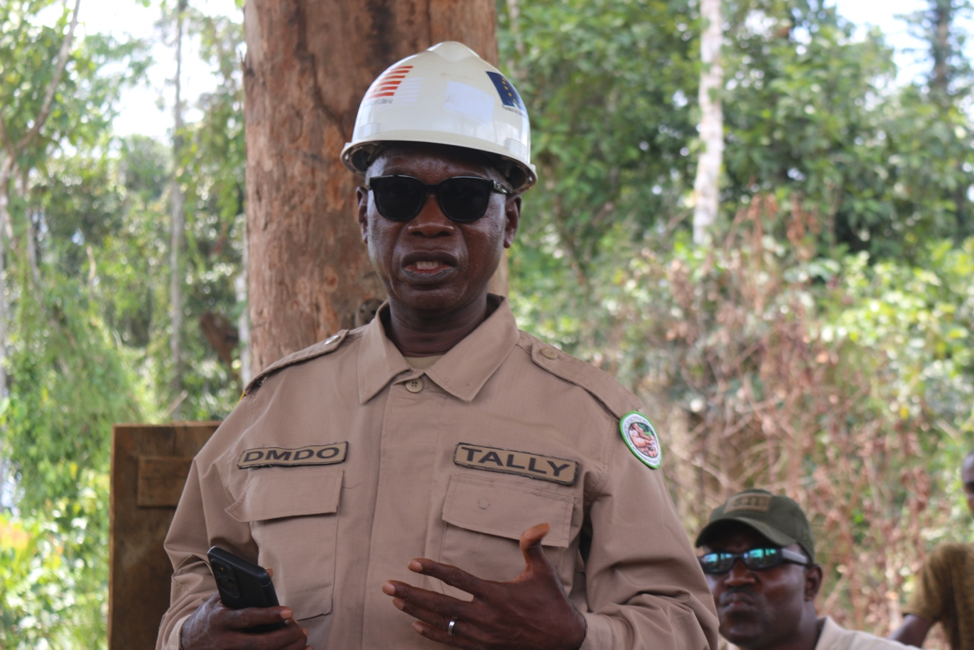
Tally, dressed in khaki uniform like all the managers of the FDA, thanked the European ambassadors for the event. “We were like turtles, and you put fire on our backs,” he said.
Joseph Tally, the deputy managing director of the Forestry Development Authority (FDA) speaks at the event. The DayLight/James Harding Giahyue
Tally’s comments were a reference to criticisms of the rise in forestry violations and the trade of illegal timber. Both the national and international media have published reports of logging wrongdoings, involving the FDA. It was a major issue at last month’s forest and climate forum, where Liberia reassured its commitment to combat illegal logging and climate change in its pursuit of climate financing.
But talking about the correction of past wrongdoings, Gheegbarn #1 was the right place for Tally and his team. Last year, a Ministry of Justice investigation found the FDA awarded WAFDI excess forest blocks. The report, seen by The DayLight, cut the deal between the company and the community from 15 to seven years. Several senior managers were replaced in the fallout of the scandal. The parties have signed a new agreement.
Conservation
Delahousse said the delegation had not come to condemn any of the actors. “This was not a trial of the company. This is a fact-finding information mission, and for us, it was very important to be here and to hear all the various stakeholders,” said Delahousse.
Delahousse said he learned that community forestry was “complicated,” a “bit of a bobble,” and lacked transparency. He urged communities to consider conservation programs instead. Of the dozens of community forests, only a few have a conservation management program. Others have scrapped it to accommodate mining.
“We need to work also on seeing how conservation can be an alternative for some communities,” Delahousse said. “Maybe they can make more money from conservation.”
After the meeting, the ambassadors and their entourage toured a portion of Gheegbarn Community Forest with the FDA. The visit ended with a trip to the log yard of Kisvan in Buchanan, which operates in the Central Morweh Community Forest in River Cess.
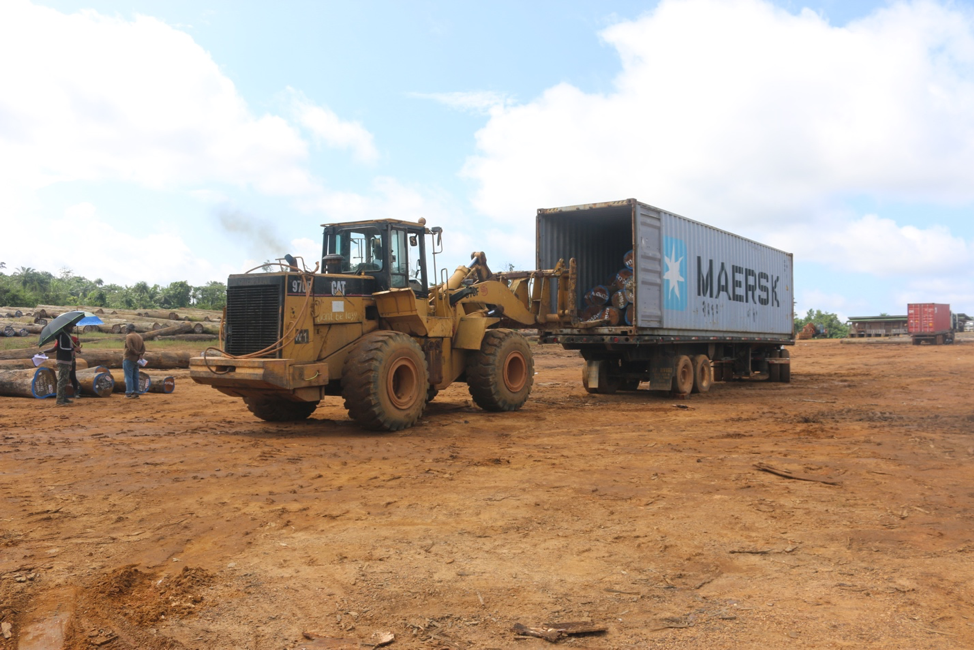
Workers of WAFDI load logs into a container at the company’s log yard in Compound Number Two, Grand Bassa County in September 2022. The DayLight/James Harding Giahyue
Top: A kpokolo operation site in Gbaryama, Gbarpolu County. The DayLight/James Harding Giahyue
By James Harding Giahyue
MONROVIA – The Forestry Development Authority (FDA) has banned the transport of squared timbers, commonly called “kpokolo,” to curtail illegal exports.
In Kpokolo logging operations, individuals sign agreements with villagers to harvest logs, and mill them into thick, heavy timber blocks. The woods are then packed into containers and smuggled out of the country.
“We have ordered all our checkpoint staff members to stop the issuance of waybills for all sawn timbers with a thickness above two inches because this is the dimensional range of thickness that is prone to illegal exportation,” said Edward Kamara, FDA’s manager for forest marketing and revenue forecast. He was responding to an email inquiry by The DayLight after reports of a likely ban on the activities began to emerge.
Kamara said the ban does not cover similar timbers produced by licensed sawmills, which resize timbers to meet local customers’ demand. He said the FDA had allowed chainsaw millers to also trade the woods locally but they went beyond their limits.
“It had been observed that most of the timber arrested for attempting to illegally export consisted of these dimensions,” Kamara told The DayLight. “Therefore, it is the chainsaw milling block wood… that is banned to be brought to the market, especially in Monrovia.”
Kamara did not say when was the ban imposed but rangers and kpokolo producers had put it to as early as September last year.
The announcement of the ban comes barely five months after the first report on kpokolo emerged in the press.
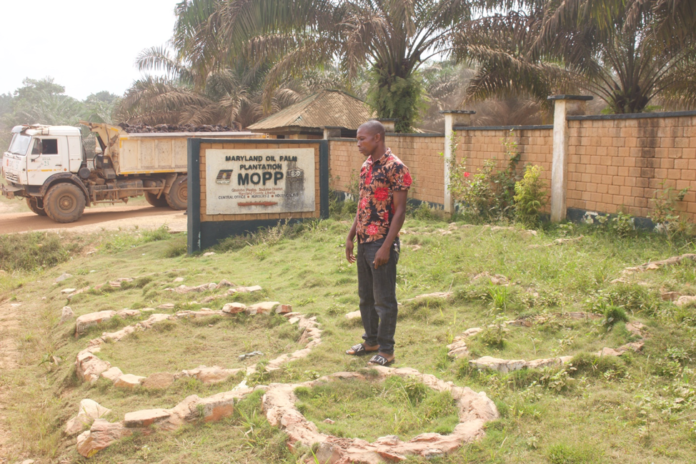
Top: Saturday Wilson has defended his farmland against the Maryland Oil Palm Plantation (MOPP) for nearly 13 years. The DayLight/James Harding Giahyue
By James Harding Giahyue
PLEEBO, Maryland County – One day in 2016 policemen arrested Saturday Wilson at his farm. Wilson had been accused by the Maryland Oil Palm Plantation (MOPP) of stealing fertilizers, a court document shows.
Wilson spent two days in a police cell and after a relatively short case, the Pleebo Magisterial Court sentenced him to three and a half months in prison. It said he prevented the company from clearing the land the government had leased to it.
“I told [the judge], ‘For me, I am not embarrassing the concession but that is my land,’” Wilson tells The DayLight at his home in Gewloken in the Gbolobo Chiefdom of Pleebo Sodoken District.
“I will serve my sentence but when I come, the land will remain there. I will meet it there. It will still be for me.”
That was not Wilson’s first ordeal with MOPP, and not his last either. In the last 13 years, the 47-year-old farmer has been embroiled in a battle with the company over his farmland. It has placed him behind bars three times. However, he still owns the land.
MOPP had come to Pleebo in 2010 and began clearing some 15,200 hectares of land ahead of its agreement with the Liberian government. Many people, including some of Wilson’s relatives, lost their villages, farmlands, ancestral graveyards and shrines. The following year, MOPP signed an agreement worth US$203 million for 25 years, stretching as far as Grand Kru.
But Wilson would beat all odds to defend the remaining portion of his ancestral land. His family and the people of Gewloken had lost a huge swathe of land to Decoris Oil Palm Company, a previous Ivory Coast-based firm that operated in that region from 1980 to 1987. As a matter of fact, MOPP inherited the ruins of Decoris’ plantation as the result of Liberia’s first and second civil wars.
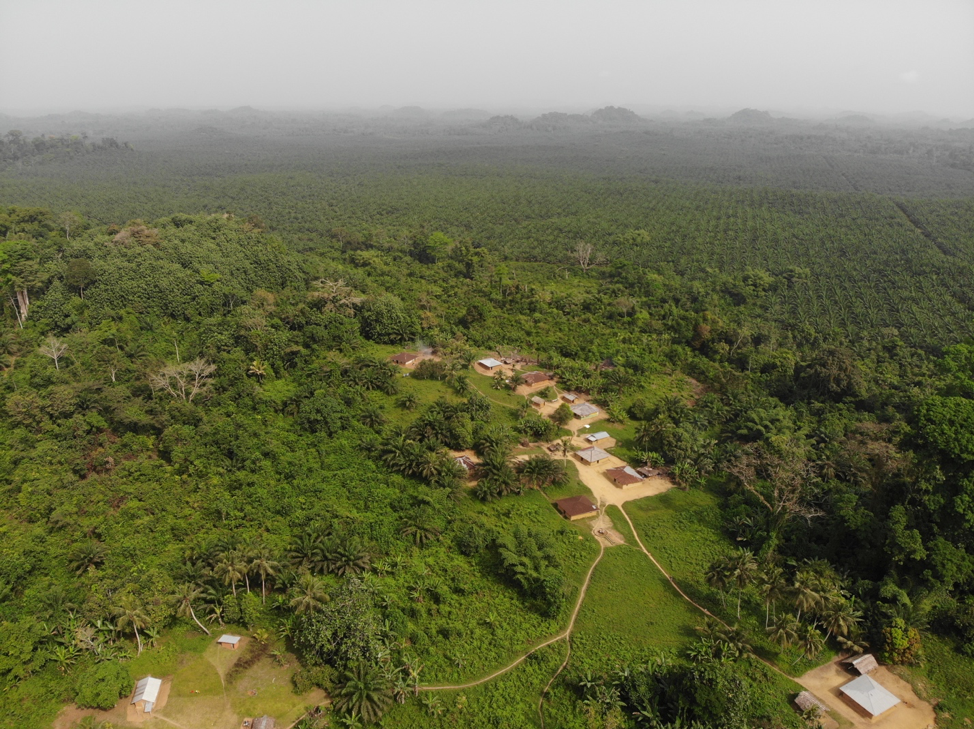
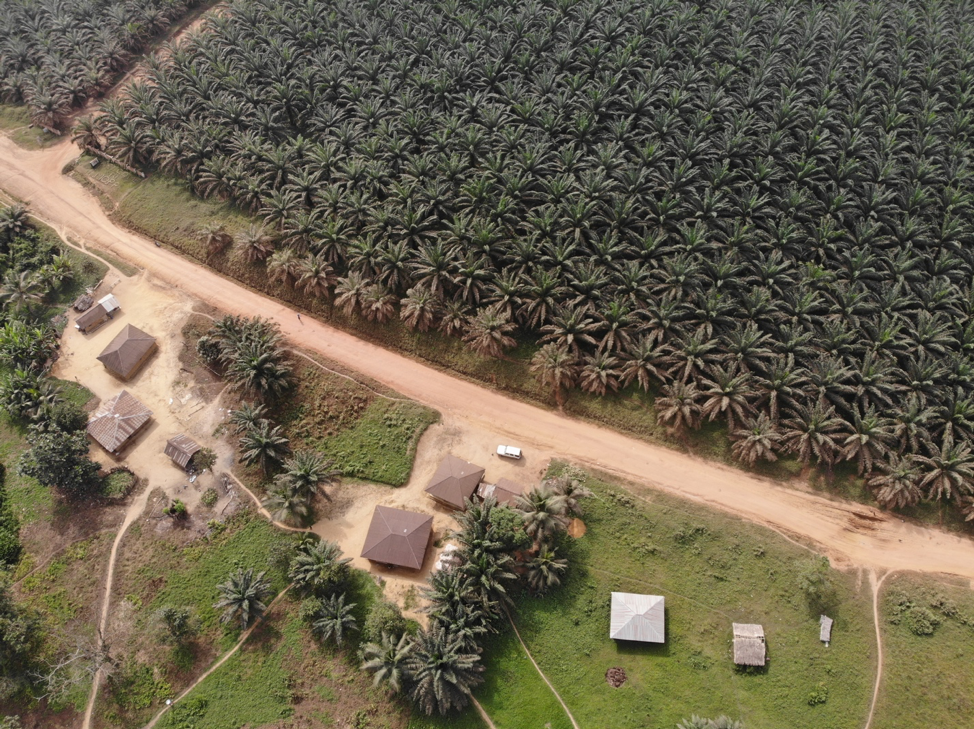
This Drone photograph shows Gewleken, Saturday Wilson’s hometown, engulfed by the Maryland Oil Palm Plantation (MOPP). The DayLight/Derick Snyder
Wilson was a teenager back then but still remembers how Decoris wiped out his Gewloken town. Several generations of the Wilson clan had lived on the land as far back as the 1800s when Maryland was a territory in Africa. In 1978, tribal chiefs and elders presented the family with a paper for the land, seen by The DayLight. In those days, customary land rights were not recognized but people were issued tribal certificates as a process leading to a formal title. Decoris, however, did not recognize that document.
Now a full-grown man, Wilson could not afford to lose an inch of the land once more. “As a child when you coming up that land becomes part of you,” says the father of six.
Wilson’s first encounter with MOPP happened in October 2010. MOPP had sent workers to clear land they claim is part of its concession area. They destroyed banana shrubs and rice stalks on his farm. Still haunted by memories of Decoris’ land grab, Wilson was furious. A scuffle ensued, with men from Gewloken joining the fray.
Then the police arrived on the scene.
“They went and arrested us, we were 16 persons, took us to Harper,” Wilson recalls. “So, after two days we were released.”
After that encounter, Wilson and MOPP tried to resolve their issue but it would only lead to more tension. Bowing to pressure from some of his relatives, friends and local officials, Wilson agreed to give up his land with the agreement that MOPP would compensate him for his crops. In 2015, MOPP counted some of the crops on his farmland but abandoned the process after the first day, according to Wilson. His half-torn handwritten record of the count shows 2,259 plantain shrubs, 327 palm trees and 25 pineapple plants.
Though frustrated over the failed crops compensation deal with MOPP, Wilson remained calm. In fact, he regretted having agreed to give out the land in the first place. Nearly all of the people who started the advocacy with him five years ago had given in. The ones in MOPP’s employ complained of alleged bad labor practices, including low wages.
This photograph shot with a drone shows Gewloken, the hometown of Saturday Wilson, just next to the Maryland Oil Palm Plantation. The DayLight/Derick Snyder
“I wanted to compromise with them… because of the tension,” Wilson says. “I am looking at other things to come. It’s better to maintain my piece of land than to work with the company. So, I am not willing to give it.”
After Wilson returned from prison, he sought permission from the court to get back to his farm.
The court arranged a hearing between Wilson and the company’s legal team. Then came the big news: MOPP told the court they had no land case with him, according to Wilson. The DayLight could not verify that claim. Wesley Kortor, the magistrate of the Pleebo Magisterial Court said it could not locate the case file due to a burglary incident. Efforts to obtain the documents from MOPP and Wilson did not materialize.
Wilson returned to his farm, happy that his struggles with MOPP were over, but his celebration would be short-lived once more. On Friday, June 8, 2018, MOPP workers made away with 180 bunches of palm nuts Wilson had harvested. He filed a complaint with MOPP’s community liaison committee, a body set up by the company to look into community grievances. It has been crucial in restoring calm to the region after MOPP’s controversial deal with the Liberian government.
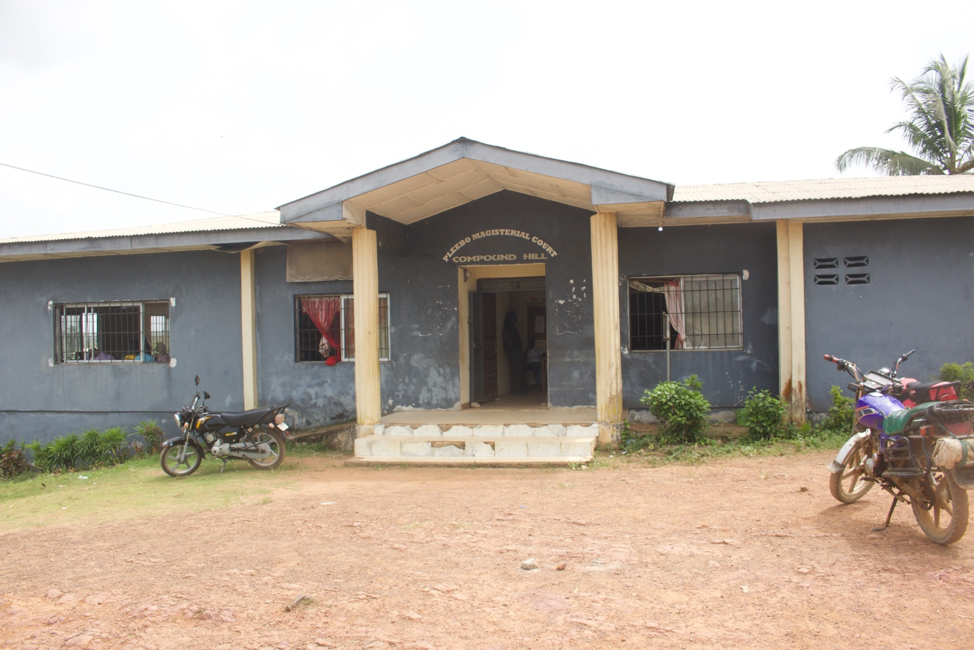
The Pleebo Magisterial Court, where Saturday Wilson was tried and convicted for stealing Maryland Oil Palm Plantation’s fertilizers. The DayLight/James Harding Giahyue
“I am therefore using this medium to register these cases to your office and request your timely intervention and [a] peaceful resolution,” Wilson said in the complaint to Olando Karbeh, the chairperson of the committee. He was citing an incident just a month before where an MOPP staff took 40 of Wilson’s palm bunches, according to his handwritten letter featuring witnesses from the company, seen by The DayLight.
Kouakou Bah, MOPP’s general manager at the time, accused Wilson of harvesting the palm nuts on MOPP’s side of their boundary. During the proceedings, Wilson argued that MOPP unilaterally demarcated boundaries. (Communities’ participation is a key concept in the global oil palm industry.) An investigation by the community liaison committee and county officials found Wilson was right, according to Karbeh. However, MOPP did not return Wilson’s harvests nor gave him any compensation. After that controversy, Wilson planted plantain trees on the widely accepted boundary between his 25-acre farm and the plantation to avert any future harvest rows.
While that move has protected his estimated 2,000 palm trees, his relationship with MOPP has remained frosty within the last six years. In a meeting late last year with county officials and citizens, MOPP representative complained about Wilson’s farmland, people, who attended the meeting, say.
“In the meeting, they said they were having problem with Saturday Wilson,” says Thomas Wilson, his brother and paramount chief for the Klebo Chiefdom under which Gewloken falls.
“The City Mayor in Pleebo Wellington Kyne came out and said ‘Saturday is not with us in here… maybe he has something to say.’
“I said in the meeting that the land that Saturday has is not even for him. It is for the.. Gewloken community,” Thomas Wilson adds in an interview at his home. Kyne corroborates his account in a phone interview.
The Community Liaison Committee has asked MOPP to resolve its conflict with Wilson more than once but the company declined, says Karbeh, calling for an end to more than a decade of hostilities.
It does not stop there. MOPP has refused to recognize him as a local palm farmer, also called a smallholder or an out-grower in the industry worldwide. The Maryland Oil Palm Outgrower Association has disclosed MOPP would begin purchasing local farmers’ harvests soon but Wilson is excluded, despite being a member of the group. He sells his harvests to Sopalm, a company more than 40 kilometers away in the Ivory coast, based on a receipt seen by The DayLight. He fears it would not change even if local farmers begin selling to MOPP.
Kwia Nelson, the president of the association, says MOPP is retaliating against Wilson. “It seems to be that human being heart will never leave things, so MOPP looks at it that the area is still for the company so at the end of the day they don’t want to do business with him,” Nelson tells The DayLight in an interview at his home in Pleeboy City.
“That is the information I have gathered as head [of the association].”
Saturday Wilson stands at the boundary between his farmland and the Maryland Oil Palm Plantation (MOPP). It covers 25 acres and has about 2,000 palm trees, according to Wilson. The DayLight/James Harding Giahyue
Outgrowers are crucial to MOPP’s concession with Liberia and the Roundtable on Sustainable Palm Oil (RSPO), which sets the standards for the global industry. The concession agreement requires MOPP to buy outgrowers’ palm bunches at a set price and quality, among other things. The RSPO mandates its members to include smallholders in their development plans. Is one of seven principles the watchdog operates on. MOPP is Owned by the SIFCA Group, an Ivory Coast-based firm owned by the Singaporean multinational Wilmar International, a member of the RSPO.
James Otto, a lead campaigner at the Sustainable Development Institute (SDI) that advocates for the rights of communities adjacent to the plantation, praises Wilson for defending his rights. Otto says Wilson’s ordeals discourage smallholder farming but show that people can stand up against powerful investors.
“Saturday needs to be a hero,” Otto tells The DayLight in Monrovia of Wilson, who is captured in a new report by SDI. “I call him the hero of the southeast.”
MOPP did not respond to a set of questions The DayLight emailed to them nearly two weeks ago.
Funding for this story was provided by the Green Livelihood Alliance (GLA 2.0) through the Community Rights and Corporate Governance Program of the Sustainable Development Institute (SDI). The DayLight maintained complete editorial independence over the story’s content.
Top: The entrance of the headquarters of Maryland Oil Palm Plantation (MOPP) in Pleebo Sodoken District. The DayLight/James Harding Giahyue
By Mark B. Newa
MONROVIA – The Maryland Oil Palm Plantation (MOPP) is involved in bad labor practices, land-grabbing and pollution, a new report by the nongovernmental organization the Sustainable Development Institute (SDI) alleges. It accuses MOPP of wiping out local communities’ livelihood in violation of Liberian laws.
The “Social and Environmental Impacts of Maryland Oil Palm Plantation in Liberia” report alleges the company of abusing the rights of locals to their land, and pushing them into poverty by polluting water sources and reneging on its concession obligations to develop their farms or smallholders program.
“Today, we bring you compelling revelations… an open disregard of the rights and dignity of local communities affected by MOPP,” James Otto, a lead campaigner at SDI, told a press conference marking the launch of the report.
“The SDI has worked to bring… issues impacting communities and environment, blatant violations of our laws and lack of respect for local communities on whose land whose land and resources company operates in our country,” Otto added.
SDI said it interviewed 23 people placed in 10 groups from seven communities for the report. It also interviewed the head of the local office of the EPA and local authorities, and photographs relevant places with global positioning system (GPS) coordinates.
MOPP did not answer queries for comments.
MOPP signed its concession agreement with the Liberian government in 2011 for covering 15,200 hectares of land in Maryland County and Grand Kru and worth US$230 million over the 25-year period. Owned by the Ivorian SIFCA Group, MOPP took over the ruins of Decoris Oil Palm Company, also based in the Ivory Coast after the end of the Liberia civil wars.
Following in Decoris’ footsteps, MOPP with the aid of armed police, cleared communities’ lands, destroyed their ancestral graveyards dishonored traditional shrines and sacred sites, leading to riots.
Land-grab
MOPP abused communities’ rights to their ancestral land, the report says. The company did not get the consent of of local communities—including some that legally documents—before developing its plantation. It accuses the company of illegally including 6,400 acres of land on which it is obligated to develop farms for villagers, and that the company has no individual agreements with communities.
Findings of the report are similar to a 2015 report by the Social Entrepreneur for Sustainable Development (SESDev) and Forest Peoples Programme.
“Communities have the right to a formal and legally binding agreement with the company on the use of their lands,” Otto said. “MOPP urgently needs to start negotiating and listening to communities agree on terms and conditions of a lease, provide loss and damages and give back land to communities where requested.”
“If the employee or contractor is sick or even if he/she is hurt at work it will be noted as an ‘absence’ and the day salary is not paid – or employees receive only half of their due payment,” according to the report.
Criminalization
Citing unnamed sources, the report alleges that MOPP harasses and intimated citizens.
One woman said MOPP security guards arrested and beat her daughter who they accused of stealing palm nuts. The woman said “I had to pay L$3,000 to the MOPP security to free her.” Her comments are backed by a civil society actor.
The report narrates an account of a local named Saturday Wilson, who it says has been frequently intimidated by MOPP for over a decade for a farmland in Gewloken, the town closest to MOPP’s headquarters.
“I am being threatened again and again repeatedly for the small piece of land owned by my family on which I planted palm. MOPP still wants to use the LLA agents and the court to take it away from me. As I speak, they are still after me.
Labor Issues
MOPP pays it contractors below the minimum wage (US$5.50 per day), cutting some contractors’ wages when they are sick or injured, the report alleges. The company does not permanently employ contractors even after three years.
“Contractors receive no payment for the day if production goals are not met. Production goals include the number of palms cleared of weeds as well as harvest volumes,” it says.
A new report by the Sustainable Development Institute (SDI) accuses Maryland Oil Palm Plantation (MOPP) of bad labor practices. The DayLight/James Harding Giahyue.
Pollution
The report accuses MOPP of planting in swamps, a breach of its environmental and social impact assessment (ESIA), the Environmental Protection and Management Law of Liberia, and principle of the Roundtable on Sustainable Palm Oil, the global watchdog for the commodity industry.
MOPP’s mill waste and fertilizers are seeping into creeks used by locals for drinking water, it says, citing several locals.
“They planted palms in all the swamps around here. And when the palm started growing, they used to apply fertilizers and it really used to affect our water,” one says.
And another, “They are still dumping the palm butter in the Swanpken river and people downstream are finding it difficult to use the water now.”
In 2017, the Environmental Protection Agency (EPA) fined MOPP US$10,000 for importing several chemicals into the country without acquiring the requisite approval from the agency.
Livelihoods
Communities told SDI researchers that their livelihoods have been heavily compromised due to pollution, forest degradation and a shortage of land, according to the report.
As the result, farmers have no access to herbs and firewood, forest to hunt, and waterfronts to fish, it says, adding grass the company had planted to control weeds are destroying their crops.
“Reduced access to farmland increases food insecurity and less cash crops to support family incomes. Villages literally find the oil palms on their doorsteps. They have no living space or only degraded or poor areas where they can try and provide for their families,” the report added.
“The little farmland that we secured is no longer good because we have used it over and over again,” one farmer says in the report.
The report calls on MOPP to halt its expansion until it signs memoranda of understanding with communities, pays compensation for land-grab, completes the development of the mandatory smallholders’ program.
MOPP did not reply a set of questions from The DayLight on the issues raised in the report. The company did not respond to follow-up emails.
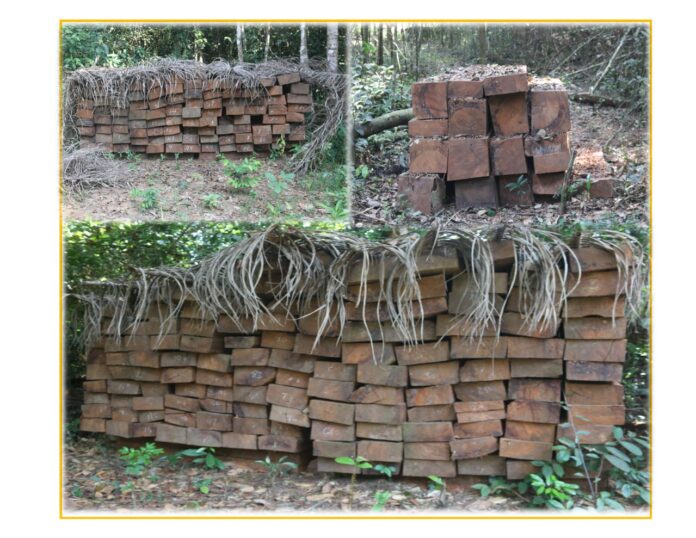
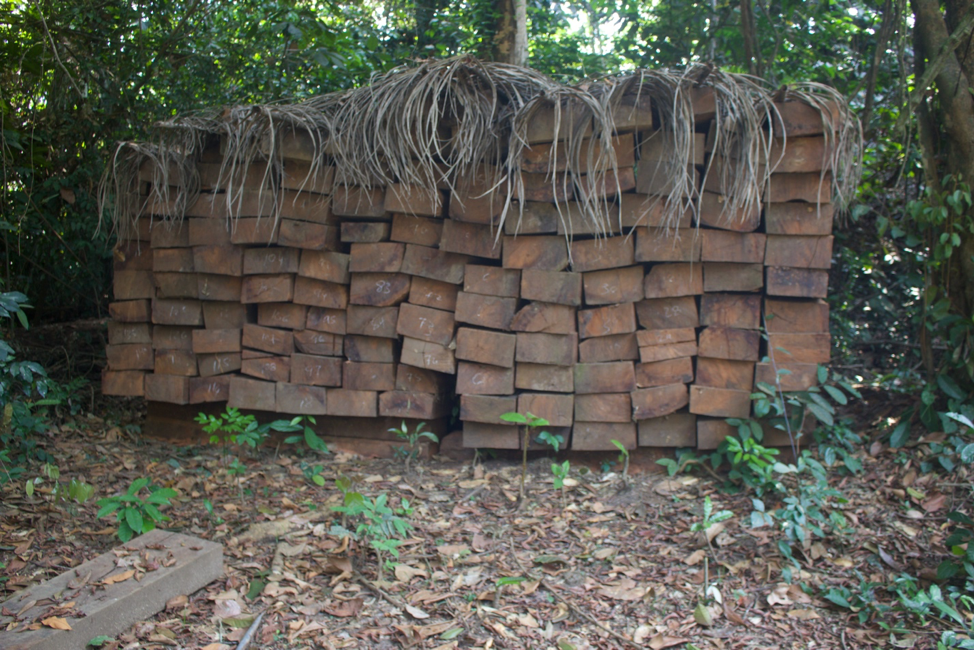
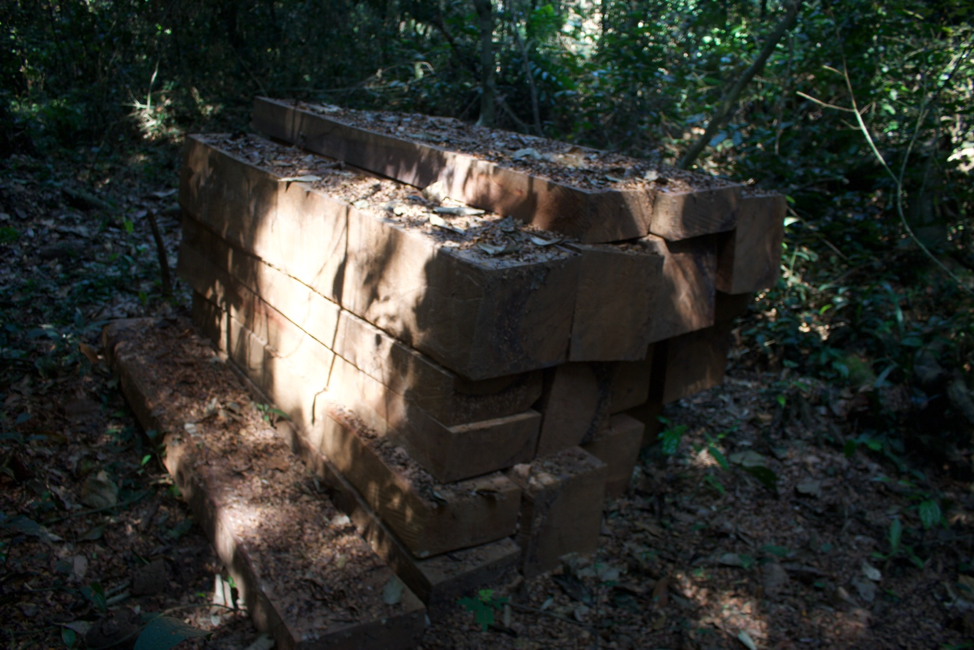
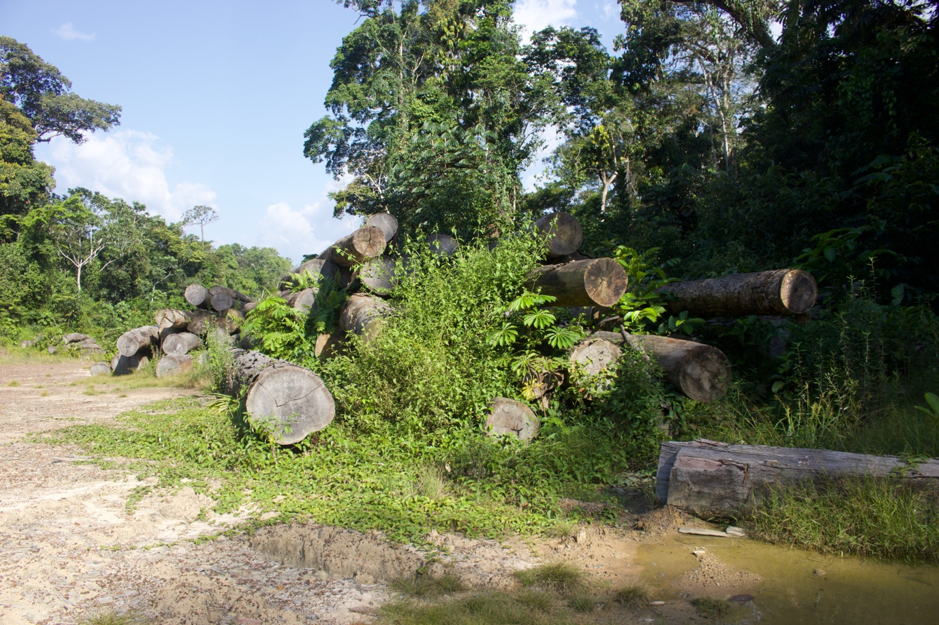
Top: A collage of pictures showing piles of squared timbers Sam Tomosiayah, an illegal logger, harvested in Darmo’s Town in Gbarpolu’s Bopolu District. The DayLight/James Harding Giahyue
By James Harding Giahyue
Editor’s Note: This story is a part of a series on an illegal logging activity commonly called “Kpokolo.”
DARMO’S TOWN, Gbarpolu County – Nearly a dozen huge piles of heavy, squared timbers are covered with palm thatches on the side of a road that branches from the Suehn Mecca-Bopolu highway. More, smaller piles are scattered in the forest here.
The woods are actually the products of a logging agreement between a Liberian-Indian company named Raytech International and the people of Darmo’s Town in Gbarpolu’s Bopolu District.
But unlike in a legal logging deal, the company and community did not obtain any rights to sign the deal. The Forestry Development Authority (FDA)—at least—did not officially authorize it. It is part of an illicit logging operation called “kpokolo” that involves shaping the woods like boxes to fit neatly in containers and smuggled out of the country.
Called block wood by the FDA, kpokolo operation thrived in plain sight for years until an apparent ban on the illicit activity in the third quarter of last year. It had become one of the most common forestry violations, particularly in the last three or four years. It harnessed the tide of political neglect in rural communities, the legacies of failed logging contracts, and the ineffectiveness and involvement of the FDA.
In Darmo’s Town, it all started during the rainy season in 2021 when a man on a motorcycle visited the area. Sam Tumosiayah, an agent of Raytech, asked chiefs and elders to grant him access to the forest there. Tumosiayah had established the company in January of that year, according to its article of incorporation.
A pile of squared timbers Sam Tomosiayah, an illegal logger, harvested in Darmo’s Town in Gbarpolu’s Bopolu District. The DayLight/James Harding Giahyue
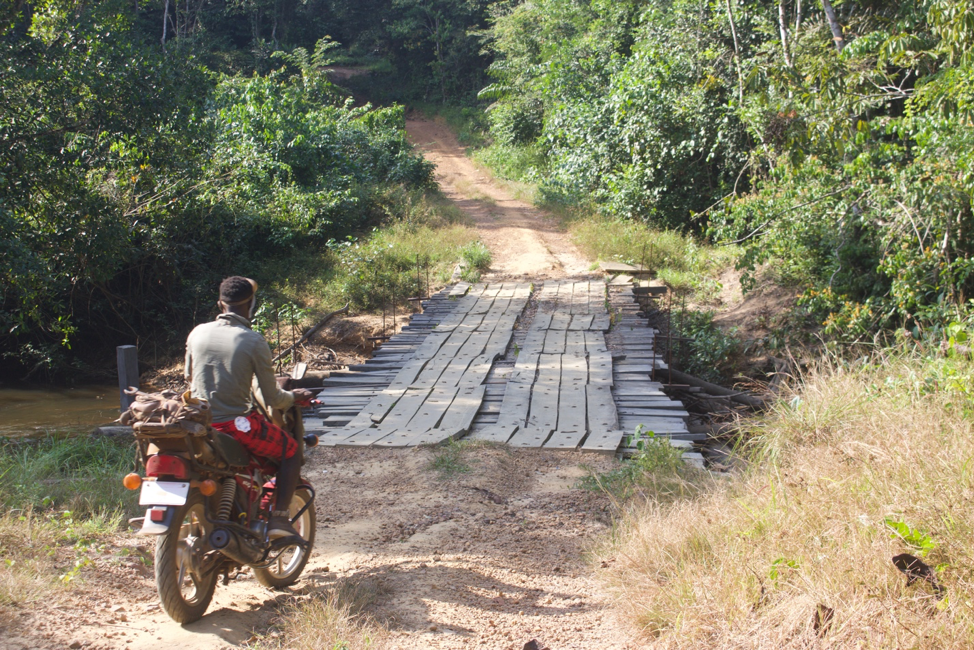
In exchange, Tumosiayah, a resident of Somalia Drive in Monrovia, promised the townspeople to repair a major bridge leading in the area among other things.
“Then they agreed to give the landowner their tolls directly. Even our town has received tolls,” said Mamadee Harris, a resident of Darmo’s Town, in an interview with The DayLight.
Peter Vah, the local manager of who Raytech, said the company paid villagers L$100 for each piece of kpokolo measuring six inches in height, 12 inches in width and seven feet in length (6X12X7). He said the company had not discussed with locals about the 12X12X7 timbers it cut.
Vah said Raytech produced a total of 2,300 pieces of kpokolo in the one year and three months it has worked in Darmo’s Town. “The first batch of kpokolo we produced was 500 pieces and the next one 1,800,” said Vah, who said his duties included finding trees and supervising the harvesting. “Nothing has been sold. Some are in the bush, and others in Monrovia.” The DayLight could not independently verify Vah’s figures.
In a mobile interview with The DayLight, Tumosiayah lied that the company had only cut 150 kpokolo in Darmo’s Town. He then diverted from the issue after this reporter presented proof the newspaper had gathered on Raytech’s operation.
Sam Tumosiayah is a representative of Raytech, an illegal logging company that operates in Gbarpolu County. Facebook/Sam Tumosiayah
Legal Documents
The FDA may have banned kpokolo operations in the third quarter of last year as pressure mounted on the agency to stamp out illegal logging, according to some of the illegal loggers and rangers at a number of FDA checkpoints. Kpokolo first appeared in the news in September last year.
Tumosiayah said he and other kpokolo loggers were appealing to the FDA to lift the ban to allow them to sell thousands of kpokolo left in various forests across the country. “Our business on the market is not going like before. We are catching some difficulties,” he said.
Tumosiayah thinks his kpokolo operation is legal because his business is registered and pays taxes. “Some people are cheating and defrauding the Liberian government,” he said. “But if you have legal documents to do X,Y,Z, the government will say, ‘Yes, this is a Liberian person.’”
Tumosiayah’s thoughts are not backed by law, as a company needs more than an article of incorporation and a business registration certificate to do logging. It must show the capacity to do logging, sign a contract, conduct an environmental and social impact assessment (ESIA), produce forest management plans, and obtain a harvesting certificate. There are also standards for harvest, export and communities’ benefits.
Kpokolo operators such as Raytech International, have harnessed the tide of neglect by successive Liberian governments of rural communities and the failed logging contracts across the country, coupled with the complicity of the Forestry Development Authority (FDA) amid enormous forestry violations. The DayLight/James Harding Giahyue
That aside, there are other issues with Raytech’s papers that further expose its forestry violations. Its article of incorporation only lists Savid Muhammed Kutty (40 percent) and Jilt Joseph (10 percent) as two of its three shareholders. The third shareholder, however, is omitted. Based on its tax-payment history, both men are foreign nationals but the company’s business registration certificate identifies it only as Liberian-owned. And Raytech amended its article of incorporation in Oct last year, according to the tax-payment record. Its new legal documents are not registered at the Liberia Business Registry as of last month and do not reflect the amendment. That is a violation of the Business Association Act, which requires firms to register changes to their legal papers.
Between June 2, 2021 and January 25 this year, Raytech brought in nine foreign nationals into the country, three of them twice, according to the company’s tax payment records. It made no payments for work permits, despite showing Kutty, Joseph and three of their colleagues obtained non-ECOWAS resident permits at least once. The other three men are Sijomon Verghese, Manilal Sasi and Sinojin Augustine.
In Liberia, shareholding or beneficial ownership, work permit and resident status are crucial to things such as taxes, business rights and logging eligibility. Kutty did not return queries via WhatsApp for comments. Joseph said he was no longer a shareholder in the company, without providing any proof.
Piles of kpokolo Raytech harvested, like this one, are scattered in the forest in Darmo’s Town, Gbarpolu County. The DayLight/James Harding Giahyue
In our phone interview, Tumusiayah claimed that he was Raytech’s majority shareholder and did not know of the omission. He further claimed that he had gone to the business registry to check the documents and would call The DayLight. However, efforts to conduct an in-person interview with him did not succeed, and he did not return further calls.
The Managing Director of the FDA Mike Doryen did not reply to an emailed inquiry on the status of kpokolo operations countrywide. However, addressing delegates at a recent forest and climate change forum in Monrovia, Doryen blamed communities for widespread illegal activities.
“These communities are undermining our efforts to deal with violations,” he said. “People go in the communities and take money from other people to harvest and transport timber to town, harvesting double-board foot outside what is required by law, it is illegal logging,” Doryen added.
While there is plenty of evidence that backs Doryen’s comments, the FDA itself has benefited from the unlawful activities. It collected fees from kpokolo operators for years but there are no records that they remitted them into the government’s coffers. An investigation by The DayLight last month revealed a number of receipts the FDA issued an illegal logger in Ganta, Nimba County. They matched other kpokolo receipts obtained so far. Doryen did not respond to a list of questions at the time.
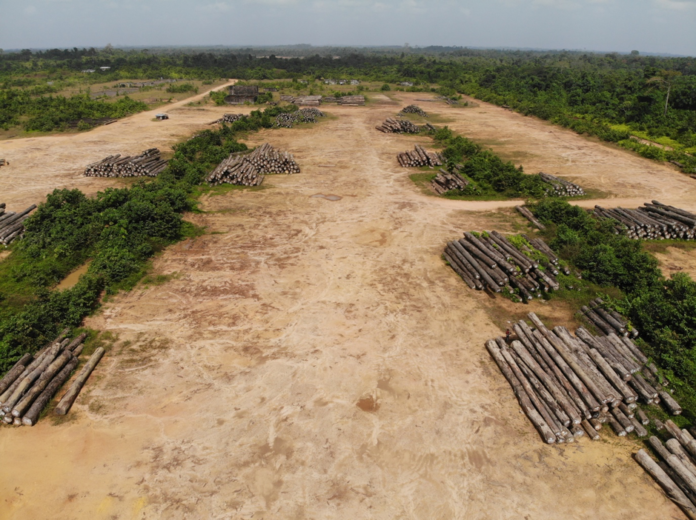
Top: A drone shot of a log yard in Greenville, Sinoe County. The DayLight/Derick Snyder
By Mark B. Newa
MONROVIA – Forestry violations and delayed payments of benefits to logging-affected communities were the major issues at the just-ended forest conference hosted by the Liberian government.
The “Forest and Climate Resilience Forum” was expected to reassess the commitment of the Liberian government and the international community to the protection of the country’s rainforest, the largest in the west African region.
The event came on the backdrop of reports of widespread irregularities and impunity in Liberia’s forestry sector. Associated Press recently reported that President George Weah ignored calls from foreign partners to tackle illegalities in the forestry sector.
“Current situation in Liberia`s forest sector is worrying,” said Laurent Delahousse, the head of the European Union (EU) Delegation, at the close of the event over the weekend. “It is characterized by [……] too short rotations, by the lack of proper forest management plans, and by illegal logging, which are real threats to forest regeneration and which affect the commercial and the global value of the forest,” Delahousse added.
On Thursday, the first day of the conference, more than 20 international nongovernmental organizations said the Liberian government was failing to control the illegal logging and undermining the systems in place to control it. They come from China, Germany, the United Kingdom, the United States of America, the Netherlands, Belgium and Finland.
“We call on the government of Liberia to ensure all timber exports go through the LiberTrace, the traceability system, and to close down all existing routes for laundering illegally sourced timber,” the group said in a joint statement.
The Managing Director of the Forestry Development Authority (FDA) Mike Doryen brushed off criticisms, promising to grant access to public information. He blamed communities for the situation.
“Illegal logging activities usually begin with forest communities. These communities are undermining our efforts to deal with violations,” Doryen said.
“People go in the communities and take money from other people to harvest and transport timber to town… outside what is required law, it is illegal logging,” Doryen added. He, however, promised to set up a task force to monitor and regulate unlawful activities in the forestry sector.
Communities’ Benefits
There were a lot of concerns about communities’ benefits during the two days of the event.
European Union Head of Delegation Laurent Delahousse flags illegalities in Liberia’s forest sector during the Forest and Climate Resilience Conference. Photo credit: Mark B. Newa/The DayLight
By law, communities hosting large-scale logging concessions and former small-scale ones set aside exclusively for Liberians, are entitled to 30 percent of the land rental fees companies pay. But this is not the case. The government, which receives the payments, owes communities US$6.6 million.
Outside the hall at the Ellen Johnson Sirleaf Ministerial Complex, where the event took place, people from those affected communities protested. The protesters carried placards with inscriptions: “Pro-poor for the poor but not against the poor,” “Government of Liberia pays our land rental fees and the forestry law is clear on community benefits, among others.”
“This money is not forthcoming, with at least over US$6 million still outstanding. The little money that has come through was [either] late or meddled in corruption,” said Loretha Pope-Kai the chairperson of the National Civil Society Council of Liberia, the largest conglomerate of pressure groups in the country.
“Our forest communities live on the forest for their cultural, social, economic, and all other needs. Forests are therefore key to all considerations of Liberia’s… future,” Pope-Kai added, receiving huge applause.
National Benefit Sharing Trust (NBST), a watchdog that oversees communities benefits, said the delayed payment made it difficult for the group to function. It is largely funded by payments communities get. It has spent US$1.8 million on 53 projects nationwide, it reported last year.
“Funding gap is undermining the long-term sustainability of the NBST,” Kollie said.
The theme of the two-day forum was “Catalyze renewed commitments and strengthen partnerships in sustainable forest management as key strategies supporting the Government of Liberia’s Pro-Poor Agenda for Prosperity and Development (PAPD).”
Top: A drone photograph of a log yard in Greenville, Sinoe County. The DayLight/Derick Snyder
By Mark B. Newa
MONROVIA – Liberia is hosting an international forest and climate conference, expected to reassess the commitment of the Liberian government and the international community to the protection of the country’s rainforest, the largest in the west African region. The event comes amid widespread irregularities and impunity in Liberia’s forestry sector.
“Liberia remains committed to the global climate change agenda,” President George Weah said in the State of the Nation Address on Monday, announcing the event, which will take place on Wednesday at the Ministerial Complex in Congo Town.
“We are looking to improve governance of the forest sector and move toward a more effective management of our forest reserves, to help us transition to a better model of climate finance,” Weah said. He added Liberia is working to enlarge its protected areas and was committed to reducing reliance on commercial logging.
Delegates expected to attend the conference include envoys from the World Bank, and the ministers of environment and forests from Ghana, Sierra Leone, and Cote d`Ivoire are also expected to attend. The climate change special envoy of Norway—the country that provided Liberia with US$150 million to combat deforestation—and the Norwegian ambassador to Liberia are also expected to attend, organizers of the event say. The same goes for the European Union, which has had a logging trade agreement with Liberia since 2011, the United States Agency for International Development (USAID) and the United Kingdom.
Liberia hosts 43 percent of the last two significant blocks of the remaining closed canopy tropical rainforest within the Upper Guinea Forest, West Africa’ spanning from Ghana, Cote d`Ivoire, Liberia, Sierra Leone and Togo. Liberia has committed to conserving 30 percent of the existing forested areas of the country.
“There are doubts from some partners that Liberia is not moving in this direction, but the forest law says we should put under conservation at least 30 percent of all our remaining forest estates to conservation,” Saah David, Jr., the national coordinator of REDD+, one of the organizers of the event. REDD+ means reducing emissions from deforestation and forest degradation and the role of conservation, sustainable management of forests, and enhancement of forest carbon stocks in developing countries.
“The forum will be used as means to now push partners to also recommit to helping Liberia helps itself,” David added.
The conference, which was rescheduled from October last year, will feature experiences from Sierra Leone, Ivory Coast, Guinea and Ghana, a country that has just been enrolled into the global carbon financing program. Ghana is now the second country in Africa after Mozambique to receive payments from the World Bank for reducing its carbon emission.
The conference comes at a time the Liberian forestry sector is marred by illegalities. Associated Press recently reported that President George Weah ignored calls from foreign partners to tackle the illegalities in the forestry sector. The investigation report highlighted illegalities in the forestry sector. Liberia failed the natural resource management component of the Millennium Challenge Compact (MCC), an American agency that measures countries’ economic policies and potential for growth.
The report said Weah had ignored calls from the international community to address forestry non-compliance, saying they were “nonsense.”
The low budgetary allotment has been another issue. In the 2021/2022 fiscal year, the Forestry Development Authority (FDA) received just below US$2.9 million, more than 90 percent of which is employees’ salaries.
But there has been some progress made in the sector. Liberia has created the Sapo National Park, the East Nimba Nature Reserve, Lake Piso Multiple Use Reserve, and the Gola National Forest. It has begun the establishment of proposed protected areas: Kpo, Krahn-Bassa Foya and others.
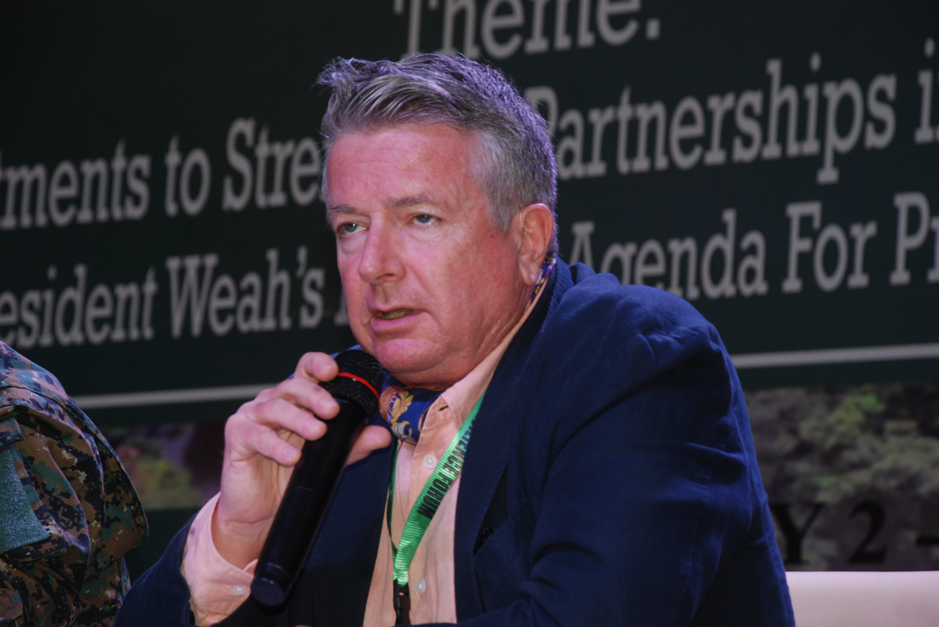
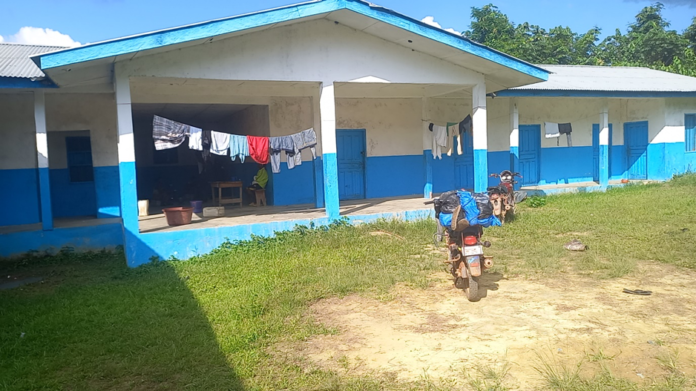
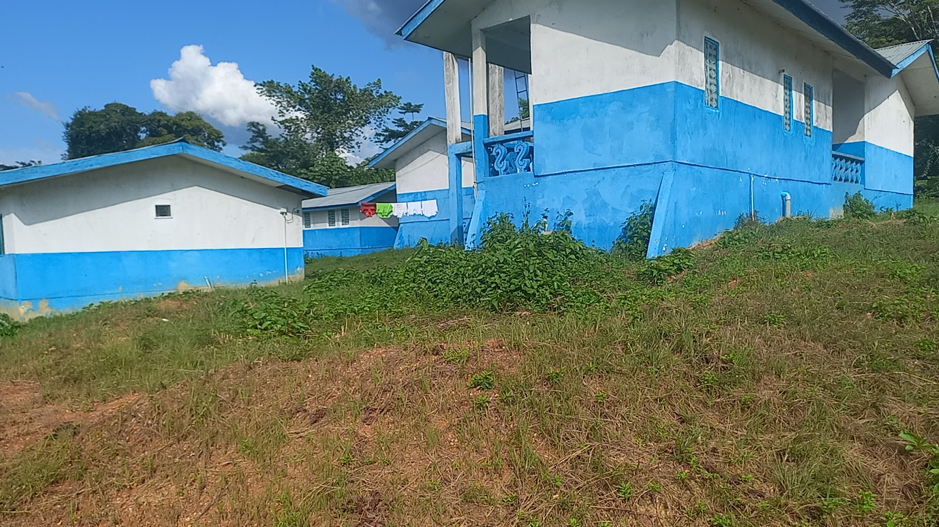
Top: The Tiah Town Clinic was funded by benefits affected communities received from a logging concession between the Liberian government and International Capital Consultant (ICC). Construction works have been completed but the lack of furniture supplies means the clinic cannot serve its people. The DayLight/Eric Opa Doue
By Eric Opa Doue for The DayLight
TIAH TOWN, Nimba County – Fifty-two-year-old Elizabeth Zialue traveled 55 kilometers from Tiah Town in Nimba to Boegeezay Town in River Cess County to seek treatment for her two-year-old grandson. Medical services in the Boegeezay community are free but Zialue has to pay LD3,500 for a motorcycle taxi to get there, and the same amount to get back.
Zialue had lost her daughter, the boy’s mother, two years ago. “My daughter was sick when she delivered. There was no money to go to the hospital in Boegeezay or Tappita so she died,” she recalled.
But Zialue’s daughter could have survived if a clinic in Tiah Town was operational. In 2017, communities around here received US$125,000 to construct a clinic here in Tiah Town. The money was a portion of their benefits from a logging concession between the Liberian government and a logging company called International Capital Consultant (ICC). The concession, known in the forestry sector as Forest Management Contract Area K, covers 266,910 hectares in both River Cess and Nimba. The community’s leadership added another US30,000 for other utilities such as water towers and an insinuator.
The clinic’s construction started in April 2017 and was expected to be completed, dedicated for full operation in March 2018. The Nimba County Health Team was supposed to provide the workforce and medical and non-medical supplies for the running of the facility. Due to its strategic location, it was supposed to serve both River Cess and Nimba Counties when completed.
Healthcare workers’ resident at the proposed Tiah Town Clinic. The DayLight/Eric Opa DoueThe Tiah Town Clinic project was funded by logging funds. The DayLight/James Harding Giahyue
Five years after its completion, nothing has happened according to plan. The National Benefit Sharing Trust Board, a watchdog that manages communities’ funds from forest concessions disbursed US$10,225.25 plus L$5.3 million to purchase furniture and drugs for the clinic. The fees come from logging-affected communities’ share of land rental fees companies pay to the Liberian government. However, the community’s forest leadership used the fund to build a guesthouse instead.
Jerry Gbaye, the head of the leadership at the time, told The DayLight his decision to divert the fund was backed by all affected towns and villages in Gbi, Gbiagloh and Doru chiefdom, where the clinic is located. The clinic is meant to provide thousands of people access to healthcare in one of the remotest places in Liberia.
“It was not the CFDC’s decision to use the money for a guesthouse,” Gbaye said. CFDC means community forest development committee, a body of villagers that co-manages a certain logging concession alongside the Forestry Development Authority (FDA).
“The people of Gbiagloh and Gbi said the people of Doru already had the clinic in their area so that money should be used to construct a guesthouse for them to benefit, too,” he added.
Alfred Zelee, an elder responsible for Tiah Town’s development matters, refutes that claim. “If a decision was reached to use the money on the guesthouse, I don’t know,” said Zelee.” “All I know is that Gbaye took the money and used it on the guesthouse.
“We are suffering here because few people decided to use the money from the land rental fees that they were supposed to use to put medicine in the clinic,” he added.
The National Union of Community Forest Development Committee (NUCFDC), a group that advocates for the benefits for villagers affected by logging concessions, is investigating the matter.
Gbi-Doru District is one of Nimba’s remotest communities, with no access to healthcare. The DayLight/James Harding Giahyue
“We are now investigating whether the project was identified by the citizens and, and the project was awarded to a competent company,” said Andrew Zelemen, the national facilitator for the group in an interview with The DayLight. “Since it is established that the money was diverted, the NUCFDC is now contemplating what punishment awaits the [community’s leadership.”
The Trust Board has also said it would not give the community’s leadership any more money unless it accounted for the furniture fund for the clinic, the most expensive of 53 projects it has funded countrywide since 2015.
“The board has the intent to release additional funding for the Tiah Town project and all other uncompleted projects across the country, under conditions,” said Roberto Kollie, the head of the secretariat. “The first criterion is the [community’s leadership] must be able to present an assessment report to the board.
“The Assessment report will include the project that was approved, the cost of the project, and the total amount that was disbursed for the implementation of the project and they must be able to provide a reason to the board why those projects were not completed.”
Zialue in Tiah Town is unaware of the unfolding. Her grandchild was treated but she had to spend additional days in Boegeezay before going back to Tiah Town.
“Ever since the people talked about the hospital to build, everybody was happy, but today no head, no tail,” Zialue said. “We [are] still doing the same thing.”
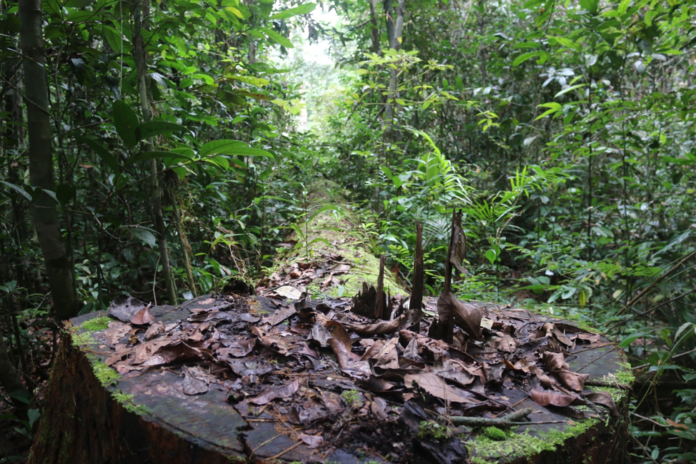
Top: One of the logs Masayaha, Magna’s partner, illegally harvested in a forest in Compound Number One, Grand Bassa County, is seen next to its stump. The DayLight/James Harding Giahyue
James Harding Giahyue
Morley Kamara, the CEO and owner of Magna Logging Incorporated emailed The DayLight, bragging not to be bothered by stories the newspaper publishes about his company’s violations
Kamara copies Cllr. Yanquoi Dolo, FDA’s lawyer, responsible to help prosecute forestry violators
Kamara’s Magna and Masayaha, its Lebanese-owned partner, have committed several offenses over the last three years—from an illegal subcontract to cutting trees outside their contract area
MONROVIA – The CEO and owner of a company has emailed The DayLight to boast that he was not bothered by revelations of the firm’s wrongdoings, copying the in-house lawyer of the Forestry Development Authority (FDA).
“These stories do not move me one bit,” said Morley Kamara of Magna Logging Corporation, sharing the communication with Cllr. Yanquoi Dolo, who helps the FDA prosecute forestry violators.
“You’re missing your mark,” Kamara added, the email in which he also copied Ali Harkous, Masayaha’s CEO and owner.
Kamara was referring to a series of investigation reports The DayLight published last year that revealed a number of logging offenses the Liberian-owned firm and Masayaha Logging Company, its Lebanese partner, committed.
The FDA failed to take any actions against the companies despite overwhelming evidence of violations revealed in the four-part series, appearing between September and October last year.
The first story exposed a string of illegal logging operations outside the Worr Community Forest in Grand Bassa County, its contract area between 2020 and 2021. It featured interviews from chiefs and elders who participated in the activities, voice WhatsApp conversations with an FDA executive and a resident, and a report from SGS on the same offenses. SGS is a Swiss firm globally acclaimed in the verification industry. It created Liberia’s log-tracking system known as the LiberTrace.
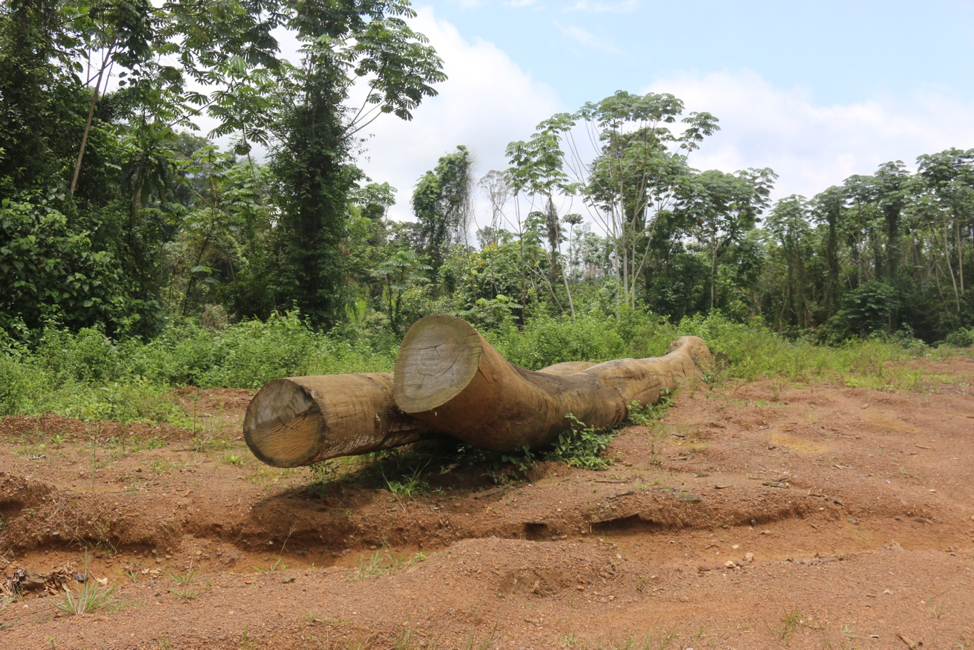
Two illegally harvested logs Masayaha Logging Company left behind in the Garkpa Charlie Town in Compound Number One, Grand Bassa County. The DayLight/James Harding Giahyue
The second story showed that Masayaha abandoned some 600 logs it had harvested during the same period of its illegal harvesting spree.
The third story covered villagers’ protest against Masayaha for their forest benefits, stopping the company from operating. The company has now paved a new road and repaired a clinic building in the community in response to the villagers’ demands.
The last part of the series uncovered the illegality of a subcontract between Magna and Masayaha. The two had signed their deal unknown to the leadership of the community, a breach of the Community Rights Law of 2009 with Respect to Forest Lands. Villagers must participate in such deals, according to one of the law’s guiding principles.
That story also shed light on Magna’s capacity to conduct logging activities, having transferred its full logging right to Masayaha, less than a year after signing its agreement with the leadership of Worr Community Forest.
By law, Magna and Masayaha should have paid different fines for stealing logs and abandoning others.