Home Tags Liberia

Tag: Liberia

Land grabs, pollution: ArcelorMittal’s ‘French-made’ steel is poisoning Liberia

Arcelor Mittal's work affecting environment

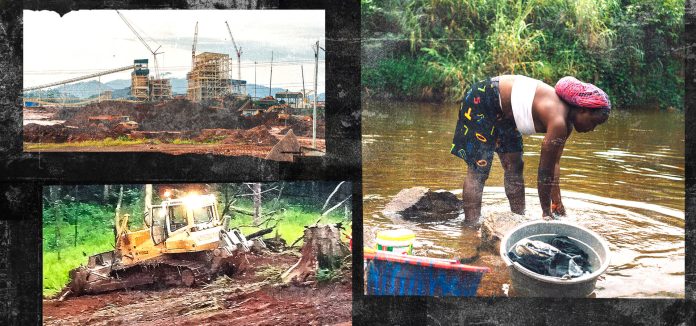
Top: To make steel in Dunkirk and Fos-sur-Mer, ArcelorMittal has been mining iron ore deposits in Liberia. By monopolising agricultural land and contaminating water resources, the company endangers the lives of thousands of people in the West African country. Revelations below on the postcolonial practices of the world’s leading steel company and how they are contributing to climate change.


This story was originally published on Disclose, a non-profit investigative news outlet based in France.


Promises only bind those who believe in them, and this has not escaped ArcelorMittal. For several years, the steel multinational has pledged to achieve carbon neutrality by 2050. This is an emergency: with 98 million tonnes of CO2 released into the atmosphere last year, ArcelorMittal is one of the largest contributors to the climate crisis on the planet. Its steel works in France, located in Dunkirk (north) and Fos-sur-Mer (south), are the two biggest polluters in the country: they release 15% of the industry’s greenhouse gases.

In spite of the climate emergency, ArcelorMittal has suspended or cancelled as many as seven projects that were supposed to decarbonise its steel production in Europe. This U-turn is as harmful for the climate as it is for the communities bearing the brunt of this fanatic extractivism, as revealed by Disclose’s latest investigation into the raw materials feeding the factories of France’s top polluter.

ArcelorMittal’s steel is ubiquitous: in cars (including the latest Renault and Peugeot models), Coca-Cola and Heineken cans as well as Miele and Samsung washing machines. To produce steel, the multinational relies on two essential components, coal and iron ore, and this resource neo-colonialism involves Africa, among other continents. In April 2026, Disclose revealed that some of ArcelorMittal’s coal burned in France comes from a mine in Mozambique, where fumes poison locals. Regarding iron ore, we have discovered that the steelmaking company gets huge supplies from Liberia, where half the population lives below the poverty line.
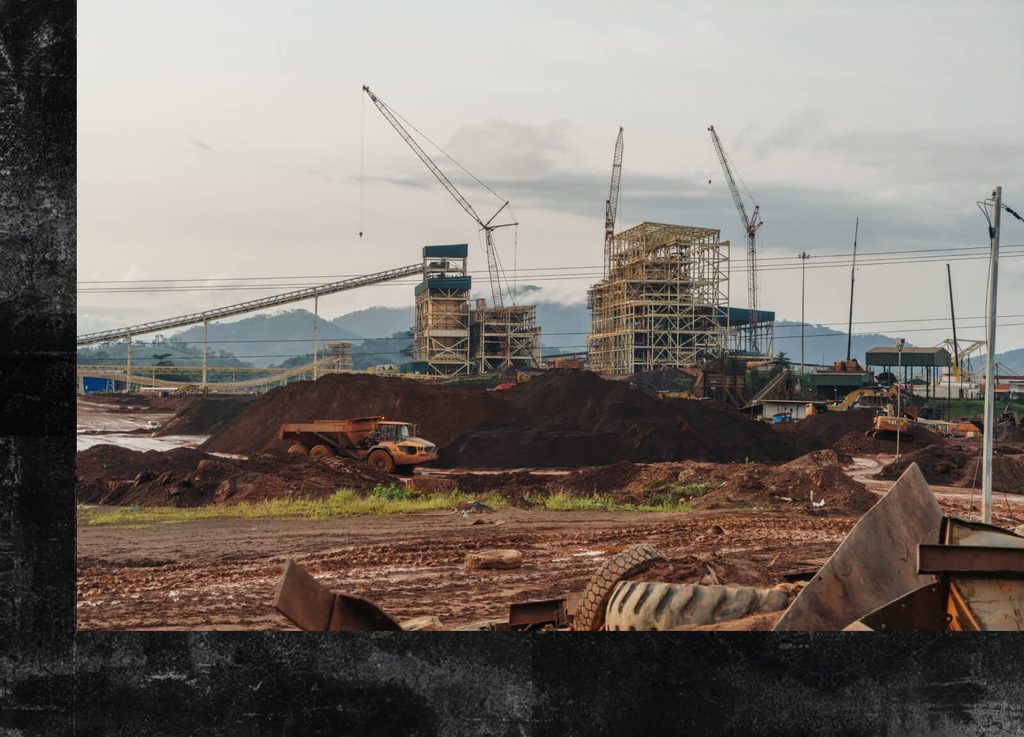
Construction of an iron ore concentrator near Mount Tokadeh, on ArcelorMittal’s concession in Nimba County, Liberia. Photo: Berta Vicente Salas

In the small West African country, ArcelorMittal has indulged in the postcolonial predation of resources, claiming mining, railway and port infrastructures. According to unpublished documents and a score of testimonies from locals, indigenous communities are paying the price for this iron ore rush: close to a thousand farmers have had their land grabbed by ArcelorMittal, which is also accused of poisoning rivers and sources of drinking water, all for the benefit of its factories in France. Mainland France is the top destination for Liberian iron ore, with 12.7 million tonnes shipped between January 2020 and August 2026, according to exclusive data provided to Disclose by trade intelligence company Kpler.

Bulldozers rip apart indigenous land

ArcelorMittal started operating in Liberia in 2005. The country was still reeling following a civil war that left more than 200,000 dead. Off the back of a very unbalanced deal with the government of the day, the multinational set up business in the north of the country on a mining concession five times the size of Paris. ArcelorMittal also grabbed two assets that were the property of the Liberian state, the railway connecting the mines and the Atlantic Ocean, and the port of Buchanan, from which cargo boats leave for France. According to the agreement, which has since been extended and will now run until 2050, a 15% share of the mines is owned by the state while ArcelorMittal holds an 85% share.
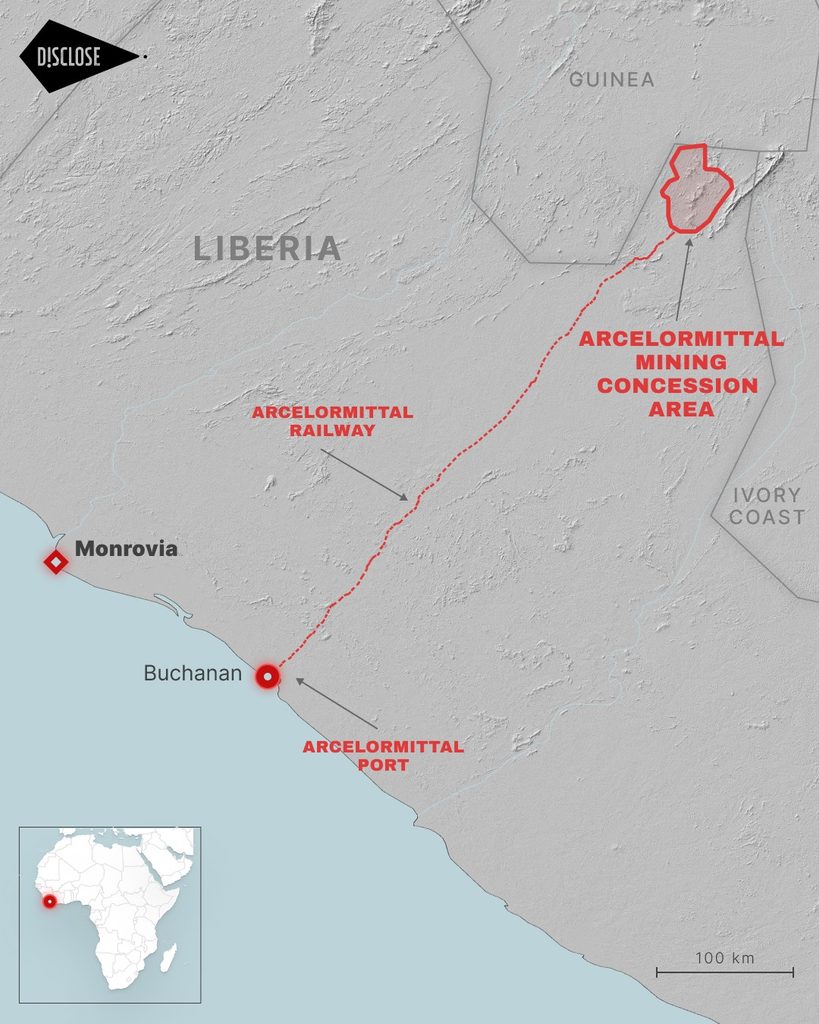
Map: Pierre Leibovici / Disclose

In the concession area, bulldozers now run at full capacity. Blasting to loosen rock can be heard deep in the jungle, as observed by Disclose. ArcelorMittal is expected to have exported 18 million tonnes of iron ore this year, a 57% increase on last year. In return for its mining operations in the country, the group claims that it paid the Liberian state close to $28m in 2025. A win-win partnership, according to the billboards that can be seen all over the mining concession. The multinational’s executive chairman, Lakshmi Mittal, is all smiles next to President Joseph Boakai.
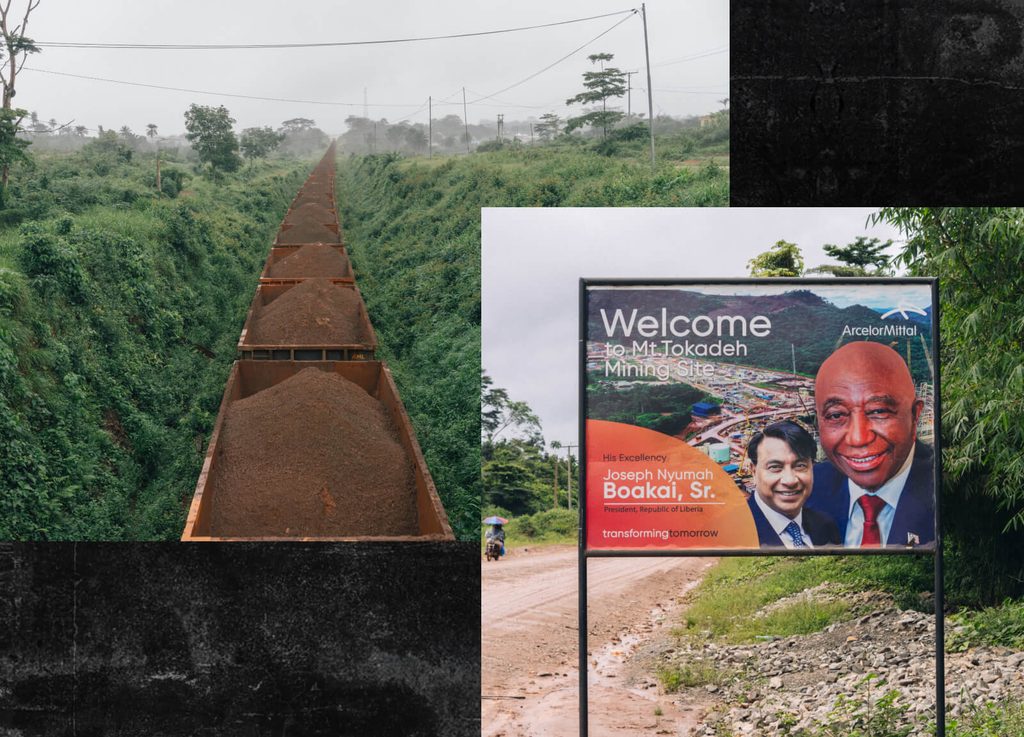
Left: iron ore being transported by train from Sanniquellie, in Nimba County, to the port of Buchanan, where it will be loaded onto ships bound for Europe. Right: a photo of Liberian President Joseph Boakai with Lakshmi Mittal, Executive Chairman of ArcelorMittal, at the company’s concession. Photos: Berta Vicente Salas

The tragedy experienced by thousands of locals in this farming region, where the Mano and Gio indigenous communities are in a majority, is in stark contrast to this success story, as shown by the testimony of Dada Konkah, a farmer in Gbarpa, at the foothills of two mountains mined by ArcelorMittal. In March 2022, while he was away for a few days, the excavators of a subcontractor used by ArcelorMittal tore to pieces a large part of his rubber, cacao and avocado crops. Neither the steel giant nor its local service providers bothered to inform him, which is illegal as the law in Liberia makes provision for the “free, prior and informed consent” of land owners, and guarantees “equitable” and “timely” financial compensation. Three months later, the group pledged to compensate his losses — close to 600 trees — in accordance with a Ministry of agriculture scale. The farmer was eventually paid a paltry $9,000. He had expected double that amount.

“I have three children. How are you expected to feed your children?”

Ernest Belleh Dolo, Gbarpa resident

“I was greatly cheated in the compensation process,” says Dada Konkah. Not only did ArcelorMittal clear his fields in early 2022, but the multinational flooded them two years later after building a dam that was supposed to hold back its wash waters but which, it turns out, was badly designed.

Since then, the plants that survived have been floating in brownish water. “I am really affected. I no longer have access to my land,” he says. After he aired his grievances, the multinational wrote to him in January 2024 to say that he would not receive compensation for the destruction of his crops.

Disclose spoke to six people with stories similar to Dada Konkah’s between August 2024 and September 2025. They said ArcelorMittal employees had barged into their fields to take stock of crops, before bringing in “yellow machines” which crushed vegetation and regraded the ground to build a road, a dam or a waste landfill facility. Ancestral land wiped off the map, without warning. “My land was destroyed over the space of two months,” says Ernest Belleh Dolo, another Gbarpa resident. “I have three children. How are you expected to feed your children? Since there is no money at the moment, the children had to drop out of school.” Here, villagers farm to feed their families but also to generate the largest part of their income.
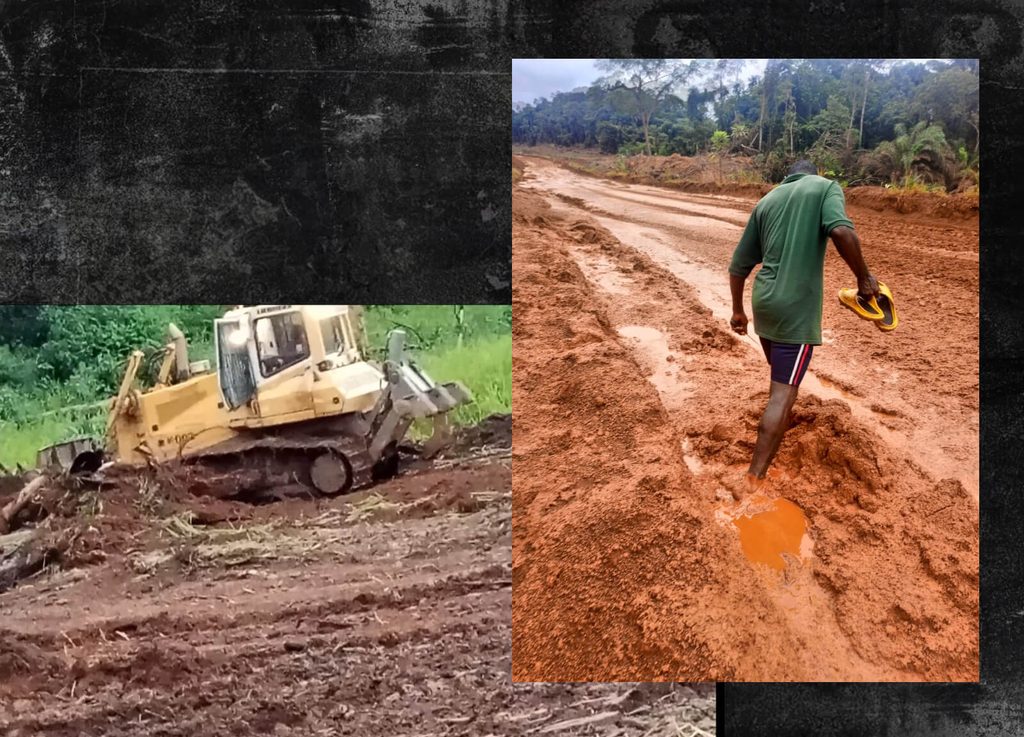
Left: a bulldozer belonging to an ArcelorMittal subcontractor destroys a farm field in Gbarpa, Nimba County, in December 2023. Right: a farmer from Gbarpa walks on the site of his former field, which was replaced by an ArcelorMittal road, in November 2024. Photos provided to Disclose by local residents

ArcelorMittal has acknowledged that “22.1% of agricultural land” that have been either destroyed, or either made inaccessible because of its operations, has been compensated. This is confirmed by a letter the company sent to local authorities in March 2026 and seen by Disclose. Two months later, mediators appointed by the Liberian government worked out that 694 farmers were still waiting to be compensated. Another 160 farmers in the concession have not been taken into account by the authorities. To this day, they have not been indemnified.

The total sum the aggrieved farmers are asking for — 4 million dollars, or about $5,400 per person — is, however, just a tiny drop in the ocean compared with the multinational’s $3bn in profits. But ArcelorMittal believes it has paid its dues. Its senior management told Disclose that “those who needed to be compensated have been”. They insist that ArcelorMittal Liberia “does not authorise land clearing activities outside of its established land access, consultation, compensation and permitting processes, and any allegation that these requirements were not followed is taken seriously and is subject to review”.

“There’s nowhere in Europe that would give mineral resources to expats while your own people don’t benefit,” Liberian Senator Crayton O. Duncan told Disclose. He is one of the few members of parliament who abstained from voting on the extension of ArcelorMittal’s concession. The health of these residents, not just their livelihood, is now at stake.

Heavy metals in wells and rivers

Indeed, other hardships have been affecting people living near the mines for months: the chemical contamination of water. In photos and videos shot by residents between September 2024 and March 2026, the rivers Gba and Velee, which flow near the extraction site, have turned a murky orange. A dead fish and dying plants can also be seen.
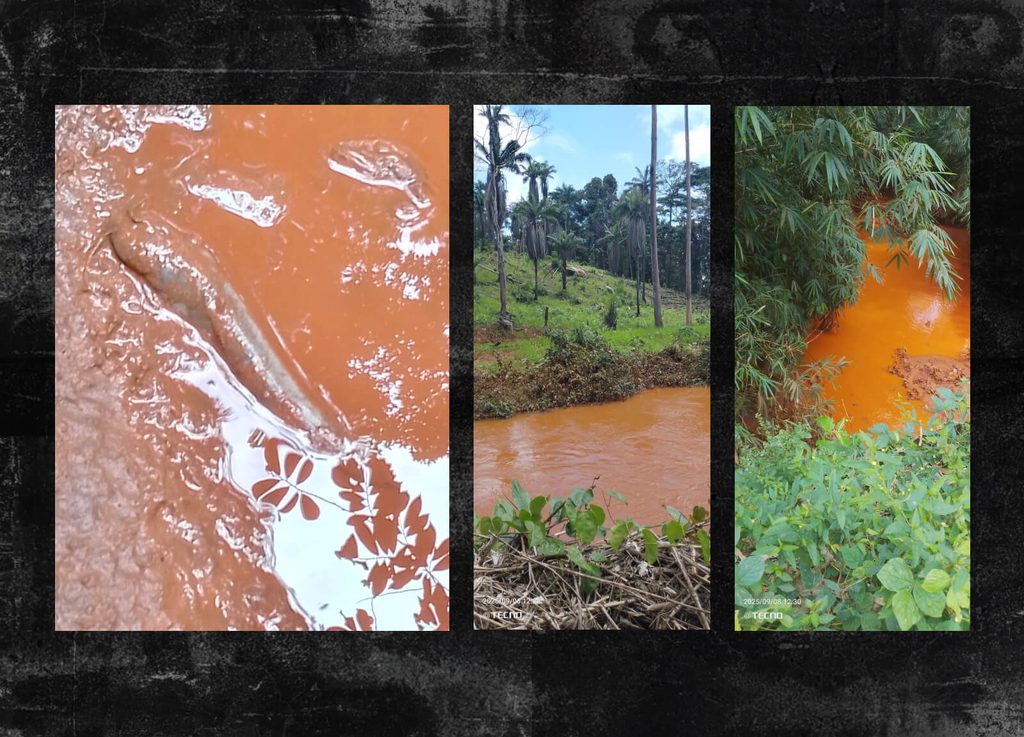
Left to right: a dead fish in the River Velee on 8 October 2025; the River Gba on 6 September 2025; the River Gba on 8 September 2025. Photos provided to Disclose by local residents

Alfred Guane is a farmer in the village of Bonla, about one km upstream. “We can no longer grow vegetables along the river banks. Soon we will produce zero,” he says. Like many of his neighbours, he had to resign himself to renting a plot of land away from the rivers.

In Nimba county, rivers and streams are used to water crops but also for drinking, washing clothes or dishes, and bathing… Some 15 km south of Bonla, in the village of Zolowee, residents have stopped drinking water from streams that they had used since time immemorial. Meanwhile, “ArcelorMittal brings drinking water from [the capital] Monrovia for their staff,” seethes Roland S. Dolo, the village chief. The group’s management confirmed this to Disclose, adding that they are taking “measures aimed at protecting local water resources”.

The scale of the pollution is confirmed by an independant laboratory report dated January 2025 seen by Disclose. According to the document, drawn up for the benefit of the Liberian government, heavy metals were found in rivers, wells and pumps used by the residents of five villages located in the mining concession. High levels of fluoride, suspected of being toxic for brain development and reproduction, were found in 19 samples out of a total of 37. Contamination is 17 times higher than the levels recommended by the World Health Organisation (WHO). Moreover, lead was found in all samples — up to 63 times the levels recommended by the WHO (0,01 mg/l). Lead impurity can be found in iron ore and is a particularly toxic compound for children and pregnant women.

Researcher and geologist Levi Nya Paye, a water specialist at Monrovia University who did not take part in the study, told Disclose that “the report gives real reason for concern about water quality in several of the sampled communities.” He added that “the report, on its own, cannot establish that ArcelorMittal caused the contamination […], but it states that ArcelorMittal Liberia’s baseline and routine monitoring data were requested and not provided. To me, it is a kind of red flag”.
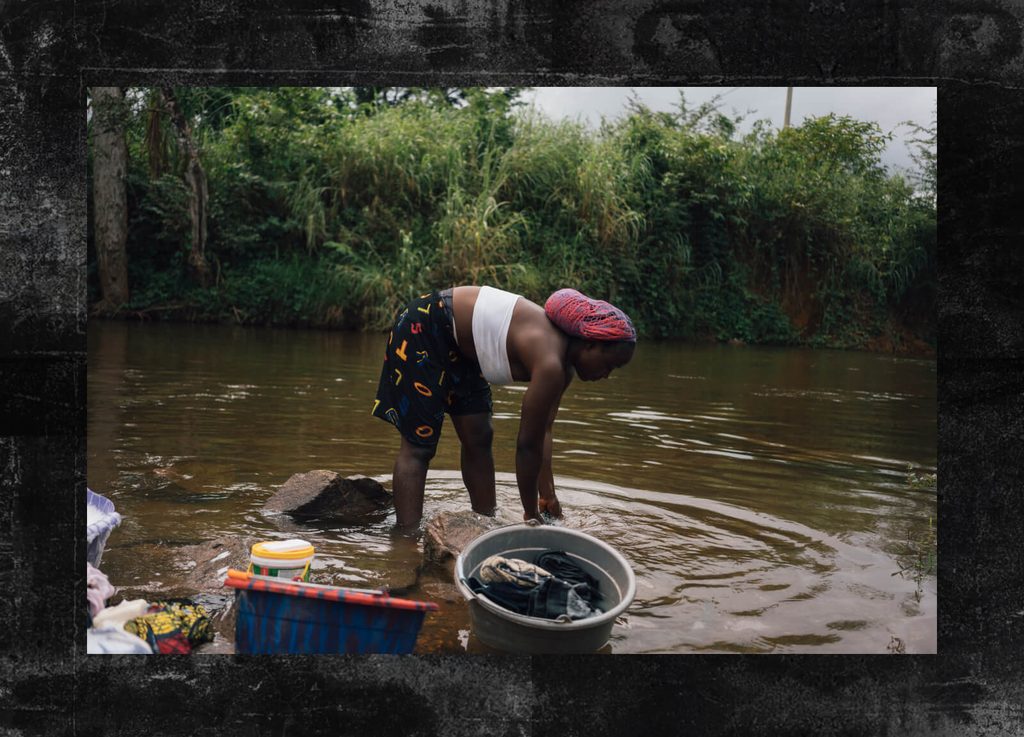
A resident of a village located within ArcelorMittal’s concession does her laundry in the river. Photo: Berta Vicente Salas

The Liberian government declined Disclose’s request for comment on its follow-up to the report. However, the Environment Protection Agency (EPA), which is under the authority of President Boakai, told Disclose that in late 2025 its laboratory analyses of soil, water and sediments showed “elevated levels of iron and certain heavy metals, including lead and chromium, exceeding national water-quality standards.” Moreover, “EPA investigators observed iron-rich, sediment-laden discharges [..] entering nearby water resources through six discharge points” used by ArcelorMittal. The company was fined $500,000 by the authorities, in addition to the $295,000 worth of sanctions in connection with its water pollution since 2022.

ArcelorMittal, approached for comment, told Disclose that “it acknowledges concerns raised regarding sediment discharges associated with its mining operations and takes these matters seriously”, that “the company maintains a comprehensive environmental monitoring programme and routinely undertakes water quality monitoring.”

According to our information, two court cases are about to be brought against the multinational in Liberia over human rights abuses and environmental degradation in Nimba County, one by local NGO Green Advocates International and the other by residents of a village in the mining concession. But this is not expected to rein in the steel giant’s ambitions. ArcelorMittal is planning to excavate 30 million tonnes of Liberian ore per year by 2030 so it is likely to keep contributing to climate change for a long time yet.


↗ Read ArcelorMittal’s full responses

Investigation: Camille Corcoran
Editorial coordination: Pierre Leibovici
Fact-checking: Rémi Labed
Editor: Mathias Destal
Translation from French: Béatrice Murail
Composite images: Thomas Steffen
Photos: Berta Vicente Salas
Locals Consider Conservation After Loggers Vanish

Loggers
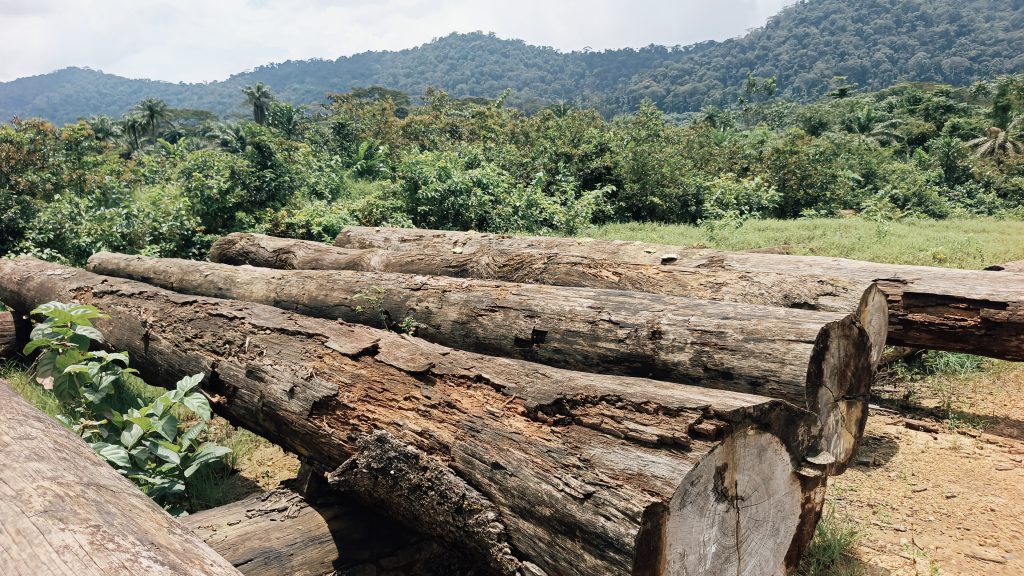
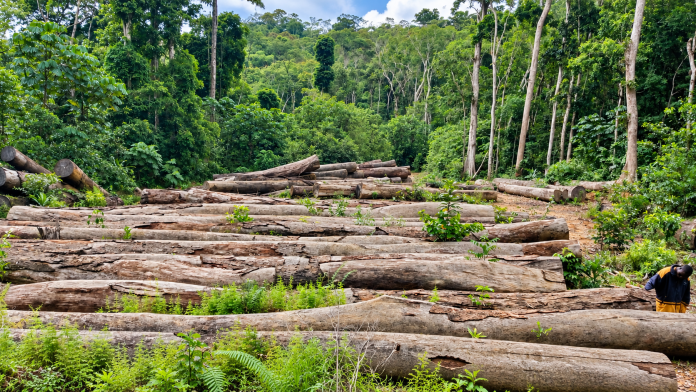
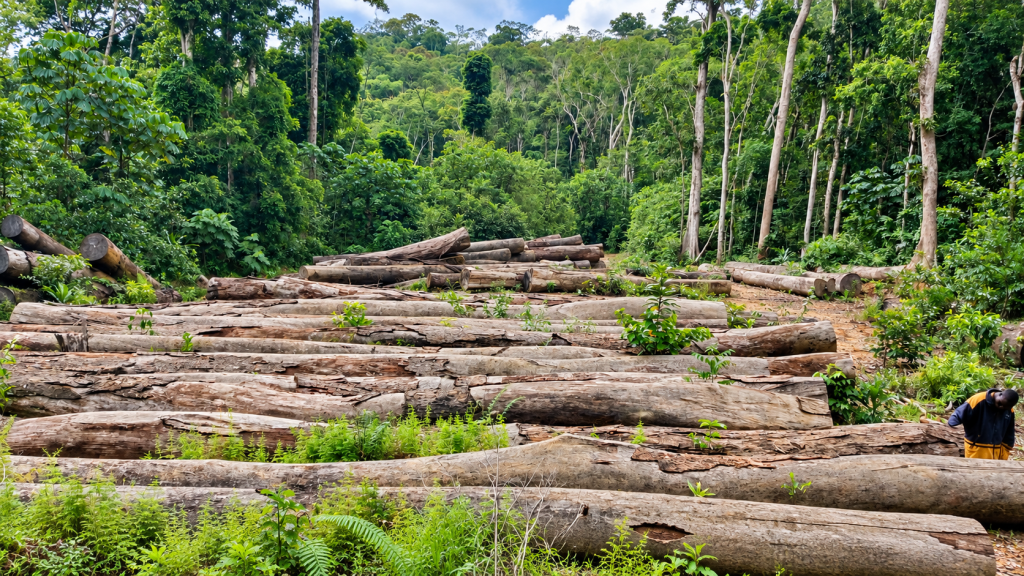
Depleted logs lying anandoned in the Tonglay forest

Top: Keshav abandoned logs in the Tonglay Community Forest, Gbarpolu County, The DayLight/Varney Kamara


By Emmanuel Sherman


TONGLAY; NORMON, Gbarpolu County – Villagers in the Tonglay Clan, Kongba District, celebrated after signing a logging contract with a new company in 2022.

Keshav Global Industries Limited promised to build roads, bridges, schools, scholarships, and healthcare assistance in exchange for Tonglay’s 18,611-hectare forest.

At about the same time, Tonglay’s neighbor, the Normon Clan, also signed a similar contract with Keshav for 12,483 hectares.

But both communities’ hopes were dashed because the agreements were short-lived, leaving behind debts, unfulfilled promises, and logs. That experience has shifted local people’s attention to conservation, a familiar recourse in that area.

“This left us disappointed because the community did not benefit anything from the contract,” said Karimu Fofana, Tonglay Community Forest’s chief officer. “There is similar disappointment in Normon.”

Keshav owes Tonglay US$79,000 for land rental, cubic meters, scholarships, healthcare, and forest guard fees, according to The DayLight’s analysis of the contract and financial records. The company failed to build two major roads in the clan between January 2023 and March 2024. It also failed to construct six concrete bridges it was required to complete by this year, among other things.

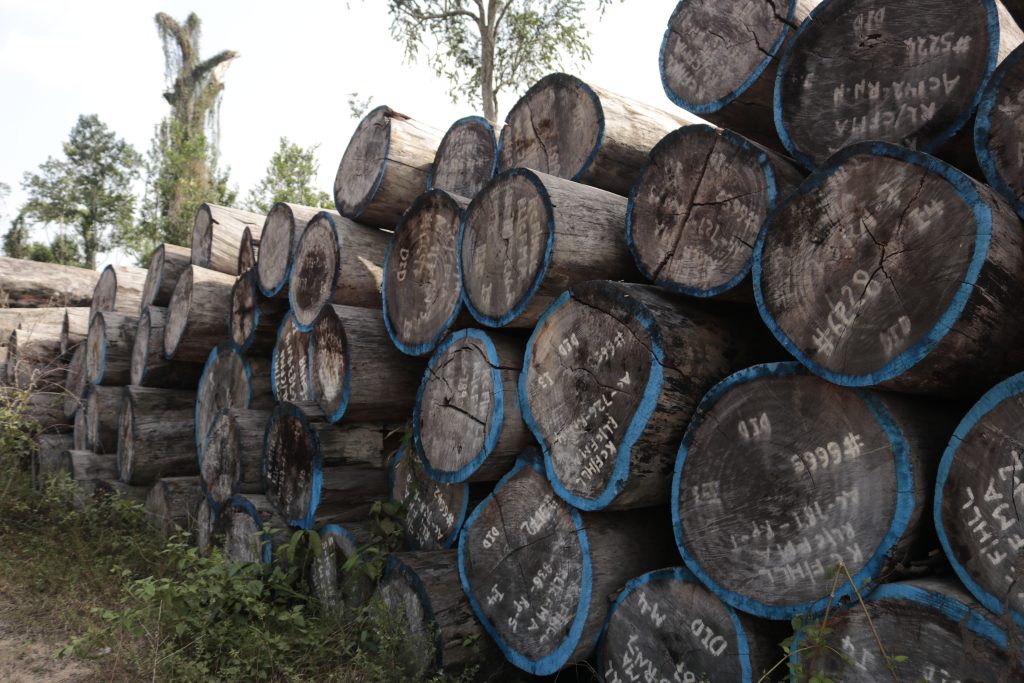
Apart from the unpaid fees, Keshav also abandoned several logs. The community puts the number at 565 logs left in the forest and by the roadside. The DayLight counted 300 logs in one location.

Things are the same in Normon. Keshav owes the community an undisclosed amount and failed to build community roads, provide scholarships, healthcare assistance, and forest guardian fees.

The roads in the region are among the most deplorable in Liberia, cutting the region off from the rest of the country. Motorcycles cannot even ply some areas.

“It hurts us a lot because the main thing we signed the contract for was to ensure the company builds our roads,” said Boakai Kanneh, head of Normon’s community leadership.

Loggers
Depleted logs lying abandoned in the Tonglay forest

“We want cars to come into the community with goods in our towns and villages. Our people are suffering.”

Keshav felled 110 logs and left them in the forest in Normon, according to Kanneh. The DayLight could not independently verify the information because of the distance to access them. The Regulation on Abandoned Logs, Timber and Timber Products prohibits leaving logs unattended in a forest for three weeks.

Concerned about its abrupt closure, the two clans visited Keshav’s headquarters in Congo Town, outside Monrovia, but did not meet a representative there. Tonglay then wrote a letter to Vyom Garg, Keshav’s owner and CEO.

On April 9, 2025, Garg replied to Tonglay, blaming his company’s abrupt closure on the global financial crisis, which “significantly” impacted its operations.

“We are committed to beginning the payment of all the outstanding liabilities to the community no later than April 30, 2025,” read Garg’s letter.  However, the payment has not happened.

The failure of Kehsav’s contracts dashed the hopes of people in Tonglay and Normon.

“We were carrying out some development, and we could not complete that development because we were financially depressed,” Fofana said. “Based on their failure, we could not go further with those things.”

Contract terminated

Last year, Tonglay filed a lawsuit in the 16th Judicial Circuit Court in Gbarpolu County to terminate its contract with Keshav, according to court records. The court sided with the community against the company, which was not represented in the two-month trial.

The court said it found no reason to deny Tonglay’s petition to cancel the third-party agreement.

“The third-party agreement between Tonglay and Keshav is hereby cancelled and terminated,” the court ruled.

With the contract terminated, Tonglay has held elections for a new corps of officers to strengthen its forest governance.

Normon, on the other hand, has not terminated its contract. To do so, the community must officially inform the FDA before heading to court.

If Normon terminates its contract, Keshav, whose vision is to work with certified forests in Africa and South America, would have no forestry contract in Liberia. Garg did not respond to queries for comment.

Keshav Global Industries Limited, an Indian-owned company, is a subsidiary of Keshav Global Trading LLC, based in Dubai, United Arab Emirates, and Keshav Global Private Ltd, based in Singapore. The conglomerate trades timber and agricultural commodities.

Conservation

Both Tongaly and Normon are weighing options on whether to pursue conservation or stick to logging. Back in 2021, Montserrado-based NGO the Society for the Conservation of Nature Liberia (SCNL) helped the clans obtain community forest status from the Forestry Development Authority (FDA). This allows locals to co-manage the woodlands alongside the FDA and share in forest resources.

The clans are part of the Gola communities adjacent to Gola National Park, a forest between Liberia and Sierra Leone, home to forest elephants, chimpanzees, and rare birds. Moreover, Normon shares a boundary with the Foya Proposed Protected Area between Gbarpolu and Lofa, which covers 168,628 hectares.

The Normon Community Forest. The DayLight/Varney Kamara

Tonglay is about to sign a conservation agreement as part of a three-year project that seeks to empower forest-dependent communities.

Normon, on the other hand, wants to do the same.

“We are in the process of terminating the contract just as the Tonglay Community Forest did. If we terminate Keshav’s contract, we will be able to sign the community conservation agreement with SCNL,” said Varney Kabba, the secretary to Normon’s leadership.

James Mulbah, forest landscape manager with SCNL, reveled in the clans’ potential switch to conservation.  

Mulbah said: “Conservation is taking root, but getting communities on board a hundred percent takes time.”


This story was produced with support from Internews’ Earth Journalism Network.

Loggers, Miners Unlawfully Operate in the Same Community Forest

Miners and Loggers Unlawfully operate in Same Community Forest
A drone shot of JM Mining Company exploration area in Bopolu District, Gbarpolu County

Top: Drone shot of JM Mining’s Rambo Base Exploration Camp in the Bondi Mandingo Authorized Community Forest. The DayLight/Samuel T. Jabba


By Varney Kamara


This is the second of a two-part series on a logging contract and a mining license in a community forest in Gbarpolu County.

GBARQUOITA — In June, the Bondi Mandingo Community Forest signed a logging agreement with Kisvan Timber Corporation, a logging company, to exploit 37,222 hectares of forest in Bopolu District, Gbarpolu County. However, it is the second contract in the same area, an irregularity.

Nine months earlier, the government issued an exploration license to the JM  Mining Company, a mining firm, on 297 square kilometers that overlaps the community forest, according to the Ministry of Mines and Energy’s records. Community people are concerned that this could lead to clashes between the two companies.  

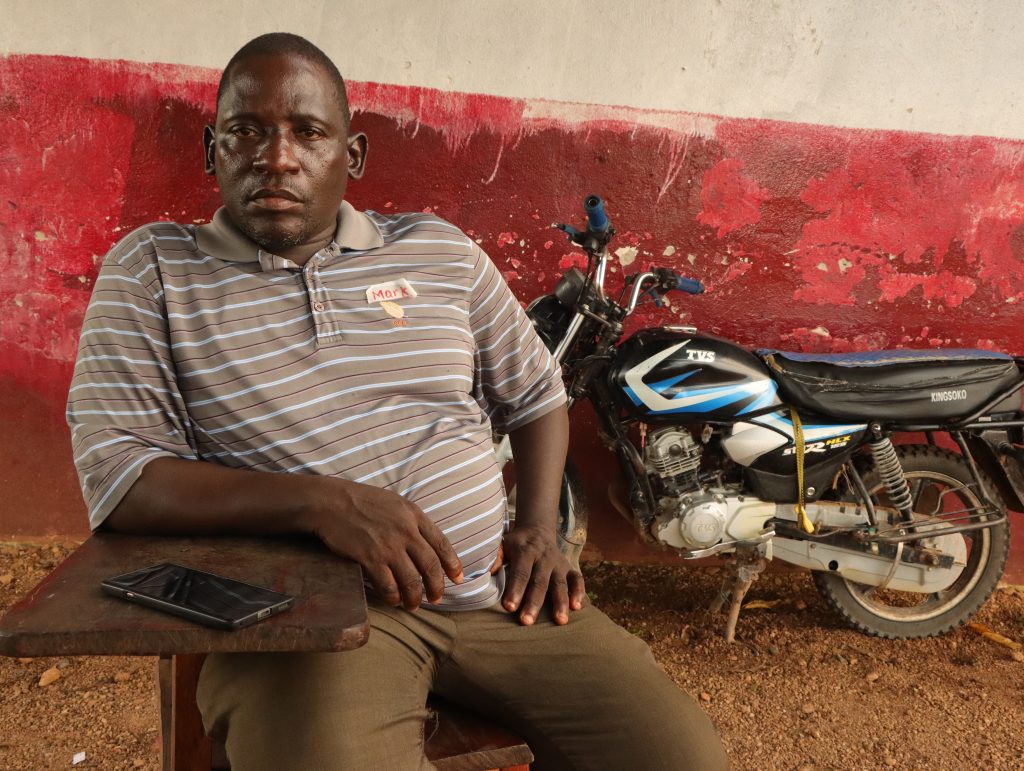
“This mining thing is a threat to our community. We are concerned because the logs that Kisvan wants are the same logs that JM  Mining is cutting down and burying in the forest,” said Mark Dennis, the chief officer of the community forest.

“Their exploration has been going on for two years now. They are doing it in the Kpo Mountain area, and we are afraid that they will give the loggers problems,” added Stanford David, General Town Chief of the Bondi Clan.

JM  Mining operated illegally in the forest before its current exploration license.  In July 2024, the Environmental Protection Agency (EPA) fined it US$95,000 for operating without an environmental permit. The EPA found that the company contaminated a major watercourse local communities depend on for safe drinking water.

Though JM  Mining was awarded a license for the area, Bondi Mandingo said it did not consent to the company’s operations in the mountainous forestland.

“There was no prior information. We only saw them here. They told us that they obtained a license from the government,” Dennis said in an interview with The DayLight in Bopolu. “They said we don’t have anything to do with their exploration business until the company signs an agreement with the government.”

Bondi Mandingo is authorized as a community forest with the Forestry Development Authority (FDA). In December 2018, it signed its first commercial contract with Indo Africa Plantations Liberia Incorporated, but terminated the contract after the company failed to meet its obligations and abandoned thousands of logs.

In February, Bondi Mandingo wrote the Ministry of Mines and Energy over the “provocative mining situation.” It was unclear whether they got a reply.

But in a statement to The DayLight, the Ministry of Mines justified its decision. “The Ministry of Mines and Energy awards exploration licenses in community forests, because the Ministry believes that exploration is a research license and hence exploration and logging can co-exist or take place in the same forest,” the statement read.

The statement was a slight turnaround from its previous position. In 2019, the ministry said it does not recognize community forestry, and it echoed that point last year. It awards licenses based on the constitutional principle that the state owns all mineral resources, except national parks, graveyards and cities.

A draft minerals and mining law recognizes community forestry and ancestral land ownership. However, the proposal has stalled over the last two years, and civil society is now pushing for it again. Created in 2000, the Minerals and Mining Law of Liberia is the oldest in the Mano River region.

Aerial view of the Bondi Mandingo Community Forest adjacent. The DayLight/Samuel T. Jabba

Kisvan did not respond to queries.

JM  Mining said it could not get the community’s consent because it only had an exploration license. An exploration license lasts for three years and can be extended by another two years. After that, it can pursue a mineral development agreement, which would grant it the right to mine the area for 25 years.

“When that is done, we will come back to the community and sit and talk,” said Hillary Simmons, an official of JM  Mining. “Until that can happen, we have no such dealings with the community regarding benefits, because nothing has really started.”

The Community Rights Law…, contradicts the Ministry of Mines and JM Mining’s comments. The 2009 law guarantees a community’s consent regarding any use of their forest resources. Furthermore, Bondi Mandingo would have to alter its agreement with the FDA to accommodate any mining activities.


The Community of Forest and Environmental Journalists of Liberia (CoFEJ) produced this story.

Locals Sign New Logging Contracts After Old One Failed

Locals Sign New Contract after Old One Failed
Abandoned logs by a roadside in Gbarpolu County.

Top: An aerial view showing several abandoned logs near Timber Village in the middle of the Bondi Mandingo Forest. The DayLight/Samuel Jabba


By Samuel T. Jabba


This is the first of a two-part series on a logging contract and a mining license in a community forest in Gbarpolu County.

GBARQUOITA – A community in Gbarpolu County has agreed to a new logging contract, reopening the forest to timber extraction after a previous contract ended unsuccessfully.  

Bondi Mandingo Community Forest, which covers 37,222 hectares in the Bopolu District, signed the seven-year deal with the Kisvan Timber Corporation on July 24. To meet expectations, community leaders have ensured this contract delivers real benefits this time.

“I think it is a good agreement. We had a similar issue before in the community, but what got me involved with this is that this one is time-bound,” says Mark Dennis, Bondi Mandingo’s chief officer. The first agreement did not have that. This time, it will not be a ‘sell and pay,’ where you will carry the wood before returning to the communities to pay benefits.”

The new agreement includes US$25,590 in annual land rent, US$3 per cubic meter in harvesting fees—one of the highest in the industry—and a US$7,000 healthcare fee. The company must provide education support, forest-protection funding, offices for community leadership, road rehabilitation, and a sawmill.

Dennis says representatives from six affected communities support the contract. It initially sought a conservation deal, but negotiations broke down midway, fixing the community’s attention back on logging.

Bondi Mandingo’s first contract was with Indo Africa, one of several companies owned by a Singaporean family. Indo Africa Plantations Liberia Incorporated owed the community US$400,212 and failed to fulfill its promises of roads, schools, and jobs, according to court filings. A Bopolu court sided with community leaders and terminated the contract last month.

“In the first contract, we did not realize our benefits, and the logs were exported out of here secretly. Nothing we received in return. We still stand to benefit from that money,” says Dennis.

Indo Africa left behind some 10,000 cubic meters of logs. The woods lay scattered in the forest and on the roadsides in Gbarquoita, a major town in that area. Reporters counted about 500 abandoned logs, mostly expensive species. Having signed the contract, Kisvan will take ownership of the abandoned logs, subject to regulatory requirements.

“We were angry because we went into the bush and saw the number of logs the company left in the forest. So, we had no other option,” says Fatu David, the chairlady of Gbarquoita Town.

Logs Indo Africa abandoned in the Bondi Mandingo Forest. The DayLight/Samuel Jabba

Also, under the contract, KISVAN must pay harvesting fees into the community account before export, replacing the previous practice in which timber allegedly left before benefits were paid. It sets deadlines, including completing the Bopolu–Gbarquoita road by next March. Community members are entitled to mid-level positions in the company and take legal action if deadlines are violated.

“This was discussed in the agreement, so that we can have eyes inside. If anything happens, we will be informed. We have also started reviewing the documents that the government gave them,” explains Dennis.

“So, we are monitoring them.”

Kisvan has another logging contract with the Marbon Community Forest in Grand Cape Mount County, a problem with which Bondi Mandingo is all too familiar. A Singaporean family that owns Indo Africa had contracts with three other community forests, apart from Bondi Mandingo. All but one of the contracts ended in court, with devastating consequences to local people. Kisvan has had issues with its previous contracts, too.  In 2021, it signed a logging contract with the Central Morweh Community Forest in River Cess County to operate 19,091 hectares of forest. The contract, however, ended prematurely, following a series of payment and project challenges.

Kisvan denies any wrongdoing regarding Central Morweh but did not respond to queries for comment in this story. Dennis, meanwhile, is confident that the Bondi Mandingo-Kisvan contract will deliver. “Not hundred percent. I trust at least 80 percent of what they have promised because they are humans,” says Dennis. “People can make promises, and at times, they may not fulfill their promises.”

Mark Dennis, Chief Officer of the Bondi Mandingo Authorized Community Forest, Bopolu District, Gbarpolu County

Miners and loggers in one forest

Pressure from miners also influenced Bondi Mandingo’s decision. A Chinese Liberian firm, J.M. Mining Company, holds a gold-exploration license that overlaps the community forest. Reporters saw earthmovers, several open pits, and a camp house of several Asian men.

Under the Mineral and Mining Law, an exploration license lasts three years and can be extended by another two. After the extension, the license could evolve into a 25-year agreement with the Liberian government. This means J.M. Mining could exploit the forest throughout Kisvan’s contract lifespan, which is a forestry offense.

“Their exploration has been going on for two years now. They are doing it in the Kpo Mountain area, and we are afraid that they will give the loggers problems,” said Stanford David, General Town Chief of the Bondi Clan.

The Ministry of Mines and Energy calms the community’s fear in a statement.

“The Ministry of Mines and Energy awards exploration licenses in community forests, because the Ministry believes that exploration is a research license and hence exploration and logging can co-exist or take place in the same forest,” reads a statement.

J.M. Mining denies any wrongdoing and supports the ministry’s view. 

“The issue of having logging and mining operations in the same space at the same time will be handled,” says Hilary Simmons, a J.M. Mining manager. “All these come down to simple understanding; I think there won’t be any conflict here.”


This story was produced with support from Internews’ Earth Journalism Network.

The Forgotten Children of Wartime Loggers

The Forgotten Children of Wartime Loggers
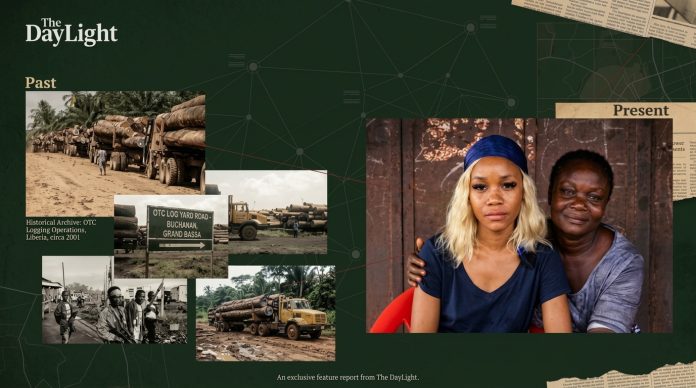
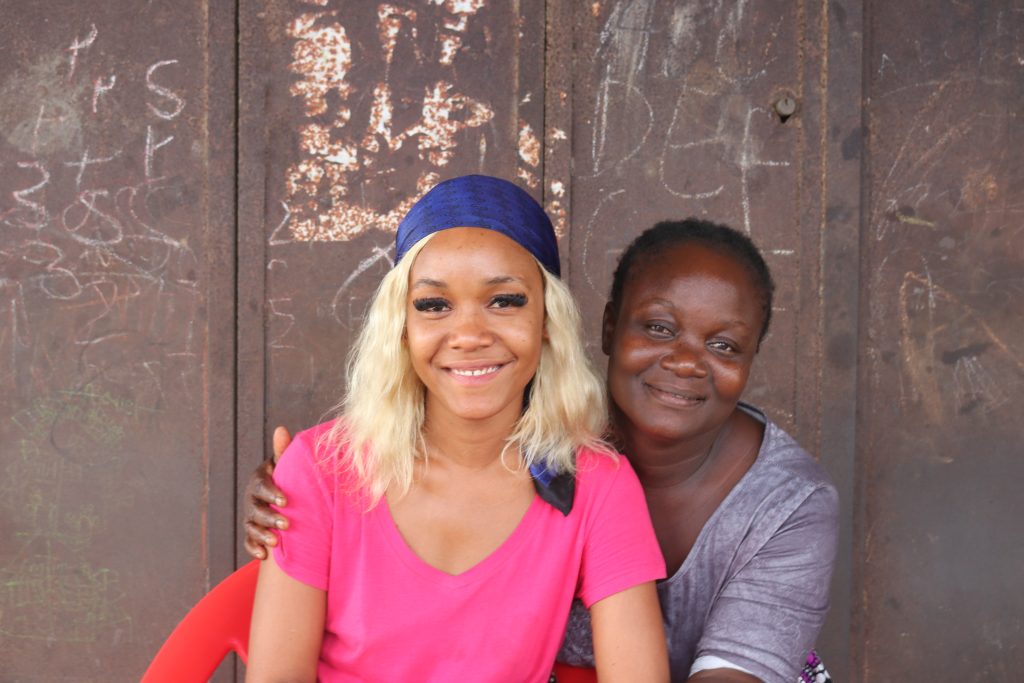
Maya Lipin, 24, sits on the lap of her mother Mahn Thomas. Maya's father worked with Oriental Timber Company between the later 1990s and early 2000s.

Top: A poster depicting OTC’s operations, combatants and Maya Lipin and her mother, Mahn Thomas. Poster by Michael Harijgens for The DayLight


By Emmanuel Sherman and Philip Quwebin  


NEEZUIN, River Cess County – In 2000, Mahn Thomas, 17, visited her aunt in Buchanan, Grand Bassa. There she met Dennis Lipin, a 35-year-old Malaysian trucker with the Oriental Timber Company (OTC), the largest logging company then.

Initially, Mahn resisted Mr. Lipin’s proposal, as she “did not want a white man.” However, her aunt, who had a great influence over her, convinced her, and she gave in to Mr. Lipin. Shortly after, she moved to Neezuin, River Cess County, where Mr. Lipin was stationed. By 2001, she was pregnant with their first child, Maya, and another daughter, Nana, arrived two years later.

“He was nice and very good,” said Mahn.

But misfortune was right around the corner. Two months after Nana’s birth, a war between Liberian government forces and rebels intensified, and the family fled to Buchanan. When the war finally broke out in the port city, Mr. Lipin departed Liberia for Malaysia. That was the last time Mahn, Maya, and Nana ever saw him.

Maya and Nana are two of a large number of children fathered by Asian workers of OTC, which was owned and operated by Guus Van Kouwenhoven, a Dutch businessman who died last month in South Africa. Gus, as he was affectionately called in Liberia, collaborated with then-President Charles Taylor, making OTC and people connected to it targets for rebels.

When Taylor’s regime ended in October 2003, OTC’s Asian workers—Malaysians, Indonesians, Filipinos and Chinese—fled the country abruptly. But they left behind scores of children they had with Liberian women and never returned.

The ‘Red Sea’

Mahn and Maya. The DayLight/Philip Quwebin

Her OTC connection in mind, Mahn decided to escape Buchanan with her children and go to Firestone. They walked all night, and by dawn, they were stuck at the St. John Estuary in Upper Buchanan, where the Benson and Mechlin Rivers meet and discharge into the Atlantic Ocean. Many people drowned attempting to cross the watercourse. Afraid of that fate, she changed her mind and headed back to Buchanan with her daughters.  

Interestingly, when she left, the water level miraculously dropped, allowing people to cross to safety. Overjoyed, people likened their experience to Moses leading the Israelites across the Red Sea in Exodus 14. “We called it the Red Sea, because the water parted and people walked on the [riverbed],” Mahn recalled.

The rebel faction that attacked Neezuin and Buchanan was the Movement for Democracy in Liberia (MODEL). Led by Thomas Nimely Yaya, the future Grand Gedeh Senator, MODEL had become active in March 2003. The group was linked to another rebel faction and based on an Ivorian militia loyal to then-President Laurent Gbagbo.

MODEL clashed with Taylor forces for the OTC belt, stretching across Grand Bassa, River Cess, and Sinoe counties. The Taylor regime granted OTC 1.6 million hectares of forest land and the Port of Buchanan in exchange for millions of dollars to fund his war, which contributed to the killing of some 250,000 people. Kouwenhoven used Hotel Africa he had managed since 1980, as a base for illegal arms trading. Joseph Wong, a Malaysian executive of the OTC, supported Taylor’s ties to rebels in Sierra Leone, fueling the carnage there. Thus, Liberia’s wartime timber was coined “conflict timber,” “blood timber,” or “logs of war.”

Struggle and stigma after the war

Twenty-three years after the war, as their hopes of reuniting with their fathers faded, OTC-linked children have moved on with their lives, amid hardship and stigmatization.

Forest resources were used to fund Liberia’s deadly civil wars between 1989 and 2003. Picture credit: Teun Voeten

Teta Giah did not meet her father, who reportedly died in Malaysia in 2004. A resident of New Buchanan, she struggles with accepting the life of fatherlessness. Her mother had met an OTC Asian worker during the war, who disappeared shortly after she was born.

“I used to think about my father when school fees, gala day fees, and other activities were hard to come by,” said Teta, a petty trader. She plans to attend college after she has saved enough money.

Prince Walker is a 23-year-old high-school graduate who no longer asks his OTC father for anything. Prince’s mother, Teta Doe, met his father in Compound Number Four. Prince lived with his grandmother, who cared for him since he was 11 months old. His father had already fled Liberia before he was born.

“Sometimes I tell him to forget about his father and move on with his life,” said Rebecca Walker, Prince’s grandmother.

For her part, Malissa Giah (no relation to Teta) lives with her aunt in Paynesville, outside Monrovia. Her father, whom she only knows as Johnny, was an OTC trucker. Before moving to Paynesville, Malissa sold in the market. Her friends used to scorn her as a “white woman selling pepper and [garden eggs].”

She wants to study accounting, but her uncle, who sponsored her through high school, cannot afford to send her to college. She is a single parent of a one-year-old girl.

“Sometimes I feel hurt, but it is where I find myself. When I am alone, I cry, pray to God to change my situation,” said Malissa.

The Truth and Reconciliation Commission (TRC) found that children faced severe stigmatization, exclusion, and shaming as a result of the conflict, and made several recommendations. The Liberian government has started the process to create the war crimes court the TRC recommended. However, war victims have yet to receive any reparations.

“So far, successive governments have failed to create a national reparations trust fund,” said John Stewart, former Commissioner of the TRC. “A reparations trust fund and a reparations commission require strong political will.”

Eric Saab, 24, hopes to meet his father to help him finish high school.

Eric’s Malaysian father, Henry Garlawu, worked as a mechanic for OTC and left Liberia before the war. His mother, Oretha, now deceased, had met his father at an OTC camp in River Cess. Eric, like Prince, lives in Buchanan with his grandmother

“I want to see my father,” Eric sobbed in a phone interview with The DayLight.

Dead feelings

Not only did the OTC children’s world fall apart, but also OTC’s. the same year of the MODEL attack, the United Nations imposed a travel ban on Taylor, Kouwenhoven, and Wong for their roles in the conflict, and embargoed Liberian Timber.  Taylor was later sentenced to 50 years for crimes he committed in Sierra Leone. A Dutch court sentenced Kouwenhoven to 19 years for war crimes he committed in Liberia while in South Africa, but he was not extradited to the Netherlands to serve the term.

Today, Mahn sells things and does manual work to sustain herself and the children. Both girls have graduated from high school, but she regrets raising the children alone.

“I regret it because he left his children with me. He is supposed to be talking with his children and talking with me,” Mahn told The DayLight.

Her eldest daughter, Maya, is now 24. She, too, has two children and wants to study nursing.  

“My feelings for my father have died, because I feel he is not concerned about what he left behind,” Maya said.   “If something is important to you, no matter what it takes, you will try to find it.”


This story was a production of the Community of Forest and Environmental Journalists of Liberia (CoFEJ).

Locals Lie to the EU over Proposed Park, Investigation Finds

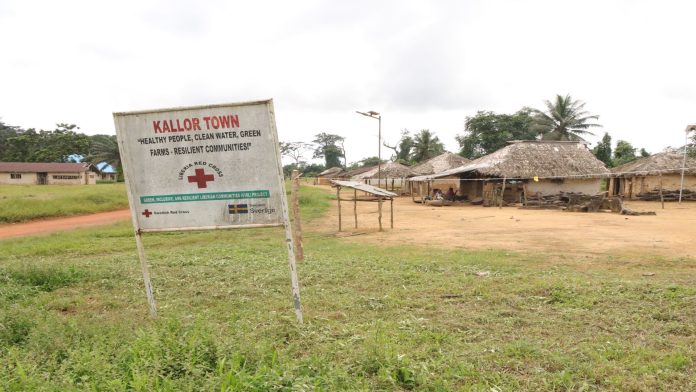
Top: A view of Kallor Town, in Lower Sanquin Clan, Sinoe County. The DayLight/Samuel T. Jabba


By Varney Kamara, Esau J. Farr and Samuel T. Jabba


KALLOR TOWN – People in Sinoe County lied in a letter to the European Union Delegation in Liberia regarding their participation in the establishment of a proposed park, a DayLight investigation found.

In early September, the Lower Sanquin Clan citizens wrote ex-Ambassador Nona Deprez to intervene in an alleged violation of their customary rights regarding the Kwa Proposed Protected Area, according to the letter, seen by The DayLight. In the letter, they claim that they did not sign any agreement with authorities and had not consented to the establishment of Kwa. They are asking the EU, which is funding the park, to halt the process until they get redress.

Kwa is a collaboration among the Forestry Development Authority (FDA), Wild Chimpanzee Foundation (WCF), and the Liberia Land Authority (LLA). Legislation to finalize its formation is now before President Joseph Boakai for his signature. Thereafter, the document would go to the Legislature for enactment. 

“To be clear, our community has not given [its consent] for the creation of the park,” read the Sanquin citizens’ letter. “We have asked that the gazettement be delayed until the FDA, the LLA, and the WCF propose a model of conservation that will respect our customary rights.”

But a DayLight review of official documents and interviews—including with signatories—contradicts the claims in the letter.

Contradiction

Covering 171,888 hectares, the Kwa Proposed Protected Area spans River Cess, Sinoe, and Grand Gedeh Counties. The forest is a habitat for Liberia’s second-largest known population of critically endangered western chimpanzees, pygmy hippopotamuses, and forest elephants. It supports national efforts to protect 30 percent of Liberia’s forests and fulfills its climate commitments. 

In 2016, the Kwa process started. However, in 2023, a group of NGOs, including Social Entrepreneurs for Sustainable Development (SESDev), objected to the process. The group flagged that communities had not confirmed their customary ownership of the forestland. The advocacy referenced the Gbehzohn Declaration, in which actors agreed to confirm customary land tenure before establishing a park.

Eventually, the process resumed in early 2023, with customary land activities. Locals finally gave their consent for Kwa, signed boundary agreements, and agreed to co-manage the park alongside authorities, official documents show. They also participated in meetings about the humid forestland.

“Our towns commit to actively participate in the sustainable management of protection of the future… Kwa National Park,” read one document they signed. “Our town wishes to receive specific benefits based on negotiations from the future… Kwa National Park.”

Ironically, three individuals who co-wrote the letter to the EU envoy had signed documents to establish Kwa.

Evelyn Kpalleh, Town Chief of Kallor Town, signed a Kwa co-management agreement on April 5, 2023, and a boundary paper on June 27 this year. She admits to signing the documents, but said she co-wrote the EU letter because she was allegedly left out of the boundary process.

Esther Broh, a farmer in Kallor Town, signed a similar Kwa co-management document that Kpalleh signed on the same day. However, she denies signing the document. “I don’t remember signing any agreement that the park should come to our community,” said Broh in an interview with The DayLight at her home.  

However, the evidence does not support Broh’s comments. Broh and three other Kallor townspeople even agreed to take part in species monitoring and patrols, according to official documents. They promised to farm outside “the agreed harmonized boundary” of the proposed park.

Reason Seequeh, the chairman of the Upper Sanquin Clan’s land committee, speaks with The DayLight. The DayLight/Samuel Jabba

Reason Seequeh, who heads the community land leadership, signed a Kwa boundary agreement with five other people, including Kpalleh and Clan Chief Anthony Blay. Seequeh now claims his signature on the Kwa document was forged, and accused authorities of extending the boundary into his farmland. 

“I remember attending a meeting in Bolue-2. We only signed the attendance sheet for people who participated in the meeting. I did not sign any form for the establishment of this park,” said Seequeh.

Two townspeople who also signed the boundary agreement confirmed Seequeh signed it.

“We signed the paper. Mr. Seequeh, who is our chairman, also signed the document,” said Sarah Jlateh, a Sayon Town leader.

“We signed the document in a big meeting in Kallor Town. I signed it. Mr. Reason Seequeh and other people signed it. The only issue we have now is that when they got ready to cut the line, they did not involve us in the process,” said Jerry Baker, a Sayon Town resident. 

Dr. Annika Hillers, WCF’s Country Director, said all legal procedures regarding customary land were followed.

“These steps served to ensure that the communities’ farming activities were excluded from the park and the boundary was shifted and the size of the park was reduced to make sure that no crops were affected,” Dr. Hillers said. “The communities were fully part and thus influenced the boundary location.”

The LLA, which oversees the customary land activities, said it would investigate Seequeh’s claim. “The same people who are now saying that they did not sign any documents are the same people who participated, got involved in meetings, and signed attendance sheets and other agreements,” said Ezekiel Weah, Assistant Director of Customary Land. The FDA did not respond to queries.

A second lie

Like the letter’s co-authors, several people who signed boundary and consent papers denied doing so. However, reporters interviewed one person who admitted signing the documents.

Mathew Tarpeay, a New Town resident, now Commissioner of Upper Sanquin: “The only issue we had was for the park to go behind our sacred creek. Once that was done and resolved, we agreed and signed for the park to come. We have no objection to it.”

A drone picture of the Kwa Proposed Protected Area in Grand Gedeh County. The DayLight/Samuel T. Jabba

This is the second time local people have lied about their involvement with Kwa. Earlier this year, The DayLight published evidence that cocoa farmers in Grand Gedeh County misinformed President Boakai, leading to a government inquest. The farmers claimed they had not given their consent for Kwa formation. Turns out, like in the Lower Sanquin case, signatories of the presidential letter had signed official documents for Kwa. The findings from the government inquest have not been published. 

But in interviews in four adjacent Kwa communities in Grand Gedeh, townspeople expressed support for the proposed park.

“From the beginning, we said no because the forest is where we can get our living,” said Cephus Krah, Town Chief of Kumah Town in Tchien District. “But after they taught us about the importance of the forest, we signed the document without anybody forcing us.”

9 Proposed Changes to the Forestry Law Explained

Top: Operators mill planks with a chainsaw in Borkeza, Lofa County, in 2022. The DayLight/James Harding Giahyue


By Roberto T. Kollie


MONROVIA – The Liberian government is considering one of the most significant overhauls of the National Forestry Reform Law since its enactment 20 years ago. In 2006, Liberia’s legal landscape was very different. Since then, the country has enacted major legislation, including the Community Rights Law… with Respect to Forest Lands and the Land Rights Act. Liberia has also committed to international agreements on climate change, biodiversity conservation, and legal timber trade.

Several provisions of the existing forestry law now conflict with these newer legal frameworks or fail to address emerging issues such as carbon trading, community land rights, traceability of timber exports, and mining activities in forest areas.

Government agencies, communities, civil society organizations, development partners, and the private sector will discuss the changes further before preparing any final legislative proposal. If consensus is reached, a formal amendment bill would eventually be prepared for consideration through Liberia’s legislative process.

Should the proposed reforms be adopted, they could significantly reshape how Liberia manages its forests, balances conservation with economic development, protects communities’ rights, regulates timber production, and improves transparency in one of the country’s most valuable natural resource sectors.

Here is what the proposed reforms could mean:

1. Sustainable management would become the foundation

One of the biggest proposals is the introduction of sustainable forest management as the guiding principle for every forestry decision. Instead of focusing primarily on commercial timber production, the revised law would require government institutions to balance economic development with biodiversity conservation, climate resilience, community livelihoods, transparency, and protection against illegal logging.

This change would align Liberia’s forestry sector with international agreements such as the Paris Agreement, REDD+, and other global forest governance standards.

2. A legal definition of ‘forest‘

Surprisingly, Liberia’s forestry law currently lacks a statutory definition of what constitutes a forest. The proposed amendment would establish an interim definition based on the 2018 National Forest Inventory. It would allow the Forestry Development Authority (FDA) to periodically revise technical criteria through regulations after future national forest inventories.

Supporters argue that this would reduce uncertainty in land classification and forest management.

Forestry reformers are attempting to define what constitutes a forest in changes to the National Forestry Reform Law. Picture credit: James Harding Giahyue

3. Clarified community ownership

One of the most important reforms concerns ownership of forest resources. The existing law generally states that forest resources are held “in trust” by the Republic. However, the proposed amendments would recognize that forest resources located on customary land belong to communities, while those on private land belong to private landowners, consistent with the Land Rights Act.

Government trusteeship would continue primarily over forests on government and public land.

4. Greater decision-making power to communities

The draft proposes making free, prior and informed consent (FPIC) a legal requirement before any forestry license affecting customary or community forests can be approved. No forest license would be issued on community land without documented approval from local people.

The objective is to ensure that communities understand proposed projects and voluntarily agree before forests are allocated for use.

5. Stronger community forestry

The review also proposes placing community forest management agreements (CFMAs) within the National Forestry Reform Law. Currently, it is not there, as the CFMAs were created by the Community Rights Law, three years after the National Forestry Reform Law. (CFMAs are agreements between communities and the FDA for co-management of community forest resources.

Although communities already manage forests under separate legislation, supporters say integrating these arrangements into the National Forestry Reform Law would eliminate confusion and strengthen community rights.

The amendments would also clarify the respective responsibilities of community forest management bodies (CFMBs), community forest development committees (CFDCs), and community land development and management committees (CLDMCs) to reduce overlapping mandates. (CFMB was created by the Community Rights Law, CFDC was created by the National Forestry Reform Law, and the CLDMC was established by the Land Rights Act).

6. Legal but regulated chainsaw milling

One of the most controversial proposals involves chainsaw milling. Although chainsaw milling has long operated informally in many parts of Liberia, it is not currently recognized as a licensed activity.

The draft would create a formal Chainsaw Milling Permit available only to Liberian citizens, cooperatives, and authorized communities under strict conditions. It would limit operations to community forests or private land, prohibit exports of chainsaw-milled timber, require environmental approvals, and establish penalties for violations.

Supporters argue that regulation is more practical than allowing widespread informal operations.

7. Transparent revenue management

The review follows concerns raised by previous audits regarding forestry benefit-sharing.

The draft requires forestry payments to pass through designated government accounts, and not directly to individuals. It would also establish by law the National Benefit Sharing Trust Board, which manages benefits for communities affected by certain commercial logging activities. It would also require annual audits and strengthen oversight of community forestry funds.

These measures are intended to improve accountability and reduce opportunities for misuse of forestry revenues.

8. Tighter controls over mining in forests

Perhaps the most controversial proposal addresses the growing overlap between mining and forestry.

The amendments would prohibit mining in protected areas, require community land access agreements before mining on customary land, and establish stronger coordination between the Forestry Development Authority and the Ministry of Mines and Energy. Mining companies would also need FDA site assessments before forest-clearing could occur.

9. Stronger monitoring of forestry operations

The draft would require annual independent audits of all major forestry licenses, including community forestry agreements and chainsaw milling permits.

Audit reports would be published, increasing public access to information about timber harvesting, payments, community benefits, and legal compliance.

The amendments would also require the National Forest Policy to be reviewed every five years through a participatory process, involving government, communities, civil society, and the private sector.

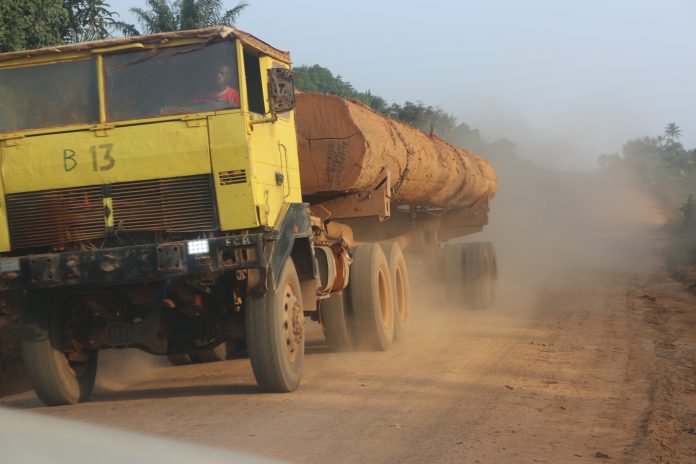
Trucks offload logs outside Greenville, Sinoe County. The DayLight/James Harding Giahyue

Other Issues

But not every issue has been resolved. The review identifies several questions requiring additional consultation, including:

  • Whether new Forest Management Contracts and Timber Sale Contracts should be allowed on community land or restricted to government land.
  • Whether all forestry contracts should follow a uniform 25-year harvesting cycle or whether smaller community forests should have different harvesting rules.
  • How large community commercial contracts should comply with public procurement principles.

US$5.4 Million Grebo-Krahn Park Project Restarts

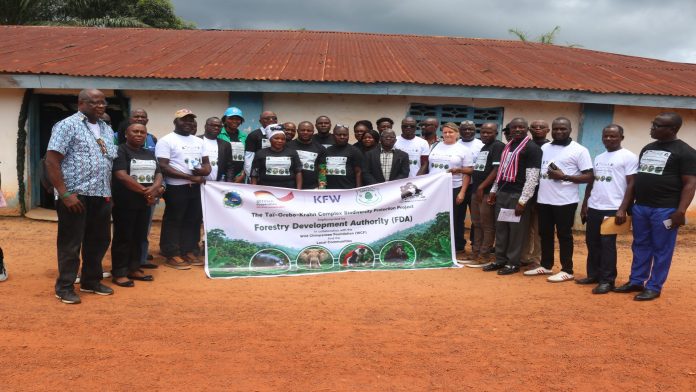
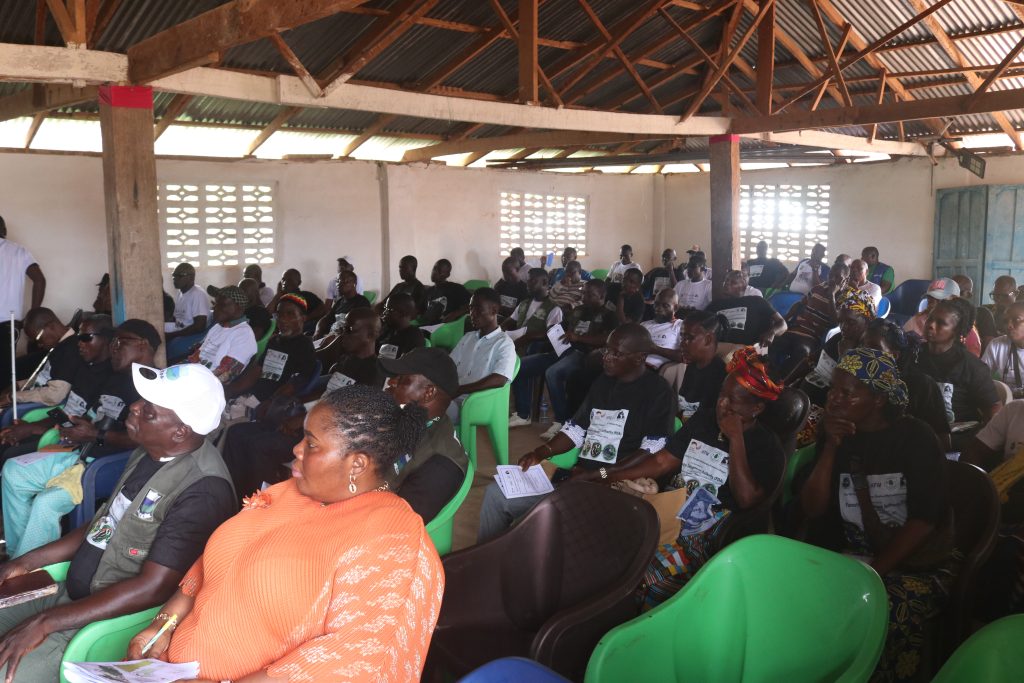
Top: Participants at the Grebo-Krahn project relaunch in Ziah City. The DayLight/Esau J. Farr, Sr.


By Esau J. Farr, Sr.

ZIAH CITY, Grand Gedeh County – The Forestry Development Authority (FDA) has relaunched a multipurpose project for the Grebo-Krahn National Park. The 4.7 million Euros (US$5.4m) project is called the Tai-Grebo-Krahn Complex Biodiversity Protection Project, meant to manage the park.

The German government is funding the project through the Wild Chimpanzee Foundation (WCF) in Liberia, a conservation NGO. The scheme was approved in 2017 by the German Development Bank (KfW) valued at 6 million Euros. 

“We hope that this project can finally address some of the issues that have been coming from the park since its establishment nine years ago,” said Wild Chimpanzee Foundation’s Country Director, Dr. Annika Hillers, at the project’s relaunch in Ziah City, Grand Gedeh County. “It will bring a lot of relief to FDA, the partners, and most of all, the development of local community members.”

The three-year plan focuses on communities’ benefits. It targets roads to connect communities around the park, and offices for the FDA to support regular monitoring. It intends to train over 300 people, employ locals, and introduce animal farming and local savings clubs.

The project also targets the construction of schools, medical facilities and hand pumps, and 150 solar street lights for communities adjacent to the park.

The FDA’s Deputy Managing Director for Community, Conservation and Carbon, Nora Bowier, encouraged locals to own it.

“You need to own it because if it succeeds, we all succeed, and if it fails, we all fail,” Bowier said. “We listened to all your concerns and interests and we are going to look into them to try and address them to the degree we can.” 

Thomas Yaya Nimely, the Senator of Grand Gedeh County, said locals were willing to help the government protect the forest.  

“Our concern is that our citizens have been keeping this forest for generations and as you have come for it, we want to know what benefits this project will bring to them?”

History and biodiversity

The Grebo-Krahn National Park was established in 2017 through a partnership of the FDA and Wild Chimpanzee Foundation. Its establishment was part of the government’s efforts to preserve a portion of its forest in line with the Paris Agreement.

The 97,136-hectare forest runs from Grand Gedeh through River Gee into the Tai-Grebo area near the Ivorian border. The area hosts several wildlife species,  including forest elephants, chimpanzees and the pygmy hippopotamus.

Additionally, it has 300 known animal species and 270 plant species, highlighting its environmental significance. The region has also been designated as an Important Bird Area (IBA) by BirdLife International, the world’s leading global partnership dedicated to the conservation of birds and their habitats.

An environmental and social impact assessment (ESIA) is expected soon, after which road construction will begin.  

Shadow Firm Smuggled over US$400K of Timber to Ivory Coast

Shadow Firm Smuggles over US$400K of Timber to Ivory Coast
A truck transports logs outside Greenville, Sinoe County in 2023.

Top: A truck transports logs outside Greenville, Sinoe County, on January 3, 2023. The DayLight/James Harding Giahyue


By Varney Kamara


MONROVIA – Horizon Logging Limited, an Israeli-owned logging company with unknown owners, smuggled timber to the Ivory Coast on multiple occasions, valued at US$437,000, A DayLight investigation found.

The two shipments occurred in 2023 and 2024, according to Trademo, a US-based business platform that publishes international trade data. However, those shipments happened outside of LiberTrace, Liberia’s legal timber-trading system.

Of the total value, Horizon shipped US$163,790 in 2023 and  US$273,380 in 2024, the data shows. One of its Ivorian buyers is the Abidjan-based Sdma, which offers sea, air and land transport services.  

A review of all of Horizon’s export records through LiberTrace shows no trace of the Ivorian shipments. Further review of its trading at the Ministry of Commerce & Industry and the Liberia Revenue Authority produced the same result.

Companies can trade outside LiberTrace and still pay export taxes to the LRA due to weak coordination among public entities. However, Horizon did not pay any taxes for its Ivorian shipments, the LRA records show. This means the exports happened outside the entire government system and were smuggled across the eastern borders. The exports were documented because the Ivorian government declared them under international trade protocols.

Exporting logs outside the legal system violates the Regulation on Establishing a Chain of Custody System. The regulation provides that timber is traced from its origins to the final destination. The idea is a centerpiece of forestry reform and Liberia’s timber trade agreement with the European Union, which has decided to terminate the deal over continued violations.

Ivory Coast, likewise, prohibits the illegal importation of timber, according to the country’s regulations on the import and export of forest products. The laws state that entities engaged in the import of forest products must get approval from the Ivoirian Minister of Water and Forests, and documentation of a timber legal origin.

“Illegal timber extraction and shipments create a compounded loss for Liberia. Communities lose legitimate forest benefits, livelihoods and climate resilience, while government loses revenue and potential economic benefits, says Dayugar Johnson, the lead campaigner at the Civil Society Independent Forest Monitor.

“At the community level, illegal logging and exports can deprive forest-dependent communities of social benefits and other revenues that could support schools, health facilities, roads, water systems and livelihoods, undermining their rights, as well as fueling local conflicts.” 

Mystery owners

The illegal shipments are not the company’s only wrongdoing. The DayLight found other issues with Horizon’s ownership. Horizon Minerals BV holds 99 percent of Horizon’s shares, and one Dov Aronvich holds the remaining. However, Horizon Minerals BV does not list its shareholders, a requirement under the Beneficial Ownership Regulation of 2023.

Originating from the Liberia Business Association Act, the regulation requires companies to declare their ultimate beneficial owners or the individuals who own them. It is part of a global scheme to combat financial crimes, including money laundering, terrorist financing, and tax evasion. As part of that fight, the Liberian cabinet approved the establishment of a beneficial ownership registry.

Horizon Logging Limited abandoned several logs in Konobo Community Forest, Grand Gedeh County. DayLight/Samuel Jabba

Horizon has been inactive for two years now, according to its business registration certificate. It deserted a 15-year logging contract with the Konobo Community Forest in Grand Gedeh County. It promised to pay the community, build a school, and erect hand pumps, among others, in exchange for harvesting Konobo’s 49,627-hectare forest. Instead, it left unpaid benefits and several logs in the moggy forest and other locations.

Horizon did not respond to The DayLight’s queries for comments.

Augustus Abram, one of its executives, acknowledged receipt of the newspaper’s queries. Later, he denied it was him, even though the newspaper had contacted him earlier this year about Horizon. The DayLight also called his number on official documents and emailed him, but both attempts failed.

Moreover, The DayLight tried contacting Lev Segev, another Horizon executive, but that effort proved unsuccessful. The newspaper then emailed Jamil Ali Fayad, Horizon’s incorporator, but that too did not materialize.     

Two Loggers Killed in Horrific Accident

Tree falls and kills two loggers in Sinoe County.
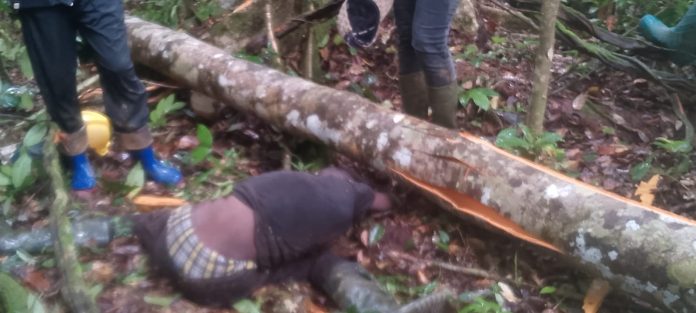
One of two loggers killed in a logging accident on August 12, 2026 in Numopoh, Sinoe County

Top: The body of one of the loggers killed in an accident last week. Picture credit: Superintendent Darius Nagbe, Sr.


By Myer Saydi


NUMOPOH — Two loggers died after a tree crushed them in Sinoe County recently, the police said. 

The victims have been identified as William Wleh Tarpeh, 49, and Stephen Chea Jr., about 25. They were contractors with African Finch Logging Limited, a company operating the Numopoh Community Forest in the Kpanyan District.

“Our investigation is ongoing. We are working to establish exactly what happened and to identify the people who were involved in the logging operation when the accident occurred,” said Moses Dweh of the Liberia National Police’s Criminal Services Division.

“Unfortunately, the company has not yet identified the workers allegedly involved, which is making it difficult for us to fully establish the circumstances surrounding the incident.”

Preliminary accounts indicate that Tarpeh and Chea had completed their assignment when the tree the unnamed worker cut fell on them. 

The accident left Wleh trapped beneath a heavy log, where he reportedly remained for nearly two days before his body could be recovered. The recovery operation drew county officials, chiefs and elders, and residents to the scene.

Chea Jr. was rushed to Kilo Town Clinic on Tuesday evening following the incident, where he was pronounced dead upon arrival.

Speaking through their grief, Stephen Chea, Sr., father of the deceased, expressed profound pain over the death of his son.

“I am fully and painfully frustrated. I don’t see any meaning in living any longer. Why is this world so wicked and heartless?”

Stephen’s mother, visibly devastated by the loss, said her son would never return home again.

“My son will never come back again. See the nasty way my son died!”

The remarks reflect the deep emotional pain surrounding the tragedy. They also express concerns about how the matter has been handled after their son’s death.

Stephen Chea Jr. (arrowed) was one of the two loggers killed last Tuesday in Sinoe County. Picture credit: Facebook/Stephen Chea, Jr.

Nathaniel Wah, African Finch’s Human Resources Manager, expressed condolences to the bereaved families.

“It was an accident, no body deserved such a death. We all regret this, and we console the families. We are in pain and frustrated,” Wah said.

He said that the deceased men were contracted through a subcontractor that is responsible for African Finch’s production.

There are growing concerns about the company’s responsibility and the circumstances surrounding the deaths.

Residents and local authorities are reportedly seeking answers about the individuals who were operating the chainsaw at the time of the accident. They want to know whether other workers have been brought in for questioning by the police.

Concerns have also been raised about why logging operations have reportedly continued while the deceased’s families are still mourning.

These concerns have intensified calls for the relevant authorities to establish exactly what happened, determine responsibility where necessary, and ensure that appropriate safety measures are being followed at logging sites.

Darius Nagbe, the Superintendent of Kpanyan District, expressed frustration over African Finch’s “inadequate response to the tragedy.”

We are worried that individuals who allegedly felled the trees are yet to be identified,” Nagbe said. He called for the chainsaw operators who felled the fatal tree to be turned over to the police for questioning. 

Dweh, the police officer assigned to the case, said the investigation has encountered difficulty because the company had not identified the alleged chainsaw operators—the company has since not commented on this issue.

For the families of Tarpeh and Chea Jr, the pain goes far beyond the questions now being asked. The two men left home expecting to return. Instead, their families received their dead bodies.

This is a production of the Community of Forest and Environmental Journalists of Liberia (CoFEJ).