
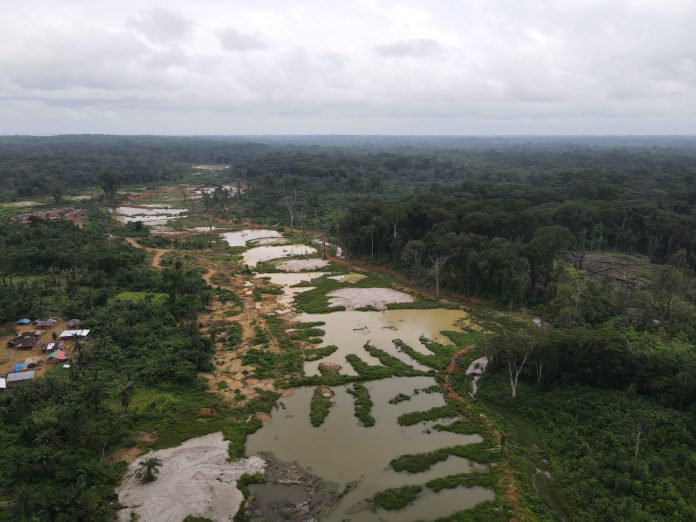
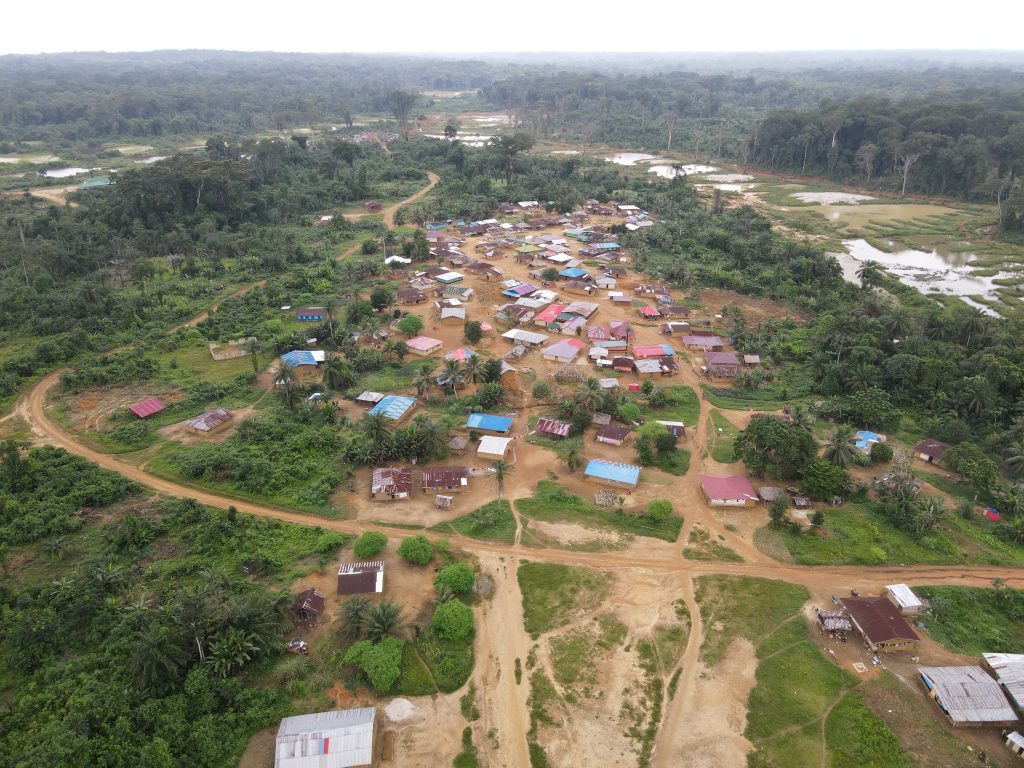
Top: A drone picture shows countless pits Deep Gold Incorporated abandoned and a portion of the forest stripped of vegetation in Gmarkemkpo, Sinoe County. The DayLight/Samuel Jabba
By Samuel Jabba and Myer Saydi
GMARKEMKPO, Sinoe County – On a Friday morning last year, Peter Togba went mining in an abandoned pit. Suddenly, he tripped and fell into the pit, and with no one else there to rescue him, he drowned. He had just turned 20.
Togba’s body was recovered the same day. Townspeople broke tradition and buried him in the town’s graveyard.
“They called me, saying, ‘Your son drowned’. How he even got here, I don’t know,” said James Togba, the victim’s father.
Togba was one of three people who have died at this mine in Gmarkemkpo, a town in Sinoe County’s Dugbe River District. The two other victims were an unnamed 10-year-old girl and a 30-something-year-old unidentified miner.
Deep Gold Incorporated Liberia, a Nigerian-owned company, has run the gold mine for over three years, having arrived here in March 2024. However, a DayLight investigation found that several people died at the gold mine; its owners have no license, and it pollutes a much-needed watercourse. It hollows out the community, has dug up an old land dispute in the region, and pays thousands to locals and community leaders to operate.
Deep Mining was established in 2023 by four Nigerian men: Olatunji and Adeyemi Odebunmi have 30 percent shares each, while Aderonke and Adediran Taiwo have 20 percent each.
Not much is known about the Taiwos in the region. However, the Odebunmis are all too familiar. Two other Odebunmis—Timothy and Samson—co-own Iroko Timber and Logging Corporation, an illegitimate logging company that operated in the Central Dugbe River Community Forest. It cut more logs than they could sell, leaving behind broken promises and unpaid benefits.
In March 2023, Deep Gold came to Gmarkemkpo, according to townspeople and company workers. One worker—we will call John Moses—said he had worked with the company in Grand Kru in 2019.
“For me, I am doing a lot of work here, but they hired me as a mechanic,” Moses said. His story was confirmed by James Jallah, the general manager, known locally as the black manager to distinguish him from the Chinese or other non-negro workers.
This means that Sinoe was not the first location of Deep Gold’s illegal activities, since official records show it has never had a license in the southeast. Notably, Deep Gold did not exist in 2019.
Payouts
Deep Gold’s footprints are all over Gmarkemkpo. There is a hilltop school, three hand pumps, and the road from Kabada through Gmarkemkpo to Pojeakpo. A document shows Deep Gold paid US$5,000 on November 18 last year for a town hall construction.
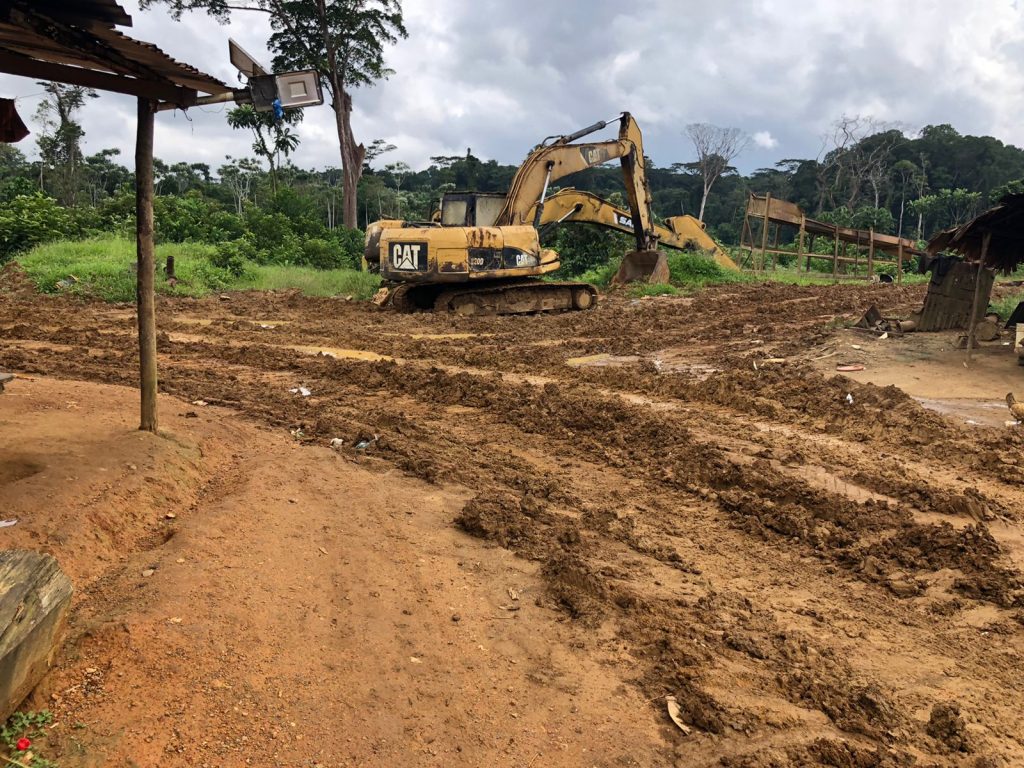
There are big payouts to county and community leaders, documents show. Deep Gold provides L$35,000 each month to 13 elders, according to Jallah, Augustine Wleh, General Town Chief and Acting Clan Chief, confirmed. One receipt shows a US$1,400 and L$210,000 payment to the Patty Gmarkemkpo’s clan.
“The money they are giving the elders is small. We want L$100,000,” said Wleh, sitting in his office wielding a gavel, a Liberian flag in the background.
Moreover, Deep Gold provides jobs for people in the region, including at least a government official. Sorrie Sackor, the Commissioner for the Gmarkempko Township, was suspended in May for alleged conflict of interest involving Deep Gold.
“This act is against the organic law of this nation,” the letter reads. Sackor denies any wrongdoing, though Jallah and Jericho Tarpeh, Deep Gold’s PRO, confirmed his employment. One document shows that Sackor witnessed a rental payment as HR manager after his suspension.
It is unclear how much minerals Deep Gold extracted from Gmarkempko since it operated in other areas.
Bartee Togba, community liaison officer, hinted at a success story. He manages the Central Dugbe River Community Forest, where the Odebunmis—the family of Deep Gold’s co-owners—operated.
“If you are seeing us wanting to renew the MoU, it means we’re one way or the other satisfied with the proceeds that came out of our operations,” he told The DayLight.
Nevertheless, Deep Gold operations are anything but open, even for a remote community. There are no signboards, and the workers have no ID cards. Three Chinese workers hid inside a camphouse, while another left on a motorbike after spotting reporters.
Emmanuel Barclay, Gmarkemkpo’s youth president, claimed that he was invited at almost nine o’clock at night to sign an MoU between the community and the company. At first, he refused because he had an issue with some of the terms of the draft. Following a dispute with the elders, he backed down.
“I told Mr. Sackor that there were some things in the MoU that were not to be there. However, some youth on the board said we should forget it and sign the document. So, we went and signed it,” Barclay said.
Open pits
Deep Gold kept Peter Togba’s and the unnamed girl’s deaths a secret. Like Peter Togba, she met her untimely death after falling into a huge mining pit.
Several abandoned, water-filled pits hollow out and nearly encircle Gmarkemkpo, extending close to residential homes. Drone footage shows that large sections of cleared green vegetation
Barclay said the company left the pits open to give local people an opportunity to mine, aware of the danger it poses.
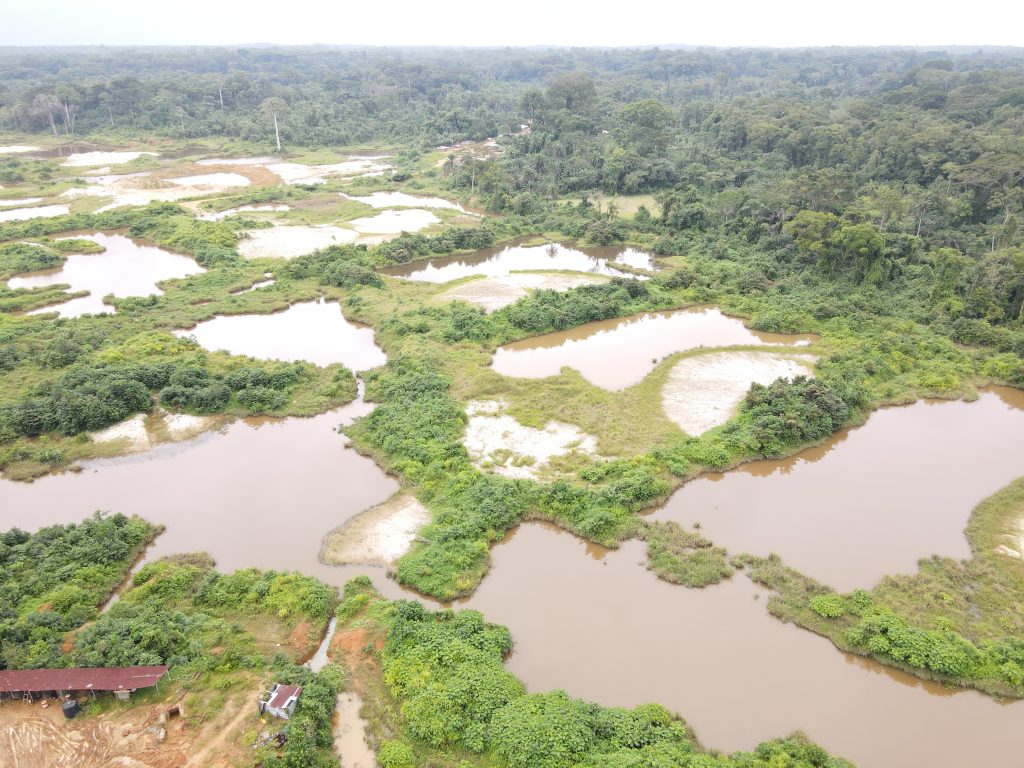
Jallah denies knowledge of Peter Togba and the unnamed child’s deaths. He said Deep Gold did not restore the area because it was commonplace for companies to abandon mining pits. Later in the interview, he said it was not his company’s policy to reclaim the land while operating.
However, Jallah acknowledges the unidentified worker’s fatal fall. He explained that the doomed worker had come to Gmarkemkpo with Deep Gold from Grand Kru County. He, along with a colleague, was allegedly making away with a barrel of fuel and fell to his death in a canal. They laid him to rest on the riverbanks—this time—in keeping with the tradition. Drowning victims in the countryside are buried outside towns and villages to cleanse the town of bad luck.
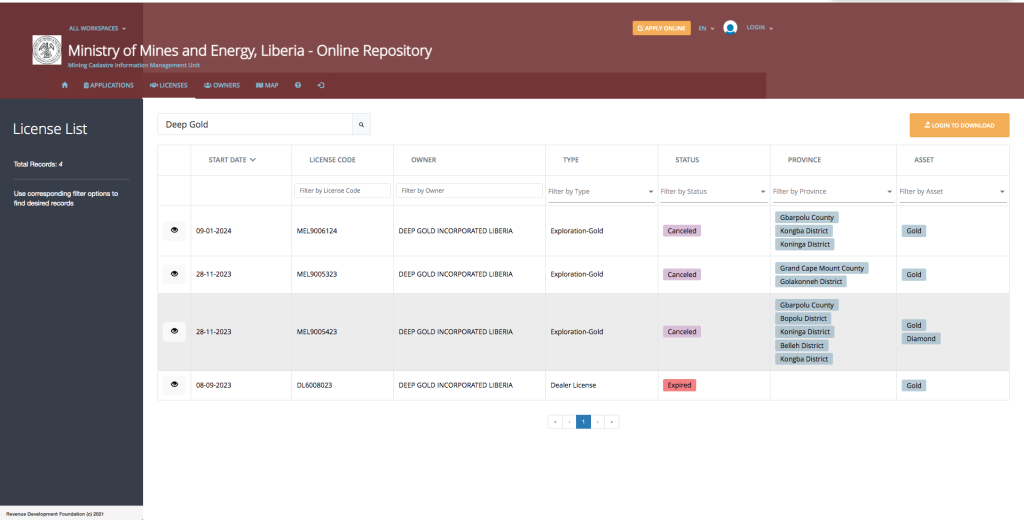
On the legality issue, Jallah said the Ministry of Mines and Energy was processing Deep Gold’s license. Bartee Togba, the liaison officer, and Sackor, the suspended HR manager, had said the same thing.
But the facts contradict their claims. Deep Mining has no current applications and has never applied for a license in Sinoe, official records show. Its only two applications were for diamond exploration in Gbarpolu and an undisclosed location in 2023 and 2024, respectively.
In all, the Ministry of Mines and Energy records show that Deep Gold has never had a license anywhere in southeastern Liberia. Its three mining licenses for Grand Cape Mount and Gbarpolu are inactive. All three mining licenses were terminated in 2024 because it failed to file its environmental permits, quarterly reports, and other required documents. The Liberia Extractive Industries Transparency Initiative only published its licenses in the northwest, further proof that none exist in the southeast.
Through its operations, Deep Gold evaded US$160,100 in mining and environmental licensing fees, based on The DayLight’s calculation of official fee structures. Liberia could be losing US$1.4 billion annually due to smuggling in the mining sector, according to SwissAid, which tracks gold trading from Africa.
A land conflict
Deep Gold awakens an old land dispute between Gmarkemkpo and its neighbor, stalling the company’s illegal activities. In early May, it decided to extend its operations. The neighboring Nana Kru, which also claims the plot, protested and demanded a separate MoU with Deep Gold.
Sam Seah, Sr., the Superintendent of Dugbe River District, halted all activities. Then last month, the parties had the resolution meeting and submitted an MoU each. Seah ordered Deep Gold to work with the two communities and merge their MoUs.
Additionally, Deep Gold paid Nana Kru US$1,500 for polluting Fenja, a creek residents depend on for washing, cooking, and fishing. The creek is one of several tributaries of the Dugbe River, which runs throughout the southeast into the Atlantic Ocean. Tarpeh, Deep Gold’s PRO, revealed the company agreed to pay the community L$100,000 monthly as part of the fine.
During four visits to the area, reporters observed that the creek was dark brown from the mining activities. Several canals divert water from the creek to the mine to wash gold-trapping gravel. Muddy runoffs, the byproducts of the process, emptied everywhere.
Angeline Swen, a 36-year-old townswoman, died of bloody diarrhea in February, likely linked to the contaminated water, according to her death certificate seen by The DayLight.
“We can’t even do anything with the water,” said Grace Nimely, a food seller in Gmarkemkpo.
Deep Mining took responsibility for the pollution. It erected three hand pumps in Gmarkemkpo, but they have all broken down. Townspeople now carry water sacks with them to their farms, with L$300 for one sack.
Back at the graveyard, sorrow subdued the surroundings. One of the newest, Peter Togba’s grave, is almost surely identifiable.
Barclay said, “My greatest regret is [Peter Togba] who died and the child that fell into the pit, especially since the company never took responsibility.”
This story was produced by DayLight with support from the Embassy of Ireland through Integrity Watch Liberia. The DayLight maintained editorial independence over its content, which does not reflect the position of the Embassy of Ireland or Integrity Watch Liberia.