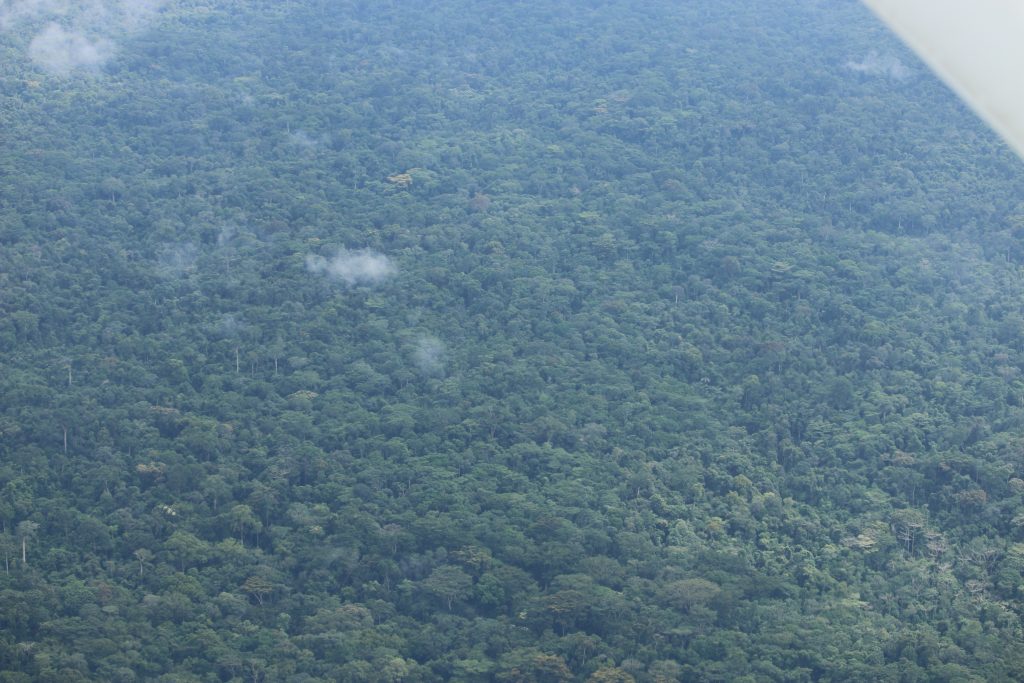
Top: Some of the logs Westwood illegally harvested in the Gba Community Forest. Picture credit: Anonymous
By Emmanuel Sherman
MONROVIA – A Nimba court issued the Forestry Development Authority (FDA) a warrant to seize logs that a company illegally harvested last year.
The Eighth Judicial Circuit Court in Sanniquillie ordered the FDA to take charge of the 5,694.33 cubic meters of logs Westwood Corporation felled outside a designated area in the Gba Community Forest, Sanniquillie-Mahn District.
“You are hereby commanded to immediately proceed to confiscate all logs harvested by West Wood Corporation outside of the 450-acre area…,” read the court warrant.
Samuel Cooper, Westwood’s manager, declined to be interviewed.
An FDA investigation had found evidence that the company harvested 4 kilometers outside the 450-acre area, near the East Nimba Nature Reserve, home to endangered species.
The Investigation confirmed an earlier DayLight publication that utilized satellite imagery to pinpoint the illegal felling. The newspaper had established that Westwood made two shipments of the illegal logs to Italy, violating Liberia’s timber-trade agreement with the European Union. Moreover, the company’s shareholders are unknown.
Having seized the logs, the FDA is required to seek a warrant for a public auction.
FDA’s Managing Director Rudolph Merab said the regulator had already auctioned the logs. “Kris Veneer [Industries] won the bid for the auction, Merab told The DayLight. (Kris operates a plywood factory in Buchanan, Grand Bassa County.)
This is the first time the FDA has auctioned illegal logs since the Regulation on Confiscated Logs, Timber and Timber Products was formulated in 2017.
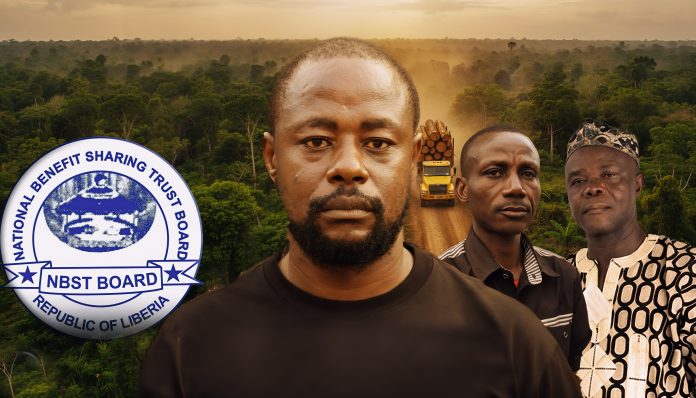
Top: A poster showing Roberto Kollie (left), St. Solomon Peters (center) and Edward Teah, the main characters in this investigation of the Benefit Sharing Trust Board. Illustration by Michael Harijgens for The DayLight
By Varney Kamara
Roberto Kollie joined the National Benefit Sharing Trust Board in 2021, with a vision to help reform it. Accordingly, Kollie scrutinized the activities of the board’s executives without fear or favor.
Last year, one executive alleged that he paid Kollie a bribe for certain payment; Kollie was subsequently suspended.
The Forestry Development Authority investigated the matter and exonerated Kollie of the accusation. The FDA praised him for championing transparency and accountability.
Nevertheless, the Board terminated Kollie’s contract, leading to a case now before the Ministry of Labor.
The case, the FDA investigation, documents, recordings, and interviews The DayLight conducted shed light on corruption in the board and impunity in forestry.
MONROVIA – In January 2021, Roberto Kollie was recruited as head of the secretariat of the National Benefit Sharing Trust Board, which regulates communities’ shares of logging resources. Kollie had just left his job as a human resource officer at a bank, and before that, an auditor with the Ministry of Finance and Development Planning.
The 41-year-old dreamed of guiding the board to uphold its core values of transparency and accountability and driving major reforms to benefit communities. Just months on the job, Kollie helped draft the board’s first budget, saving it from bankruptcy, according to a 2021 report.
“I had a vision to ensure that during my time at the board, we would make sure there was value for money, where funds delivered for projects would be properly accounted for,” Kollie said in an interview with The DayLight. “In that way, the board would be living up to its objectives, and that communities would benefit from a fair share of their natural resources.”
But his story was too good to be true. Last July, months before his fifth anniversary as head of secretariat, Kollie received shocking news: His contract had been terminated. It was the grand finale of an internal struggle that would shed light on corruption inside the board and the culture of impunity in forestry.
It all started on November 25, 2024, when Edward Teah, a local forest leader in Grand Gedeh County, requested L$702,494.61 (US$3,753 today) check from the board for his community leadership’s share of land rental that the International Consultant Capital (ICC) had paid the Liberian government.
In 2009, ICC signed a logging concession with the Liberian government, covering 266,910 hectares across River Cess, Nimba, and Grand Gedeh. Thirty percent of the land rental fees companies pay to the government goes to affected communities under the National Forestry Reform Law. Of that amount, community leaders are entitled to a tenth of land rental fees. It was that money that Teah had requested.
Kollie denied the request, based on an issue he discovered with Teah’s previous report. Kollie had noticed that Federick Soloe, a Sinoe County community leader, did not attend an event in Grand Gedeh for which he had received US$240.
A day after that encounter, Teah filed a complaint against Kollie with the board. He alleged that Kollie had not denied his request because of Soloe’s failure to attend the Grand Gedeh event. Instead, Kollie was demanding a bribe before issuing his check.
“I write to officially inform the board that Roberto Kollie is in the constant [habit] of holding my documents without turning [them] over to the rightful committee that has the authority to review [them],” Teah said in his complaint letter. “My… document was kept for more than one month because I didn’t promise him a share of the project cost.”
Kollie was suspended in January last year, two months after the complaint, and the board immediately asked the Forestry Development Authority (FDA) to investigate.
Teah told investigators that he allegedly gave Kollie US$600 as a kickback, which Kollie denies. Then Teah said Soloe had attended the dedication of a town hall in Dougee Town, Grand Gedeh County, refuting Kollie’s claim.
Soloe corroborated Teah’s testimony, claiming he had attended the event but arrived late. However, he told the FDA investigators that he only received US$150, corroborating Kollie’s claim.
Based on the evidence, the FDA cleared Kollie of all allegations, concluding a four-month investigation. The regulator instructed the board to reinstate Kollie. It found no evidence that he solicited US$600 or any kickbacks. There was no evidence of delayed check payments, and Soloe’s testimony justified Kollie’s doubt in questioning Teah.
The National Benefit Sharing Trust Board collects funding from the government that logging concessioners pay, disburses the money to affected communities, and oversees its expenditure. Picture credit: James Harding Giahyue
“The committee determined that the query operates to enhance the integrity of the board as opposed to disrespecting its authorities,” the investigation report said. “The nature of evidence presented was mostly speculative.”
The investigators recommended that Kollie be reinstated. They further recommended that the board hold a retreat to review its roles and responsibilities and conduct an audit within three months.
Now exonerated, Kollie thought that his nightmare had ended. He could push forward with his reform agenda.
“I felt relieved that I was exonerated from allegations that had the propensity to damage my professional career and negative image on my family,” Kollie said. “I had hope that my return to work could pave the way for massive reform at the [board], given that many of the accountability issues that I flagged were captured in the investigation report.”
But Kollie’s nightmare was far from over. Instead of reinstating him, the board terminated his contract, saying that it had expired.
Conspiracy
Kollie suspected that Teah’s allegation against him was only a smokescreen because he had been a pain in the buttocks. In September 2024, Kollie and other officials of the board found out that the Dougee town hall project was incomplete, despite a report from the CFDC that the project was finished. Subsequently, the monitoring team compelled Teah, his accuser, to sign a commitment to complete the unfinished town hall within a specified period.
Kollie suspected the board was conspiring against him, too. In January last year, Solomon Peters, its chairman, presented a US$3,294 budget to celebrate the Ziadue and Teekpeh clans’ customary deed acquisition in River Cess. He advised the board against reviewing Peters’ budget for three reasons: One, Peters had not completed certain projects in River Cess, a requirement for him to get further payment. Two, the board’s window for budget submission had closed. And Ziadue and Teekpeh clans’ deed celebration was a land matter, not a forestry project.
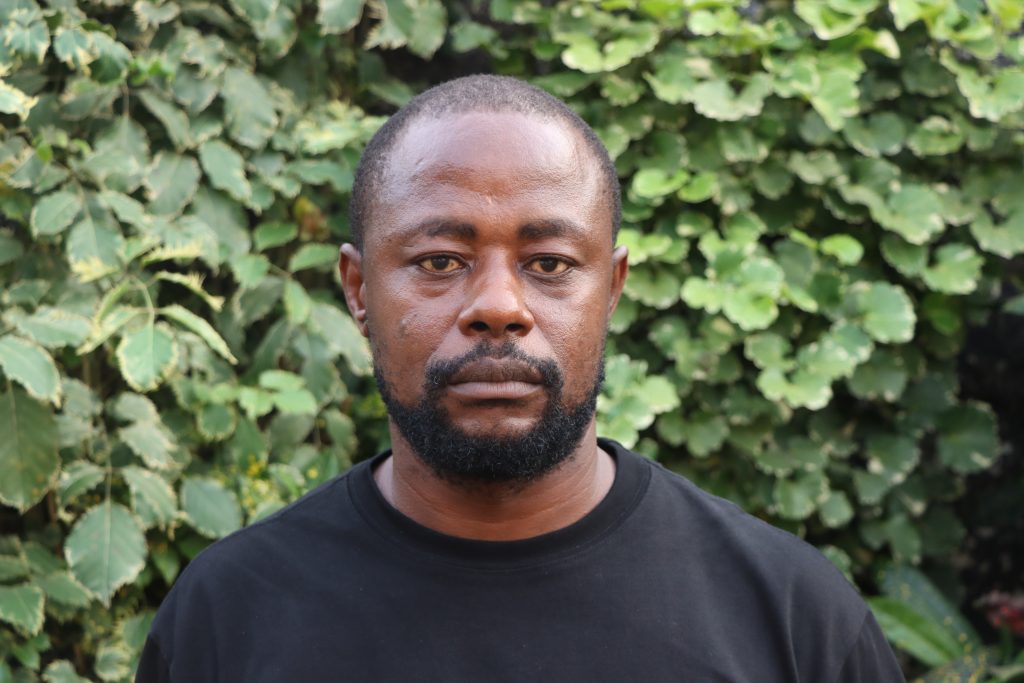
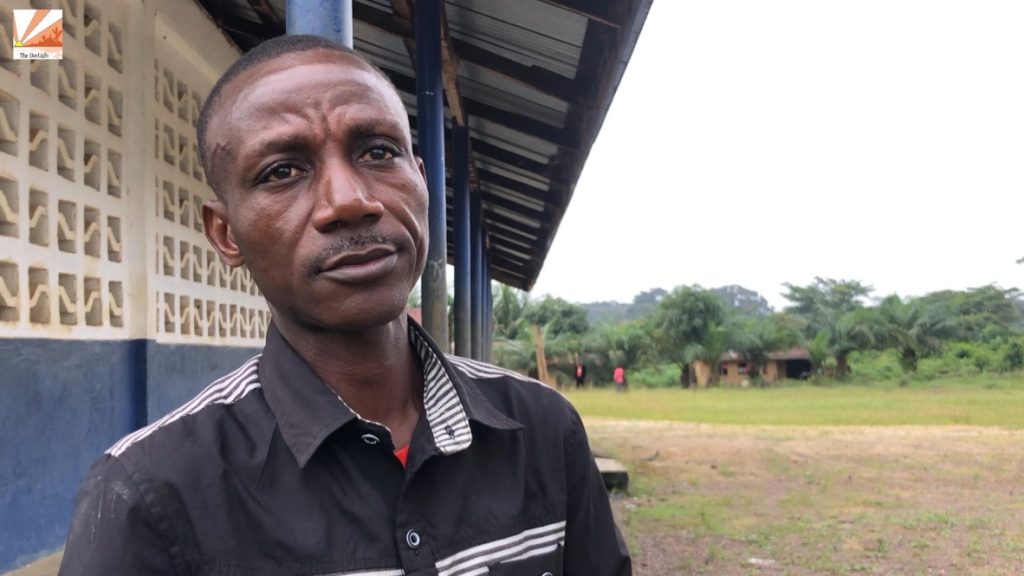
Here: St. Solomon Peters, the chairman of the board. Above: Roberto Kollie, embattled head of the secretariat of the National Benefit Sharing Trust Board. The DayLight/James Giahyue and Esau J. Farr
The board ignored Kollie’s advice and approved Peters’ budget, though Kollie abstained from the process.
An email, seen by The DayLight, confirmed Kollie’s suspicion of the board’s plot to remove him. In the communication, Andrew Zelemen, a community forest union leader, with the highest representation on the board, discussed the conspiracy.
“I… realized that there is a plan to remove Mr. Kollie from the board due to his critical stance on some decisions that have been made by the chairperson of the board, who is also a [community forest] official,” the email read.
“These decisions, it is believed, often favored the communities, but sometimes did not align with best practices, and the secretariat, headed by Roberto, is always critical of these decisions.”
If Zelemen’s email was revealing, then text messages and WhatsApp conversations between Kollie and Peters in July and August were explosive.
On an evening last March, Peters met Kollie at a bar in 72nd, Paynesville, while the FDA investigation proceeded. In an audio recording obtained by The DayLight, Peters can be heard trying to reach a compromise with Kollie.
“If it is left with me, these issues that are going around will not come out among us anymore. I don’t like for it to come to my mind. That is the reason why I sent the texts that you, Andrew [Zelemen], and myself meet and discussed, so we can find means to solve it,” Peters suggested.
Kollie rejected the chairman of the board’s proposal and urged him to hold on until the investigation was completed. The allegations were too grave to be swept under the carpet, as they concerned his reputation. National and International partners had heard of the matter, and it would be good to see it finalized.
Teah, Kollie’s accuser, walked in and sat near Peters without saying anything. Shortly after that, Kollie left the bar, fearing incrimination. Teah did not respond to The DayLight’s queries.
But that was not the only Kollie-Peters encounter. On Thursday, July 31, at 11:50 pm last year, Peters engaged Kollie for a “friendly” conversation, according to a Facebook chat between the pair, obtained by The DayLight.
“What would be your top priority on a list of many with regard to the foregoing? What would you wish I could initiate in favor of your top priority?” Peters began.
“I’m saying this because I have had a series of discussions with many interested parties, finding an alternative approach to an amicable resolution, but I sometimes get quenched by certain actions and information,” Peters said. He appeared to reference the board’s refusal to reinstate Kollie, defying the FDA, a decision that forestry actors had criticized.
The controversial town hall in Dougee Town, Grand Gedeh County. The DayLight/James Giahyue
“I am not sure a fight can better address our situation,” Peters added.
Kollie replied, starting with pay and benefits.
“The first thing I would appreciate from you is if you consider that I am entitled to my May and June salary, including communication allowances for February to July.
“That is a very good beginning for a very good dialogue,” Kollie added.
“Rest assured,” Peters replied, ending that day’s chat.
The negotiation, it turns out, did not hold. Kollie filed a complaint with the Ministry of Labor for “unfair labor practice.” He seeks reinstatement and settlement of unpaid wages.
Kollie argues that his contract was continued, as the board paid him several months after January last year, when his contract was supposed to have expired.
Peters did not respond to detailed queries for his side of the story, citing the case before the ministry.
The story was a Community of Forest and Environmental Journalists of Liberia (CoFEJ) production.
Top: Drone picture showing deserted sand deposits, mangroves, and grass growing on the abandoned mining site. The DayLight/Samuel Jabba
By Harry Browne and Samuel Jabba
SEAVIEW – Illegal miners, who ravaged a beachfront in the Robertsfield Highway community of Gbengbar Town for over a decade, have left the area, following residents’ persistence, authorities’ actions, and a DayLight investigation.
Last December, The DayLight reported that the miners allegedly threatened to kill residents of the Seaview community for opposing their illegal activities. The community involved the police, the Environmental Protection Agency, and the Ministry of Mines and Energy, which shut down the illegal operations.
“On behalf of the community, I want to say a big thank you to the government of Liberia for intervening,” said Victor Sumo, a Seaview resident and lecturer at the University of Liberia.
“We also appreciate The DayLight for helping us to expose every illegal activity. The drone that was flown and key photos taken exposed them clearly.”
After a DayLight investigation, the Ministry of Mines arrested and jailed Jacob Dolo, the illegal miners’ ringleader.
Upon his release days later, Dolo signed a commitment not to mine in the Seaview area again, according to Agatius Cooker, Inspector General, Ministry of Mines. Dolo confirmed the information.
It is not the first time that the illegal miners have stopped operating—only to later return. Last May, soldiers of the Armed Forces of Liberia removed them from the beach, seizing their tools.
However, they returned five months later and intensified their activities. The illicit miners had operated in the area since 2014, two years after the government banned beach sand mining.
To prevent the recurrence of that situation, residents have set up a task force to monitor beach activities. Samuel G. Ford, the director of Community Policing at the Liberia National Police, created awareness in the area.
Above and here: Views of the abandoned illegal sand mining site after the jailing of Jacob Dolo, the illegal miners’ ringleader. The DayLight/Samuel Jabba
‘Thank God for The DayLight’
Reporters visited the infamous ‘Block-40’ mining site, located between the beach and a swamp. Back in October, miners uploaded sand in pickup trucks, while others transferred sand from the beach. This time around, the site was a ghost town.
Reporters observed nature reclaiming the illegal sand mine and its environment. Sand deposits lay deserted, the ocean was refilling a gigantic canal the miners dug to transfer sand from the beach. Makeshift shelters were demolished. Grass grew everywhere. At least one squirrel appeared to have observed the noticeable absence of activities, running across the site.
While the illegal miners expressed grievances over the situation, residents were full of praise for The DayLight.
“When they came in, I was really overlooking them to admit the fact. I thought that they could not make,” said Garwool Baysah, a resident. “I tell God thank you for the DayLight. They did extremely well for us.”
This story is produced by The DayLight, with support from the Embassy of Ireland through Integrity Watch Liberia. The DayLight maintained editorial independence over its content, which does not reflect the position of the Embassy of Ireland or Integrity Watch Liberia.
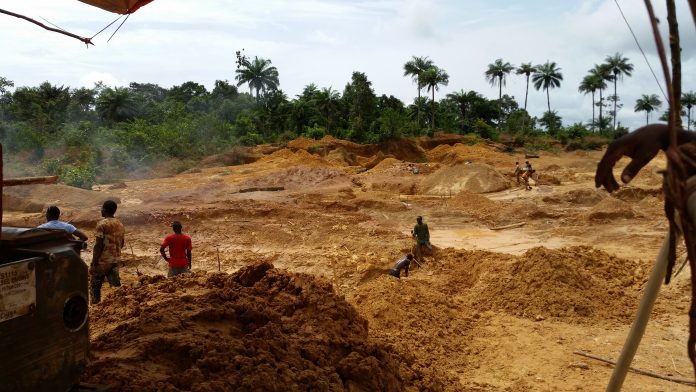
Top: Artisanal miners in Wayjue, Grand Cape Mount County, in 2019. Picture credit: James Giahyue
By Varney Kamara
MONROVIA – Gold is one of Liberia’s most valuable natural resources, yet much of it may be slipping quietly out of the country—untaxed and undocumented. New findings by SWISSAID, a Switzerland-based NGO that provides data on Africa’s mineral exports, suggest that gold smuggling from Liberia has reached alarming levels, potentially leading to billions of U.S. dollars loss for Liberia each year.
The report, published last May, is part of a larger research project on African gold flows. The information it provides was collected from state agencies, company reports, publications, civil and multilateral organizations, researchers, and open-access databases.
This explainer breaks down the report into five key things to understand about how Liberia’s gold is smuggled. It explains where it goes and why weak data, tax gaps, and informal mining continue to fuel the illegal trade.
So, here are five things to know about gold smuggling in Liberia:
1. Liberia Could be Losing US$1.4B to Gold Smuggling
Liberia could be losing US$1.4 billion to gold smuggling annually, according to a DayLight calculation, based on the current price of gold on the world market. Smugglers could be illegally exporting nine tonnes of gold from Liberia through Guinea and Mali yearly.
2. Liberia’s Smuggled Gold Comes mainly from Artisanal Miners
Liberia’s smuggled gold comes mainly from the artisanal and small-scale mining sector (ASM), a largely informal sector that undervalues and underreports the volumes of gold exported out of the country. All of Liberia’s industrial golds are shipped through official border records. However, a majority of the country’s rich yellow minerals produced in the artisanal sector is smuggled through neighboring countries, with no official data reflecting the actual volumes of gold extracted.
While it was asserted that gold is being smuggled into all of Liberia’s neighboring countries, it is a universal consensus that the mineral is mainly trafficked through Guinea before ending up in Mali. Switzerland, the United Arab Emirates, and Lebanon are the top three destinations outside of Africa. Liberian gold is also smuggled through airports, mainly to the UAE, and directly to Dubai, which is by far the main destination for all undeclared ASM gold from Africa.
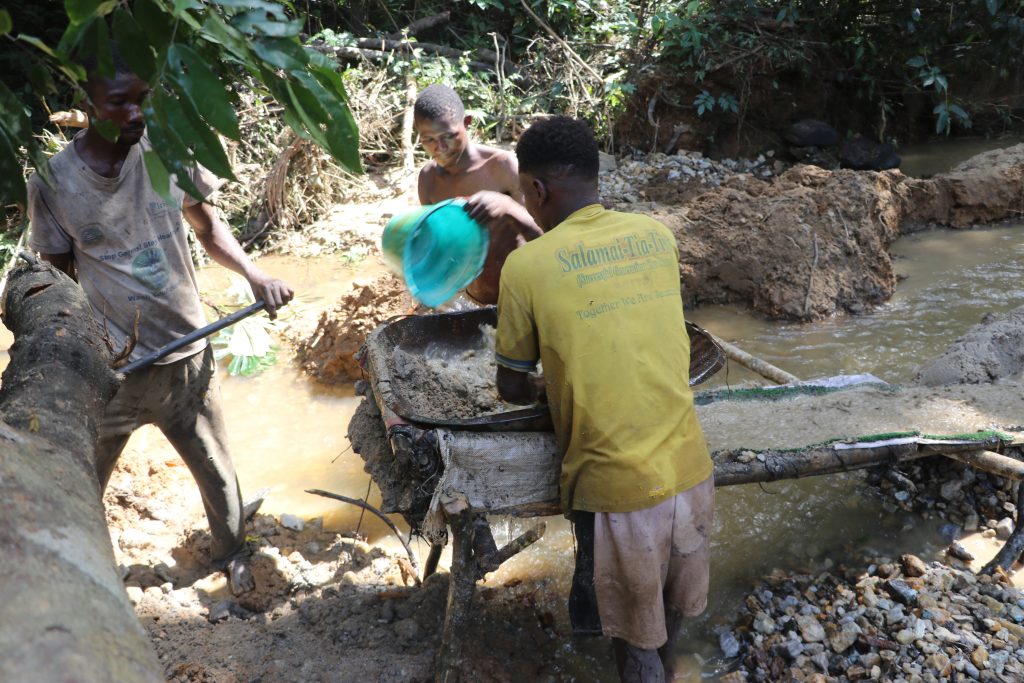
Artisanal miners in the Salayea Community Forest in Lofa County. The DayLight/Harry Browne
3. Differences in Tax Rates and Loopholes
Differences in tax rates for exported gold, destinations, and variations in tax systems serve as the main loopholes or incentives for gold smuggling between Liberia and Guinea.
Liberia and Guinea have one percent lower royalty or export rates, compared to other countries in the sub-region, one of the main factors driving illicit gold flows across the region.
In an effort to maximize profits, foreign investors prefer to travel to Liberia and Guinea, which impose lower royalty rates on gold exports. These countries trade in United States dollars, a currency more accessible for international trade. Analysis showed that lower tax rates and access to U.S. dollars were the main smuggling patterns, according to the Global Initiative against Transnational Organized Crime.
In an effort to maximize profits, foreign investors prefer to travel to Liberia and Guinea, which impose lower royalty rates on gold exports. These countries are able to trade in United States dollars, a currency more accessible for international trade. SWISSAID’s analysis showed that lower tax rates and access to U.S. dollars were the main smuggling patterns.
To resolve this situation, interventions must be developed beyond mine sites, addressing cyclical financial flows influenced by power structures, and formalizing ASM efforts aligned with the government’s medium-term production goals, including standardizing regional tariff rates to combat smuggling, SWISSAID recommended.
4. Discrepancies in Stats
There are discrepancies between Liberian statistics and the Swiss statistics on imports of gold from Liberia.
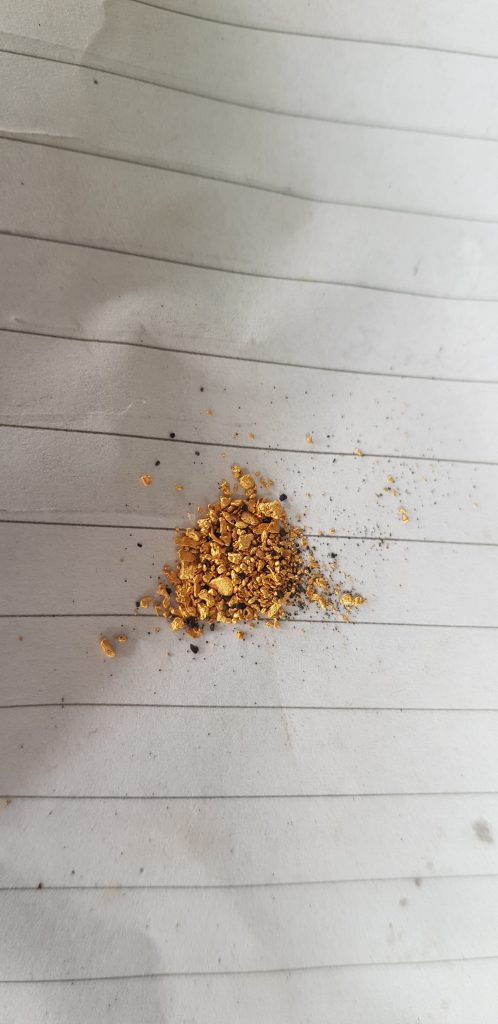
Gold is selling for US$4,874 as of Thursday. The DayLight/James Giahyue
Liberia’s data on gold production and exports, released by the Central Bank of Liberia in its annual reports, is inconsistent with that reported by the Liberian chapter of the Extractive Industries Transparency Initiative (LEITI).
This is surprising for both entities refer to the same sources, namely the Ministry of Mines and Energy. Second, Liberian authorities do not report trade data to the UN Comtrade, which provides export trade data globally. To resolve this issue, SWISSAID had to ask Liberia’s mining authorities to provide export figures that grouped countries of destination. Large discrepancies of data provided were observed, compelling SWISSAID to cast serious doubts over their credibility.
Official figures on gold production cover only part of the actual volumes of gold being extracted and traded. This is because artisanal and small-scale mining in Liberia, which has taken place on a larger scale in recent years, is highly informal. In 2018, large discrepancies were observed between the figures on gold exports published by the CBL and those on gold exports from Liberia, reported to the UN Comtrade by the authorities of the countries of destination.
SWISSAID noticed substantial inconsistencies in the official figures published by various Liberian entities. Gold export estimates are not updated. This suggests several tons of gold were smuggled out of the country yearly, and imported illegally into other countries, in particular the UAE.
5. Poor Data Complicates Analysis
Poor data situation complicates the analysis of gold flows in Liberia. Comparing figures on the imports of gold from Liberia reported by the authorities with those of the countries of destination to UN Comtrade or published by the London Bullion Market Association (LBMA), SWISSAID observed such large discrepancies with available data, which impacted the quality of its analysis and seriously hampered its ability to conclude. As a result, several questions remain unanswered.
This story is produced by The DayLight, with support from the Embassy of Ireland through Integrity Watch Liberia. The DayLight maintained editorial independence over its content, which does not reflect the position of the Embassy of Ireland or Integrity Watch Liberia.
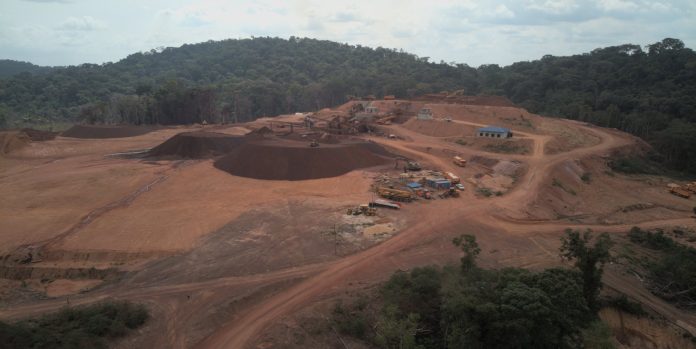
Top: A Bao Chico iron ore mine in Gbarpolu County in 2023. The DayLight/Derick Snyder
By Varney Kamara
The Liberia Extractive Industries Transparency Initiative (LEITI) 16th report highlights both progress and challenges across the country’s extractive sectors.
The report provides information on the mining, agriculture, forestry, and oil/gas sectors’ contribution to the Liberian economy. The annual report is meant to enhance natural resource governance, accountability and transparency.
Covering January 1 to December 31, 2023, the report provides details on payments, productions, exports, and other things. It was published last December, weeks before President Joseph Boakai’s recent State of the Nation Address.
In the address, President Boakai praised the extractive sectors’ contribution to Liberia’s 5.1 percent economic growth in 2023, largely driven by mining, citing the International Monetary Fund.
So, here are nine key takeaways from the LEITI’s 16th report on the performance of the extractive industries in 2023:
Liberia exported US$1.3 billion of extractive commodities in 2023. Major exports included gold, iron ore, diamonds, and round logs. The country exported 12,379 kilograms of gold, 4,002,474 metric tons of iron ore, and 56,838 carats of diamonds.
Artisanal and small-scale mining exports increased, with gold exports rising to 232 kilograms from 82 kilograms in 2022. Diamond exports rose slightly from 55,111 carats in 2022 to 56,838 carats in 2023, a 3.04 percent increase.
The forestry sector produced 661,958 cubic meters of round logs, but exported only 98,426 cubic meters.
Rubber, crude palm oil, and kernel oil sold US$188,463,190 million, representing 13.9 percent of all export earnings. Rubber represents 7.6 percent of the country’s total export receipts and 54.9 percent of agriculture exports, while 6.12 percent of the sector’s exports came from crude palm oil and kernel oil.
Key export destinations for artisanal minerals were Israel, Belgium, the United Arab Emirates, and Turkey. Israel imported diamonds valued at US$6.68 million (27.09 percent), while Belgium imported US$6.57 million (26.67 percent). The UAE and Turkey dominated gold imports, valued at US$4.46 million (18.09 percent) and US$2.29 million (9.27 percent), respectively.
2. Mining is the Largest Exporter
Mining accounted for US$1.16 billion, the most among the four extractive industries. Bea Mountain Mining Company and ArcelorMittal Liberia were the top exporters.
Bea Mountain exported 12,146 kilograms of gold, valued at US$653.6 million, representing 56.3 percent of extractive exports, up from 52.38 percent in 2022.
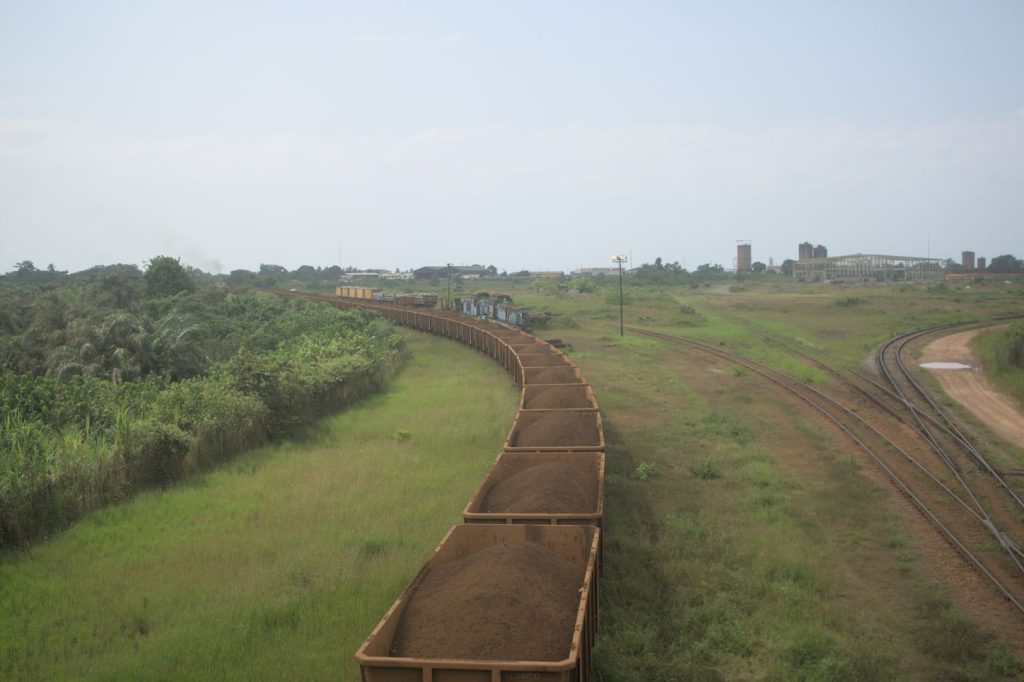
An ArcelorMittal train transporting iron ore to the Port of Buchanan in 2021. The DayLight/James Harding Giahyue
On the other hand, ArcelorMittal’s iron ore production declined from 471 metric tons in 2022 to 70 metric tons in 2023. Together, Bea Mountain and ArcelorMittal accounted for 93 percent of mining exports, up from 91 percent the previous year.
Gold accounted for 72 percent of mining exports, up from 40 percent in 2019, driven by higher global prices and increased production.
3. Forestry Is the Least Exporter
Forestry recorded the lowest export performance. Companies exported 98,426 cubic meters of logs, generating US$4.3 million in 2023, compared to 159,473 cubic meters valued at US$3.6 million in 2022. The report attributes the decline—over 38 percent in volume—to the closure of several forestry companies during the year.
Euro Liberia Logging exported 39,676 m3 of logs from 27,675 cubic meters, representing 30.3 percent, the highest in forestry. WESTNAF Limited followed, exporting 753 cubic meters in 2023 from 1,662 m3 in 2022, constituting 18.2 percent of exports.
Keshav Global Industries Ltd recorded the lowest export with 312 m3 of logs in 2023, representing 0.4 percent of exports, and recorded no exports in 2022.
Most logs were shipped to China, Bangladesh, and India, which together accounted for 93 percent of forestry exports.
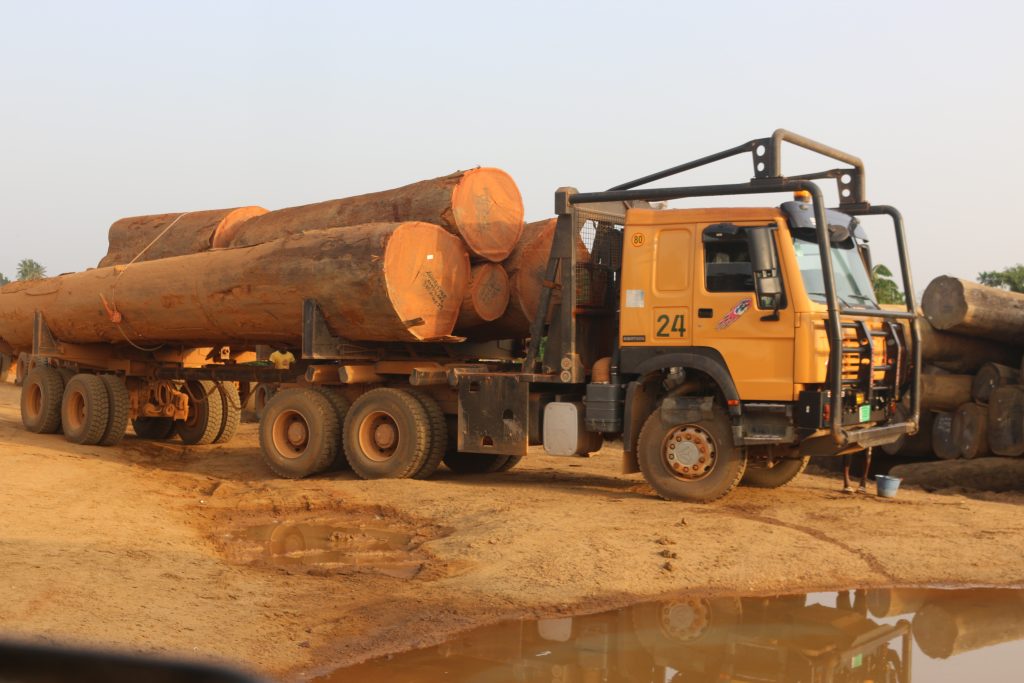
A truck transfers logs outside of Greenville, Sinoe County in 2023. The DayLight/James Harding Giahyue
4. Extractive Revenue Hit US$152.46 Million
Mining, agriculture, forestry, and oil/gas contributed US$152.46 million to the Liberian government’s revenue. This amount represents over a fifth of total revenue and over half of gross domestic product.
The 2023 contribution was a 14percent decline from US$182.35 million from July 2021 to December 2022.
The Liberia Revenue Authority collected 80.45 percent of the revenue. The National Port Authority, Forestry Development Authority, the Environmental Protection Agency, and social and environmental contributions accounted for the remaining.
5. Mining Contributed the Highest
Mining accounted for the largest share of extractive revenues, reinforcing its role as the backbone of the Liberian economy. It brought in US$121.49 million, a fall from US$140.61 million in 2022, representing 19.61 decline. Gold, iron ore, and diamond were the main contributors.
6. Oil/Gas: the Least Contributor
The oil and gas sector was the lowest contributor to overall extractive revenue, recording a minimal contribution of $0.55 million (US$550,000), constituting 0.36 percent of the overall extractive revenue.
No oil/gas licenses, production, exports, or agreements existed in 2023, with no records of active companies. However, the NOCAL collected the money from seismic data and contracting.
The amount contrasts with the 2011/2012 fiscal year, when the sector generated US$82.07 million, 14 percent of GDP at the time.
7. Agriculture: largest Employer
The extractive sector employed 12,333 people, representing 0.49 percent of Liberia’s labor force. Of this workforce, agriculture employed 9,302 workers, making it the largest employer among the extractive industries. Women accounted for 23 percent of agricultural employment, the highest female participation rate among extractive industries.
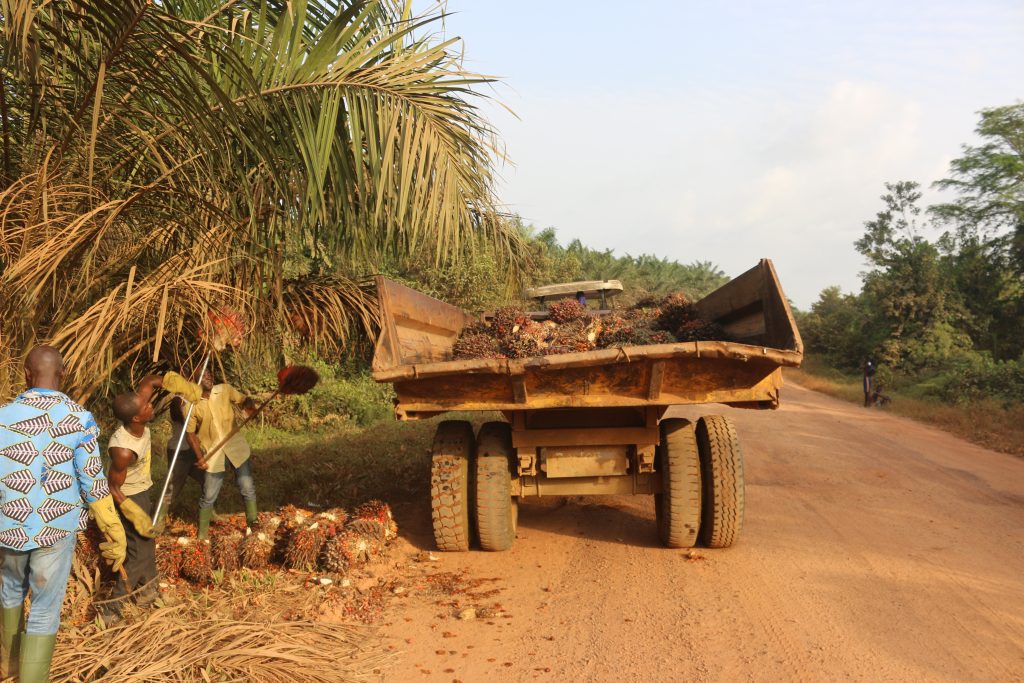
Workers with the Maryland Oil Palm Plantation (MOPP) are uploading fresh palm bunches to a truck in 2023. The DayLight/James Harding Giahyue
Meanwhile, mining employed 2,587 workers, while forestry employed 444, the least.
Firestone Natural Rubber concession, the world’s largest natural rubber producer, is the biggest private sector employer in Liberia.
8. ArcelorMittal Single-largest Taxpayer
ArcelorMittal Liberia was the single-largest tax payment, with US$60 million or 39.4 percent of all extractive revenue. Bea Mountain followed with US$37.6 million or 24.7 percent. Firestone (US$11.6 million or 7.6 percent), Western Cluster (US$10.2 or 6.8 percent), and China Union (US$9.6 million or 6.3 percent) were third, fourth, and fifth, respectively.
Additionally, ArcelorMittal paid US$17.5 million in “unidentified taxes” into the government central account. The LRA provided no details of the payment, the 16th LEITI report found.
9. Beneficial Ownership Regulation Formulated
The Beneficial Ownership Disclosure Regulation is one of the features of the report. It aims to combat illicit financial flows, including money laundering and tax evasion.
Enforced by the Liberia Business Registry, the regulation requires companies to disclose their ultimate beneficial owners, in line with amendments to the Business Association Act of 1976. The regulation is also consistent with Liberia’s Anti-Money Laundering Act, the National Forestry Reform Law, and the Code of Conduct for Public Officials.
This story is produced by The DayLight, with support from the Embassy of Ireland through Integrity Watch Liberia. The DayLight maintained editorial independence over its content, which does not reflect the position of the Embassy of Ireland or Integrity Watch Liberia.