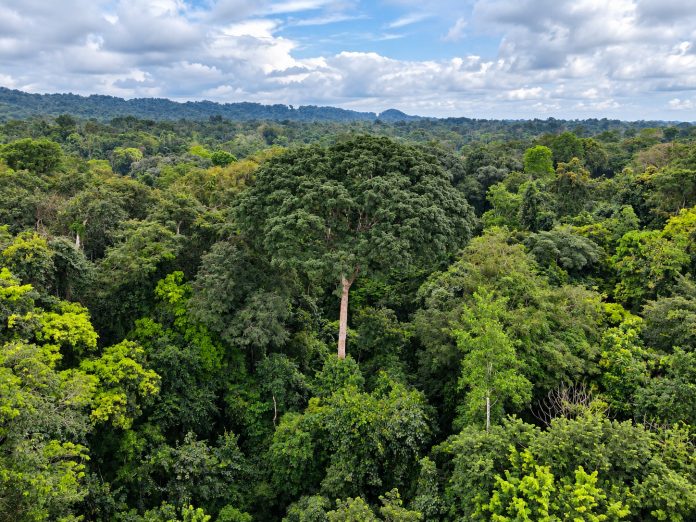
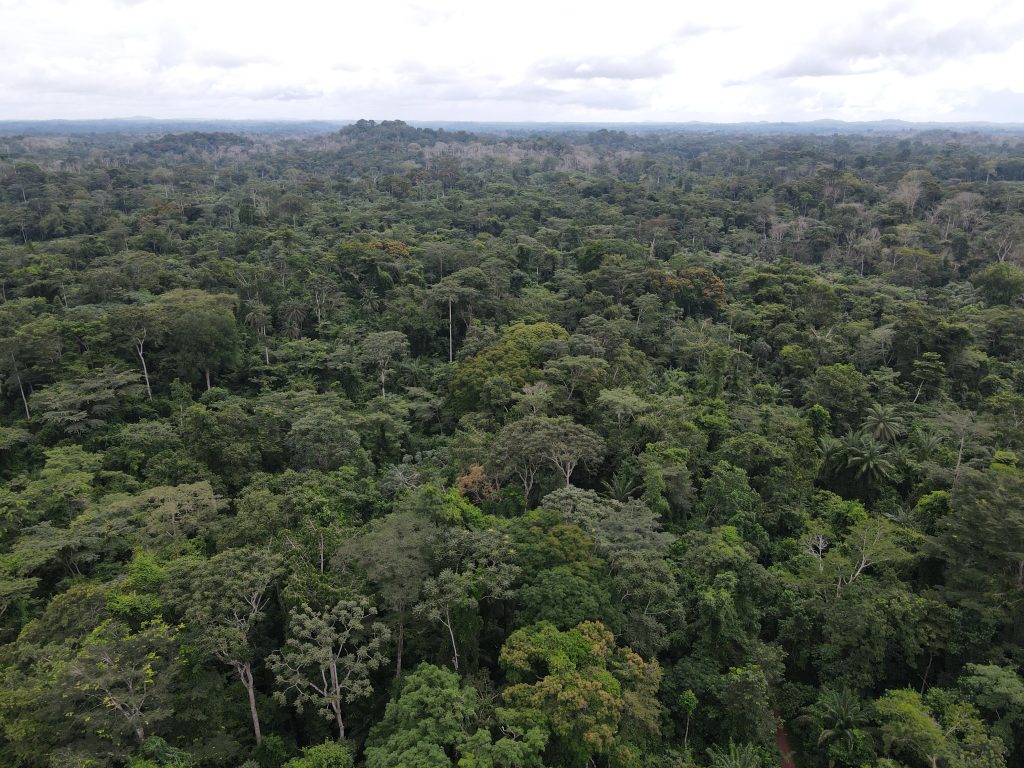
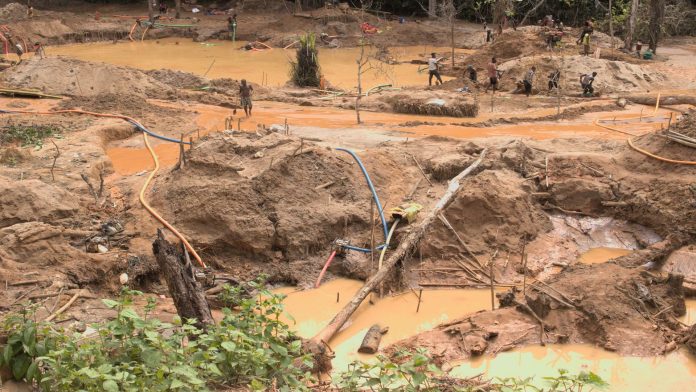
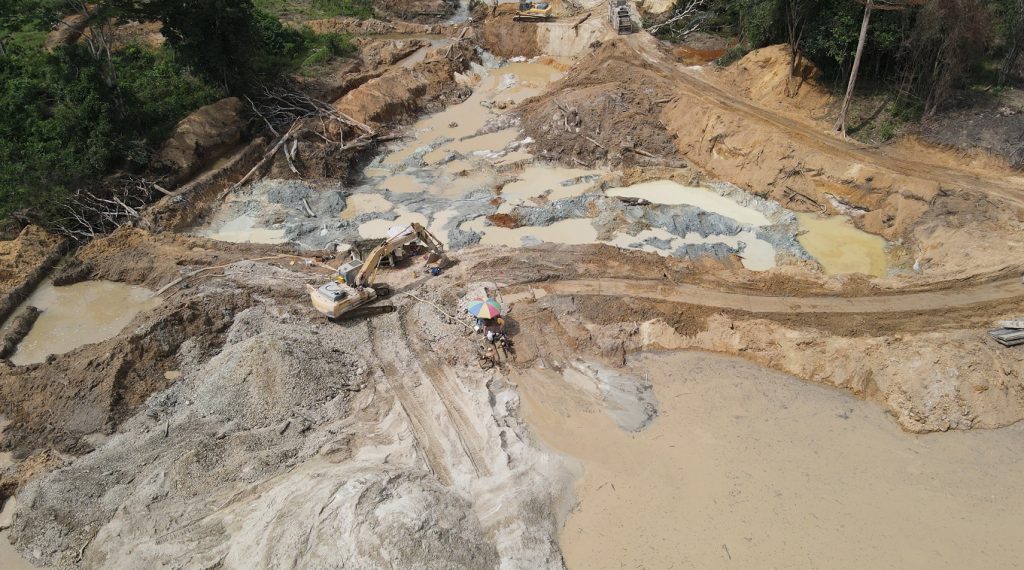
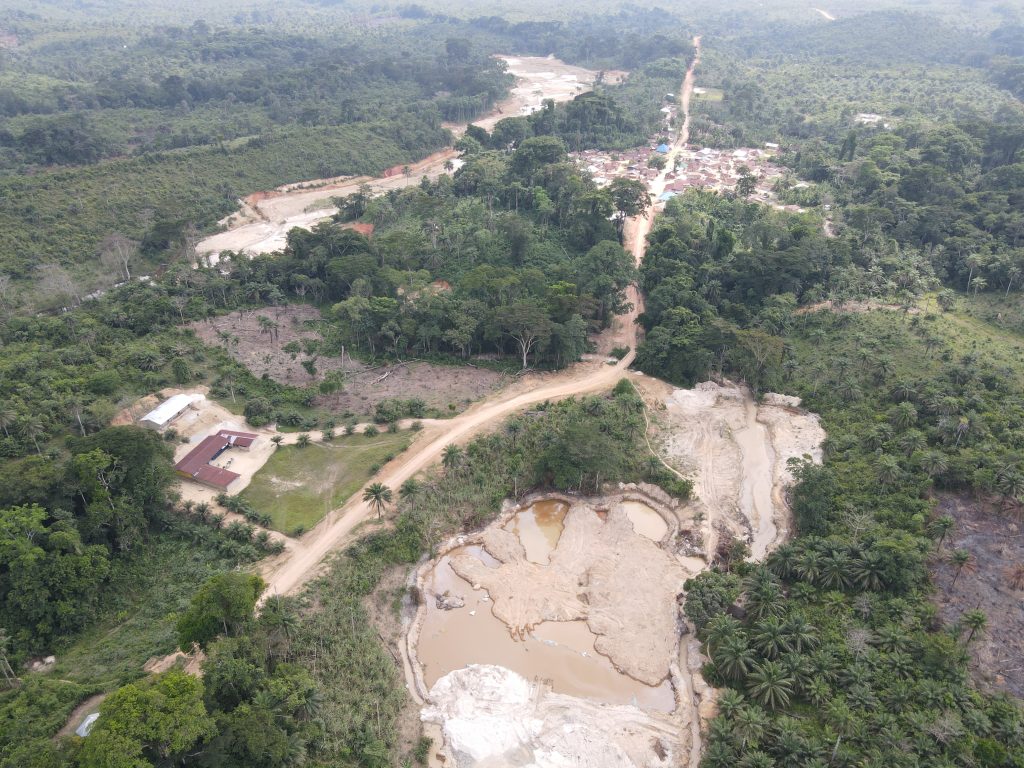
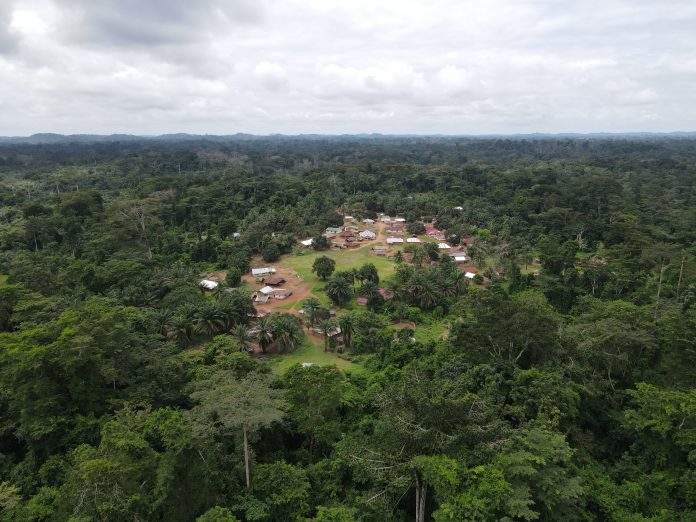
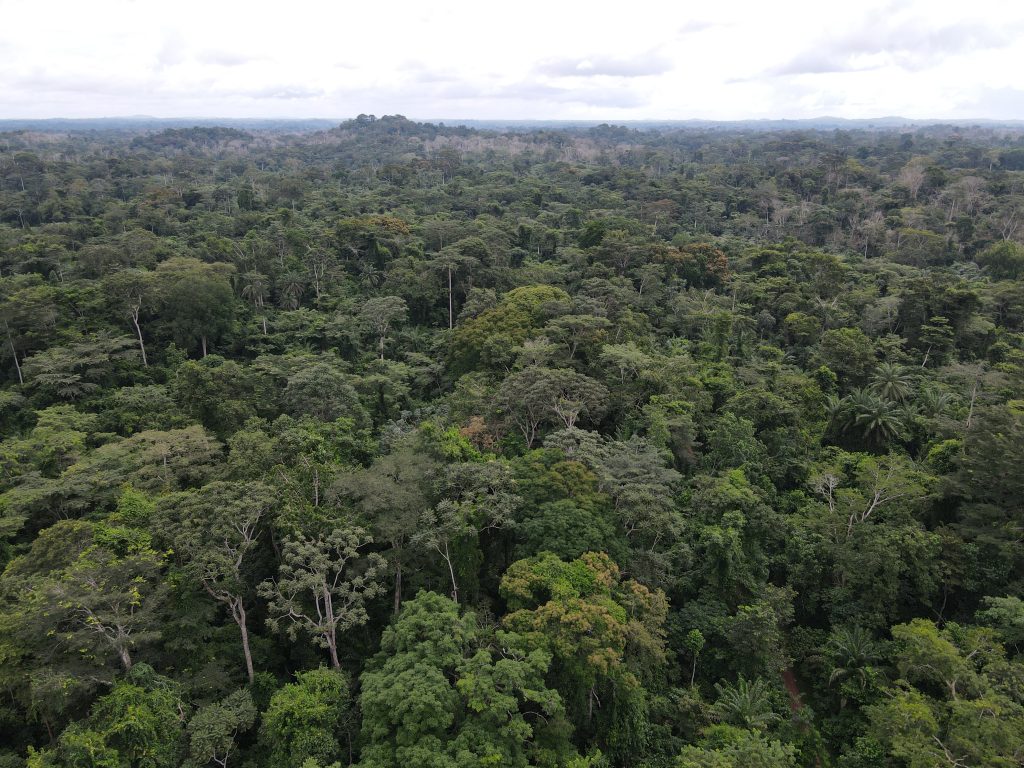
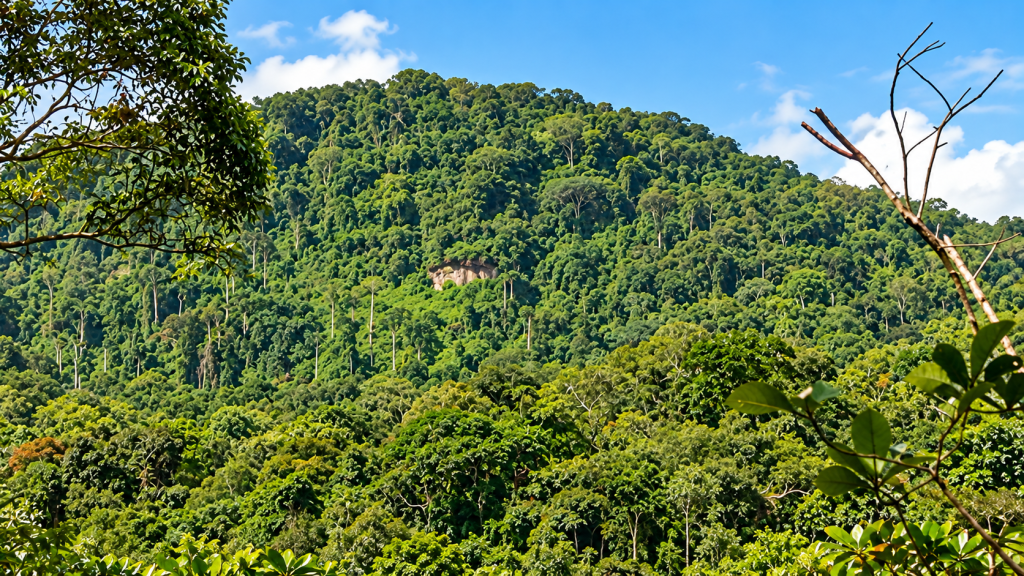
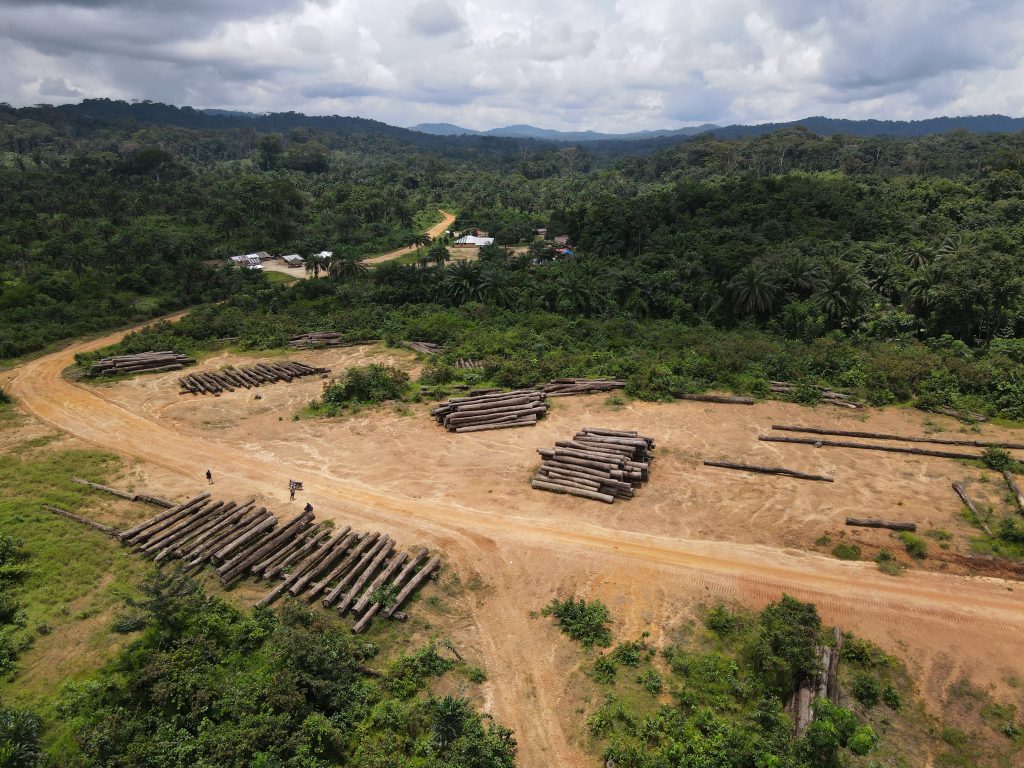
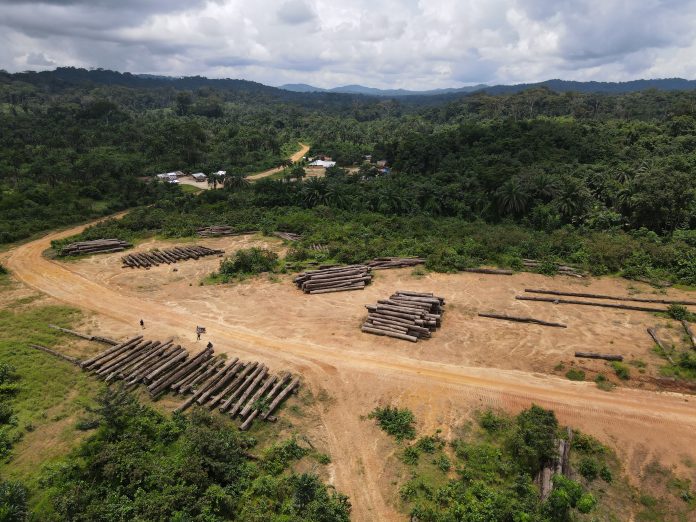
A drone shot of a portion of the Marbon Community Forest in Gola Konneh, Grand Cape Mount County
Top: An aerial view of the Marbon Community Forest from Meskina Town. The DayLight/Samuel T. Jabba
By Samuel Jabba and Philip Quwebin
JAWAJEH, Grand Cape Mount County – On one Monday in March 2022, the Marbon Community Forest signed a logging contract with Kisvan Timber Corporation, an Indian-owned firm. The agreement allows Kisvan to operate the 18,680-hectare forest in exchange for development in local communities. Established in 2021, it is the first contract for Marbon Community Forest in Gola Konneh District, Grand Cape Mount.
Now, four years into the contract, Kisvan is failing to deliver on its obligations. By now, Kisvan should have undertaken 45 projects across communities, including schools, hand pumps and roads. It has yet to fulfill those promises, according to townspeople.
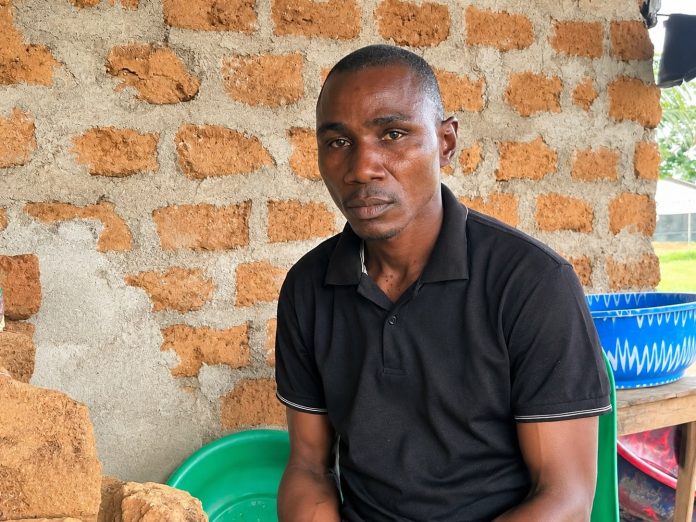
“Some of the things we agreed to do in one year have passed, some of the things we agreed to do in two years have passed, and even in three years have passed,” said Mohammed Daramie, Marbon’s chief officer. An official monthly report published last February confirmed Daramie and the townspeople’s claims.
It was unclear how much Kisvan owes Marbon, as neither Daramie nor Kisvan responded to queries about payments. However, a review of the contract, official records and the interviews with townspeople provides a clue.
Members of Marbon’s community assembly—the highest decision-making body in community forestry—said they received L$100,000 (US$588) since Kisvan began its operations. They heard that Kisvan paid money into Marbon’s account but had not seen any receipts.
The revelation is a far cry from the contract, which requires Kisvan to pay Marbon US$219,210 each year in training, healthcare, land rental fees, and forest monitoring, according to The DayLight’s analysis of the contract.
Daramie confirmed payments were made but did not say the amount. He promised to share payment documents but did not turn out at his office the next day and did not return calls or text messages.
Regardless, official records show that Kisvan exported at least 4,730 cubic meters of timber between 2024 and this August. That is an additional US$14,190 to Marbon, per the contract, bringing the total to roughly US$233,400.
In addition to payment issues, Kisvan did not respond to other questions for comment. Beginning in September, reporters contacted the companies’ executives via letters, WhatsApp messages, and texts, but got no replies. However, last year, Van Ngo, Kisvan’s CEO, blamed the global timber market for the company’s struggle to pay its debt.
The Forestry Development Authority (FDA), too, did not respond to inquiries about approving Kisvan’s exports while the firm is indebted to the Marbon. Forestry Regulation on Forest Fees bars a company from exporting when it owes the government or a community.
The official monthly report urges the FDA to be “more operational” in paying communities. It suggests the agency requires companies to upload receipts to communities in LiberTrace, the system that tracks timber before export.
‘Liars’
Reporters visited six of Marbon’s 36 landowning communities to find out more about contractual projects.
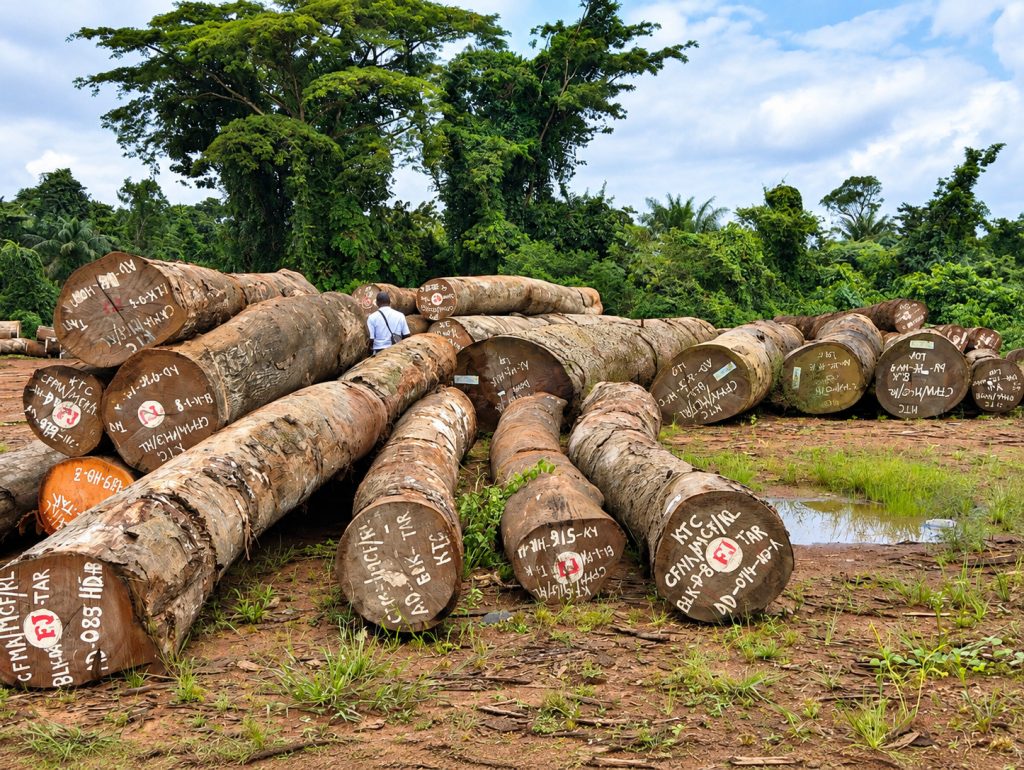
An FDA worker inspects logs at the Kisvan log yard in Jawajeh Town. The DayLight/Samuel T. Jabba
In Jawajeh, which hosts Kisvan headquarters, the contract’s failure lay bare. The town is supposed to have four hand pumps, four toilets, and a school, according to a community assembly member who represents the town. However, it is not the case. There are no Kisvan-built water facilities here, and people defecate in a nearby creek.
“One thing I know about Kisvan is that they are liars. No latrine, no safe drinking water, and no school. Every time we call to meet with them, Kisvan will always come with stories,” said Memah Kemokai, chairperson of Jawajeh Town.
“We are suffering, while we are surrounded by riches.”
Daramie acknowledged that Kisvan failed on some of its contract terms. However, he said that Marbon’s resolution did not capture Jawajeh, adding that the town’s representative did not present a proposal. Per the contract, Kisvan should construct two roads by 2023, a school by 2024, and eight hand pumps each year up to 2027. Nevertheless, communities can also decide to build other schools from the land rental and harvesting fees Kisvan pays.
The situation in Jawajeh is the same as in Meskina. A more populous and larger town, and closest to the forest, Meskina does not have any schools, in addition to lacking hand pumps and toilets. The closest school from here is in Kinjor, a famous mining town, about an hour away on a motorbike.
“We’re supposed to get some of our benefits by now, but there’s nothing yet,” said Alex Kamara, a Meskina resident.
No roads
Hand pumps, toilets and schools aside, roads are Marbon’s biggest problem. The worst stretch of the road is in Macca, the headquarters of the Darblo Clan, which hosts the forest. The contract requires Kisvan to maintain all roads in the area.
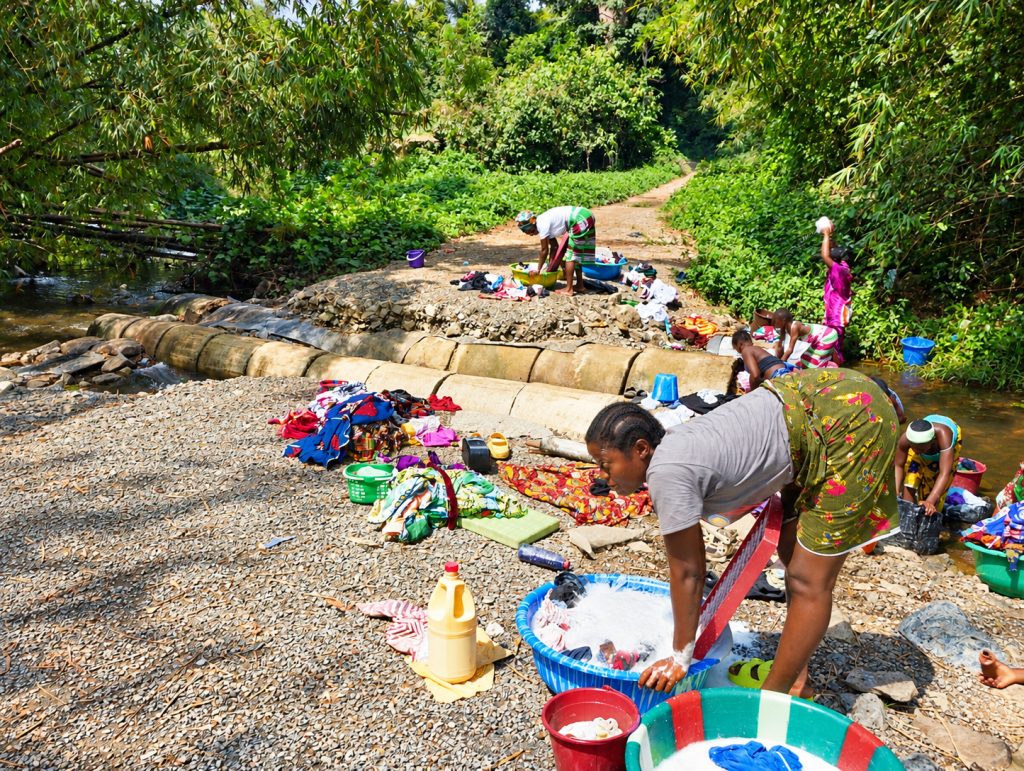
Yet no roads have been paved. A major bridge on the road leading to Macca is broken. Reporters saw motorcycle-taxi drivers pushing their vehicles across the water, while townspeople either jumped over culverts or stepped in the water to cross. The motorcycle-taxi driver carrying reporters fell into the water at the broken bridge.
Jenneh Brown, a large town next to Macca and home to a Kisvan log yard, faces the same obstacles. Thick, red mud makes the road leading to the town nearly impassable.
Women wash at a broken bridge between the Jenneh Brown Town and Macca, Grand Cape Mount County. The DayLight/Samuel T. Jabba
“Kisvan promised to construct the road from Jenneh Brown to Sinje Town and Marbon Wanga, but they failed to do the road rehabilitation,” said Zinah Boakai, a community assembly member. “I’m disappointed with the projects.”
Marbon is not Kisvan’s first struggle with a logging contract. Kisvan had similar circumstances with the Central Morweh Community Forest in River Cess County, where it did not complete several projects and delayed payments.
Ultimately, Kisvan and Central Morweh terminated the contract by mutual consent. After the termination, the River Cess community opted to conserve the forest, while Kisvan signed a new deal with the Bondi Mandingo Community Forest in Gbarpolu County to add to Marbon.
[Additional reporting by Philip Quwebin]
This story was produced with support from Informed Earth.
Superintendent Solomon Pillet of Sinoe's Sanquin District in an interview The DayLight
Top: Superintendent Solomon Pillet in an interview in Togbaville, Sinoe County. The DayLight/Esau Farr
By Varney Kamara
SAYON TWON, Sinoe County – Local government officials in Sinoe County’s Sanquin District have accused a Paynesville-based NGO of not recognizing their authority in community land activities. The NGO, Social Entrepreneurs for Sustainable Development (SESDev), denies any wrongdoing.
SESDev is supporting communities in Lower Sanquin to get their customary land deed. For nearly two years, it has conducted land rights awareness campaigns in the communities adjacent to the proposed Kwa National Park. However, local authorities here say the NGO does not invite them to participate in these events.
“They came and organized a local community land development management committee without any involvement of the local authorities,” said Solomon Pillet, Superintendent of Sanquin. “By virtue of the fact that I am the legitimate leader of this place, if the citizens have a concern, it should be channeled through me.”
Mathew Terpeay, Commissioner of Upper Sanquin Neequiah Clan, confirmed Solomon’s accusation against SESDev, which wants the proposed park suspended until adjacent communities get deeds to their customary lands. Tarpeay accused the NGO of sowing conflict in the district in an interview with this reporter in Nenneh Town.
SESDev denies the allegation, calling the accusation “unfounded.” Daniel Krakue, a SESDev lead campaigner, said the NGO had worked with the consent of late Clan Chief Thompson Gboweah and the Sinoe County Land Administrator Office.
A drone shot of the Proposed Kwa Protected Area. The DayLight/Samuel T. Jabba
“Therefore, the allegation by Mr. Pillet A. Solomon, Superintendent of Sanquin Statutory District, that the establishment of the [Community land development and management committee] undermines local leadership is completely unfounded,” said Krakue in a statement.
Krakue said SESDev could not be blamed for the conflict Terpeay alleged, as confusion was not unique to the Sanquin District. “Boundary harmonization often brings out existing historical land disputes,” he added.
The Land Rights Act came into force, granting rural communities land based on their ancestry, customs and traditions. Under the Land Rights Act, a landowning community must complete a legal process before obtaining its deed. However, under the law, local officials are required to play a role.
“Each community land development management committee shall work with the relevant local government officials…,” states the law.
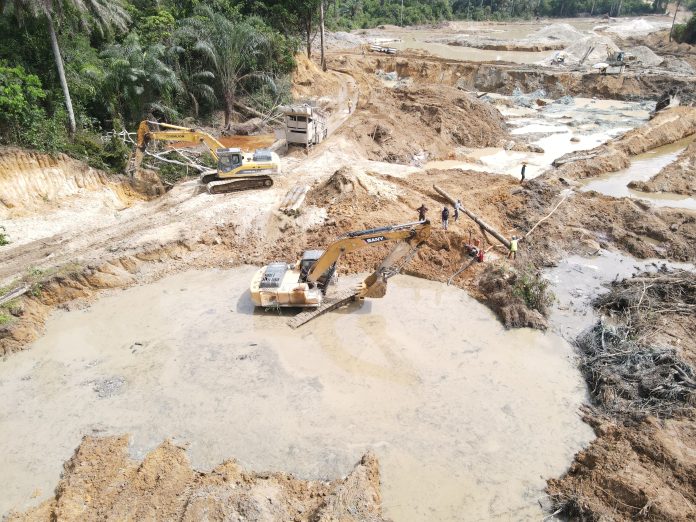
Top: Excavators on a mine in Kiliwu Town in Zorzor District, Lofa County. The DayLight/Samuel Jabba
By Varney Kamara
UNIFICATION TOWN, Margibi – President Joseph Boakai has called on investors to respect the laws and regulations governing Liberia’s mining sector.
“Liberia seeks clear rules, fair administration, and predictable procedures. Operators must obey the law, pay required fees and taxes, meet environmental obligations, and respect workers and host communities,” said President Boakai. He made the remarks at the Liberia International Mining and Energy Conference (LIMEC 2026), where he delivered a keynote address.
“Mineral resources are finite, and we must ensure they generate lasting returns for Liberians. Our Government is strengthening mineral-rights administration, licensing, oversight, and accountability,” the President added.
LIMEC 2026 is a two-day high-level mining conference meant to showcase the country’s mineral potential and attract companies to invest in its mining industry. Its overall goal is to transform the Liberian economy through sustainable mining investments.
Organized by the Ministry of Mines and Energy,Liberia Chamber of Mines, and AME Trade, a UK-based event organizer, the meeting brought together more than 250 delegates from across the world. It opened at Unification Town, Margibi, on Wednesday and ended on Thursday.
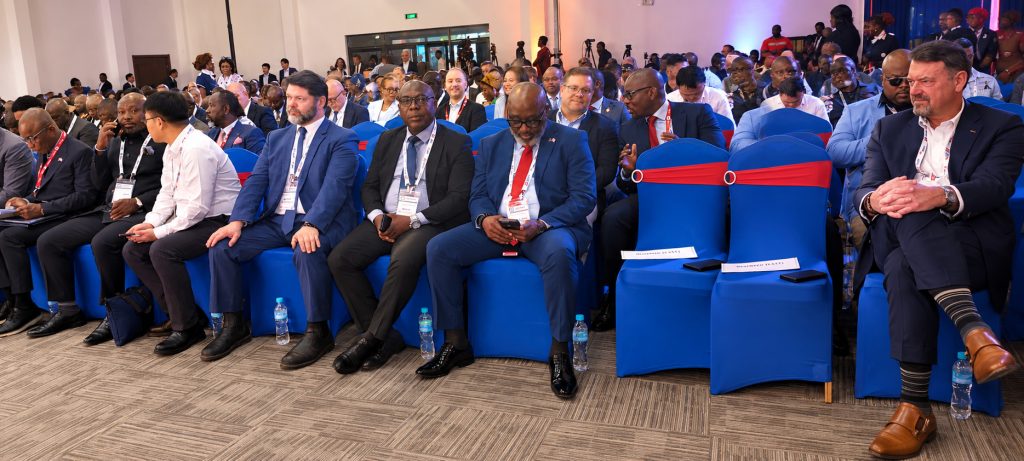
Delegates at the Liberia International Mining and Energy Conference Listen Attentively to Group Presentations. The DayLight/Varney Kamara
To reflect mining investments and expand the economy, President Boakai also called for a review of the country’s minerals and mining law and regulations.
Liberia’s Minerals and Mining Law, the oldest in the Mano River basin, has failed to bridge regulatory gaps, resulting in illegal mining, costing the government billions. This has triggered the need for reform, with the Law Reform Commission and campaigners currently spearheading a comprehensive reform of the sector.
“We will review mining-related regulations to reflect investment practices, environmental standards and Liberia’s development objectives,” Boakai said as the audience cheered.
Mining dominates Liberia’s economy. It is the single highest contributor to the nation’s economic growth. Last year, Liberia’s Gross Domestic Product (GDP) grew by 5.1 percent from 4.0 percent in 2024, according to the World Bank. This year’s GDP is projected at 5.5 percent, largely due to ongoing mining expansion and infrastructure, according to the IMF.
Earlier, Minister of Mines and Energy Matenokay Tingban invited qualified investors and partners to engage and support established processes that are best suited to Liberia’s production realities and regional market opportunities.
“Our priorities are responsible exploration, transparent licensing, protection of national skilled development, and local participation,” said Minister Tingban. “Our aim is a credible, commercially-grounded system that strengthens the formal gold sector and delivers measurable national benefits.”
Liberia’s mining sector is closely linked to illicit financial flows. A 2024 report by SwissAid, which tracks mineral exports from across Africa, found that five tons—equivalent to US$646.1 million worth of gold—are being smuggled out of the country each year.
The government has issued 13,149 licenses since the Ministry of Mines and Energy began keeping records online. However, the industry has been plagued by environmental degradation.
The environmental toll of mining is severe. Communities affected by mining have faced widespread pollution of water sources and environmental destruction, said Forest Trends, a US-based NGO, in a March report. It found that communities are not receiving benefits, while forests are being cleared and their livelihoods disrupted.
Company representatives at the conference agreed to abide by the country’s laws and regulations governing the sector.
“I agree with what the President said. Our company is fully compliant, and we are abiding by the Decent Work Act. We are respecting all the laws and all the rules. We can even do better in the future,” said Frederic van Haute, an executive of Westcrest Liberia Limited. The company has presented a proposal for an iron ore concession with Liberia for the Gibi Range, Margibi County.
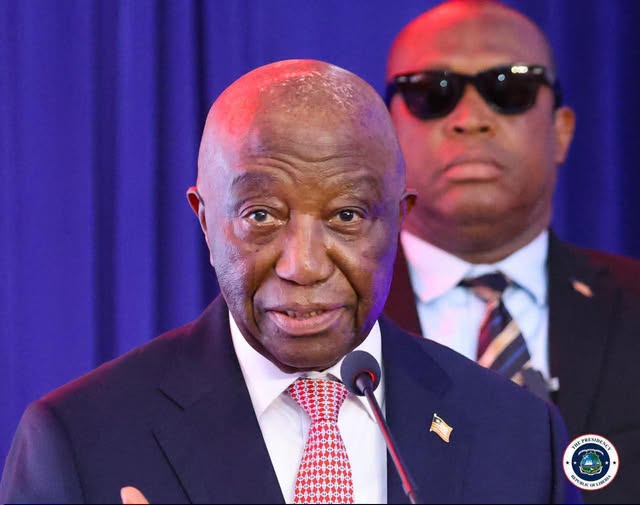
President Joseph Boakai Delivers the keynote address at this year’s edition of Liberia International Mining and Energy Conference (LIMEC 2026) on Wednesday. Picture Credit: The Executive Mansion
Amara Kamara—not related to this reporter—head of the Chamber of Mines, said the country must go beyond compliance to creating opportunities for its local population.
“Responsible mining must remain non-negotiable. The industry must demonstrate responsible resource development,” said Kamara.
“We need investment with technical experience to address development challenges. Above all, we must ensure that mining contributes to economic development,” said Kamara.
The conference closed with delegates agreeing to establish a framework for future partnerships, artisanal miner integration, and renewable energy targets, aiming for 75 percent renewable energy.
Artisanal miners at a camp in Salayea, Lofa County.
Top: An illegal mining site in the Salayea District of Lofa County. The DayLight/Samuel T. Jabba
By Varney Kamara
MONROVIA – For decades, Liberia’s Minerals and Mining Law, the oldest in the Mano River basin, has failed to bridge regulatory gaps, resulting in widespread illegal mining, environmental degradation, and mineral smuggling. This sickens local people and costs the Liberian government billions in extractive revenues, among other things. Moreover, the lack of transparency, weak enforcement, and inadequate benefit-sharing mechanisms have only compounded those issues.
Decade-long Efforts to solve this problem by enacting a new law have involved active coordination across government, civil society and the international community. The Law Reform Commission and campaigners are spearheading a comprehensive reform of the sector rather than specific amendments.
The proposed law aims to tackle issues affecting the industry, touching everything from environmental pollution to the protection of communities’ rights and to combating financial crimes. Here are seven highlights of the draft law you need to know:
Proposed Protected Areas and Local People Consent
The current mining law recognizes forest reserves. However, it does not recognize community forests and proposed protected areas. The Ministry of Mines and Energy issues licenses here under the constitutional supremacy that the state owns all minerals beneath the ground.
This is even though the National Wildlife Conservation and Protected Area Management Law does. The wildlife law protects parks and proposed ones. Proposed forest reserves are being reduced for mining activities, while mining licenses overlap proposed parks. These overlaps are undermining Liberia’s commitments to conservation and the rights of local communities.
Unlike the current law, the draft law bans mining in proposed protected areas. In the same vein, it outlaws mining in community forests without local people’s consent. This is respect for the Community Rights Law… and the Land Rights Act. The Community Rights Law created the community forestry, in which locals co-manage and share in forest resources alongside the government, while the Land Rights Act is revered as one of the best in Sub-Saharan Africa for recognizing ancestral land rights.
Reduction of Small and Medium-scale Licenses
Under the current legal framework, a small-scale or class ‘C’ license holder is entitled to up to four licenses that last for a year, covering 25 acres each.
The draft mining law, however, proposes a reduction in the number of licenses for small-scale miners from four to three, each covering 12.4 acres, or nearly half of the current size. The draft law also proposes two years for each license term, and a likely one-year extension.
A drone photo of a mine in Kiliwu Town, Lofa County’s Zorzor District. The DayLight/Samuel Jabba
On the other hand, a medium-scale miner can hold as many licenses as they want, each for five years. It is silent on the size of the area, but can cover up to a hundred acres. However, the draft mining law allows only medium-scale licenses and proposes a limit of 98 acres. (Not much of a change here, or is it?)
Experts see the intended changes as crucial in combating capacity issues and reducing the environmental footprint small and medium-scale miners leave behind.
Environmental Permit for Small-scale Mines
Under the existing law, the holders of artisanal and small-scale licenses are not required to obtain an environmental permit. The permit follows an assessment of the impact the mining would have on the environment and people. Only medium- and large-scale license holders are required to do that.
Thus, small-scale miners exploit this gap to violate environmental safety requirements. As a result, miners have polluted major watercourses across communities that locals rely on for drinking, carried out widespread deforestation, thus disrupting major livelihoods. The lack of proper oversight compounds the problem. As of Tuesday, 10,345 small-scale and 258 medium-scale licenses have been issued since online record-keeping.
Now, the draft law intends to reverse this course. It requires small-scale miners to demonstrate their technical and financial capacity to operate. If required by the Environmental Protection Agency, a small-scale miner shall conduct a report on their impact on the environment and people. This would restrain artisanal miners’ ability to wreak havoc on the environment and make them accountable the environmental standards and best practices.
Recognition of New Agencies
When the Minerals and Mining Law was enacted in 2000, extractive agencies such as the Environmental Protection Agency, the Liberia Land Authority, and the National Oil Company of Liberia were not established. They were created beginning two years after the mining law. At the time, the Ministry of Lands, Mines and Energy performed the roles and responsibilities of these agencies.
However, after their establishment, coordination among these sector agencies has been lacking, resulting in overlapping functions. This overlap has created duplication and resource scattering, among other challenges the sector faces.
Now, the draft mining law proposes the recognition of these new institutions and calls for coordination of mineral development among them. For instance, it recommends an “artisanal small-scale mining sector working group 90 days after the law comes into force. It names the EPA, the Corporate Development Agency, and the Ministries of Labor and Local Government as permanent members. The Minister of Mines would designate members of the group to advise the Ministry of Mines on licensing and small-scale operations.
Soar Mining site sits close to Killiwu Elementary School, almost encircling the town. The DayLight/Samuel T. Jabba
The measures demonstrate that Liberia’s extractive industries are transparent to attract loans and grants from the World Bank, International Monetary Fund, and other multilateral financial institutions.
However, the LEITI experiences recurring delays and noncompliance by government agencies and extractive companies. These issues have been exacerbated by weak enforcement, contractual and monitoring gaps, and illicit activities.
The draft mining law incorporates the LEITI law—created seven years after the current mining law—into the mining legal framework. It proposes full cooperation and requires license holders to comply with the LEITI rules.
“A holder shall disclose to the LEITI reconcilers and to the Minister on an accurate and timely basis and in the required manner all payments made to the State,” proposes the draft law.
The Kimberley Process
Kimberley Process Certification Scheme is an international trade certification scheme, established in 2003 to prevent the flow of “conflict diamonds.” It protects legitimate trade—ensuring that diamond markets remain clean. The process requires that a validated Kimberley Process Certificate be presented for every shipment of rough diamonds.
In May 2007, Liberia was officially admitted to the Kimberley Process. However, the current mining law was already in its seventh year when the diamond certification scheme arrived. Thus, Liberia has been enforcing the global Kimberley rules without domestic legislation.
To solve this problem, the draft law proposes that the Kimberley Process be incorporated into the country’s legal system.
Enforcement of Cultural Rights
Under the current mining law, mineral rights shall not be granted to cover areas including military bases, traditional bush schools, cemeteries, among others. It lists these places as excluded zones. However, it gives no clear protection for cultural relics. Not having a clear legal framework could lead to destruction.
The proposed mining law goes beyond the current law in preserving traditional knowledge, values, and practices that are passed down through generations. It proposes that cultural relics be protected through safe relocation. In instances where their removal would prove difficult, the draft law requires that the Ministers of Mines and Local Government be notified. In that case, mining activities around said artifacts shall be suspended until authorities decide.
Top: Bargblor, Grand Gedeh County, is one of 78 towns and villages adjacent to the proposed Kwa National Forest. The DayLight/Samuel Jabba
By Varney Kamara
Story highlights
Social Entrepreneurs for Sustainable Development calls for the government to suspend the establishment of the Kwa National Park until local communities complete the customary deed process.
The NGO cites the Gbehzohn Declaration, in which actors resolved on various aspects of land and forest matters.
Turns out, the Gbehzohn Declaration does not refer to the proposed Kwa National Forest, which began seven years earlier. In fact, the document does not require communities to get a deed before a park is established on their lands.
The NGO’s claim that the government unlawfully obtained communities’ consent is contradicted by documents consistent with the Gbehzohn Declaration.
The NGO is the latest to attempt to use misinformation to delay the conservation of the Kwa forest.
MONROVIA – In August, President Joseph Boakai received documents for his signature as part of a legal procedure to establish the Kwa National Park. When he signs it, the document will go to the Legislature for enactment as Liberia’s sixth and second-largest protected forest.
However, the Social Entrepreneurs for Sustainable Development (SESDev), a Paynesville-based NGO, wants the process suspended until landowning communities adjacent to the forest get their customary land deed.
“If this gazettement goes ahead as planned, it will violate the rights of countless, and as yet undefined, customary landowners whose rights are guaranteed by the law, and create animosity with local communities from the outset of its establishment,” said SESDev in an August letter to the Forestry Development Authority (FDA).
It urged the FDA to respect the Gbehzohn Declaration in which actors agreed on ancestral land ownership and protected forests. It enhances the implementation of the 2018 Land Rights Act, harmonizing stakeholders’ approaches to customary land rights, protected areas, and rights-based conservation governance.
But a DayLight review of the Gbehzohn Declaration shows that SESDev misinterpreted it, undermining the basis of its campaign.
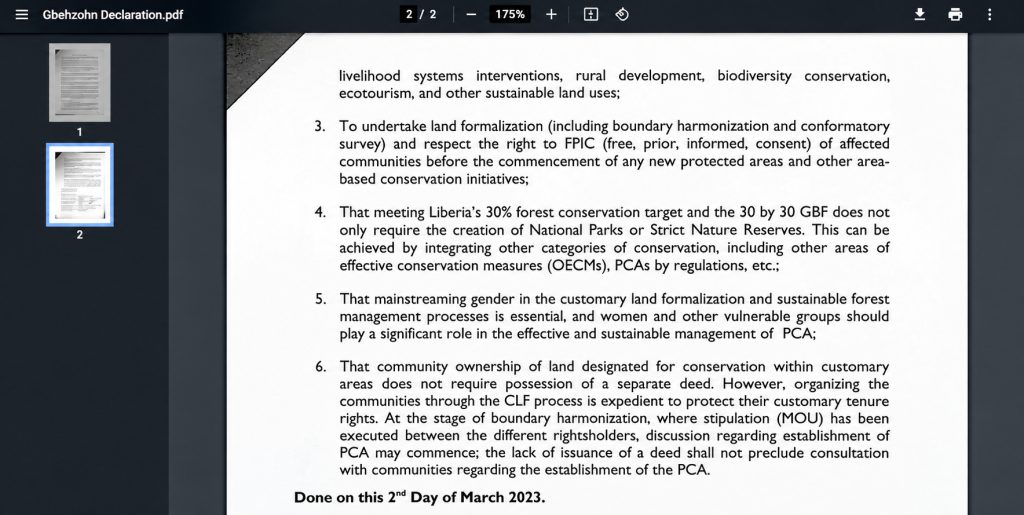
In the letter to the FDA, the NGO cited a provision of the declaration that communities first acquire a deed and give their consent before the government creates “any new protected areas.” Thus, that provision excludes Kwa, whose establishment began in 2016, two years before the Land Rights Act, and seven years before the Gbehzohn Declaration. The proposed park is a part of Liberia’s Permanent Forest Estate, established in 1953.
Drone shot of the Proposed Kwa National Forest. The DayLight/Samuel T. Jabba
Interestingly, the Gbehzohn Declaration provides that park procedures can proceed without communities acquiring a customary deed. It states, “At the stage of boundary harmonization, where stipulation (MoU) has been executed by rightsholders, discussion regarding the establishment of [a park] may commence.”
The Gbehzohn Declaration also does not prevent authorities from protecting a forest when landowning communities lack a deed. It does the opposite: “A lack of issuance of deed shall not preclude (stop) consultation with communities regarding the establishment of [a park].”
Covering 171,888 hectares across River Cess, Sinoe and Grand Gedeh, the Proposed Kwa National Park is home to critically endangered western chimpanzees, pygmy hippopotamuses, and forest elephants. It supports national efforts to protect 30 percent of Liberia’s forests and fulfills its climate commitments. Liberia currently has the Sapo National Park, the East Nimba Nature Reserve, the Lake Piso Multiple Use Reserve, the Gola Forest National Park, and the Grebo-Krahn National Park.
The EU is funding Kwa through a collaboration among the FDA, the Liberia Land Authority, and the Wild Chimpanzee Foundation, an NGO working in the Mano River basin. The funding comes from €289 million (over US$320 million) that the EU has granted Liberia for conservation, agriculture, and other sectors.
Kwa is already behind schedule. Having received the documents in August, the Executive Mansion was expected to send them to the Capitol Building last month. That did not happen amid President Boakai’s travel to this year’s UN General Assembly in America. The Executive Mansion and the EU Delegation in Liberia did not respond to queries on the delay.
Suspending Kwa’s establishment until communities get their deeds could further delay the park. The Land Rights Act grants communities ownership of their ancestral territories, but getting a deed to formalize that ownership has proven to be difficult. About 70 communities have completed the legal steps to get their deed, while 150 are processing theirs.
Sayon Town in the Lower Sanquin Clan, Sinoe County. The DayLight/Samuel Jabba
It is unclear how many clans—the level at which communities get a deed—are affected by Kwa in all three host counties. However, the clans where the 78 Kwa-related towns and villages are located are in the customary deed process.
The process started in 2023 after the Gbehzohn Declaration, a group of NGOs, including SESDev, objected to Kwa. The group flagged that communities had not confirmed their customary ownership of the forestland. Authorities agreed and started the customary land procedures.
But this time, authorities refute SESDev’s criticism.
“Officially, it is the position of the government of Liberia… to ensure that communities… go through the complete [ customary deed] process. That is why we started the process from Grand Gedeh along with all those communities at the fringes,” said Julius Kawa, Director for Planning and Policy at the Land Authority.
“This is not about before or after. It is not just that one must be done before the other one. We are the government of Liberia. We are doing what is right for the people,” added Kawa. He said the Land Authority would complete the customary deed process within two or three months.
Consent and Lies
SESDev also criticized the method authorities used to obtain communities’ consent. By law, local people have the right to consent to projects on their lands. That consent must be free of intimidation or manipulation, prior to a project, and informed in every way.
SESDev dubbed the consent information in the Kwa package “inadequate,” “invalid,” and “non-compliant.” Forms were not signed by required community bodies, and locals received no legal advice before signing them.
“As a result, the consent forms included in the gazettement package are inadequate and unable to provide the consent they purport to contain,” said SESDev.
“This again provides sufficient grounds for invalidating the [consent] process that was carried out. On that basis, it was non-compliant with national and international standards,” added the NGO.
A screenshot of the relevant portion of the Gbehzohn Declaration SESDev wrongly cited as a basis for the NGO’s campaign for the government to suspend the establishment of the Kwa National Park.
But the official documents SESDev condemns, and interviews The DayLight conducted with townspeople tell a different story. The evidence shows communities are aware of Kwa, participated in its processes, and consented to its formation. Townspeople even signed boundary agreements and agreed to co-manage the park alongside authorities. They attended a series of meetings and participated in awareness campaigns on forest conservation.
“In 2023, SESDev… ignored all available [consent] documents. Now they are still ignoring all available documents, including the entire [customary land formalization] documentation,” said Dr. Annika Hillers, Wild Chimpanzee Foundation’s Country Director. “Instead, they are misinforming and sharing wrong information with the EU.”
SESDev’s letter to the FDA to suspend Kwa is not the first to be based on falsehoods.
A DayLight investigation in July established that cocoa farmers in Grand Gedeh lied in a complaint to President Boakai about their participation in Kwa processes. A report from an inquest ordered by the President on the matter has yet to be published
Then, weeks after SESDev’s communication, local people in the Lower Sanquin Clan in Sinoe County wrote a letter to the EU, claiming they also did not participate in Kwa processes. A DayLight publication revealed they actually consented to the creation of the park.
For instance, Reason Seequeh, the community land leader for the Lower Sanquin Clan, Sinoe, claims his signature on a boundary agreement was forged. However, two other people who signed the document said they saw Seequeh sign it.
The Land Authority said it would investigate amid the false claims.
Top: To make steel in Dunkirk and Fos-sur-Mer, ArcelorMittal has been mining iron ore deposits in Liberia. By monopolising agricultural land and contaminating water resources, the company endangers the lives of thousands of people in the West African country. Revelations below on the postcolonial practices of the world’s leading steel company and how they are contributing to climate change.
Promises only bind those who believe in them, and this has not escaped ArcelorMittal. For several years, the steel multinational has pledged to achieve carbon neutrality by 2050. This is an emergency: with 98 million tonnes of CO2 released into the atmosphere last year, ArcelorMittal is one of the largest contributors to the climate crisis on the planet. Its steel works in France, located in Dunkirk (north) and Fos-sur-Mer (south), are the two biggest polluters in the country: they release 15% of the industry’s greenhouse gases.
In spite of the climate emergency, ArcelorMittal has suspended or cancelled as many as seven projects that were supposed to decarbonise its steel production in Europe. This U-turn is as harmful for the climate as it is for the communities bearing the brunt of this fanatic extractivism, as revealed by Disclose’s latest investigation into the raw materials feeding the factories of France’s top polluter.
ArcelorMittal’s steel is ubiquitous: in cars (including the latest Renault and Peugeot models), Coca-Cola and Heineken cans as well as Miele and Samsung washing machines. To produce steel, the multinational relies on two essential components, coal and iron ore, and this resource neo-colonialism involves Africa, among other continents. In April 2026, Disclose revealed that some of ArcelorMittal’s coal burned in France comes from a mine in Mozambique, where fumes poison locals. Regarding iron ore, we have discovered that the steelmaking company gets huge supplies from Liberia, where half the population lives below the poverty line.
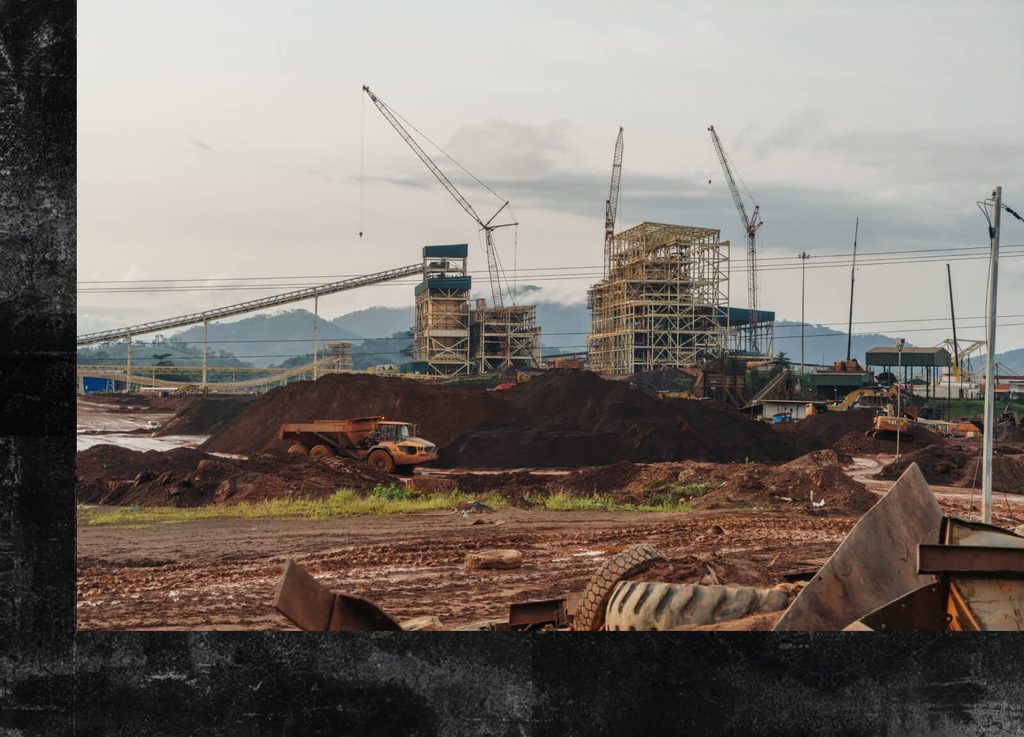
Construction of an iron ore concentrator near Mount Tokadeh, on ArcelorMittal’s concession in Nimba County, Liberia. Photo: Berta Vicente Salas
In the small West African country, ArcelorMittal has indulged in the postcolonial predation of resources, claiming mining, railway and port infrastructures. According to unpublished documents and a score of testimonies from locals, indigenous communities are paying the price for this iron ore rush: close to a thousand farmers have had their land grabbed by ArcelorMittal, which is also accused of poisoning rivers and sources of drinking water, all for the benefit of its factories in France. Mainland France is the top destination for Liberian iron ore, with 12.7 million tonnes shipped between January 2020 and August 2026, according to exclusive data provided to Disclose by trade intelligence company Kpler.
Bulldozers rip apart indigenous land
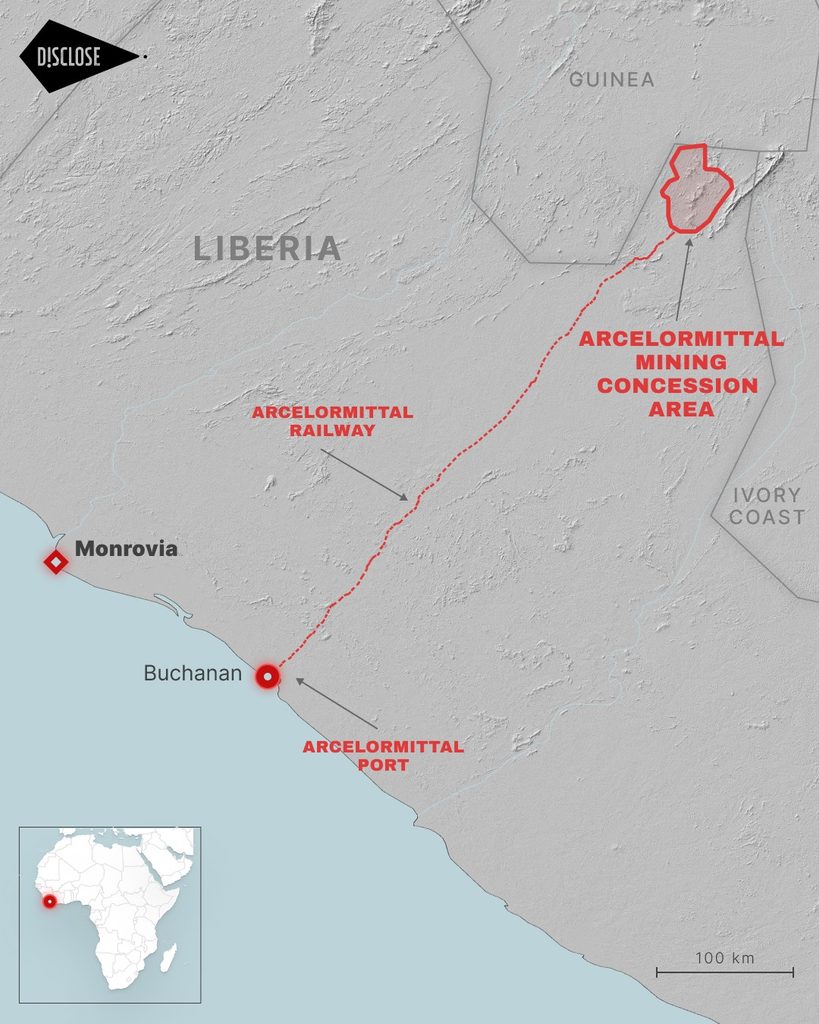
ArcelorMittal started operating in Liberia in 2005. The country was still reeling following a civil war that left more than 200,000 dead. Off the back of a very unbalanced deal with the government of the day, the multinational set up business in the north of the country on a mining concession five times the size of Paris. ArcelorMittal also grabbed two assets that were the property of the Liberian state, the railway connecting the mines and the Atlantic Ocean, and the port of Buchanan, from which cargo boats leave for France. According to the agreement, which has since been extended and will now run until 2050, a 15% share of the mines is owned by the state while ArcelorMittal holds an 85% share.
Map: Pierre Leibovici / Disclose
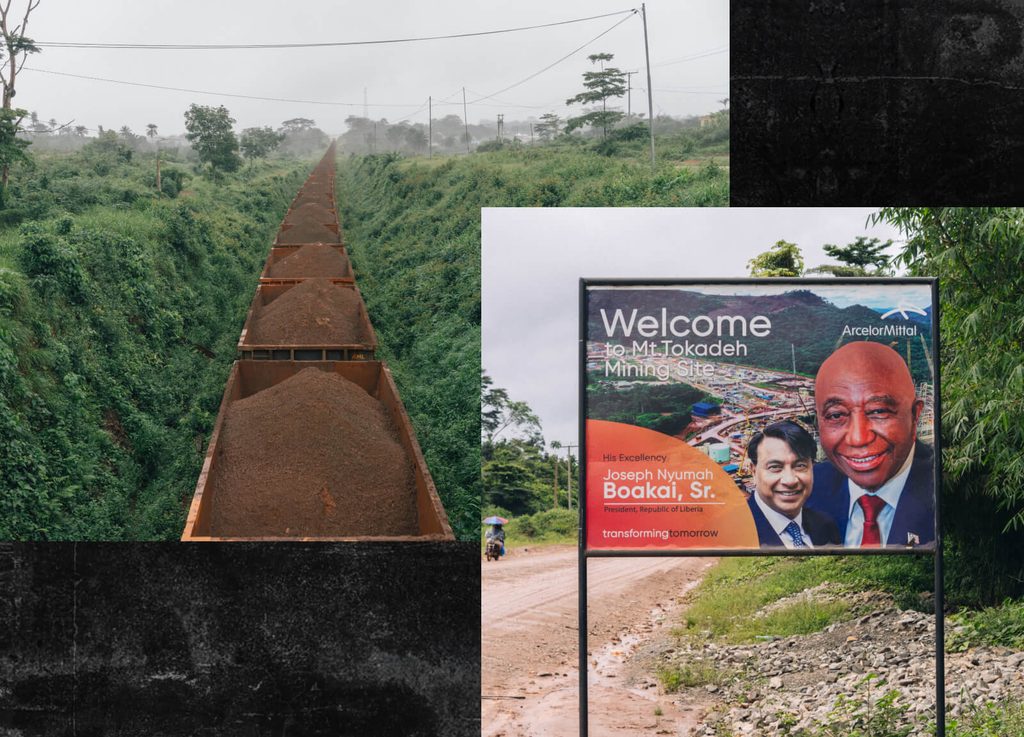
In the concession area, bulldozers now run at full capacity. Blasting to loosen rock can be heard deep in the jungle, as observed by Disclose. ArcelorMittal is expected to have exported 18 million tonnes of iron ore this year, a 57% increase on last year. In return for its mining operations in the country, the group claims that it paid the Liberian state close to $28m in 2025. A win-win partnership, according to the billboards that can be seen all over the mining concession. The multinational’s executive chairman, Lakshmi Mittal, is all smiles next to President Joseph Boakai.
Left: iron ore being transported by train from Sanniquellie, in Nimba County, to the port of Buchanan, where it will be loaded onto ships bound for Europe. Right: a photo of Liberian President Joseph Boakai with Lakshmi Mittal, Executive Chairman of ArcelorMittal, at the company’s concession. Photos: Berta Vicente Salas
The tragedy experienced by thousands of locals in this farming region, where the Mano and Gio indigenous communities are in a majority, is in stark contrast to this success story, as shown by the testimony of Dada Konkah, a farmer in Gbarpa, at the foothills of two mountains mined by ArcelorMittal. In March 2022, while he was away for a few days, the excavators of a subcontractor used by ArcelorMittal tore to pieces a large part of his rubber, cacao and avocado crops. Neither the steel giant nor its local service providers bothered to inform him, which is illegal as the law in Liberia makes provision for the “free, prior and informed consent” of land owners, and guarantees “equitable” and “timely” financial compensation. Three months later, the group pledged to compensate his losses — close to 600 trees — in accordance with a Ministry of agriculture scale. The farmer was eventually paid a paltry $9,000. He had expected double that amount.
“I have three children. How are you expected to feed your children?”
Ernest Belleh Dolo, Gbarpa resident
“I was greatly cheated in the compensation process,” says Dada Konkah. Not only did ArcelorMittal clear his fields in early 2022, but the multinational flooded them two years later after building a dam that was supposed to hold back its wash waters but which, it turns out, was badly designed.
Since then, the plants that survived have been floating in brownish water. “I am really affected. I no longer have access to my land,” he says. After he aired his grievances, the multinational wrote to him in January 2024 to say that he would not receive compensation for the destruction of his crops.
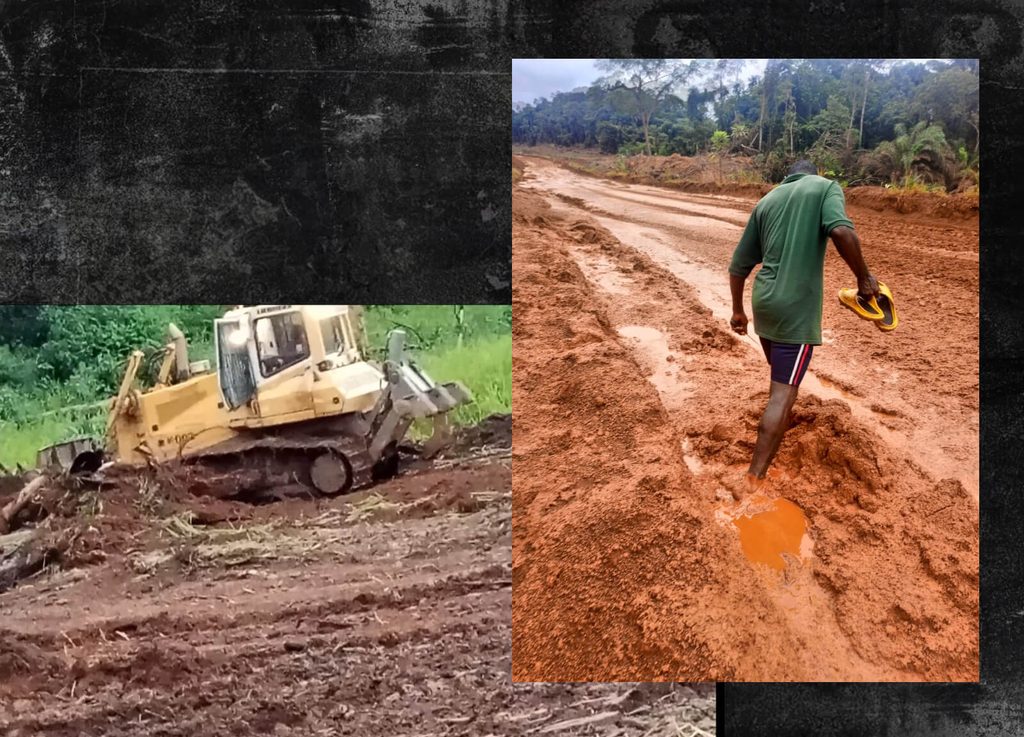
Disclose spoke to six people with stories similar to Dada Konkah’s between August 2024 and September 2025. They said ArcelorMittal employees had barged into their fields to take stock of crops, before bringing in “yellow machines” which crushed vegetation and regraded the ground to build a road, a dam or a waste landfill facility. Ancestral land wiped off the map, without warning. “My land was destroyed over the space of two months,” says Ernest Belleh Dolo, another Gbarpa resident. “I have three children. How are you expected to feed your children? Since there is no money at the moment, the children had to drop out of school.” Here, villagers farm to feed their families but also to generate the largest part of their income.
Left: a bulldozer belonging to an ArcelorMittal subcontractor destroys a farm field in Gbarpa, Nimba County, in December 2023. Right: a farmer from Gbarpa walks on the site of his former field, which was replaced by an ArcelorMittal road, in November 2024. Photos provided to Disclose by local residents
ArcelorMittal has acknowledged that “22.1% of agricultural land” that have been either destroyed, or either made inaccessible because of its operations, has been compensated. This is confirmed by a letter the company sent to local authorities in March 2026 and seen by Disclose. Two months later, mediators appointed by the Liberian government worked out that 694 farmers were still waiting to be compensated. Another 160 farmers in the concession have not been taken into account by the authorities. To this day, they have not been indemnified.
The total sum the aggrieved farmers are asking for — 4 million dollars, or about $5,400 per person — is, however, just a tiny drop in the ocean compared with the multinational’s $3bn in profits. But ArcelorMittal believes it has paid its dues. Its senior management told Disclose that “those who needed to be compensated have been”. They insist that ArcelorMittal Liberia “does not authorise land clearing activities outside of its established land access, consultation, compensation and permitting processes, and any allegation that these requirements were not followed is taken seriously and is subject to review”.
“There’s nowhere in Europe that would give mineral resources to expats while your own people don’t benefit,” Liberian Senator Crayton O. Duncan told Disclose. He is one of the few members of parliament who abstained from voting on the extension of ArcelorMittal’s concession. The health of these residents, not just their livelihood, is now at stake.
Heavy metals in wells and rivers
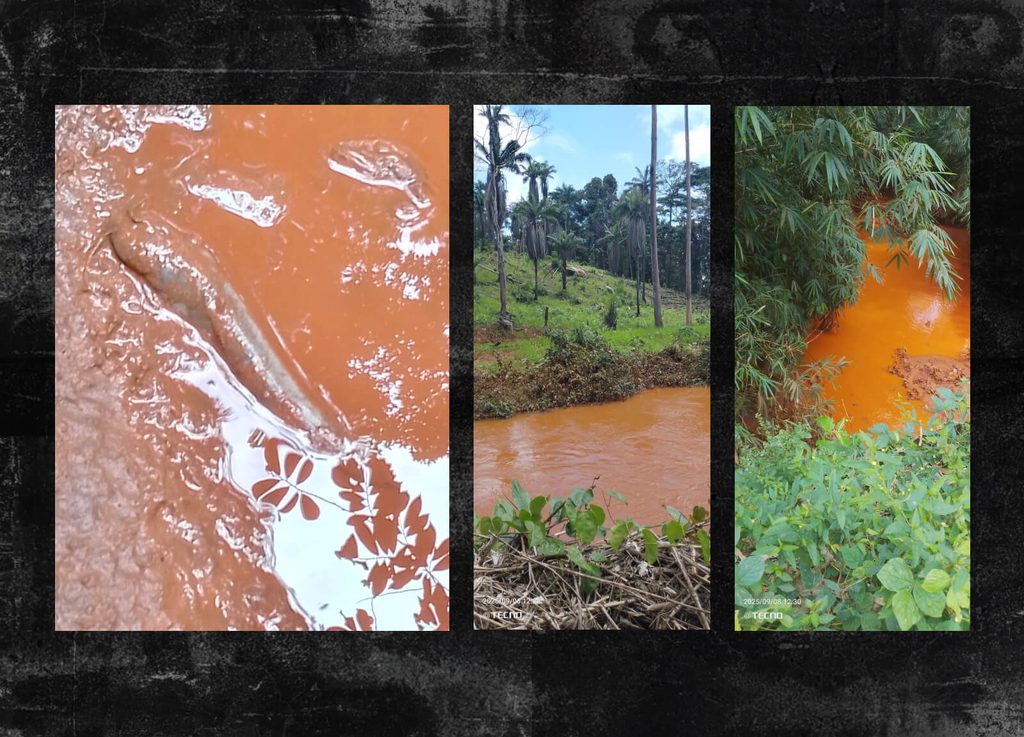
Indeed, other hardships have been affecting people living near the mines for months: the chemical contamination of water. In photos and videos shot by residents between September 2024 and March 2026, the rivers Gba and Velee, which flow near the extraction site, have turned a murky orange. A dead fish and dying plants can also be seen.
Left to right: a dead fish in the River Velee on 8 October 2025; the River Gba on 6 September 2025; the River Gba on 8 September 2025. Photos provided to Disclose by local residents
Alfred Guane is a farmer in the village of Bonla, about one km upstream. “We can no longer grow vegetables along the river banks. Soon we will produce zero,” he says. Like many of his neighbours, he had to resign himself to renting a plot of land away from the rivers.
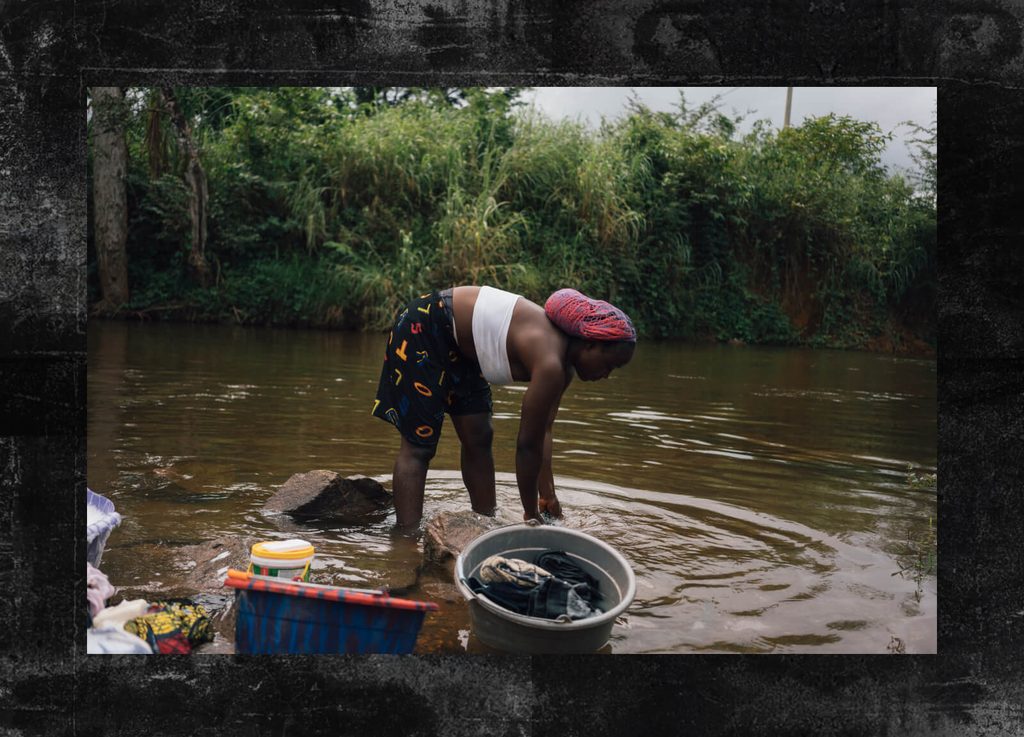
In Nimba county, rivers and streams are used to water crops but also for drinking, washing clothes or dishes, and bathing… Some 15 km south of Bonla, in the village of Zolowee, residents have stopped drinking water from streams that they had used since time immemorial. Meanwhile, “ArcelorMittal brings drinking water from [the capital] Monrovia for their staff,” seethes Roland S. Dolo, the village chief. The group’s management confirmed this to Disclose, adding that they are taking “measures aimed at protecting local water resources”.
The scale of the pollution is confirmed by an independant laboratory report dated January 2025 seen by Disclose. According to the document, drawn up for the benefit of the Liberian government, heavy metals were found in rivers, wells and pumps used by the residents of five villages located in the mining concession. High levels of fluoride, suspected of being toxic for brain development and reproduction, were found in 19 samples out of a total of 37. Contamination is 17 times higher than the levels recommended by the World Health Organisation (WHO). Moreover, lead was found in all samples — up to 63 times the levels recommended by the WHO (0,01 mg/l). Lead impurity can be found in iron ore and is a particularly toxic compound for children and pregnant women.
Researcher and geologist Levi Nya Paye, a water specialist at Monrovia University who did not take part in the study, told Disclose that “the report gives real reason for concern about water quality in several of the sampled communities.” He added that “the report, on its own, cannot establish that ArcelorMittal caused the contamination […], but it states that ArcelorMittal Liberia’s baseline and routine monitoring data were requested and not provided. To me, it is a kind of red flag”.
A resident of a village located within ArcelorMittal’s concession does her laundry in the river. Photo: Berta Vicente Salas
The Liberian government declined Disclose’s request for comment on its follow-up to the report. However, the Environment Protection Agency (EPA), which is under the authority of President Boakai, told Disclose that in late 2025 its laboratory analyses of soil, water and sediments showed “elevated levels of iron and certain heavy metals, including lead and chromium, exceeding national water-quality standards.” Moreover, “EPA investigators observed iron-rich, sediment-laden discharges [..] entering nearby water resources through six discharge points” used by ArcelorMittal. The company was fined $500,000 by the authorities, in addition to the $295,000 worth of sanctions in connection with its water pollution since 2022.
ArcelorMittal, approached for comment, told Disclose that “it acknowledges concerns raised regarding sediment discharges associated with its mining operations and takes these matters seriously”, that “the company maintains a comprehensive environmental monitoring programme and routinely undertakes water quality monitoring.”
According to our information, two court cases are about to be brought against the multinational in Liberia over human rights abuses and environmental degradation in Nimba County, one by local NGO Green Advocates International and the other by residents of a village in the mining concession. But this is not expected to rein in the steel giant’s ambitions. ArcelorMittal is planning to excavate 30 million tonnes of Liberian ore per year by 2030 so it is likely to keep contributing to climate change for a long time yet.
Depleted logs lying anandoned in the Tonglay forest
Top: Keshav abandoned logs in the Tonglay Community Forest, Gbarpolu County, The DayLight/Varney Kamara
By Emmanuel Sherman
TONGLAY; NORMON, Gbarpolu County – Villagers in the Tonglay Clan, Kongba District, celebrated after signing a logging contract with a new company in 2022.
Keshav Global Industries Limited promised to build roads, bridges, schools, scholarships, and healthcare assistance in exchange for Tonglay’s 18,611-hectare forest.
At about the same time, Tonglay’s neighbor, the Normon Clan, also signed a similar contract with Keshav for 12,483 hectares.
But both communities’ hopes were dashed because the agreements were short-lived, leaving behind debts, unfulfilled promises, and logs. That experience has shifted local people’s attention to conservation, a familiar recourse in that area.
“This left us disappointed because the community did not benefit anything from the contract,” said Karimu Fofana, Tonglay Community Forest’s chief officer. “There is similar disappointment in Normon.”
Keshav owes Tonglay US$79,000 for land rental, cubic meters, scholarships, healthcare, and forest guard fees, according to The DayLight’s analysis of the contract and financial records. The company failed to build two major roads in the clan between January 2023 and March 2024. It also failed to construct six concrete bridges it was required to complete by this year, among other things.
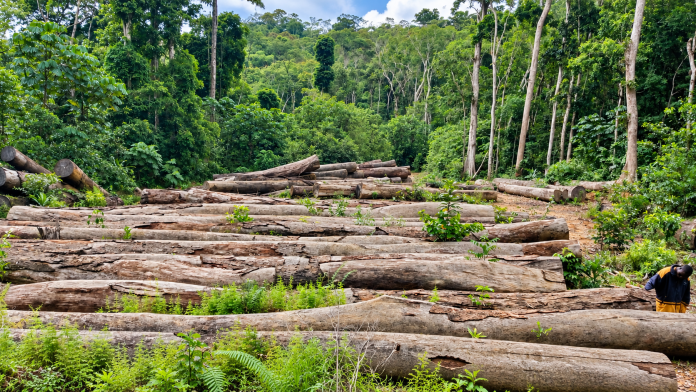
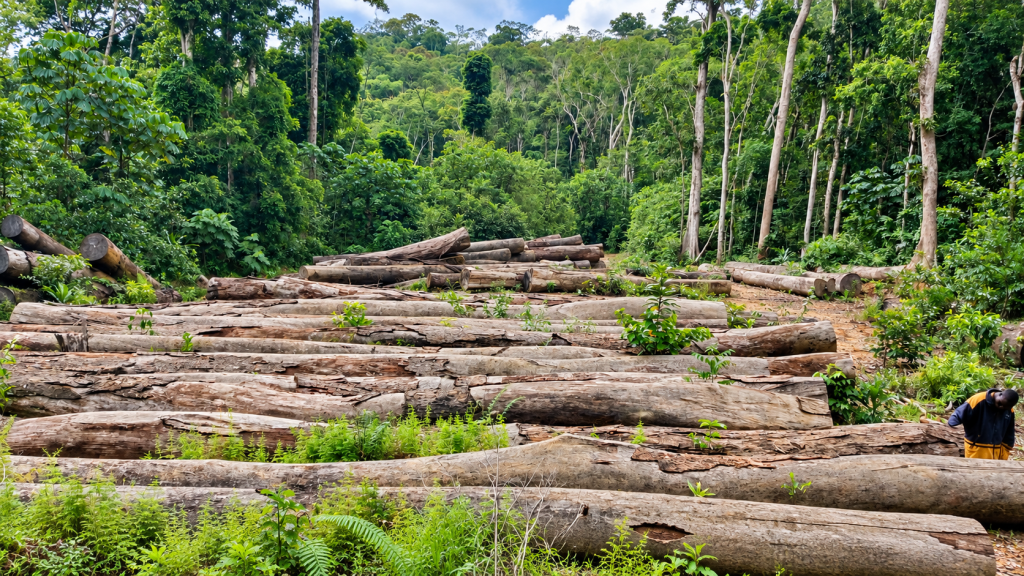
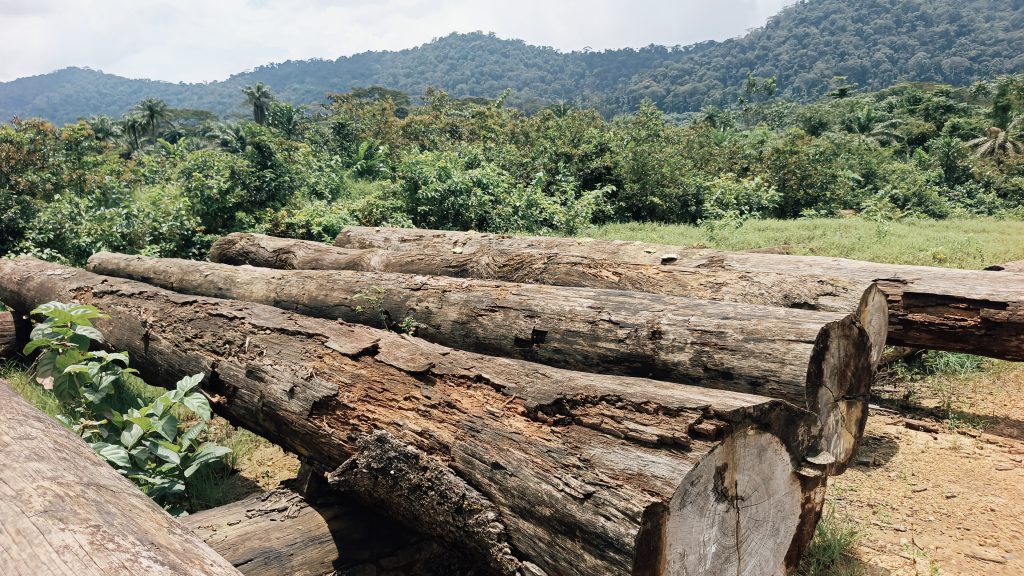
Apart from the unpaid fees, Keshav also abandoned several logs. The community puts the number at 565 logs left in the forest and by the roadside. The DayLight counted 300 logs in one location.
Things are the same in Normon. Keshav owes the community an undisclosed amount and failed to build community roads, provide scholarships, healthcare assistance, and forest guardian fees.
The roads in the region are among the most deplorable in Liberia, cutting the region off from the rest of the country. Motorcycles cannot even ply some areas.
“It hurts us a lot because the main thing we signed the contract for was to ensure the company builds our roads,” said Boakai Kanneh, head of Normon’s community leadership.
Depleted logs lying abandoned in the Tonglay forest
“We want cars to come into the community with goods in our towns and villages. Our people are suffering.”
Keshav felled 110 logs and left them in the forest in Normon, according to Kanneh. The DayLight could not independently verify the information because of the distance to access them. The Regulation on Abandoned Logs, Timber and Timber Products prohibits leaving logs unattended in a forest for three weeks.
Concerned about its abrupt closure, the two clans visited Keshav’s headquarters in Congo Town, outside Monrovia, but did not meet a representative there. Tonglay then wrote a letter to Vyom Garg, Keshav’s owner and CEO.
On April 9, 2025, Garg replied to Tonglay, blaming his company’s abrupt closure on the global financial crisis, which “significantly” impacted its operations.
“We are committed to beginning the payment of all the outstanding liabilities to the community no later than April 30, 2025,” read Garg’s letter. However, the payment has not happened.
The failure of Kehsav’s contracts dashed the hopes of people in Tonglay and Normon.
“We were carrying out some development, and we could not complete that development because we were financially depressed,” Fofana said. “Based on their failure, we could not go further with those things.”
Contract terminated
Last year, Tonglay filed a lawsuit in the 16th Judicial Circuit Court in Gbarpolu County to terminate its contract with Keshav, according to court records. The court sided with the community against the company, which was not represented in the two-month trial.
The court said it found no reason to deny Tonglay’s petition to cancel the third-party agreement.
“The third-party agreement between Tonglay and Keshav is hereby cancelled and terminated,” the court ruled.
With the contract terminated, Tonglay has held elections for a new corps of officers to strengthen its forest governance.
Normon, on the other hand, has not terminated its contract. To do so, the community must officially inform the FDA before heading to court.
If Normon terminates its contract, Keshav, whose vision is to work with certified forests in Africa and South America, would have no forestry contract in Liberia. Garg did not respond to queries for comment.
Keshav Global Industries Limited, an Indian-owned company, is a subsidiary of Keshav Global Trading LLC, based in Dubai, United Arab Emirates, and Keshav Global Private Ltd, based in Singapore. The conglomerate trades timber and agricultural commodities.
Conservation
Both Tongaly and Normon are weighing options on whether to pursue conservation or stick to logging. Back in 2021, Montserrado-based NGO the Society for the Conservation of Nature Liberia (SCNL) helped the clans obtain community forest status from the Forestry Development Authority (FDA). This allows locals to co-manage the woodlands alongside the FDA and share in forest resources.
The clans are part of the Gola communities adjacent to Gola National Park, a forest between Liberia and Sierra Leone, home to forest elephants, chimpanzees, and rare birds. Moreover, Normon shares a boundary with the Foya Proposed Protected Area between Gbarpolu and Lofa, which covers 168,628 hectares.
The Normon Community Forest. The DayLight/Varney Kamara
Tonglay is about to sign a conservation agreement as part of a three-year project that seeks to empower forest-dependent communities.
Normon, on the other hand, wants to do the same.
“We are in the process of terminating the contract just as the Tonglay Community Forest did. If we terminate Keshav’s contract, we will be able to sign the community conservation agreement with SCNL,” said Varney Kabba, the secretary to Normon’s leadership.
James Mulbah, forest landscape manager with SCNL, reveled in the clans’ potential switch to conservation.
Mulbah said: “Conservation is taking root, but getting communities on board a hundred percent takes time.”
This story was produced with support from Internews’ Earth Journalism Network.
Top: The DayLight publishes environmental news, mainly investigations
By The DayLight Editorial Board
MONROVIA – The Independent Information Commission has made an administrative decision in favor of The DayLight in a case against the Environmental Protection Agency. The decision ends a yearlong battle over access to information in the extractive sector.
The newspaper filed a complaint with the Commission in April after the EPA refused to provide environmental reports, audits, and permits regarding certain companies beginning September last year.
“The Environmental Protection Agency is hereby ordered to provide The DayLight Inc. with the records responsive to the request forming the subject of the complaint…,” said Joash T. Hodges, Information Commissioner, in his ruling last Thursday.
“The constitutional and statutory right of access to information cannot be effectively exercised where lawful requests to public institutions are met with prolonged silence, unexplained delay, or administrative inaction,” added Hodges.
The EPA had argued in an August hearing that some of the documents The DayLight requested were proprietary information or state secrets. The agency blamed its failure to provide the documents on challenges with implementing its own regulation.
It even expressed doubt over the newspaper’s ability to handle “technical” and “sensitive” information despite having fined companies based on the newspaper’s investigations in the past.
But the Commission rejected the EPA’s “blanket withholding of requested records.” It said the EPA had not demonstrated that the documents The DayLight requested fell within a statutory exemption.
“The Commission recognizes the specialized regulatory responsibilities of the Environmental Protection Agency and the legitimate need to protect information that falls under a statutory exemption,” read the decision.
EPA director, Dr. Yarkpawolo/EPA Facebook
“However, regulatory complexity does not displace statutory obligations, and administrative inconvenience does not constitute an exemption from disclosure.”
The Commission ordered the EPA to provide the documents and report on its compliance with the order in 15 working days. It ordered the agency to pay a fine of L$9,000 (US$53) to the government revenue by Tuesday.
Furthermore, the EPA must review its information regulation—published in March—and remove provisions inconsistent with the Freedom of Information Act.
“This is not just a victory for The DayLight, but also for the media, and public access to information,” said James Harding Giahyue, The DayLight’s Director/Managing Editor. “We hope the EPA respects the decision of a constitutional authority and closes this chapter.”
The EPA did not immediately respond to queries for comment, but it can appeal the decision in a civil court in Montserrado County.
A drone shot of JM Mining Company exploration area in Bopolu District, Gbarpolu County
Top: Drone shot of JM Mining’s Rambo Base Exploration Camp in the Bondi Mandingo Authorized Community Forest. The DayLight/Samuel T. Jabba
By Varney Kamara
This is the second of a two-part series on a logging contract and a mining license in a community forest in Gbarpolu County.
GBARQUOITA — In June, the Bondi Mandingo Community Forest signed a logging agreement with Kisvan Timber Corporation, a logging company, to exploit 37,222 hectares of forest in Bopolu District, Gbarpolu County. However, it is the second contract in the same area, an irregularity.
Nine months earlier, the government issued an exploration license to the JM Mining Company, a mining firm, on 297 square kilometers that overlaps the community forest, according to the Ministry of Mines and Energy’s records. Community people are concerned that this could lead to clashes between the two companies.
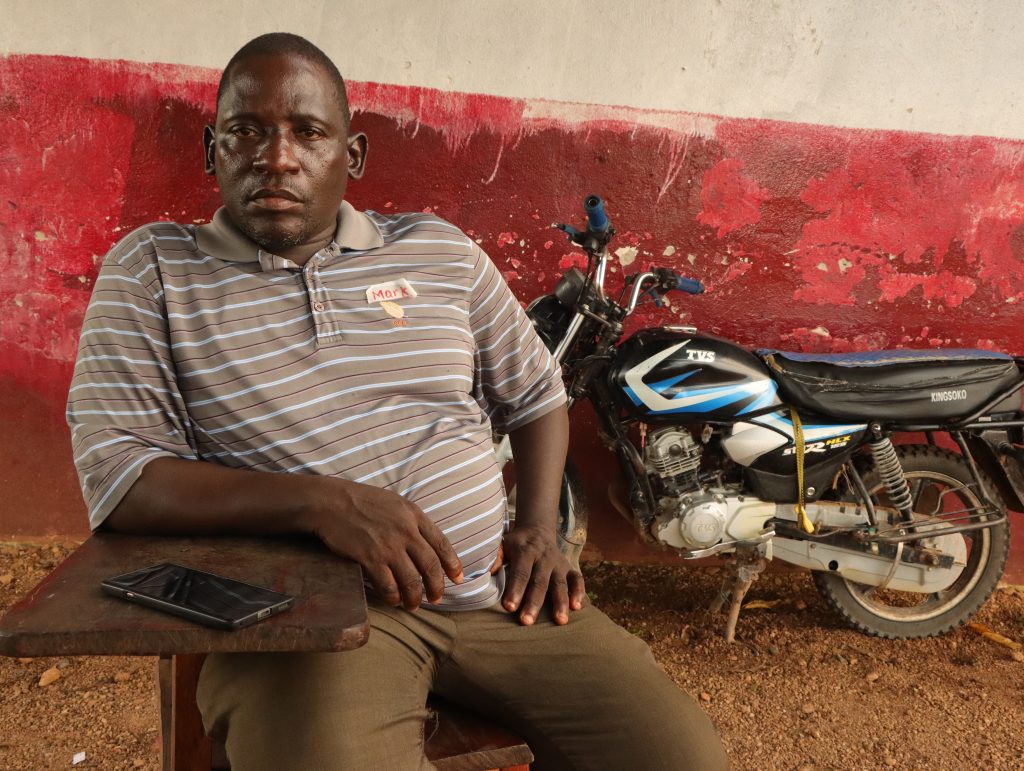
“This mining thing is a threat to our community. We are concerned because the logs that Kisvan wants are the same logs that JM Mining is cutting down and burying in the forest,” said Mark Dennis, the chief officer of the community forest.
“Their exploration has been going on for two years now. They are doing it in the Kpo Mountain area, and we are afraid that they will give the loggers problems,” added Stanford David, General Town Chief of the Bondi Clan.
JM Mining operated illegally in the forest before its current exploration license. In July 2024, the Environmental Protection Agency (EPA) fined it US$95,000 for operating without an environmental permit. The EPA found that the company contaminated a major watercourse local communities depend on for safe drinking water.
Though JM Mining was awarded a license for the area, Bondi Mandingo said it did not consent to the company’s operations in the mountainous forestland.
“There was no prior information. We only saw them here. They told us that they obtained a license from the government,” Dennis said in an interview with The DayLight in Bopolu. “They said we don’t have anything to do with their exploration business until the company signs an agreement with the government.”
Bondi Mandingo is authorized as a community forest with the Forestry Development Authority (FDA). In December 2018, it signed its first commercial contract with Indo Africa Plantations Liberia Incorporated, but terminated the contract after the company failed to meet its obligations and abandoned thousands of logs.
In February, Bondi Mandingo wrote the Ministry of Mines and Energy over the “provocative mining situation.” It was unclear whether they got a reply.
But in a statement to The DayLight, the Ministry of Mines justified its decision. “The Ministry of Mines and Energy awards exploration licenses in community forests, because the Ministry believes that exploration is a research license and hence exploration and logging can co-exist or take place in the same forest,” the statement read.
The statement was a slight turnaround from its previous position. In 2019, the ministry said it does not recognize community forestry, and it echoed that point last year. It awards licenses based on the constitutional principle that the state owns all mineral resources, except national parks, graveyards and cities.
A draft minerals and mining law recognizes community forestry and ancestral land ownership. However, the proposal has stalled over the last two years, and civil society is now pushing for it again. Created in 2000, the Minerals and Mining Law of Liberia is the oldest in the Mano River region.
Aerial view of the Bondi Mandingo Community Forest adjacent. The DayLight/Samuel T. Jabba
Kisvan did not respond to queries.
JM Mining said it could not get the community’s consent because it only had an exploration license. An exploration license lasts for three years and can be extended by another two years. After that, it can pursue a mineral development agreement, which would grant it the right to mine the area for 25 years.
“When that is done, we will come back to the community and sit and talk,” said Hillary Simmons, an official of JM Mining. “Until that can happen, we have no such dealings with the community regarding benefits, because nothing has really started.”
The Community Rights Law…, contradicts the Ministry of Mines and JM Mining’s comments. The 2009 law guarantees a community’s consent regarding any use of their forest resources. Furthermore, Bondi Mandingo would have to alter its agreement with the FDA to accommodate any mining activities.
The Community of Forest and Environmental Journalists of Liberia (CoFEJ) produced this story.
Top: An aerial view showing several abandoned logs near Timber Village in the middle of the Bondi Mandingo Forest. The DayLight/Samuel Jabba
By Samuel T. Jabba
This is the first of a two-part series on a logging contract and a mining license in a community forest in Gbarpolu County.
GBARQUOITA – A community in Gbarpolu County has agreed to a new logging contract, reopening the forest to timber extraction after a previous contract ended unsuccessfully.
Bondi Mandingo Community Forest, which covers 37,222 hectares in the Bopolu District, signed the seven-year deal with the Kisvan Timber Corporation on July 24. To meet expectations, community leaders have ensured this contract delivers real benefits this time.
“I think it is a good agreement. We had a similar issue before in the community, but what got me involved with this is that this one is time-bound,” says Mark Dennis, Bondi Mandingo’s chief officer. The first agreement did not have that. This time, it will not be a ‘sell and pay,’ where you will carry the wood before returning to the communities to pay benefits.”
The new agreement includes US$25,590 in annual land rent, US$3 per cubic meter in harvesting fees—one of the highest in the industry—and a US$7,000 healthcare fee. The company must provide education support, forest-protection funding, offices for community leadership, road rehabilitation, and a sawmill.
Dennis says representatives from six affected communities support the contract. It initially sought a conservation deal, but negotiations broke down midway, fixing the community’s attention back on logging.
Bondi Mandingo’s first contract was with Indo Africa, one of several companies owned by a Singaporean family. Indo Africa Plantations Liberia Incorporated owed the community US$400,212 and failed to fulfill its promises of roads, schools, and jobs, according to court filings. A Bopolu court sided with community leaders and terminated the contract last month.
“In the first contract, we did not realize our benefits, and the logs were exported out of here secretly. Nothing we received in return. We still stand to benefit from that money,” says Dennis.
Indo Africa left behind some 10,000 cubic meters of logs. The woods lay scattered in the forest and on the roadsides in Gbarquoita, a major town in that area. Reporters counted about 500 abandoned logs, mostly expensive species. Having signed the contract, Kisvan will take ownership of the abandoned logs, subject to regulatory requirements.
“We were angry because we went into the bush and saw the number of logs the company left in the forest. So, we had no other option,” says Fatu David, the chairlady of Gbarquoita Town.
Logs Indo Africa abandoned in the Bondi Mandingo Forest. The DayLight/Samuel Jabba
Also, under the contract, KISVAN must pay harvesting fees into the community account before export, replacing the previous practice in which timber allegedly left before benefits were paid. It sets deadlines, including completing the Bopolu–Gbarquoita road by next March. Community members are entitled to mid-level positions in the company and take legal action if deadlines are violated.
“This was discussed in the agreement, so that we can have eyes inside. If anything happens, we will be informed. We have also started reviewing the documents that the government gave them,” explains Dennis.
“So, we are monitoring them.”
Kisvan has another logging contract with the Marbon Community Forest in Grand Cape Mount County, a problem with which Bondi Mandingo is all too familiar. A Singaporean family that owns Indo Africa had contracts with three other community forests, apart from Bondi Mandingo. All but one of the contracts ended in court, with devastating consequences to local people. Kisvan has had issues with its previous contracts, too. In 2021, it signed a logging contract with the Central Morweh Community Forest in River Cess County to operate 19,091 hectares of forest. The contract, however, ended prematurely, following a series of payment and project challenges.
Kisvan denies any wrongdoing regarding Central Morweh but did not respond to queries for comment in this story. Dennis, meanwhile, is confident that the Bondi Mandingo-Kisvan contract will deliver. “Not hundred percent. I trust at least 80 percent of what they have promised because they are humans,” says Dennis. “People can make promises, and at times, they may not fulfill their promises.”
Mark Dennis, Chief Officer of the Bondi Mandingo Authorized Community Forest, Bopolu District, Gbarpolu County
Miners and loggers in one forest
Pressure from miners also influenced Bondi Mandingo’s decision. A Chinese Liberian firm, J.M. Mining Company, holds a gold-exploration license that overlaps the community forest. Reporters saw earthmovers, several open pits, and a camp house of several Asian men.
Under the Mineral and Mining Law, an exploration license lasts three years and can be extended by another two. After the extension, the license could evolve into a 25-year agreement with the Liberian government. This means J.M. Mining could exploit the forest throughout Kisvan’s contract lifespan, which is a forestry offense.
“Their exploration has been going on for two years now. They are doing it in the Kpo Mountain area, and we are afraid that they will give the loggers problems,” said Stanford David, General Town Chief of the Bondi Clan.
The Ministry of Mines and Energy calms the community’s fear in a statement.
“The Ministry of Mines and Energy awards exploration licenses in community forests, because the Ministry believes that exploration is a research license and hence exploration and logging can co-exist or take place in the same forest,” reads a statement.
J.M. Mining denies any wrongdoing and supports the ministry’s view.
“The issue of having logging and mining operations in the same space at the same time will be handled,” says Hilary Simmons, a J.M. Mining manager. “All these come down to simple understanding; I think there won’t be any conflict here.”
This story was produced with support from Internews’ Earth Journalism Network.