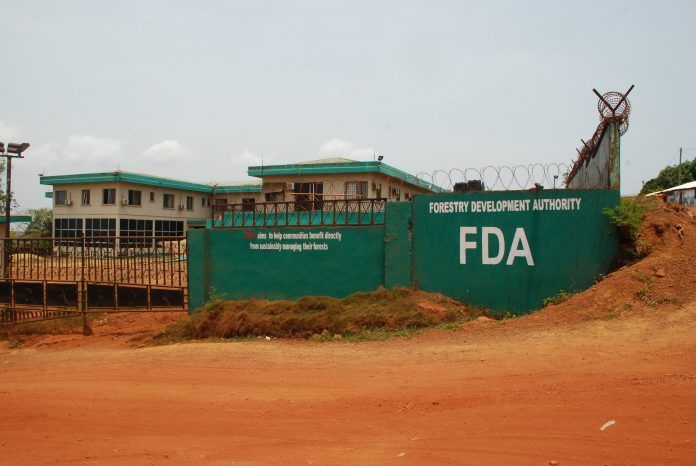
Top: The headquarters of the Forestry Development Authority in Whein Town, Paynesville. The DayLight/James Harding Giahyue
By Esau J. Farr
MONROVIA – A logging company cut numerous trees outside its authorized area in a Nimba community forest, according to an unpublished, official report, seen by the newspaper.
The June report found that Westwood Corporation harvested an unspecified number of logs outside the Gba Community Forest in the Sanniquillie-Mahn District. Forestry Development Authority (FDA) investigators found that Westwood worked 4 kilometers outside the 450-acre forestland, confirming a DayLight investigation. The newspaper had utilized satellite imagery to establish the illicit activities following an initial probe that raised plenty of legal questions.
“All the harvested logs were felled elsewhere without any traceability,” the report read. Samuel Cooper, Westwood’s manager, did not respond to questions for comment on the report.
The FDA initiated the investigation after receiving a tip from SGS, an independent verifier, which was concerned about the quantity of logs coming from the plot. Investigators found Westwood harvested in Gba’s conservation area, a regional biodiversity hotspot. Gba is adjacent to the East Nimba Nature Reserve, part of the Nimba Reserve, a UNESCO World Heritage Site.
“Their felling was scattered,” the report said, “under the pretense of constructing an alternative road.”
It was unclear how many logs Westwood harvested. However, the report put the total logs in one location as 1,135 (5,694 cubic meters), valued US$127,729. Westwood exported 216 logs (921 cubic meters) in March to Italy when the scam had not been discovered.
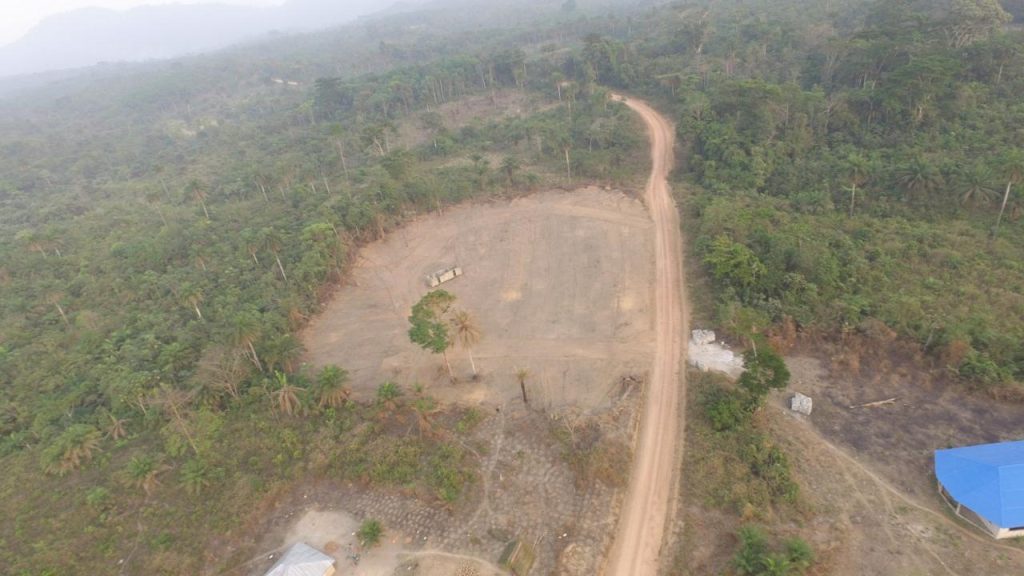
A drone shot of Westwood Corporation’s illegal logging activities in the Gba Community Forest in Nimba County. The DayLight/Derick Snyder
The report urged the FDA to halt Westwood’s operations and punish the company for “economic sabotage.” Westwood had signed an agreement with Gba to clear-cut the 450 acres for an ArcelorMittal Liberia waste plant.
Westwood faces a fine of three times the value of the logs it harvested, and logs it has already exported in line with the Regulation on Confiscated Logs, Timber, and Timber Products. The penalties also include a six-month imprisonment, or a fine and a prison term.
The report urged the FDA to confiscate and auction Westwood’s unsold logs as the regulation requires.
Additionally, FDA investigators found that Gba’s leadership was “complicit” in the underhanded operations. “During the investigation, it was discovered that the [leadership] had full knowledge of Westwood’s illegal actions,” the report added.
Nyan Flomo, a Gba leader who is familiar with the operations, said he was still reviewing the report. The DayLight caught up with Augustine Suah, Gba’s leader, at an event in Congo Town, but he declined an interview.
The report said Aaron Nyenebo, a ranger assigned to that region, and an unnamed FDA staffer, “condoned” Westwood’s illegal activities. Investigators are calling for a further probe and a possible dismissal due to the scale of the illicit harvesting. The report quoted Nyenebo, the accused ranger, as alleging that the FDA management in Monrovia was aware that the harvesting was outside of the legal location.
Efforts to contact Nyenebo for his side of the story did not materialize, as he did not answer phone calls. The DayLight will update this story once it contacts him.
Investigators also urged the FDA to take administrative actions against Gba’s leadership over its role.
Though submitted on June 20, the FDA has yet to publish, mention, or act on the report. Managing Director Rudolph Merab did not respond to email queries regarding what is perhaps the biggest forestry crime committed during his administration.
This is a Community of Forest and Environmental Journalists of Liberia production.
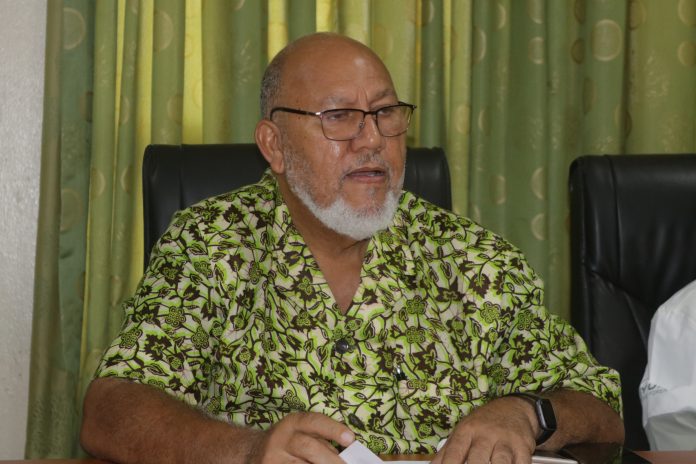
Top: The Managing Director of the Forestry Development Authority, Rudolph Merab. The DayLight/Harry Browne
By Varney Kamara and Esau Farr
SEEKON-PELLOKON – The Managing Director of the Forestry Development Authority (FDA), Rudolph Merab, is allegedly pushing a community forest to sign a logging contract with a dormant company owned by his friend.
Leaders of the Seekon Pellokon Community Forest in Sinoe’s Seekon District said the FDA was on their backs to enter a contract with the Liberia Hardwood Corporation. The company is now scouting the 44,989-hectare forest, with the parties reportedly close to a deal.
“When they finish looking in the bush, we will all come back to the table to discuss the contract,” Junior Kumah, a Seekon Pellokon leader, told The DayLight.
“Our interest is to take our people from years of poverty. They need development, roads, schools, and clinics.”
Earlier this year, the FDA disapproved a deal between Seekon Pellokon and Universe Forest Group, a new logging company, because it lacked the capacity to operate two contracts simultaneously. Universe Forest has a contract with the Tarsue Community Forest in the Sanquin District.
Instead, locals said, the FDA welcomed a deal with the Liberia Hardwood Corporation, co-owned and run by Jihad Akkari. He holds 15 percent of the company’s share, while Khalil Zein Baalbaki and Giuliano Dassi hold 42.5 percent shares apiece.
Akkari’s relationship with Merab dates back to the 1990s, when both men operated logging companies. Akkari served as the vice president when Merab was president of the Liberia Timber Association (LibTA) for nearly 20 years. Multiple sources said their friendship was playing out for Akkari in Seekon Pellokon.
“FDA is the one that is negotiating,” said Kumah in a phone interview. “The FDA has all those documents in its possession.”
Stanley Kreejarly, a member of Seekon Pellekon’s leadership, corroborated the claim, adding another layer.
“FDA said it would not do business with us unless the community signed a contract with Liberian Hardwood,” said Kreejarly. Like Kumah, he presented no evidence.
“FDA recommended that we should do business with the Liberian Hardwood, and we agreed because it is the one overseeing the sector.”
Tarpeh Wluh-Sam, Seekon Pellokon’s leader, would not speak on the matter but said they needed development.
Judu Town, one of the landowning communities of Seekon Pellokon Community Forest. The DayLight/Esau J. Farr
The claim that Merab is negotiating or pressuring locals for Liberian Hardwood is grave. Per the Community Rights Law…, the FDA does not negotiate contracts. Rather, it approves them. Negotiating for a company would violate the Code of Conduct for Public Officials, which prohibits the violation of any law and using official positions for personal benefit.
Merab did not respond to queries for comments on the allegation, but Akkari did, defending his company and the FDA’s boss. He denied that Merab favored Liberian Hardwood and that the people who made the claim were likely unaware of the matter.
“[Liberian Hardwood] reiterates that Hon. Merab never made any such intervention on its behalf vis-a-vis the people of Seekon-Pellokon for the management of their community forest(s),” said Akkari.
“[Liberian Hardwood] does not entertain any sliver of thought that Honorable Merab… would engage in flouting the law… and stoop to meddling in the award of Community [forest contract].”
‘Not a rocket scientist’
The FDA might have disapproved of Universe Forest Group. However, Liberian Hardwood may not have the capacity to handle Seekon Pellokon either.
Liberian Hardwood’s previous contract in the Bloquia and Neezonnie Community Forests ended disastrously. It left the Grand Gedeh communities with debts, broken promises, and hundreds of logs that are now rotting.
In 2016, the FDA halted Liberian Hardwood’s operations until it could export timber it had abandoned in the forest. Three years later, the company’s account was disabled in LiberTrace, the timber-tracking computer system.
Samuel Kreejarlay, a Seekon Pelloken leader, speaks in an interview. The DayLight/Esau Farr
Sampson Zammie, the secretary general of the community forests union, said he warned Wluh-Sam against contracting Liberian Hardwood. “I told him that he should not do it and if he does it, he will be doing it at his own risk,” said Zammie. Tarpeh confirmed having that conversation with Zammie, who is also Bloquia’s leader, promising to review Liberian Hardwood’s records.
Junior Kumah, another Seekon Pellokon leader, dismisses Zimmie’s warning. Kumah said that Seekon Pellokon had put in place a mechanism to avoid the Bloquia-Neezonnie experience. They would sign a five-year contract, the company would pay after production, and they would terminate the contract if Liberian Hardwood breached it, common safeguards in community forestry.
“I am not a rocket scientist to know whether Hardwood will fail or not. All I am telling you is that what happened in Bloquia will not be repeated here. What happened to John doesn’t mean the same thing will happen to Paul,” Kumah said.
Akkari denies any wrongdoing in Grand Gedeh, claiming he lost US$4 million there. He referenced a 2021 Supreme Court ruling that cleared Liberian Hardwood of US$90,325.15 in damages to Bloquia and US$123,332 to Neezonnie in a contract-termination lawsuit.
In the ruling, the Supreme Court said that a Grand Gedeh judge had “improperly” executed its initial verdict. “This was a petition for cancellation, which proceedings do not give awards, as is done in an action of damages,” read the ruling.
But the high court ordered that local people were free to sue Liberian Hardwood for damages, which they would never do. The ruling concluded by ordering the 7th Judicial Circuit Court to allow Liberian Hardwood to remove its equipment from the forest. The case was filed by A&M Enterprise Inc., which had subcontracted Liberian Hardwood for its contract with Bloquia and Nezonnie.
Logging amid controversies
There are other capacity concerns, as Liberian Hardwood is not the only company Akkari manages. The Lebanese is also the manager of Euro Liberia Logging Company.
Euro Logging operates the second-largest forestry concession in Liberia, covering Grand Gedeh and River Gee Counties, 254,670 hectares. Combined with Seekon Pellokon’s 44,989 hectares, that would be nearly 300,000 hectares, and one of the largest managed by a single individual in Liberia’s postwar forestry.
Obtaining community forest contracts has proved counterproductive in several cases for managers of large logging concessions. One example is Cesare Colombo, then manager of International Consultant Capital, which holds 266,910 hectares across Grand Gedeh, River Cess and Nimba and is the largest forestry concession in Liberia. Colombo acquired two community forestry contracts with Marblee & Karblee, and Gbarsaw & Dorbor in Grand Bassa and River Cess, but failed.
A screenshot that shows Liberian Hardwood Corporation’s account is one of 12 disabled in the FDA’s log-tracking system, or LiberTrace
Campaigners said loggers were exploiting rural communities.
“My understanding is that some of these companies are taking advantage of the limited capacity of community members who are awarding these concessions to them,” said Andrew Zelemen, a campaigner for Euro Logging-affected and other communities, in 2022.
“Something is wrong somewhere…, and these companies need to tell us what they are doing with the Liberian people’s forests,” added Zelemen.
Akkari said he was unaware of the failure of individuals who run large concessions and community forests. Yet, he did not doubt handling the second-largest concession and Seekon Pellokon at once.
“[Liberian Hardwood] can affirmatively state that it has the capacity to operate such forest area(s),” Akkari said.
“In any case, however, the FDA does not give its [approval] to any arrangement unless it is satisfied that the prospective operator has the capacity…,” he added, though the evidence disproves this claim. The FDA has awarded several individuals multiple contracts, including four to a Singaporean family, after they failed their previous contract.
That aside, a review of the forestry sector last year found that it was unclear whether Euro Logging’s US$250,000 performance bond was sufficient. However, the review identified it as the company with, perhaps, the fewest issues in forestry.
Also, Akkari is disqualified from engaging in logging activities in Liberia, according to the Regulation on Bidder Qualifications. The regulation bars individuals who were involved in the logging industry before January 2006. They can only participate unless they confess their wartime wrongdoings to the Truth and Reconciliation Commission and repay embezzled or unpaid funds.
There is no record that Akkari, who ran the Akkari Timber Inc. during the Second Liberian Civil War (1999-2003), whose contract was cancelled for noncompliance, met those requirements. He did not respond to queries regarding his wartime activities and Euro Logging’s capacity.
[Additional reporting from Oniel Philips from the Temple of Justice in Monrovia]
This story was a Community of Forest and Environmental Journalists (CoFEJ) production.
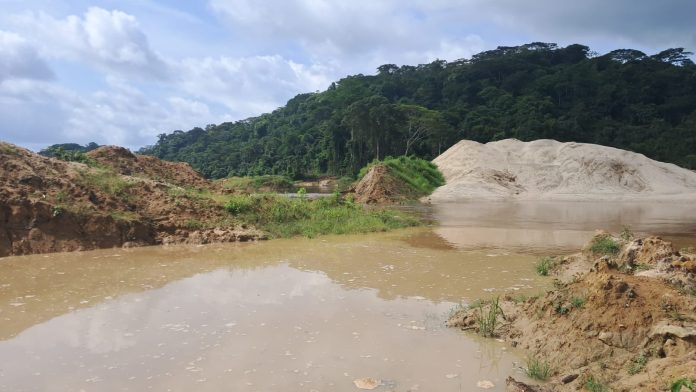
Top: A portion of one of two mines that Gee Mining Resources Group Limited operates in Tartuken, River Gee County, that is outside its authorized claim. The DayLight/Prince Copeland
By Prince Copeland, for The DayLight
One company, RAC Incorporated, has an MoU with a River Gee community, while another, Gee Mining Resources Ltd, conducts the operations
Satellite imagery shows that the operations are outside Gee Mining’s two claims in the Nyeniwroken District, a violation of the Minerals and Mining Law
RAC’s business registration certificate expired on Independence Day last year. However, it was issued an exploration license. Randy Scott, RAC’s majority shareholder, is one of Liberia’s most notorious miners
The evidence suggests that Nelson Worjolo, Gee Mining’s owner, is fronting for a non-Liberian
Townspeople benefit from dredging activities on the Gee River next to Gee Mining’s claims, and right under a local Ministry of Mines agent’s nose
TARTUKEN, River Gee County – Towering trees background huge sand mounds, water-filled pits, earthmovers, plastic barrels and a fuel tank. Mineworkers operate machines, digging through the brown earth. Pipes transport water from a nearby river to large, makeshift plants, where gold nuggets are trapped in inclined carpets.
This goldfield in Tartuken, Nyeniwroken District, looks like one of River Gee’s 48 active regulated mines. However, official documents, satellite imagery, a Ministry of Mines repository, and interviews proved otherwise. Turns out, the mine is illegal and is linked to one of Liberia’s most notorious miners.
Our story starts on July 10 last year, when RAC Incorporated, owned by a man named Randy Scott, signed an MoU with Tartuken’s chiefs and elders. In the document, RAC promised to build a guesthouse, a clinic and pay the community US$500 each month, among other things.
The company is delivering on its promises. This reporter documented three hand pumps, the five-bedroom guesthouse, while the elders confirmed that RAC paid monthly fees, including US$100 each for six teachers.
But the reporter noted a red flag when he interviewed townspeople. RAC had signed the MoU on behalf of Gee Mining Resources Group, a five-month-old company with no prior mining experience. Nelson Worjolo, Gee Mining’s owner, signed the document for Scott.
Confronted with the finding, Scott confirmed the information in a phone interview with the reporter. He disclosed that Gee Mining conducted the actual mining, while RAC handled community projects.
An excavator at work at a Gee Mining mine in Tartuken, River Gee County. The DayLight/Prince Copeland
“Yes, Gee Mining and RAC are in partnership. They are the same,” Scott, who holds 95 percent of RAC’s shares, phoned this reporter.
Worjolo also confirmed the inconsistency. He said RAC had intended to conduct the operation but it had a “small issue,” so Scott contacted him. He had spoken with the community about correcting the MoU but suspicious locals refused. He would rectify the issue in the coming weeks.
Elijah Toe, an elder who signed the MoU, denies Worjolo’s story. “No, they never came back to tell the townspeople that they were changing the company’s name from RAC to Gee Mining,” said Toe.
Myers Moyan, a Tartuken elder, corroborated Toe’s comments. “They didn’t tell us the elders the difference [between the two companies],” Moyan said.
‘Hold the ground’
Seeking the truth, the reporter turned to RAC and Gee Mining’s documents and the Ministry of Mines and Energy repository.
The search proved Gee Mining had two medium-scale or class ‘B’ gold licenses in the Tartuken area, and RAC Incorporated’s only license is in Zorzor, Lofa County. So, RAC truly signed the MoU but Gee Mining conducted the operation, a red flag.
But the repository shows that the Tartuken MoU was signed at least six months before the licenses were issued, and three months before Gee Mining prospected the area.
Worjolo said they signed the MoU that early because it was part of the requirements for the licenses. Asked why he signed the MoU before prospecting, he said they were sure the area had gold, which is not a requirement but is not illegal. “We did that to hold the ground first before prospecting,” Worjolo said.
A portion of Gee Mining’s illegal gold mine in Tartuken, River Gee County. The DayLight/Prince Copeland
Next, the reporter reviewed RAC and Gee Mining’s business registration certificate. Interestingly, RAC’s business registration certificate had expired on Independence Day last year and has not been renewed as of August 5. This means that RAC was ineligible for the gold-exploration license it was awarded in January for Lofa County.
Gee Mining’s business registration certificate and article of incorporation identify it as a Liberian company. However, the ministry’s repository recognizes it as a “Liberian and foreign-owned.” This appears to explain why Worjolo said he needed to talk to his boss in Monrovia before talking to us. The evidence suggests he is fronting for a mysterious non-Liberian.
Worjolo did not respond to queries for comments about his company’s ownership.
Outside the claims
Now suspicious of everything, the reporter decided to focus on the mine’s location. Was the digging inside or outside Gee Mining’s claims? Is the claim this close to the river?
To answer those questions, the reporter turned once more to the Ministry of Mines’ repository. There, the ministry stores maps of all medium and large mining claims. Those maps come with the shapes of the claims and coordinates, imaginary vertical and horizontal lines called longitudes and latitudes.
Armed with that information, the reporter took the photographs fitted with Gee Mining’s goldfield coordinates and presented them to a DayLight geolocation expert.
The expert uploaded the data into a certain software. Utilizing data from the Liberia Institute for Statistics and Geoinformation Services (LISGIS), the expert found the location. Then he drew up a map with Google Earth, a computer program that uses satellite imagery.
The map established that the mine the reporter photographed was at least 1,000 meters away from Gee Mining’s claims. Even a second mine the reporter snapped was just outside the company’s other claim.
This Google Earth map shows that Gee Mining operates outside its legal claims in Tartuken, River Gee County. Kenkpen Cassell Group of Companies for The DayLight
Confronted with this evidence, Worjolo said it was “not to my knowledge” that his operations were outside the authorized locations.
Scott, on the other hand, suggested that Gee Mining had a small-scale license for the operations in question. However, the repository shows that neither RAC nor Gee Mining has a small-scale or class ‘C’ mining license. Even if it did, earthmovers are outlawed in small-scale claims with soft or sandy grounds as Tartuken.
Mining outside one’s claim is a criminal offense, according to the Minerals and Mining Law. Violators face a US$2,000 fine, up to 24 months in prison, or both fine and term upon conviction by a court. The penalties could be harsher if prosecutors increased the charges.
Dredges on the river
RAC/Gee Mining’s illegal mines lie next to the Gee River, after which the county got its name in 2000. Gee or Chee means “leopard” in the Grebo language, but there was no sighting of the critically endangered big cat. Instead, four dredges, rafts made of plastic barrels with machines used to suck sediments from water, decorated the muddy river.
This alerted the reporter, who was aware that dredging had been banned since 2019 due to its associated environmental harms. From that moment, the reporter’s attention switched from land to water, and the mystery began to unravel instantly.
The miners operating the dredges said that they paid Tartuken’s locals a weekly fee they would not say. Chiefs and elders corroborated their claim. “It is true they were asked to pay L$15,000 per canoe (dredge) but they accepted to pay L$10,000 per canoe. We have only received L$30,000, which is equivalent to three canoes,” said Paul Kity, an elder spokesman.
Miners conduct a slew of dredges on the Gee River in Tartuken, River Gee County. The DayLight/Prince Copeland
The dredge operators said they paid the RAC/Gee Mining an undisclosed amount weekly. They also paid one gram of gold or L$20,000 (US$100) monthly to Tanneh Borteh, the ministry’s agent for that region.
“If we are not paying anything, I will tell you, but we are paying dues to the mining agent, the town people, and the claim agent too,” said Habib Zigi, a Ghanaian miner who operates two dredges.
Worjolo, RAC/Gee Mining’s owner, denies Zigi’s claim. He said he had driven the dredgers from the area on multiple occasions, but they always returned.
Similarly, Borteh, the ministry’s agent, who also denies any wrongdoing, said the same thing. “I went there and I told them to leave the water, ‘I don’t want you to lose your properties.’ Since then, I have not gone there,” Borteh said via mobile phone.
Notorious illegal miner
Based on Gee Mining’s legal documents and a desk review, Tartuken could be Worjolo’s first known illegal mining operation. However, it only adds to Scott’s brushes with the law.
In 2023, a DayLight investigation found that Urban and Rural Services, a company Scott has ties with, operated an illegal gold mine in Todee, with the aid of Montserrado County officials. It found that the company ran a full-scale mining operation with a prospecting license.
A relative of Prince Hali, a mineworker who drowned in a mining pit left by illegal mining activities in Bella Yalla, is helped from the scene after his body was recovered in January 2024. The DayLight/James Harding Giahyue
A follow-up investigation established that the license had expired and that the company had evaded taxes. Scott claimed that the license overstayed due to the coronavirus, though the pandemic had no such impact on the industry. Except for the involvement of two companies, Scott’s Todee illegal operations bear a striking resemblance to his Tartuken illicit activities.
A year after Todee, Scott was involved in a US$48.8 million lawsuit in Belle Yalla, Gbarpolu County. It was what Worjolo referenced in explaining why Gee Mining stepped in for RAC, though it signed the Tartuken MoU.
Perhaps the largest illegal mining scandal in Liberia’s history, Scott, Gao Feng, a Chinese nicknamed “the real minister,” and other people, allegedly encroached on another company’s mine. Scott was accused of defrauding the Liberian government of nearly US$12 million, according to a Ministry of Justice estimate.
Scott and the other suspects were accused of economic sabotage, tax evasion, criminal conspiracy and environmental degradation. In January last year, a man in his 20s drowned in a mine pit that mineworkers had abandoned in the community.
This story was a production of the Community of Forest and Environmental Journalists of Liberia (CoFEJ).
Top: A screengrab of a drone video showing a portion of a cocoa farm in Bargblor, Cavala District in Grand Gedeh County. The DayLight/Carlucci Cooper
By Carlucci Cooper
ZWEDRU – The Liberia Land Authority has charged two communities in Grand Gedeh County US$11,900 to cut their boundary, dragging a dispute over Burkinabe cocoa farmers.
Early last year, Bargblor and Tojallah in the Gbao and Cavalla Districts started a boundary dispute involving Burkinabé cocoa farmers. After a police probe and a court intervention, the matter was passed to the Land Authority for a settlement, which imposed the fee.
The majority of the money covers transportation, allowance and data collection, and administrative costs, according to an estimated budget obtained by The DayLight.
Townspeople in Bargblor said they paid US$500 against the charge, but presented no evidence. Those in Tojallah, on the other hand, said they had paid US$170 for “registration, transportation and mediation” to Daniel Togbasie, County Land Dispute Officer.
“They told us we had to pay a hundred US dollars each just for them to listen to us,” said Peter Carr, a Tojallah elder. “That’s just to hear the case, not even to get the survey done. And now, they want us to cough out nearly US$12,000 before they can even step on our land.”
The charge is inconsistent with the Land Rights Act, which puts the responsibility for boundary harmonization on the government. The law was passed in 2018, granting customary communities ownership of their ancestral territories, ending decades of marginalization. However, neither Tojallah nor Bargblor has established their boundaries, a crucial part of the law.
Campaigners, who have seen the document, said the Land Authority was pricing the communities out of their rights.
“Yes, it’s true the Land Authority charges fees to carry out customary land activities under the fees and regime, but it’s wrong to charge customary communities this much,” said Alphonso Henries, the coordinator for NGOs working on land reform in Liberia.
“The law is intended to build the economic strength of the people and not to deprive them. The Land Authority’s action was wrong and hasty. I think they went too far to exploit the situation,” added Henries.
The Liberia Land Authority has charged Tojallah and Bargblor US$11,900 to resolve their dispute.
Togbasi and Paye Freeman, Grand Gedeh’s Acting Land Administrator, who approved the charge, said they were not authorized to speak on the matter. Kweshie Tetteh, the Land Authority’s communication director, who has that authorization, justified the charge in a Monrovia interview.
“Tojallah and Bargblor are not just a case of customary land formalization,” said Tetteh. “This is a dispute referred from the court. In these instances, we don’t follow the customary process, so the payment responsibility falls on both parties.”
Tetteh added that Tojallah and Bargblor were not project communities and that the Land Authority did not have funding for formalization activities. “The fees could even be higher than this, depending on the size of land and workload,” Tetteh said. He added that the Land Authority, which has US$1,715,260 in the current National Budget, had no money for customary land processes, except for donations.
But the facts contradict Tetteh’s comments. The Land Rights Act Regulation does not mention fees for any activities, except for a “reasonable” amount that communities determine. In the last five years or so, the Land Authority has been drafting a fees regime, but has yet to complete the process. Even so, the breakdown of the US$11,900 is inconsistent with the draft fees regime seen by The DayLight.
The budget the Land Authority’s Grand Gedeh Office presented includes: US$6,300 for allowance for employees, US$2,000 for survey, US$1,200 for Monrovia-based personnel transportation and US$1,600 for administrative costs. This is a far cry from the US$50 and US$100 for most transactions in the draft fees regime.
“To ask communities to pay any money outside of the law can be interpreted as an attempt to deprive communities of their deeds,” said Daniel Wehyee, the lead land rights campaigner at the Sustainable Development Institute (SDI).
“If the Land Authority says communities need to pay money before intervening in boundary disputes, then it means the Land Authority is undoing, is undermining the implementation of the Land Rights Act.”
Furthermore, Tetteh’s suggestion that the court case erases the communities’ customary profile is misleading. Alternative dispute resolution (ADR) also applies to customary communities, meant to prevent or resolve land conflicts. It was the fear of these conflicts causing Liberia’s next civil conflict that led to the establishment of the Land Authority.
Stalled
The Tojallah-Bargblor dispute started when men of Tojallah abducted a group of Burkinabe farmers working for Bargblor on a farmland in a place called Karblee. Local people are hosting Burkinabes to plant cocoa in a cross-border joint venture. As of last month, the Liberia Immigration Service registered over 36,000 Burkinabes in Grand Gedeh alone.
Tojallah claims Burkinabés working for Bargblor crossed the Thwanee Creek, their boundary with Bargblor. On the other hand, Bargblor insists that the creek falls within their traditional territory and that the true boundary was Dulee, further into Tojallah.
After several failed mediation attempts, Bargblor filed a complaint with the police, which jailed a host of Tojallah townsmen. Later, the matter was forwarded to the Zwedru Magisterial Court, which then transferred the matter to the Land Authority for settlement.
An elevated view of the Thwanee Creek, which Tojallah argues is the boundary with Bargblor. Their neighbors, however, disagree, sparking a yearlong dispute. The DayLight/Carlucci Cooper
“Most of the cases we receive are customary land cases, so we forward them to the Land Authority with an arbitration team, who will establish who the rightful owner of the land is. And we’ve been able to achieve this with the help of the community leaders,” said T. Shad Dweh, Senior Associate Magistrate.
The Land Authority’s excessive request has dragged the dispute, with tensions flaring in the area. People from both sides of the conflict accuse the other of spoiling their crops and people fear walking alone in an area known for intermarriages.
Paul Rancy in Zwedru, Grand Gedeh County, contributed to this report.
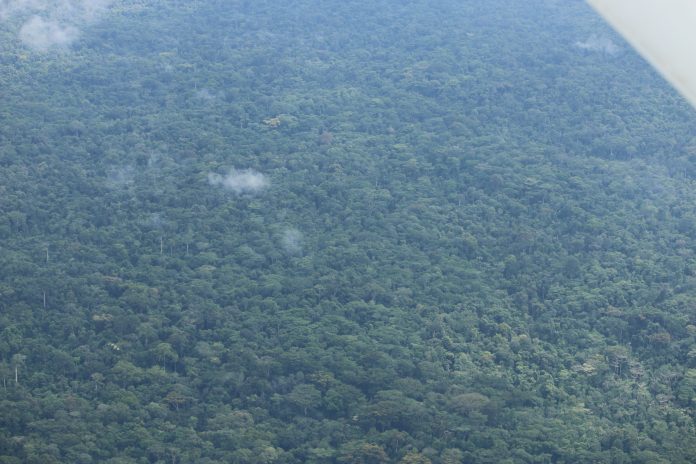
Sapo National Park (SNP) is one of Liberia’s greatest natural treasures. Globally, it is recognized as both an Important Bird Area and a Key Biodiversity Area, underscoring its irreplaceable value for avian conservation and biodiversity. Regionally, SNP contains the second-largest area of intact tropical rainforest in West Africa, after Cote d’Ivoire’s Tai National Park, and stands as Liberia’s first and largest protected area.
The park provides critical habitat for the pygmy hippopotamus–found only in the Mano River Union countries–with Liberia hosting the largest population. It also shelters the largest population of western chimpanzees in Liberia, making the country second only to Guinea in West Africa for this endangered species. Moreover, SNP holds Liberia’s most significant population of African forest elephants, a species now severely threatened across the region.
Concerns with the De-Gazettement Proposal
Hon. Thomas Romeo Quioh’s proposal to partially or fully de-gazette Sapo National Park (SNP) raises serious concerns. While socio-economic development and community welfare are essential, any alteration of SNP’s legal status must be consistent with Liberia’s constitutional mandate, national legislation, and international commitments to environmental protection and sustainable development. De-gazettement would violate these obligations, undermine conservation gains, and risk irreversible ecological damage.
This initial response highlights key legal frameworks that support the preservation of SNP, emphasizing the importance of upholding Liberia’s environmental obligations and the long-term ecological and socio-economic consequences of de-gazettement. A subsequent response – scheduled for release in the coming days – will examine the economic benefits Liberia can gain (monetary and non-monetary benefits) from ecotourism, carbon sequestration, and other sustainable practices associated with the park and other protected areas in the country.
1. International Legal Frameworks Upholding Conservation of Sapo National Park
Convention on Biological Diversity (CBD, 1992): Liberia has committed to conserving biological diversity (Articles 6 and 8) and to meet the 30X30 target under the 2022 Kunming-Montreal Global Biodiversity Framework, which requires protecting at least 30% of the world’s land and sea areas to be under effective protection and sustainable management by 2030. De-gazettement would directly undermine this goal.
Ramsar Convention on Wetlands (1971) and UNESCO’s Man and Biosphere Programme: SNP’s wetlands provide vital ecosystem services such as water regulation, carbon storage, and climate resilience. Downsizing or de-gazetting the park would diminish these services and harm local livelihoods.
UN Framework Convention on Climate Change (UNFCCC) & REDD+ Initiatives: Liberia commits to forest protection to mitigate climate change through reducing deforestation. De-gazettement of SNP would lead to deforestation, forest degradation, carbon emissions, and loss of international climate financing opportunities
2. National Legal Protection and Policy Frameworks
Constitution of Liberia (Article 7): Mandates sustainable use and conservation of natural resources for present and future generations.
Liberia Forestry Reform Law (2006): Mandates the protection of forest reserves and national parks for sustainable development and environmental preservation. It provides mechanisms for review but strongly emphasizes conservation and does not facilitate facile removal of protected status without stringent assessments and multi-stakeholder consultation.
Environmental Protection Agency (EPA) Act of 2003: Demands comprehensive Environmental and Social Impact Assessments (ESIA) before any action that could harm protected ecosystems. No such ESIA has been conducted for SNP’s de-gazettement
Land Rights Act (2018): While affirming customary land ownership, this law requires coordination with environmental protection efforts. The presence of communities within the park’s boundaries necessitates integrated land-use planning without compromising ecological integrity, not wholesale de-gazettement.
National Biodiversity Strategy and Action Plan (NBSAP 2017): Commits Liberia to expanding, not reducing, its network of protected areas.
3. Conservation and Sustainable Development Interdependence
Sustainable Development Goals (SDGs): Particularly SDG 15 (Life on Land): Obligates countries to sustainably manage forests and halt biodiversity loss. De-gazettement of SNP would contravene this goal and risk isolating Liberia from international development partnerships.
Long-Term Socio-Economic Impacts: While some short-term economic gains may arise from legalizing mining and logging, these are outweighed by biodiversity loss, disruption of ecosystem services (such as water regulation and soil conservation), and increasing vulnerability of local communities to environmental degradation.
4. Addressing Enforcement and Governance Challenges without De-Gazettement
The proposal rightly identifies enforcement and governance as challenges, yet de-gazettement is not the sole or best solution. Alternatives supported by conservation laws include:
Strengthening the institutional capacity of the Forestry Development Authority, EPA, and law enforcement with adequate financing, training, and community empowerment.
Enhancing community-based natural resource management, offering genuine benefit-sharing schemes under existing legal frameworks to incentivize conservation.
Creating the enabling environment and infrastructure for sustainable ecotourism as part of diversified local economies, consistent with national forest and wildlife policies.
5. Risks of Creating a Precedent for Protected Area Downgrading
Partial or full de-gazettement would set a dangerous precedent, inviting similar moves across other protected areas and emboldening illegal encroachment, contrary to the global principle of “no net loss” of biodiversity or natural ecosystems.
6. Conclusion
Sapo National Park is not only a symbol of Liberia’s heritage but also a cornerstone of its environmental obligations and sustainable development ambitions. De-gazettement would cause lasting ecological, social, and economic harm, eroding Liberia’s credibility in global environmental governance. The responsible path forward is to improve governance, strengthen enforcement, empower communities, and pursue sustainable economic models that keep SNP intact for future generations.
Author: Saah A. David, Jr. – Development Practitioner, REDD+ and Climate Change Specialist. Former Natural Resource Management Specialist – USAID-Liberia, former National REDD+ Coordinator Liberia. Co-authored two books – Sustainable Forest Management (SFM in Liberia – The 4 Cs Approach and Sustainable Forest Management in Liberia (SFM) – Practices and Approaches
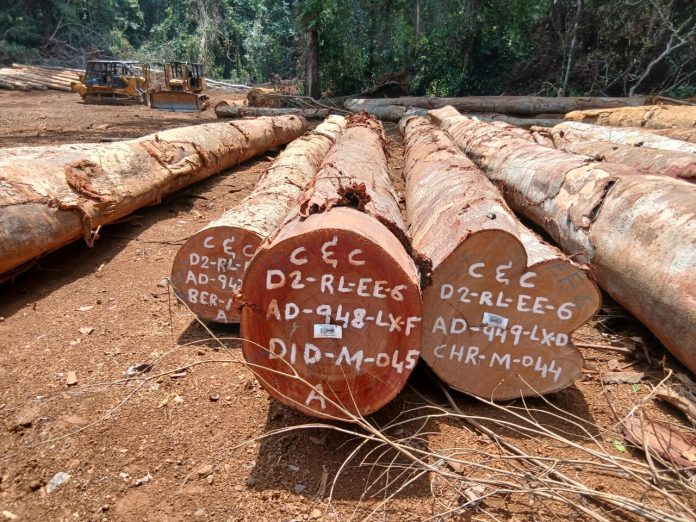
Top: Logs felled on 3,200 acres in the Mavasagueh Community Forest claimed by Khalil Haider. Mr. Haider has filed a US$5 million lawsuit against the Forestry Development Authority and C&C Corporation. The DayLight/Emmanuel Sherman
By Emmanuel Sherman
MONROVIA – A man has filed a lawsuit against the Forestry Development Authority (FDA) and a logging company for at least US$5 million over alleged damages to his private property in Grand Bassa’s District Number Two.
Khalil Haider accuses the FDA of authorizing C&C Corporation of harvesting trees on 3,200 acres of forestland in the Vambo Township, according to court filings.
“The FDA took my client’s property, and awarded it to a company, and the company has been [harvesting] logs on the property without the consent and acceptance of my client,” said Cllr. Vaani-Faate Kiawu, Haider’s lawyer.
The FDA and C&C Corporation did not respond to queries for comments.
Alleged forgery
Last year, the FDA authorized Mavasagueh as a community forest, covering 26,003 hectares. Then the new community forest signed a contract with C&C Corporation, co-owned and managed by Clearance Massaquoi, a logger active during the Second Liberian Civil War.
Shortly after, Haider wrote to the FDA, claiming the land in the company’s harvest blocks for this year. Haider, a resident of Paynesville, is the administrator of the interstate estate of his late mother, Rosa E. Dillion of Montserrado, court filings show.
Later, Haider asked C&C Corporation to settle with him or halt the harvesting. Instead, the FDA acted on a letter that the lawsuit alleges was forged, misspelling Haider as “Hajder,” ignoring the plaintiff’s notice.
The lawsuit alleges that Rudolph Merab, Haider’s “cousin,” appeared to be “exploiting the relationship to deprive [Haider] of his property rights by granting permission to C&C Corporation.
“The C&C has been cutting logs for over four months without the consent of [Haider] despite every effort to resolve the issue amicably,” it added.
The suit cited a decade-old survey, which found 21 species and 778 trees in every 100 acres of the land, valued at US$672 million, using approved prices.
The lawsuit referenced a provision of the National Forestry Reform Law, which recognizes that the state does not own forests on private plots.
“Although the FDA is a government agency responsible for… the regulation of forest resources…, it has illegally granted C&C Corporation to cull logs from the private property of the plaintiff.”
This story was a Community of Forest and Environmental Journalists (CoFEJ) production.
Top: The Land Authority headquarters in Monrovia. The DayLight/Carlucci Cooper
By Varney Kamara
MONROVIA – Mayors across the Country Thursday refused to sign a land governance agreement with the Liberia Land Authority, citing a lack of prior information.
The Mou aims to enhance land governance through collaboration among the Land Authority, the Mayor’s Council, and Township Commissioners. It solicits the officials’ collaboration in identifying public and government lands.
“We did not expect to come here today to sign the MoU. We cannot sign a document whose contents we have not seen or reviewed,” Gallah Varpilah, chairman of the Mayor Council of Liberia, said at a news conference at the Land Authority’s headquarters in Monrovia.
“As it is now, we cannot sign because we do not know the full details of what is in it. We would love to have the document, review it, and then make a decision.”
Kweshie Tetteh, the Land Authority’s communication director, said it was “an oversight” not to share the document with the mayors.
The Land Authority displayed the document to the public but did not share copies with journalists, promising to upload it to its website.
Also at the news conference, the Land Authority unveiled new regulations on squatters’ rights and a new form for deeds.
The squatter’s regulation does not allow people to build concrete or permanent structures on public lands.
On the other hand, the form is fitted with security features that vary from one country to another. It is intended to enhance the customary deed process.
“By unveiling this form today, the LLA has taken a giant step further to reduce land conflict in this country,” said Samuel Kpakio, the Land Authority’s Chairman.
“Now that it has been unveiled, in the coming days or weeks, [the Land Authority] will embark on a massive public awareness campaign to educate our people on their rights and how they can legally acquire land,” Kpakio added.
Due to the regulations, the Land Authority lifted a February ban on public land sale. The moratorium aimed to address unregulated land sales and conflicts.
“After months of careful review and, [because] this Commission has already put into place new regulations and mechanisms to effectively address those issues, the moratorium on the sale of public land is hereby lifted,” Kpakio said.
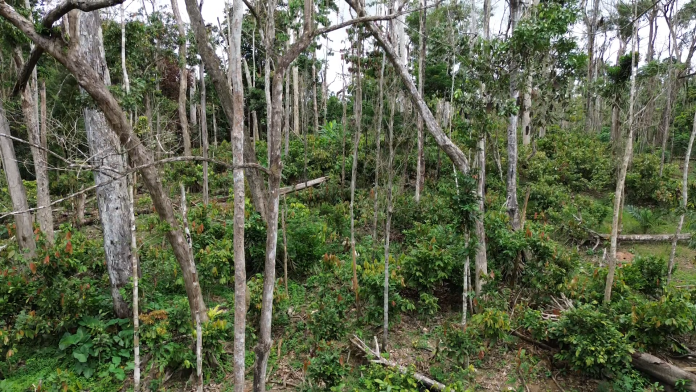
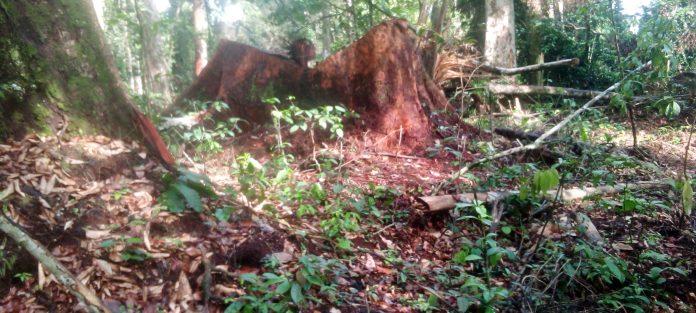
Top: The stump of a tree Westwood Corporation harvested outside a 450-acre authorized area in the Gba Community Forest, based on satellite imagery. The evidence also established that the firm even harvested outside the community forest. The DayLight/James Flomo
By Esau Farr and James Flomo
SEHYI-GEH – Earlier this year, Westwood Corporation, a firm with no known logging experience, harvested timber outside its authorized area in the Gba Community Forest in Nimba’s Yarmein and Sanniquillie-Mahn Districts, a DayLight investigation has found.
In 2016, ArcelorMittal Liberia signed an MoU with Gba, giving the community US$150,000 to clear 450 acres of rocky forestland to construct a mine waste plant. However, Gba misapplied the money and turned to loggers to do the job multiple times in eight years.
Those efforts failed until this January this year, when Gba signed the agreement with West Wood, known for roadworks. The agreement included logs that previous companies had abandoned in the 11,538-hectare forest.
Westwood soon began the felling, and exported 216 logs (921.124 cubic meters) in two March shipments, according to the FDA’s records. An initial DayLight investigation found that the exports were illegal in several ways. The logs had been harvested under an agreement that did not match a legal forestry contract. The logs were exported to Europe despite not being from a legal source, violating Liberia’s timber trade agreement with the European Union.
But this investigation established that things were a lot worse. Geolocations of tree stumps with Westwood tags show the company harvested outside the designated area, apparently targeting expensive, first-class timber. Reporters photographed a dirt road that the company paved inside the forest to access the logs.
Using official dataset and geolocation technology, The DayLight used coordinates fitted into pictures taken of stumps of trees Westwood harvested to draw a map, exposing the illegal harvest.
It was unclear how many logs were illegally harvested. However, DayLight estimated 250 first-class logs in the Makingo Town. Their species—ekki and niangon—matched those Westwood exported in March.
It is unclear how many logs were harvested outside a 450-acre designated area in the Gba Community Forest. Picture credit: Anonymous
Westwood’s activities were an open secret. Three DayLight visits found that people and the Gba leadership were aware of the illegal harvest.
“They went to Gbarpa, where they did not send them, felled logs and carried them,” said Paul Gahnto, Sehyi-Geh Town’s assistant youth chairman.
The illegal harvesting adds to Nimba’s deforestation. Between 2002 and 2024, Nimba recorded 393,000 hectares of tree cover loss, second only to Bong (434,000 hectares), according to Global Forest Watch, which tracks countries’ deforestation. A tree cover is any vegetation that is at least three meters high.
World Heritage Site
The illegal harvest is counterproductive to a region known internationally for conservation.
Gba and its neighbors—Blei, Sehyi Ko-doo and Zor—serve as a buffer with East Nimba Reserve, a part of the Nimba Reserve, a UNESCO World Heritage Site, running through Guinea and the Ivory Coast. The region is home to the Nimba flycatcher, the Nimba toad and other endangered and common species.
Based on the region’s importance, Gba and the other communities have an agreement with the Liberian government and ArcelorMittal to protect the forest there. As part of the agreement, the steel giant supports the communities’ conservation programs, including a monthly stipend for forest guards and tree planting.
Gba, in particular, has also received support for its conservation from other institutions. It had been established by a USAID project and continued to receive support from the United States Forest Service. Since 2023, Social Entrepreneurs for Development (SESDev) has worked with Gba’s leadership to strengthen its governance mechanism.
Westwood adds to the list of companies Gba has contracted to clear the controversial 450 acres. In 2016, LTTC Thanry signed a contract with Gba but did not deliver. Later in 2021, Six S International entered the picture, but, like LTTC Thanry, it failed.
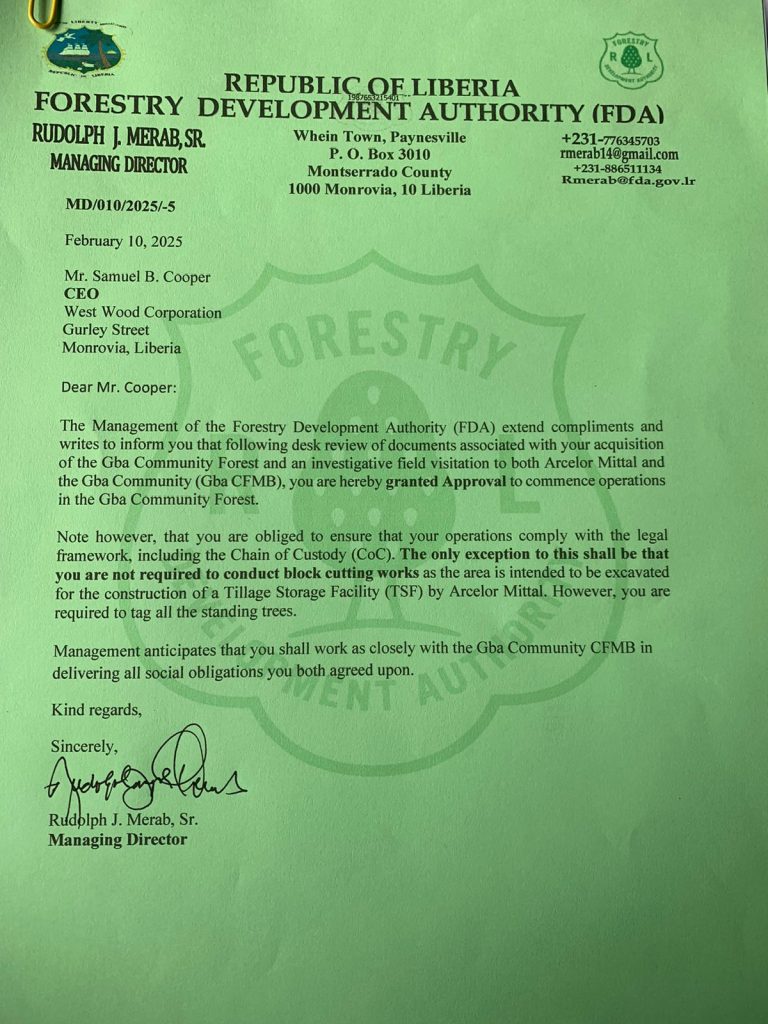
A map utilizing satellite imagery shows areas affected by the illegal harvest outside the Gba Community ForestRudolph Merab’s letter approving Westwood’s harvest in the Gba Community Forest, bypassing forestry regulations
Before those deals, Gba was among several community forests whose status the FDA’s board canceled in 2014 for errors. The agency had mistakenly combined Gba with Zor and had to be split into two community forests.
‘Hereby granted’
The Forestry Development Authority played a part in the illegal harvest. Managing Director Rudolph Merab ignored legal requirements and authorized West Wood.
In normal logging practices, the FDA counts and marks trees in a mapped area before harvest. Then, there are FDA fieldworkers who monitor the process and verify the legality of the log before export.
In Gba’s case, a warning letter replaced that rule, even though more crucial, given the nature of the harvest.
“You are obligated to ensure your operations comply with the legal framework,” wrote Merab. “You are required to tag all standing trees.
“You are hereby granted approval to commence operation in the Gba Community Forest.”
Interestingly, Merab lowered the bar Mike Doryen, his immediate predecessor, had set for Gba. Doryen, whose administration was characterized by forestry offenses, ensured that previous companies obeyed the rules.
Rules aside, the FDA did not verify West Wood’s legal documents before approving its operations in Gba. The company’s article of incorporation does not list its shareholders. The document has only two articles in the legal documents: I and III. This violates the Beneficial Ownership Regulation, which mandates businesses to name the people who own them.
Westwood’s illegal article of incorporation
That rule does not only apply when registering a business. It is also a forestry requirement. The Regulation on Bidder Qualifications requires a company’s owners or “significant individuals” to be scrutinized. It curtails conflicts of interest involving public officials and prevents forest resources from being placed into the hands of broke or dishonest individuals.
The FDA and Samuel Cooper, owner of Westwood, did not respond to requests for comments.
The Forestry Development Authority investigated the harvest following the initial DayLight publication, but has not released any report months on. Logging outside an authorized area is a crime, punishable by a fine, imprisonment and penalties.
Nyan Flomo, a Gba leader, fears locals will bear the brunt of West Wood’s actions. Flomo now runs Gba’s affairs due to the death of Samuel Johnson, Gba’s leadership head, in March.
“What we heard is that the FDA will investigate, declare the logs abandoned, auction [them] and give the community its benefits,” said Flomo, who initially supported Westwood and was critical of The DayLight investigation. “We are still looking up to the FDA to give us the [official] outcomes of the investigation they carried out.”
The story was produced by the Community of Forest and Environmental Journalists (CoFEJ).