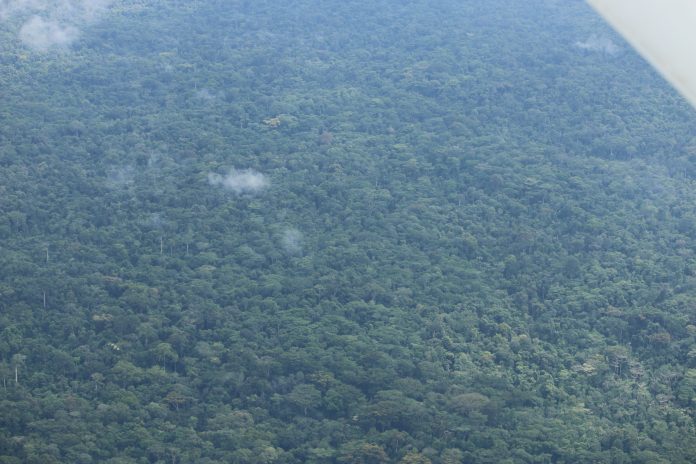
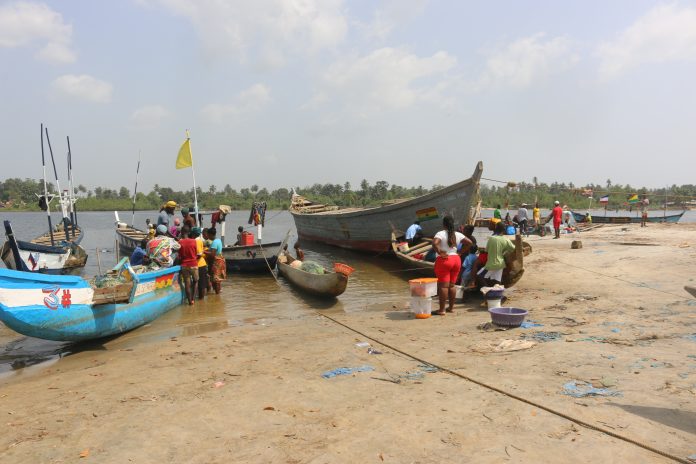
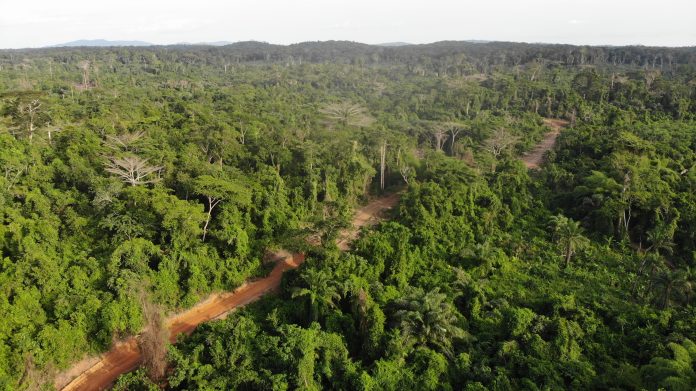
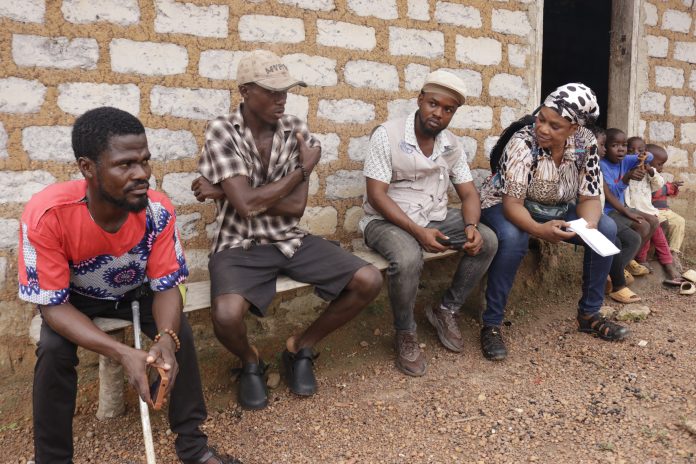
A bird’s-eye view of a forest in Sinoe County in 2018. Picture credit: James Harding Giahyue
ByEsau J. Farr
CONGO TOWN – A local NGO, Integrated Development and Learning (IDL), has launched a roadmap that proposes payment for communities that keep their forests.
The “Roadmap for Pursuing Alternative Options for Liberia’s Forest Benefits” is a partnership among IDL, the Forestry Development Authority (FDA) and communities. It offers to pay locals who do not farm, build houses, mine, and log in forests for commercial purposes. Organizers call it payment for stewardship.
“Today, there is emphasis on conservation because we realized that the misuse of forests [negatively] affects the lives of people,” said FDA Managing Director Rudolph Merab at the roadmap’s launch recently in Congo Town. “We are committed to managing forests sustainably so that the forest canopy will not be depleted.”
Leaders of Wedjah and the Jaedae Districts, Sinoe County, where the strategy is being tested, said they were committed to it. Last and earlier this month, the communities signed agreements for a two-year trial with 50,000 hectares in exchange for US$152,022. Customary communities own most of the forests in Liberia, which hosts 43 percent of West Africa’s largest rainforests.
Stakeholders in a group photo after the launch of the Roadmap for Pursuing Alternative Options for Liberia’s Forest Benefits. The DayLight/Esau J. Farr
“We want to encourage our people in our forest communities to ensure that we play our role well in managing our forests for us to get money and develop our communities,” said Lasting Kadee, a Wedjah community forest leader.
IDL intends to scale up to 202,342 hectares by 2027, setting the stage for international financing in line with the Paris Agreement. This will lead to forest communities being merged to meet the minimum standard for climate finance, according to IDL’s Executive Director, Silas Siakor.
“IDL wants the pilot communities to begin climate mitigation and anti-deforestation activities by properly managing their forest and get paid for keeping their forests standing,” said Siakor at the launch of the roadmap recently.
The Executive Director of the Environmental Protection Agency (EPA), Dr. Emmanuel Urey Yarkpawolo, urged the communities to obtain environmental permits to allow the EPA to help protect their forests. “From the EPA’s point of view, I think the whole idea is good,” Yarkpawolo said. “It seems that the process will be smooth.”
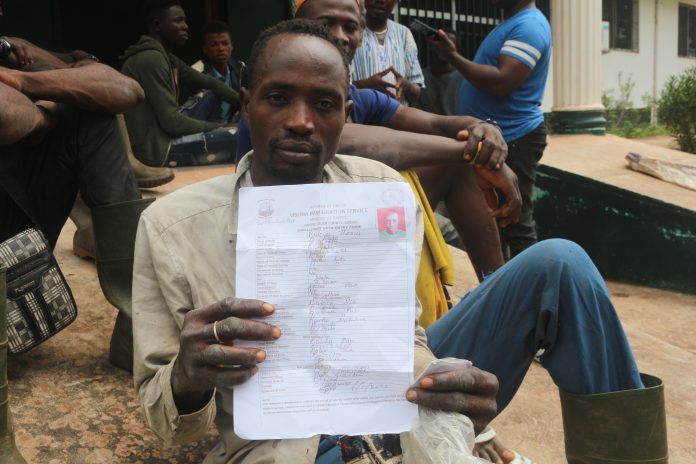
Top: A Burkinabé man displays his immigration document at the FDA regional office in Zwedru, Grand Gedeh County. The DayLight/James Harding Giahyue
By Varney Kamara
GBOLEKEN, Grand Gedeh – The Liberia Immigration Service (LIS) reported that it has recorded over 40,000 Burkinabé cocoa farmers to monitor and legalize their status.
“It is intended to establish how many of them entered the country and where exactly they crossed,” Alex Kpakolo, Assistant Immigration Comptroller of Grand Gedeh County.
“We are taking stock of their movements and actions across the different towns, villages, districts, and communities where they are hosted. By doing this, we can easily trace them if there is a problem.”
Burkinabés began to enter Liberia from the Ivory Coast in the 2010s to plant cocoa. Last year, France 24 reported 25,000, capitalizing on Liberia’s weak monitoring, large rainforests, and higher cocoa prices. Ivory Coast has lost 90 percent of its forest to cocoa farming in the last six decades, according to that report. The same is happening in Liberia, which has lost 386,000 hectares of primary forests between 2002 and 2024, according to Global Forest Watch, which tracks annual deforestation.
Immigration records show over 1,000 Liberians host at least one Burkinabe farmer, known locally by their ethnic group, Mossi. They have settled mainly across Maryland, River Gee and Grand Gedeh.
In Grand Gedeh alone, the number of registered Burkinabes has exceeded 36,000. To ensure a smooth process, immigration authorities have established 18 registration sectors. “As a result of this process, most of the Burkinabes are now coming out of the bushes and registering. Their hosts, too, encourage them daily to come for the registration. That’s why you see we have this kind of high number,” Kpakolo said in an interview at his office in Gboleken, Gbarzon District.
A Burkinabé man sets a tree ablaze in a forest in Grand Gedeh County. Picture credit: Forestry Development Authority
After the registration, the Burkinabes would be vetted and issued resident permits, in line with the Alien and Nationality Law of Liberia. The law requires non-Liberians to obtain a permit to reside in Liberia. ECOWAS citizens pay US$100 for the permit, with a fine or deportation for violators.
“After registration, we will review their status and find out whether they are here only temporarily or if they want to stay and work here permanently. After this process, LIS will decide to start issuing resident permits,” Kpakolo said.
Rising tension
Labor authorities are watching the process. Robson Bah, Labour Commissioner of Grand Gedeh, said the ministry intended to formalize contracts between locals and their West African partners.
“We have noticed that people who don’t have titled deeds are cutting boundaries and giving out land to Burkinabés. And, as a result of this, you have confusion all over the place,” said Robson Bah, Labour Commissioner of Grand Gedeh.
“Today, everything appears to be going well between the Burkinabes and their Liberian hosts, but when money starts to come and things start to happen, they may not be peaceful.”
Across the southeastern region, cocoa farming is splitting families and communities, according to court records. The Zwedru City Magisterial Court has recorded at least 10 similar cases. Last week, 31 accused of illegally encroaching on concessions to plant cocoa were jailed at the Zwedru Correction Palace.
This was a Community of Forest and Environmental Journalists (CoFEJ) production.
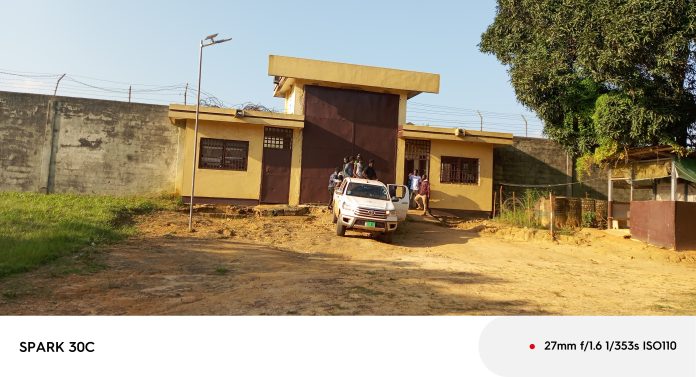
Top: An FDA vehicle transports Burkinabés suspected of criminal trespassing in a community forest and a logging concession to the Zwedru Correction Palace. The DayLight/Varney Kamara
By Varney Kamara
ZWEDRU – Thirty-one Burkinabé cocoa farmers were jailed for allegedly clearing forestry concessions in Grand Gedeh County to plant cocoa.
The men, with ages ranging from teenagers to the 50s, were rounded up by rangers of the Forestry Development Authority (FDA) during a routine patrol. They were recently arrested at two forestry contract areas.
“The Burkinabés are damaging these places with cocoa farming. We met them brushing in the park. We also caught some of them cutting demarcation in the FMCs,” Yei Neagor, FDA’s head for that region, told The DayLight at the Zwedru City Magisterial Court. Pictures shared by the FDA show the man setting up camps and setting trees ablaze.
“I can tell you that the situation is alarming. They are destroying the forest. It is on a massive scale,” added Neagor.
The suspects were arrested in the Gbarzon District at two locations. Fifteen were picked up at Marbo 1 Community Forest and 16 at a dormant concession known as Forest Management Contract Area K or FMC ‘K’.
They had been arraigned at the FDA’s regional office in Zwedru and later taken to the police station before being forwarded to court. They have been charged with criminal trespassing and criminal mischief, court documents show. They were jailed at the Zwedru Correction Palace after failing to post bail.
‘The land belongs to us’
In an interview with The DayLight, the suspects admitted to the charges but blamed their Liberian hosts for the situation.
“We fell into this problem because our host did not show us the actual demarcation of the boundary,” said Soré Sayouba, a spokesman for the Burkinabés.
Sayouba, 57, said he and the other men crossed the Ivorian border into Grand Gedeh through local people or hosts. Immigration records list Bamba Paye, a Gbarzon resident, as one of their hosts.
Paye denies any wrongdoing, saying his family farmed on the controversial land for decades. “I don’t understand why they arrested my Burkinabé workers because my parents planted cocoa and orange way back on this land. In our traditional setting, life crops represent inheritance,” Paye said via phone.
“The land belongs to us.”
The suspects have been freed on bond and are expected to reappear in court on Tuesday.
Cocoa court cases
The case adds to several lawsuits involving Burkinabés, the FDA and individuals in Grand Gedeh, regarding cocoa cultivation.
Burkinabés began flocking into Liberia in the 2010s, after a cross-border agreement between then-President Sirleaf and Ivoirian leader Alhassan Ouattara, according to immigration authorities.
Alleged Burkinabés forest invasion suspects head for the Zwedru Correction Palace. The DayLight/Varney Kamara
“From that time, we noticed that people started coming in. But they were not coming as agriculturists. Now, as we speak, they are all along the Cavalla belt,” said Alex Kpakolo, Grand Gedeh’s Assistant Comptroller of Immigration.
Last year, France 24 reported 25,000, capitalizing on Liberia’s weak law enforcement, large rainforests and high cocoa prices.
Ivory Coast, the world’s largest cocoa producer, has lost 90 percent of its forest to “brown gold” farming in the last six decades, the report said.
This trend continues in Liberia, which lost 386,000 hectares of primary forests between 2002 and 2024, according to Global Forest Watch.
This story was a production of the Community of Forest and Environmental Journalists of Liberia (CoFEJ).
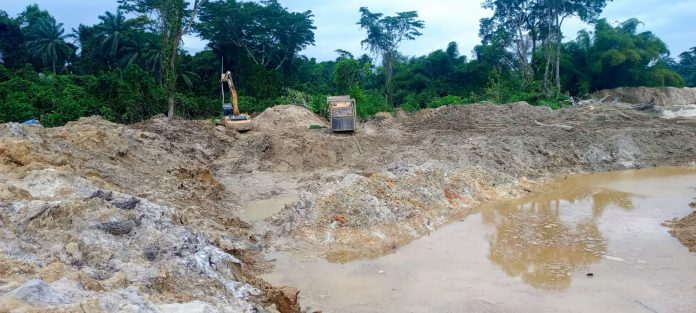
The illicit mine in Paboken, Jaedepo District, Sinoe County, where the Ministry of Mines made the seizure. Picture credit: Ministry of Mines and Energy
ByVarney Kamara
ZWEDRU, Grand Gedeh – The Ministry of Mines and Energy has seized machines at an illicit mine in Sinoe County, ordering its closure.
Over the weekend, the Ministry held an excavator and a mini washing plant at the mine in Paboken, Jaedepo District. The mine owner, identified as Mohamed Kamara (no relation to this reporter), fled the scene, said Awell Aloysius Carr, the Director of Mines at the ministry.
“Based on the scale of illicit mining activities we saw in this area, we immediately issued a closure and seizure order,” Carr, the told The DayLight in the Zwedru. “I saw massive footprints. I mean areas that were excavated, water courses were diverted, vegetation was destroyed.”
Carr said the ministry would take the matter, and had informed local chiefs and elders, urging them not to shield the alleged perpetrator. Mining without a license violates the Minerals and Mining Law, with a fine, a prison term, or both for violators.
The seizure forms part of a broader crackdown on illegal mining across the country, particularly artisanal and small-scale mines. However, it was the authorities’ first visit to Paboken.
Recently, the ministry appointed a mining agent to the area after recalling the previous one in a move to reform one of the government’s most important yet challenging sectors. The ministry has established County Mining Offices to counter illegal mining.
“I am not going to sugar-quote this,” Carr said.
“We want to say to people out there… that gone are the days you will come and destroy our forest, deplete our resources, and you think that you will go scot-free.”
People at a canoe landing on a Greenville beach in 2023.
Top: People at a canoe landing in Greenville, Sinoe County in 2023. One of the canoes, marked “The Lord is my Shepherd,” transports timber to Buchanan. There, the timber are uploaded to a larger canoe to Ghana. The DayLight/James Harding Giahyue
By Emmanuel Sherman
BIG FANTI TOWN, Grand Bassa – Planks are scattered at various sites on a beachfront, a stone’s throw away from the Port of Buchanan, a fishing hub and a transit point for fishermen and fishmongers. Some are old, others fresh.
The wood are leftover of timber smuggling that involves fishermen. Fisherpersons, canoeists, villagers and businesspeople in Sinoe, Grand Bassa and River Cess confirmed that fishermen used canoes to smuggle timber predominantly to Ghana. Smugglers, aided by villagers and artisanal loggers, paid Fanti fishermen to transport wood, including to other countries, a DayLight investigation found.
“All the canoes can bring the planks, they can carry them to Ghana,” said John Kwakue, a Ghanaian fisherman who lives in the Buchanan fishing community of Fanti Town.
“I saw it for the first time in 2014 and I did a little bit before but I am doing something else now,” added Kwakue.
Kojo Ittah, another Ghanaian fisherman and a 15-year Fanti Town resident, said he had witnessed the smuggling on several occasions. “Last year, we went fishing, and I saw the canoe carrying [the timber] to Ghana. They are not just sticks. They are the fat, short planks, heavy and thick,” Ittah said.
Ittah’s description matched banned timber blocks that are prone to smuggling. However, until now, canoes had not been known to be used in illicit timber trafficking—at least not publicly.
Ittah’s story was corroborated by James Banney, a Ghanaian owner of a canoe called Exodus; Praise Jlamontee, an ex-Fanti Town leader; and Zebedee Bowin, a businessman in Buchanan.
Bonwin disclosed that “I used the boat one or two times.” The DayLight has investigated Bonwin before for trafficking chewing sticks to Ghana amid a Liberian moratorium.
Banney, with a Ghanaian accent like Ittah and Kwakue, revealed that the timber are taken to Takoradi, Ghana’s western region. A person, who did not want to be named, spoke of ferrying wood even to Mali, Guinea and The Gambia.
Boys in a canoe in Compound Number Four, Grand Bassa County. The DayLight/Emmanuel Sherman
Timber smuggling is bad news for Liberia, which lost 386,000 hectares of primary forest. That’s a decrease of 8.7 percent of all the country’s humid primary forest, according to Global Forest Watch, which tracks deforestation worldwide.
In 2023, the Associated Press reported that 70 percent of Liberia’s timber exports may have happened outside of the legal channel, citing diplomatic sources. Five years earlier, a report by the Switzerland-based Global Initiative Against Transnational Organized Crime had listed Liberia as one of the main West African countries for illicit logging.
‘The Lord is my shepherd’
But where in Liberia do the fishermen get the timber from? The DayLight found the answer in Sinoe, River Cess and Grand Bassa, which lost nearly a combined 500,000 hectares of tree cover in the last 22 years, according to Global Forest Watch. Tree cover loss measures the removal of any woody vegetation at least five meters tall.
Evidence we gathered showed that smugglers transferred timber to Buchanan from Sinoe, River Cess and other places in Bassa. Once on the beach, they are transferred to larger, motorized canoes for at least a six-hour voyage outside Liberia.
In Sinoe, The DayLight interviewed Lama Jalloh, a Greenville resident and a Fulani canoeist, who spoke of a canoe with the service name “The Lord is my Shepherd.” Reporters caught up with the canoe on a Greenville beach, where local fishermen confirmed its suspected smuggling activities.
“Planks and timber are sawn and brought from various parts of Sinoe, and transported to Buchanan,” said Jalloh.
A fisherman who reporters encountered at the Lord is my shepherd canoe said he was not authorized to speak. Similarly, efforts to interview truckers allegedly involved in smuggling did not materialize because service names are unofficial, making tracking their owners difficult. And reporters were unable to get any license plate number.
‘King David’
While Sinoe smugglers used ocean routes to transfer timber, their River Cess counterparts utilize the roads. Earlier in Buchanan, Banney mentioned a place called Waterside in Cestos, River Cess’ capital. Now, reporters visited the seaside community and asked locals whether it was true.
“Yes, trucks can go to the waterfront to take goods and carry them,” said Michael Juludoe, a Cestos gardener, echoing other residents’ comments. “They pack [sand], sticks and planks.”
Two chainsaw millers in the Bush of Grand Bassa District Number four, while one is standing on the wood sawn, the other is looking on. The DayLight/Johnson Buchanan
Gathering timber in River Cess is the same as in Grand Bassa. Locals and fishermen alike identified a certain truck with the service name “King David” that hauled wood periodically. Also mentioned was another truck with the service name “Nimba Peking,” reporters spotted in a Compound Number Four town.
The DayLight tracked down the truck on the Big Fanti Town beach and Compound Number Four, where reporters videotaped villagers cutting trees.
In the footage, two men justify dealing with smugglers next to tree stumps and timber on the grass-carpeted forest floor. One of the men can be heard saying, “We have to survive.”
This story was a Community of Forest and Environmental Journalists of Liberia (CoFEJ) production.
Top: Community Assembly members are drafting a resolution to present to the Grand Bassa County authorities. The DayLight/Franklin Nehyalor
By Franklin Nehyalor and Emmanuel Sherman
GBOR JIMMY TOWN – A community forest in Grand Bassa County has threatened to stop a logging company’s operation for failing to deliver on development projects, barely two months after protesting for the same reason.
The Grand Bassa District 3 B&C Community Forest has vowed to stop the West Water Group Liberia’s operations for failing to deliver on community projects.
“We will stop their operation until the community gets all its benefits. We will hold onto their machines and prevent them from working,” said Jeremiah Whoe, the community leadership head.
“West Water lied to us. They told us that they would do five hand pumps, 25 market tables, build a junior high school, and maintain the two Bassa-Gio roads in the first five years, but none of those things happened.”
In April 2021, District 3 B&C Community Forest signed a 15-year logging contract with West Water, a Chinese-owned company. The community leased 24,175 hectares of woodland to West Wood in exchange for hand pumps, roads, and a school.
Community Assembly members are drafting a resolution to present to the Grand Bassa County authorities. The DayLight/Franklin Nehyalor
However, West Water has not lived up to its promises. Four years after signing the contract, it owes the community a substantial amount in land rental, educational benefits and other fees.
Between April 2021 and now, West Water has only constructed three out of eight hand pumps, according to community leaders. It owes US$4,500 for health and educational benefits, US$17,000 for land rental, and an unknown amount for the timber it harvested.
The planned protest would be the second in about four months. In March, the community staged a protest, halting West Water’s operations following several failed attempts to get their benefits. The protest ended after county authorities intervened, with the company making new commitments.
“We are demanding West Water to pay the remaining land rental and cubic meter fees, complete all major projects earmarked, and provide all community benefits before it continues operations here,” said Jeremiah Whoe, the community leader.
Meanwhile, as tension rises against West Water, the Nyuinwein Administrative District Development Association (NADDA), a local pressure group, is threatening court action.
“NADDA intends to push arbitration because the company cannot be trusted,” said Omega Jimmy, an NADDA executive. West Water did not respond to The DayLight’s request for comments.
The District 3B&C-West Water deal is one of the most controversial in forestry. In 2024, a DayLight investigation found it had exported 797 logs that it had illegally harvested.
Exporting timber without community benefits violates the Community Rights Law of 2009 and the Regulation on Forest Fees. The law and the regulation require that communities manage and benefit from forest resources, mandating companies to settle with communities before shipment.
This story was a Community of Forest and Environmental Journalists of Liberia (CoFEJ) production.
Top: A townsman speaks with the Land Authority and Parley Liberia fieldworker in Gbarmue, a town in the Jorpolu Clan, Jorquelleh District in Bong County. The DayLight/Varney Kamara
By Varney Kamara and Harry Browne
GBARMUE – Townspeople in a Bong clan have registered their homes to own the land on which their houses sit. It is the first since Liberia passed the Land Rights Act nearly seven years ago.
The law requires communities to set aside residential areas in parts of customary land for homes and protect residents’ rights; however, this provision has not been enforced since it was established in 2018.
“The fact that this project is going on in the community, people have already started coming together to settle land disputes, leading to reconciliation among our people,” says Moses Kotogboe, Jorpolu’s Clan Chief, whose house was registered earlier during the exercise.
“This will allow us to preserve our culture and inheritance from our ancestors. This is important and unique for us. It’s a blessing for our community.”
In Gbarmue, 17 kilometers from Gbarnga, the capital of Bong County, enumerators visit houses, recording GPS coordinates and collecting household details, including the owner’s name, number of rooms, and exact location.
Parley Liberia, a Gbarnga-based NGO, is leading this first residential registration, also taking place in Grand Bassa, River Cess, and Bong Counties.
Nearly 300 homes have been registered under the trial, and the process is expected to be replicated in other parts of the country. Fieldworkers are recording all structures in the town, using geolocation.
Roseline Mulbah, Parley Liberia’s senior project officer, marks a house in Gbarmue, Jorpolu Clan, as part of a residential plot registration. The DayLight/Harry Browne
Gbarmue, for “tall palm tree” in the Kpelleh language, is the headquarters of the Jorpolu Clan, Jorquelleh District. It has applied and demarcated its borders with neighboring clans. It has only the Liberia Land Authority to conduct an official survey to acquire a customary land deed.
Though a moratorium on public land transactions, imposed in February, has stalled Jorpolu’s quest for a deed, the restriction does not affect the residential home registration. People will get a certificate at the end of the exercise, legalizing their ownership.
Gbarmue’s townspeople welcome the development, including women. Despite their legal rights to ancestral plots, their male relatives and traditional beliefs continue to deny them.
“Hearing about people like us receiving certificates for our homes and the land we are sitting on, I am too happy,” says Nancy Weedor, a Gbarmue resident and owner of a four-bedroom house. “This will enable us to plant our cassava to earn something … and allow us to support our homes.”
In the coming weeks, a full list of homeowners will be published for verification and thereafter, residents will apply for residential certificates, according to organizers.
“Residents will apply to the LLA for residential certificates, which will be signed by the [community land leaders] and the town chief before issuance,” says Roseline Mulbah, Parley Liberia’s senior project officer.