29 C
Monrovia
Tuesday, December 23, 2025
Home 2025 June

Monthly Archives: June 2025

Wilmot Paye: Minister Reforming Mining Sector

Minister Reforming Mining
#image_title

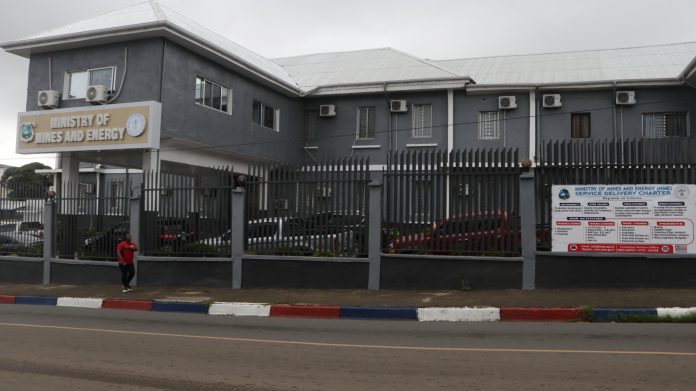
Top: The newly renovated Ministry of Mines and Energy is part of an ongoing reform by Minister Wilmot Paye. The DayLight/Harry Browne


By Varney Kamara


MONROVIA – A bold, new signboard brandishes the phrase: “Ministry of Mines and Energy.” The walls glitter with freshly painted gray and white. Just beyond the lobby, a fenced yard holds items seized from miners. Inside, lighted corridors beam with hope and accountability. 

These are part of a sectoral reform Minister Wilmot Paye is instituting for a bewildered yet promising mining sector. In an exclusive interview with The DayLight, Paye explains the reform, which ranges from employees’ productivity to combating illicit activities.  

“That’s not where we want to be. We had to get the basics right. If we don’t get the basics right, how can we regulate two key sectors of our economy: the mining and energy sectors?” Paye tells The DayLight.  

“Former South African Finance Minister Trevor Manuel said, ‘If you can’t measure it, you can certainly not manage it.’ So, first, we need to have the capacity. You have to have the personnel.  You have to boost the morale. You have to have the equipment.”

Part of the internal restructuring, the ministry purchased office computers and equipment, according to Paye. Next, the administration stabilized electricity and restored order. Workers are now coming to work as early as 8 am and departing offices by 4 pm, in line with civil service rules.

Furthermore, the ministry has relocated the Liberian Geological Survey and Liberian Hydrological Survey on the Old Road to the ministry’s headquarters on Capitol Hill. The two offices collect and analyze rocks and water data to support mineral exploration.

Recent surveys suggest Liberia has vast mineral potential beyond its traditional mineral resources. However, the lack of scientific, evidence-based data has prevented the full realization of this endowment. Paye says the refurbished geological and hydrological surveys, with modern equipment, will help bridge that gap.

Minister of Mines and Energy Wilmot Paye speaks to The DayLight on June 10, 2025. The DayLight/Harry Browne

Recently, the ministry embraced new data from a Chinese-funded study that revealed over a dozen previously unidentified minerals, moving beyond iron ore, diamonds, and gold to seeking complete geological mapping of all ten quadrats nationwide, with only one section surveyed so far, he says.  

Also, the ministry has abolished voluntary work, which has plagued the mining sector for decades. A 2021 General Auditing Agency (GAC) report found that 65 percent of the ministry’s workforce were volunteers. So, Paye dropped 225 volunteer inspectors, mining agents and patrolmen who did not complete high school, and retained 85 who did.

“When you have volunteer inspectors who were deployed across the country to help implement the mining laws and regulations, you are simply saying to them, ‘Go and pay yourselves, and that’s what happened,’” says Paye.  

“What has happened over the years is that we had mining agents and people assigned to regulate the sector and implement the mineral mining laws—some of whom didn’t even finish high school. So, how can you monitor what you don’t understand?”

Eighty-five geologists and mining engineers have been incorporated into companies in line with the Minerals and Mining Law, and that number could rise to 114 in the coming months, according to Paye. The law requires firms to give preference to employing skilled Liberians in senior roles. 

“The companies are legally obligated to provide what is called a “sustenance allowance” for two years. Some young professionals are earning about US$2,000. So, imagine a young person just leaving university and becoming part of the system. This is one way of grooming an industry, producing future industry leaders and decision-makers who can then be deployed and recruited across the country.”

That aside, the ministry has assigned  30 additional geologists and mining engineers to newly established County Mine Offices. Established in all 15 counties, these structures help to fight illicit mining activities. They, Paye says, are equipped with GPS devices and other tools whose lack hinders supervision.

The Ministry of Mines and Energy is enforcing a legal provision through which Liberian geologists and mining engineers work at mines, including Bao Chico in Gbarpolu County, seen in this elevated view. The DayLight/Derick Snyder

Newly established county mine offices would oversee all mining and energy-related activities in their respective counties. Mining agents, the ministry’s highest local officers, will report to these offices, which in turn will report to the central office, Paye says. He adds the ministry has purchased GPS equipment and drones for fieldworkers to make their work easier.

Asked whether new county mine officers would not usurp existing mining agents’ function, Paye says, “No, there won’t be a clash. The county mine offices will oversee all mining and energy-related activities in their respective counties. The mining agents employed at the lower levels will report to the county supervisory offices.

“The only way to effectively curtail illicit mining activities is to have people on the ground with the technical knowledge to implement sustainable and environmentally friendly mining programs. We must consider the entire ecosystem of the mining sector: community welfare, the rights of license holders, and protecting investors, while preventing illicit operations. The real risk here is that we are losing a lot as a country due to illicit activities,” Paye says.  

“What we are doing is establishing a serious presence across the country. Once we achieve that, we can hold people accountable, because there will be decentralized oversight,” Paye says. “We want to know what mining activities are taking place in River Gee County, for example—who is operating there, and who holds a license.”

‘Kata-kata’ machines

Illicit mining undermines Liberia’s mining sector, which contributes 15 percent to the country’s GDP. It is linked to pollution, deforestation, and annual losses of US$200 million, according to a 2021 report by the Global Financial Integrity, a US-based think tank dedicated to researching and combating corruption, illicit trade, and money laundering worldwide.

Men operate a mining machine, locally known as a kata-kata machine, in Grand Cape Mount County in 2019. Picture credit: James Giahyue
Two dredges on the River Dugbe in Sinoe County. The DayLight/Derick Snyder

From the start of this year, the ministry and the Environmental Protection Agency (EPA) have shut down illegal and noncompliant mines countrywide. Coordinating with the Ministry of Justice and the Liberia Drug Enforcement Agency (LDEA), the crackdown has led to fines and prosecutions.

One of the areas of concentration is the use of devices in the artisanal mining subsector, locally known as “kata-kata” machines. Normally, the Ministry of Mines issues permits for kata-kata machines in difficult terrain. However, miners are using the machine so widely without the ministry’s approval.  Illicit miners are also using dredges, which pollute rivers with mercury, destroy habitats, and pose a risk to public health.

In addition to those illegal activities, noncompliance is commonplace. There are government officials with shares in or control over companies, creating conflicts of interest. Some firms do not meet requirements, and there are issues with foreign staffers’ residency and work permits. Some companies have vague ownership structures, a breeding ground for terrorist financing, tax evasion and money laundering.

Paye calls on journalists and the public to join in the fight against illegal mining.

“We always tell our people to push their government to do the right thing,” Paye. Don’t side with companies. They’re not here because they love your country. They’re here because of what they see. Push your government to act right so the citizens benefit.”

Fresh Elections Reduce Tension in Community Forest

#image_title

Top: Newly elected members of Mavasagueh Community Forest. The DayLight/Ojuku Kangar


By Emmanuel Sherman


VAMBO TOWNSHIP – Eleven townspeople have been elected to a community forest leadership in Grand Bassa County, calming months of tension over their towns’ alleged misrepresentation.

Mavasagueh Community Forest’s previous election, held in August last year, was marred by irregularities, prompting fresh elections. Those elected include representatives from Boe, Borbor Kaykay, and Togar Towns. Zeogar, the twelfth town, was disqualified because its representative serves as a town chief, debarred from direct community forest activities.

“Now that we have been elected, we will do the proper thing for the affected towns and the Vambo Township,” said Ojuku Kangar, a community assembly representative from Boe Town, one of the 11 elected persons.

Wooded areas get community forest status when they complete nine legal steps, including establishing a governance structure. This structure comprises a day-to-day forest management body, a supervising executive committee, and a topmost decision-making assembly.

“We will form unity with our counterpart as a community assembly to hold the company accountable to our contract,” added Kangar, a DayLight affiliate.  

The election in Mavasagueh has eased tensions in the Compound Number Town area, following months of hostilities. Before the election, townspeople protested for representation in the leadership.  There was an imbalance in the allocation of projects in the 39 towns that own the 26,003-hectare forest.  

The elections could also lead to the unfreezing of the community forest’s account, which was frozen after funds were misapplied. Kangar said more signatories would be added to the account to reflect inclusion. “We will ensure the FDA includes us in the bank account,” he said.  

Citizens blamed the FDA for the chaos. The regulator conducted inadequate awareness, leading to some towns not participating in Mavasagueh’s formation, according to civil society and locals. That finding was corroborated by an investigative series over the last five months.

Daniel Dayougar, the former Vambo Commissioner, was accused of handpicking representatives to serve on Mavasagueh’s assembly. Dayougar denies any wrongdoing.

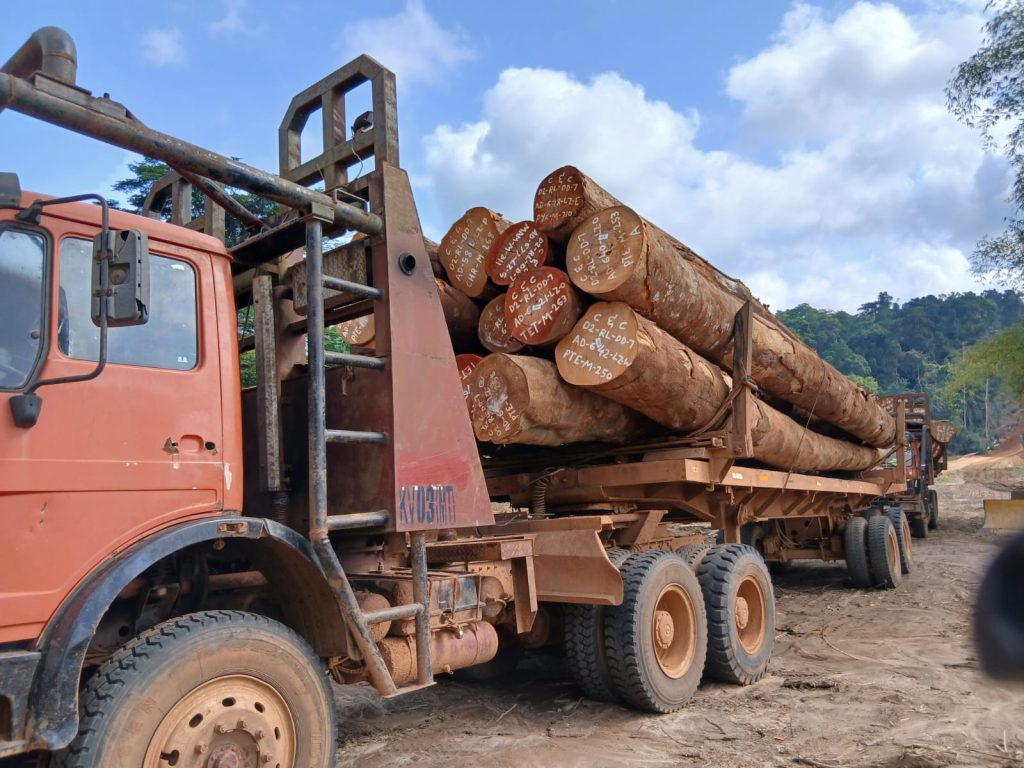
Trucks carrying logs from the Mavasagueh Community Forest. The DayLight/Ojuku Kangar

Amid the chaos, C&C Corporation, the logging company Mavasagueh’s leadership signed a contract with, has been operating. So far, it has paved dirt roads in the area and has harvested logs that are being stored at Krish Veneer Industries, a sawmill in Buchanan, a few miles away.

“All of our logs are taken to Buchanan without benefit. This is what happened during RETCO days until we blocked the roads and chased them out,” said Zechariah Boima, of Togar Town. He was referencing RETCO Liberia Timber Industry, a company that worked here in the 1990s and paid the community L$10,000 (roughly US$90 today).

The FDA did not respond to queries. However, Kangar David, head of the agency’s sub-office in Buchanan, who conducted the election, urged the new leadership to work in Mavasagueh’s interest.

The election is yet another proof of Mavasagueh’s flawed formation. It has already been established that the FDA skipped legal steps in granting it a community forest status. C&C Corporation is illegitimate because its owner, Clarence Massaquoi, is an ineligible logger. Krish Veneer, the company’s buyer, operates on the FDA Managing Director Rudolph Merab’s family land with an ineligible status. The forest overlaps a private land that two men are claiming.


This is a Community of Forest and Environmental Journalists (CoFEJ) production.

Court Hears Case Against Suspected Timber Smugglers

1-4064x3074-1-0#

Top: The Bushrod Island Magisterial Court conducts preliminary hearings in the case against two suspected timber smugglers from Caldwell, following a January DayLight investigation. The DayLight/Varney Kamara


By Varney Kamara


MONROVIA – A Montserrado court has begun preliminary hearings into a case against two suspected timber smugglers, exposed in a DayLight interview.

In late January, the Bushrod Island Magisterial Court charged Amara Fofana and Suleyman Karabacak, officials of Libfor Forest Corporation, with smuggling and economic sabotage. The pair had been at the Monrovia Central Prison for weeks after failing to secure a US$100,000 bond.

Their detention came within 48 hours after a DayLight investigation that unearthed Libfor traded timber outside the legal system.

Their case commenced recently after months of delay, and will resume later this month when the suspects’ lawyer returns. A court document shows that Cllr. Alhaji Sesay traveled to Saudi Arabia for the Hajj pilgrimage and medical reasons. He returns to Liberia on June 27, 2025, according to court filings.

“In view of the above, movant counsel humbly requests an excuse for all pending matters,” the document read.

The case will move to a circuit court, as magisterial courts lack the authority to prosecute cases of economic sabotage. However, the preliminary hearing is a legal requirement for the case to be transferred to a higher court.


This story was a Community of Forest and Environmental Journalists of Liberia (CoFEJ) production.

Government Investigates Lebanese Over Alleged Crimes

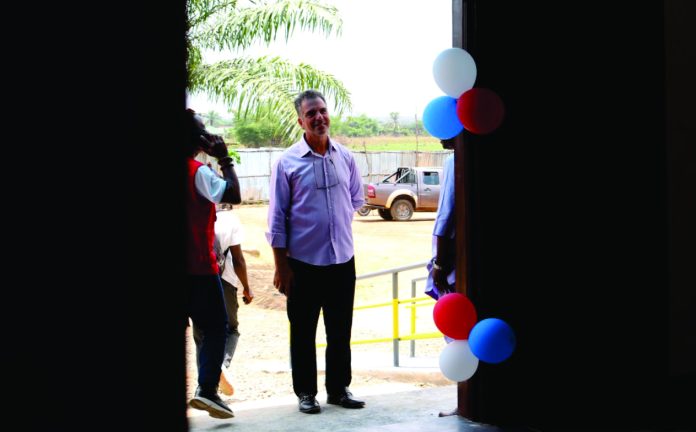
Top: Moussa Abdul Karim, who The DayLight found allegedly evaded government taxes, at the opening of the Fisheries college at the University of Liberia in April. The DayLight/Franklin Nehyalor


By Varney Kamara


MONROVIA – Multiple government agencies are investigating a Lebanese businessman for allegedly committing forestry, financial, and immigration crimes.  The news comes after a DayLight investigation found that Moussa Abdul Karim, the owner of several companies, smuggled timber, evaded taxes, and declared multiple nationalities, winning a World Bank contract worth nearly half a million dollars.

The Liberia National Police, the Liberia Immigration Service, the Liberia Revenue Authority, the Ministry of Labor, and the Association of Liberian Construction Contractors have started to investigate Karim separately. If found guilty, he risks several fines and prosecution.

Court documents show that the Financial Crimes Division of the Liberia National Police obtained a subpoena on May 5 for the tax records of a company Karim owns “to enhance an ongoing criminal investigation surrounding alleged money laundering.”

The police are seeking the tax records of Mak Timber Group Liberia Inc., a company Karim used to export a US$350,000 worth of timber in 2022.

The police’s probe follows up on evidence that The DayLight published that the export occurred outside the legal channel. One year after the export, Karim won a US$498,203.52 World Bank bid to construct a fisheries college at the University of Liberia, the newspaper reported.

Likewise, immigration authorities are investigating Karim’s alleged failure to obtain a resident permit. The DayLight reported that he allegedly defrauded the government of thousands of dollars by evading the permit for close to a decade. Under the Alien and Nationality Law, Karim is required to pay US$750 for a resident permit for the first time and US$350 for renewal.  

“He appeared today and is due back here on Monday,” Augustine Wolo, an immigration officer, told The DayLight last Thursday.

Immigration authorities are also looking into suspicions that Karim has multiple nationalities. DayLight cited an immigration source and official business documents identifying him as Lebanese and Guinean.

Moussa Abdul Karim’s business headquarters are on the Old Road, Congo Town Township. From here, he conducted business for at least three companies: Mak Enterprises Inc., Mak Timber Group Liberia Inc. and Atlantic Developer & Logistics Inc. The DayLight/James Giahyue  

Living in Liberia without a resident permit as a non-Liberian is a crime punishable by a fine or deportation. Using multiple identities constitutes fraud and can lead to expulsion, deportation, and criminal prosecution.  

The Ministry of Labor said they were also investigating Karim for allegedly failing to obtain a work permit. The DayLight publication alleged that Karim had not gotten a work permit in the last nine years.

“We are investigating and will fine him because we have checked the system and did not find any payment records there,” said Ralphael Donokolo II, Assistant Minister for Alien Registration and Liberianization at the Ministry of Labor.

The Work Permit Regulation requires that non-Africans pay US$1,000 for a regular work permit, or pay fines ranging from $1,000 to $10,000.   

The Liberia Revenue Authority, which collects all government taxes, disclosed it also launched an investigation.

“We are not taking this lightly. You can rest assured,” James Dorbor Jallah, Commissioner General of the Liberia Revenue Authority, told this reporter.

The Association of Liberian Construction Contractors (ALCC), which regulates construction companies’ activities, said it was probing whether Karim followed its rules. He defeated 20 other bidders, who were rejected due to noncompliance, to win the contract, administered by the National Fisheries and Aquaculture Authority.  

“If we establish that he acutally operated outside of our membership, we will blacklist him and ensure that he doesn’t get any construction contract in Liberia,” said Sackie Johnson, ALCC’s president.

Joseph Bennett, Karim’s lawyer, did not respond to queries for comments.


This is a Community of Forest and Environmental Journalists of Liberia (CoFEJ) production.

Podcasts