
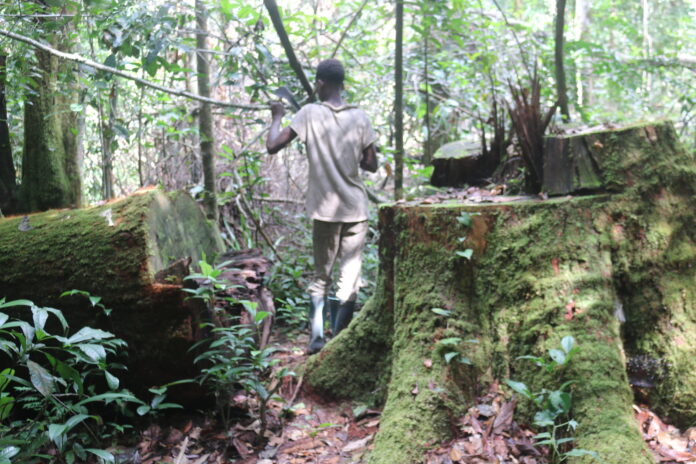
Top: The Worr Community Forest is no stranger to illegal logging. Between 2021 and 2022, Masayaha conducted a string of illegal harvesting on the fringes of the forest. The DayLight/James Harding Giahyue
By Emmanuel Sherman
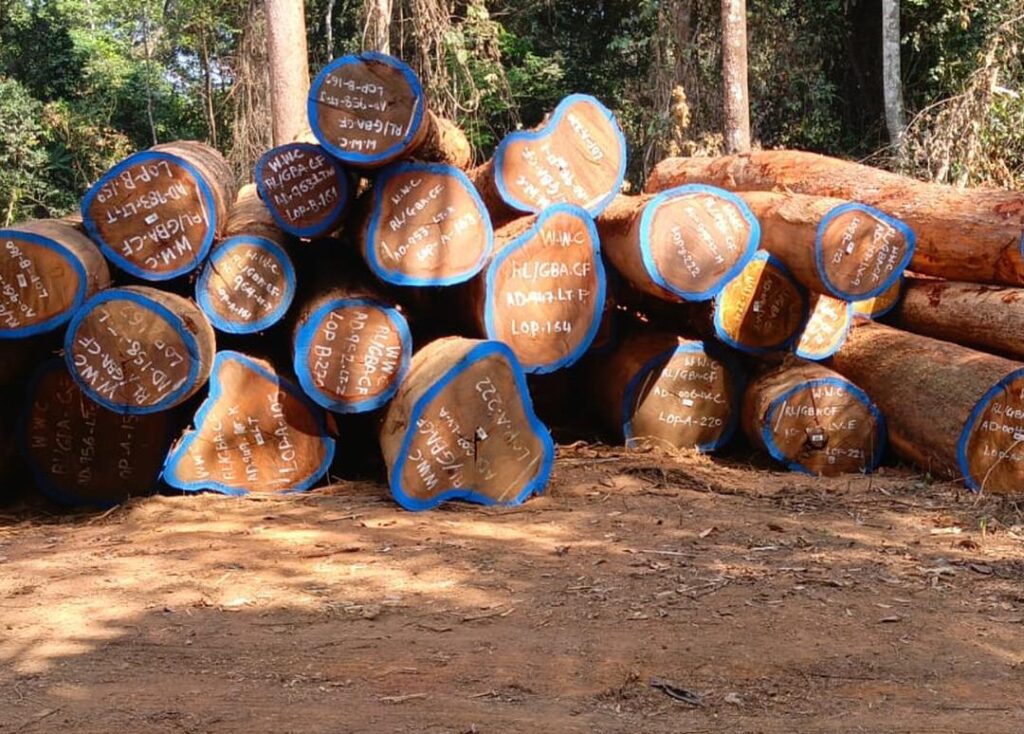
DOEWEIN, Grand Bassa County – Last year, Westwood Corporation, a little-known company, illegally harvested 1,135 logs (5,694.33 cubic meters) in a Nimba County community forest. A court there ordered the Forestry Development Authority to seize the logs, something the FDA did. However, the regulator’s attempt to prosecute Samuel Cooper, Westwood’s owner and CEO, was unsuccessful, and Westwood disappeared into thin air.
That was until some two months ago, when Westwood reappeared in the Worr Community Forest in Grand Bassa County for another illegal operation. Interviews and official documents show that Westwood is negotiating a contract for the 35,337-hectare forest against the law.
“Cooper expressed interest in the forest and wants us to do business,” said Zeogar Varney, Worr Community Forest’s chief officer. He said residents had agreed to contract Westwood for the woodland at a meeting, but no deal had been reached.
Varney said the region’s dire need for roads and bridges was driving Worr’s negotiation with Westwood. The only bridge connecting the Worr River, a tributary of the Farmington River, to other areas is impassable. People use an alternative route via Kakata, Margibi County, to cross the river by canoe to access the community.
“All our roads and bridges are damaged, and our people are suffering. Cars cannot reach the chiefdom, and motorbikes struggle to get there. What we have is a footpath,” said Varney.
Worr had hoped to end the decades-long nightmare when it signed a contract with the Liberian-owned Magna Logging Company in 2019. The contract required Magna to build bridges on six primary and secondary roads in the region.
Shortly after the signing, Magna subcontracted Masayaha, a Lebanese-owned firm, dashing Worr’s hopes. It did not construct the roads or bridges, owes the community thousands of United States dollars, failed to build a clinic, and abandoned many logs. Earlier this year, Magna relinquished the contract, according to a letter the FDA wrote to Worr, seen by The DayLight. That leaves Worr without a contract and free to sign a new one.
But Westwood is anything but a legal choice, as its exploits in Nimba County disqualify it. The Regulation on Bidder Qualifications debars any company or individual penalized for illegal logging in the last five years.
Following the illegal harvesting in the Gba Community Forest, Cooper did not contest the FDA’s petition to confiscate the logs. The Eighth Judicial Circuit Court’s ruling marked the first time the Regulation on Confiscated Logs, Timber and Timber Products was enforced since its creation in 2017.
Cooper declined to speak on his debarment. However, he said he was waiting for the Ministry of Justice to clear him for logging ventures. “I violated, and my rights have to be restored,” Cooper told The DayLight in a phone interview.
He claims he did not intentionally cut the logs illegally in Nimba, because local people permitted it. But the facts contradict his claims. An FDA investigation found that Westwood harvested expensive wood species outside its contract area under the guise of paving a road. A forest ranger and the Gba community leadership connived with Westwood to cut them. Westwood exported an initial batch of 216 logs to Italy, in violation of a trade agreement with the European Union. It had requested another shipment of 142 logs to Bangladesh, official records show.
‘Prospecting’
The evidence shows that Westwood brought its illegal logging experiences from Nimba to Bassa. A Westwood worker, who does not want to be named for fear of reprisal, revealed that Westwood had already started operations in Worr. It had 20 workers in the humid, virtually virgin forest in Compound One.
“The company has cut one block, and intends to cut 20,” said the worker. Two other people familiar with the community forest’s matters corroborated the worker. Block-cutting is prohibited without any felling plans, even for qualified companies, according to the Code of Harvesting Practices. It is done by dividing the forest into sections to keep some trees standing, while avoiding environmental harms.
Cooper denies cutting blocks in Worr, but confirmed he had workers tree-finding at the outskirts of the forest. “We’ve got people prospecting, but not cutting blocks, two or three people,” he said.
Timber blocks
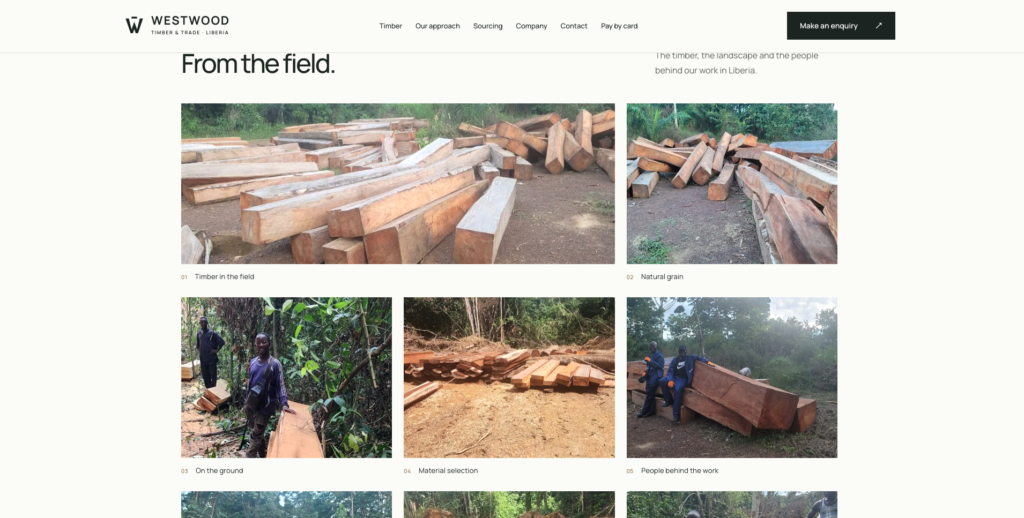
Westwood’s website reveals that it trades kpokolo, timber blocks the government in 2022 finally recognized as illegal. The website further features a kind of advertisement consistent with documented Kpokolo operations. “Tell us what you need. Availability, commercial terms and delivery requirements are discussed for your specific order,” reads the website.
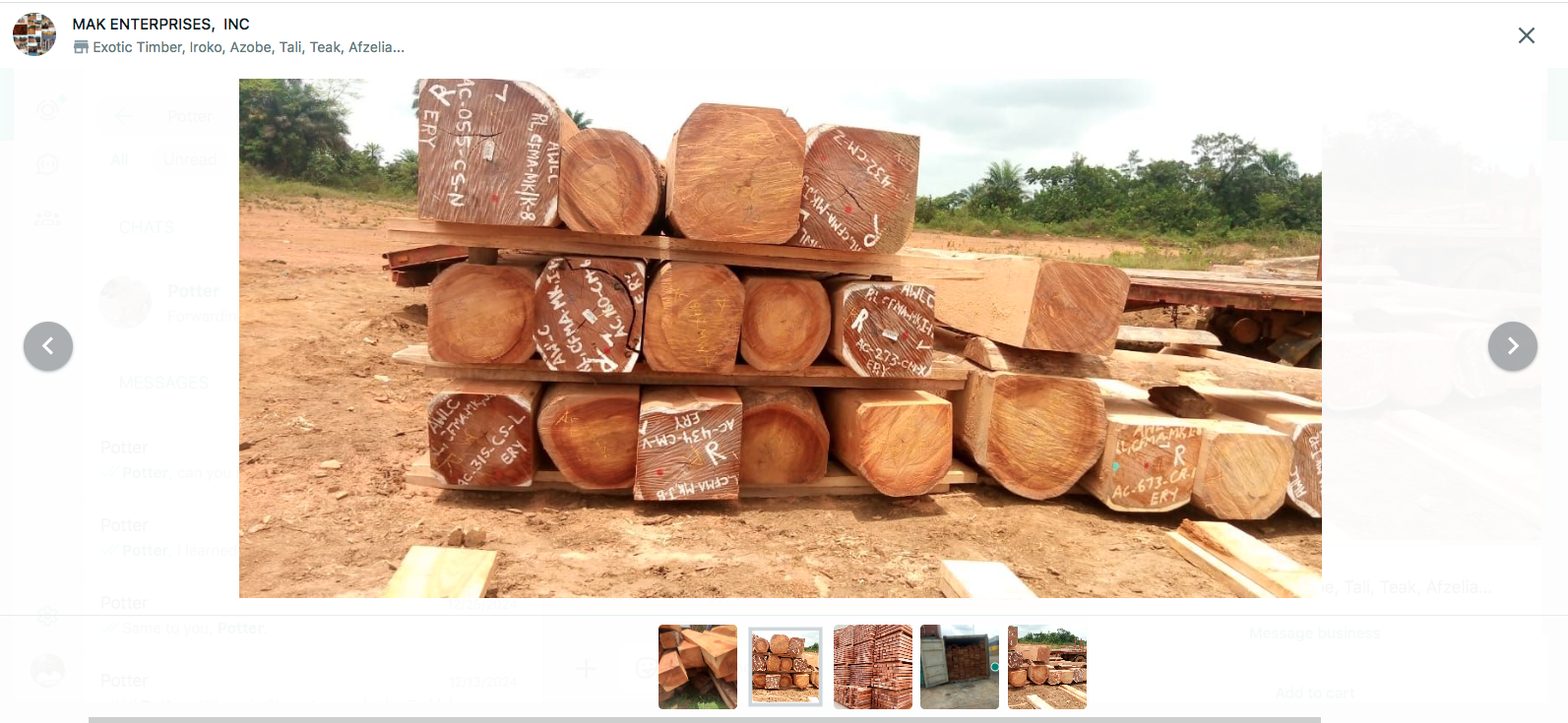
There is no evidence Westwood has had another contract, apart from the controversial one in Nimba, in which it produced round logs, not timber blocks. It was unsuccessful in its negotiations with the Gheegbarn #1 and the Beyan Poe Community Forests next door in Compound Two, and Gibi District, Margibi County, respectively. Westwood only other known contract was for road construction in Lofa County. Cooper did not respond to questions about Westwood’s website and other issues in this story.
The Gba Community Forest harvesting is not Westwood’s only brush with the law. It was established in 2003 and amended its articles of incorporation in 2010. However, the document omits its shareholder page and, in effect, hides its owners.
That is a violation of the Business Association Act, which requires companies to declare their human owners, a safeguard against tax evasion, money laundering, and terrorist financing. Enshrined in forestry legal instruments, the requirement also helps prevent government officials, human rights abusers and broke businesspersons from acquiring forestry contracts. In 2023, Liberia formulated the Beneficial Ownership Regulation to complement the 1976 law. The regulation calls for a public register of companies and their owners for transparency and accountability.