
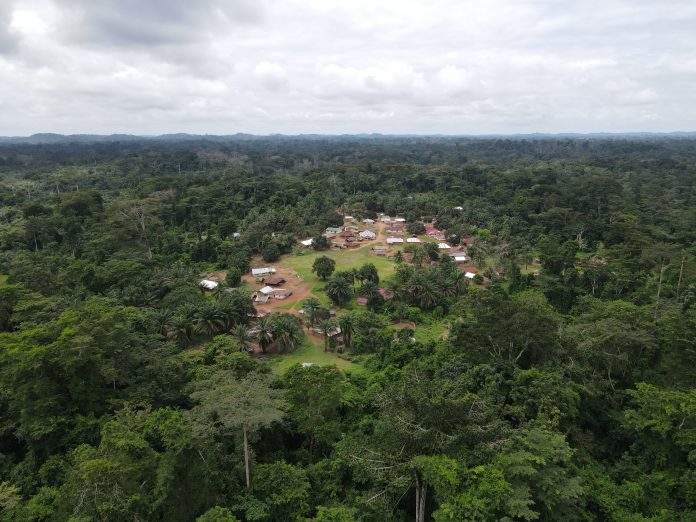
Top: Bargblor, Grand Gedeh County, is one of 78 towns and villages adjacent to the proposed Kwa National Forest. The DayLight/Samuel Jabba
By Varney Kamara
Story highlights
- Social Entrepreneurs for Sustainable Development calls for the government to suspend the establishment of the Kwa National Park until local communities complete the customary deed process.
- The NGO cites the Gbehzohn Declaration, in which actors resolved on various aspects of land and forest matters.
- Turns out, the Gbehzohn Declaration does not refer to the proposed Kwa National Forest, which began seven years earlier. In fact, the document does not require communities to get a deed before a park is established on their lands.
- The NGO’s claim that the government unlawfully obtained communities’ consent is contradicted by documents consistent with the Gbehzohn Declaration.
- The NGO is the latest to attempt to use misinformation to delay the conservation of the Kwa forest.
MONROVIA – In August, President Joseph Boakai received documents for his signature as part of a legal procedure to establish the Kwa National Park. When he signs it, the document will go to the Legislature for enactment as Liberia’s sixth and second-largest protected forest.
However, the Social Entrepreneurs for Sustainable Development (SESDev), a Paynesville-based NGO, wants the process suspended until landowning communities adjacent to the forest get their customary land deed.
“If this gazettement goes ahead as planned, it will violate the rights of countless, and as yet undefined, customary landowners whose rights are guaranteed by the law, and create animosity with local communities from the outset of its establishment,” said SESDev in an August letter to the Forestry Development Authority (FDA).
It urged the FDA to respect the Gbehzohn Declaration in which actors agreed on ancestral land ownership and protected forests. It enhances the implementation of the 2018 Land Rights Act, harmonizing stakeholders’ approaches to customary land rights, protected areas, and rights-based conservation governance.
But a DayLight review of the Gbehzohn Declaration shows that SESDev misinterpreted it, undermining the basis of its campaign.
In the letter to the FDA, the NGO cited a provision of the declaration that communities first acquire a deed and give their consent before the government creates “any new protected areas.” Thus, that provision excludes Kwa, whose establishment began in 2016, two years before the Land Rights Act, and seven years before the Gbehzohn Declaration. The proposed park is a part of Liberia’s Permanent Forest Estate, established in 1953.
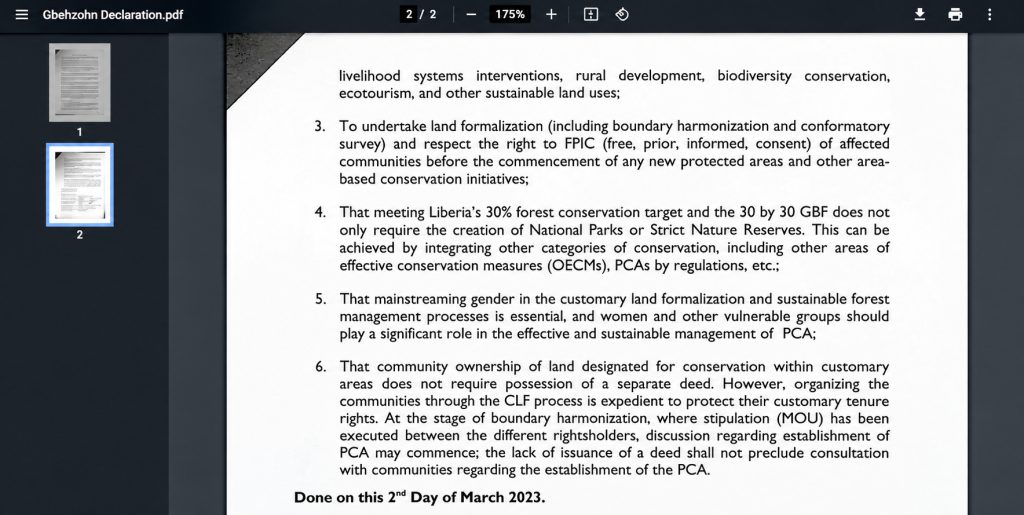
Interestingly, the Gbehzohn Declaration provides that park procedures can proceed without communities acquiring a customary deed. It states, “At the stage of boundary harmonization, where stipulation (MoU) has been executed by rightsholders, discussion regarding the establishment of [a park] may commence.”
The Gbehzohn Declaration also does not prevent authorities from protecting a forest when landowning communities lack a deed. It does the opposite: “A lack of issuance of deed shall not preclude (stop) consultation with communities regarding the establishment of [a park].”
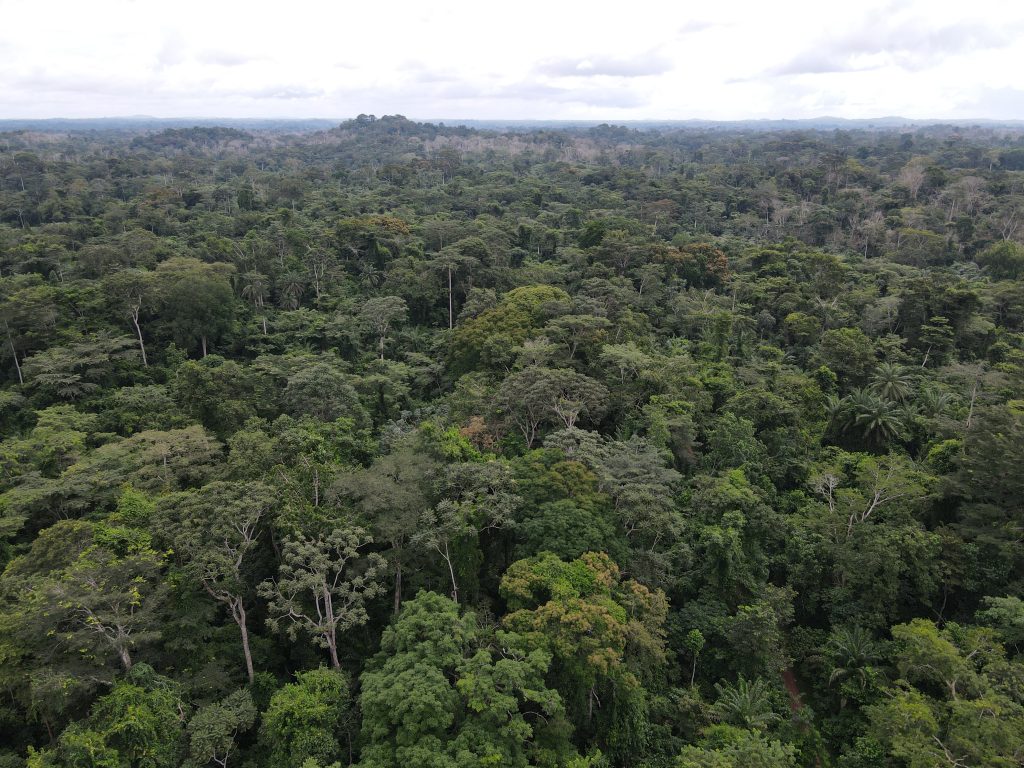
Covering 171,888 hectares across River Cess, Sinoe and Grand Gedeh, the Proposed Kwa National Park is home to critically endangered western chimpanzees, pygmy hippopotamuses, and forest elephants. It supports national efforts to protect 30 percent of Liberia’s forests and fulfills its climate commitments. Liberia currently has the Sapo National Park, the East Nimba Nature Reserve, the Lake Piso Multiple Use Reserve, the Gola Forest National Park, and the Grebo-Krahn National Park.
The EU is funding Kwa through a collaboration among the FDA, the Liberia Land Authority, and the Wild Chimpanzee Foundation, an NGO working in the Mano River basin. The funding comes from €289 million (over US$320 million) that the EU has granted Liberia for conservation, agriculture, and other sectors.
Kwa is already behind schedule. Having received the documents in August, the Executive Mansion was expected to send them to the Capitol Building last month. That did not happen amid President Boakai’s travel to this year’s UN General Assembly in America. The Executive Mansion and the EU Delegation in Liberia did not respond to queries on the delay.
Suspending Kwa’s establishment until communities get their deeds could further delay the park. The Land Rights Act grants communities ownership of their ancestral territories, but getting a deed to formalize that ownership has proven to be difficult. About 70 communities have completed the legal steps to get their deed, while 150 are processing theirs.
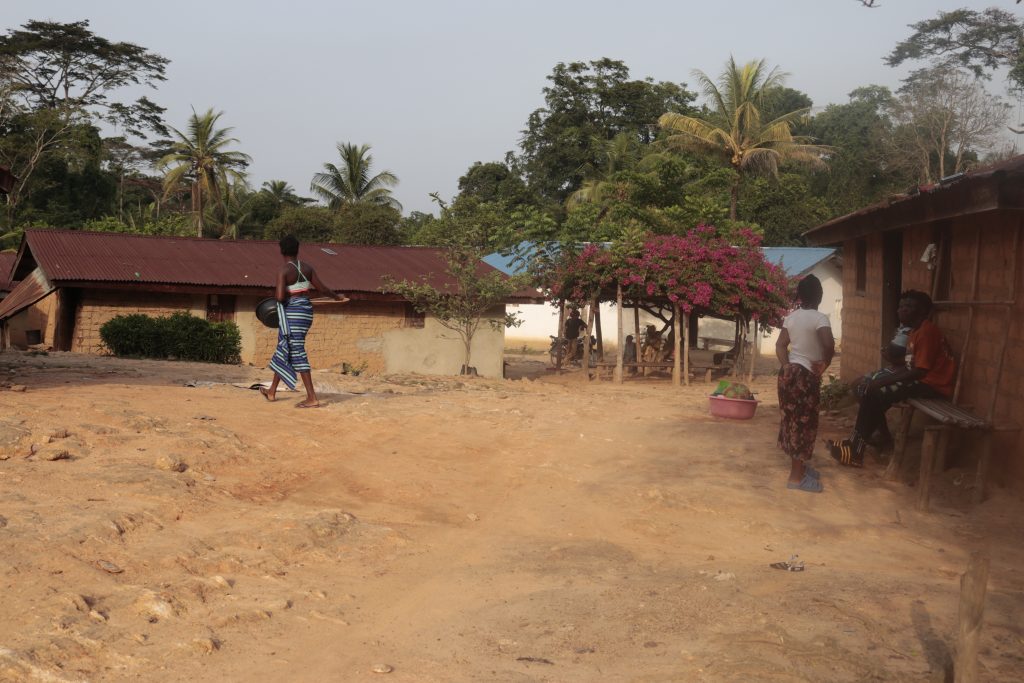
It is unclear how many clans—the level at which communities get a deed—are affected by Kwa in all three host counties. However, the clans where the 78 Kwa-related towns and villages are located are in the customary deed process.
The process started in 2023 after the Gbehzohn Declaration, a group of NGOs, including SESDev, objected to Kwa. The group flagged that communities had not confirmed their customary ownership of the forestland. Authorities agreed and started the customary land procedures.
But this time, authorities refute SESDev’s criticism.
“Officially, it is the position of the government of Liberia… to ensure that communities… go through the complete [ customary deed] process. That is why we started the process from Grand Gedeh along with all those communities at the fringes,” said Julius Kawa, Director for Planning and Policy at the Land Authority.
“This is not about before or after. It is not just that one must be done before the other one. We are the government of Liberia. We are doing what is right for the people,” added Kawa. He said the Land Authority would complete the customary deed process within two or three months.
Consent and Lies
SESDev also criticized the method authorities used to obtain communities’ consent. By law, local people have the right to consent to projects on their lands. That consent must be free of intimidation or manipulation, prior to a project, and informed in every way.
SESDev dubbed the consent information in the Kwa package “inadequate,” “invalid,” and “non-compliant.” Forms were not signed by required community bodies, and locals received no legal advice before signing them.
“As a result, the consent forms included in the gazettement package are inadequate and unable to provide the consent they purport to contain,” said SESDev.
“This again provides sufficient grounds for invalidating the [consent] process that was carried out. On that basis, it was non-compliant with national and international standards,” added the NGO.
But the official documents SESDev condemns, and interviews The DayLight conducted with townspeople tell a different story. The evidence shows communities are aware of Kwa, participated in its processes, and consented to its formation. Townspeople even signed boundary agreements and agreed to co-manage the park alongside authorities. They attended a series of meetings and participated in awareness campaigns on forest conservation.
“In 2023, SESDev… ignored all available [consent] documents. Now they are still ignoring all available documents, including the entire [customary land formalization] documentation,” said Dr. Annika Hillers, Wild Chimpanzee Foundation’s Country Director. “Instead, they are misinforming and sharing wrong information with the EU.”
SESDev’s letter to the FDA to suspend Kwa is not the first to be based on falsehoods.
A DayLight investigation in July established that cocoa farmers in Grand Gedeh lied in a complaint to President Boakai about their participation in Kwa processes. A report from an inquest ordered by the President on the matter has yet to be published
Then, weeks after SESDev’s communication, local people in the Lower Sanquin Clan in Sinoe County wrote a letter to the EU, claiming they also did not participate in Kwa processes. A DayLight publication revealed they actually consented to the creation of the park.
For instance, Reason Seequeh, the community land leader for the Lower Sanquin Clan, Sinoe, claims his signature on a boundary agreement was forged. However, two other people who signed the document said they saw Seequeh sign it.
The Land Authority said it would investigate amid the false claims.