26.1 C
Monrovia
Thursday, December 18, 2025
Home Tags Samuel Kpakio

Tag: Samuel Kpakio

Land Authority Dirty Deed Defense Dies

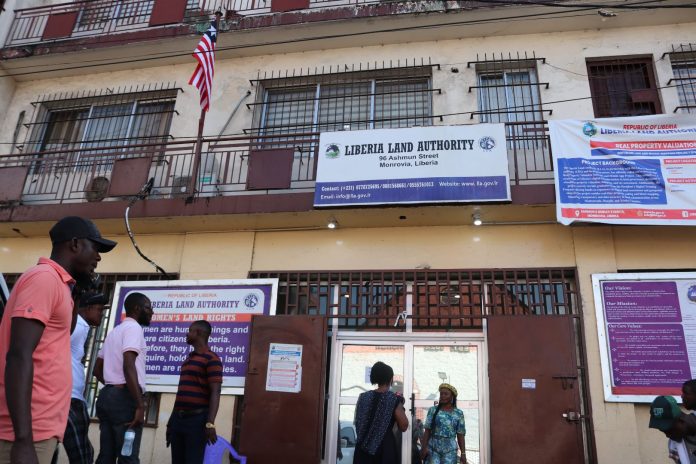
Top: The headquarters of the Liberia Land Authority on Ashmun Street, Monrovia. The DayLight/Harry Browne


By James Harding Giahyue


MONROVIA – On Monday, the Liberia Land Authority justified issuing a fraudulent land deed as part of an illegal cocoa cultivation agreement between Grand Gedeh authorities and a Burkinabe businessperson. It was responding to a DayLight investigation and another by the Liberian Investigator, accusing it of wrongdoings.  

The DayLight had established that Chairman Samuel Kpakio violated a moratorium on public land transactions announced by President Joseph Nymah Boakai in this year’s State of the Nation Address. The investigation determined that Kpakio had masterminded the scam and was not misled, as the Land Authority had claimed.

The Liberian Investigator, on the other hand, found evidence that the deed was illegally issued to two entities: the Grand Gedeh Local Government Reserved Farmland and Moore Agro Inc., co-owned by ex-Minister of Public Works Gyude Moore.

The Land Authority revoked the deed in question, while Grand Gedeh County authorities terminated their agreement with the Burkinabe farmer.

In a press release, the Land Authority defended Kpakio’s actions about two weeks after The DayLight investigation. It said accusations against Kpakio were “unsubstantiated,” meant to tarnish his reputation, and “derail” donors’ attention.

“The Liberia Land Authority wishes to inform its implementing partners that the moratorium issued has halted all leases and sales of public land. Thus, the development grant deed signed was in no way a violation of the moratorium,” the release read.

It restated the suspension of Paye Freeman, the Grand Gedeh Land Administrator, and David Togbasie,  county land dispute officer. The Land Authority blames the two men and Grand Gedeh Superintendent Alex Grant for “misleading” Kpakio into issuing the deed. All three men declined to speak on the matter.

But an analysis of the Land Authority’s justification, a relook at the deed, laws and regulations, and interviews with people knowledgeable of the land sector, corroborated the newspapers’ publications. The evidence further exposed the institution’s attempt to scapegoat and lessen Kpakio’s role in the illegal activities.

The moratorium, which was lifted in August,  did not mention the phrase “development grant deed.” However, the facts contradict the Land Authority’s defense. A development grant deed can be issued only for public or government land, under the Land Rights Act.

The 2018 law categorizes land into private and customary, government and public, whose sale and lease the Land Authority oversees.
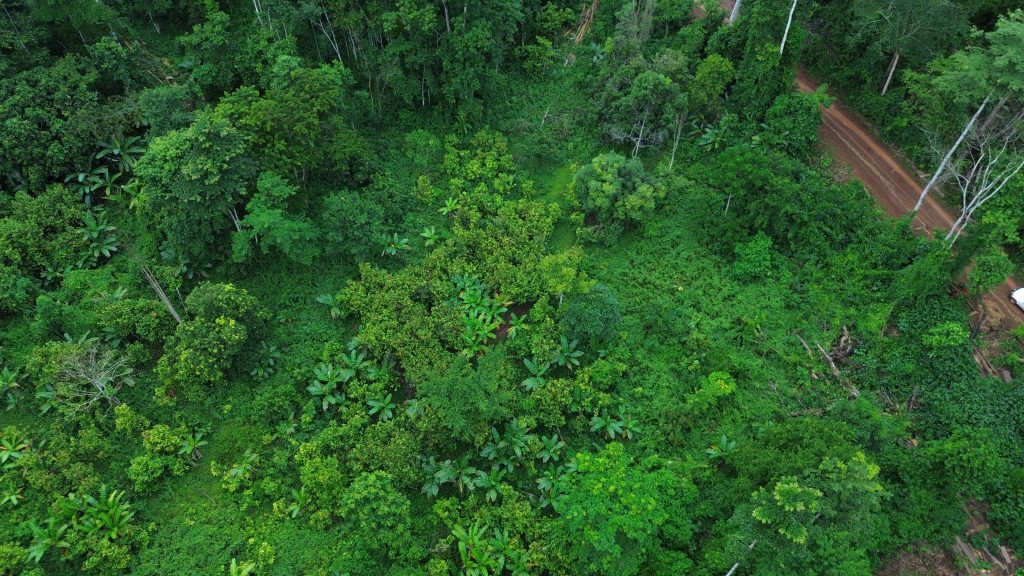
The Liberia Land Authority issued a fraudulent deed to Grand Gedeh County authorities as part of a scam to lease out 500 acres of land to a Burkinabe businessman. The DayLight/Carlucci Cooper

“Development grant deeds come from public land because the Land Authority manages public land,” said a person familiar with the entity’s workings.  “Development grant deeds cannot be issued on private land, government land (normally already allocated), customary land, unless in certain cases.”

Even other government institutions could not get a deed during the time of the moratorium, according to the source. They got an attestation, one of which The DayLight has seen. 

The source said the Liberia Land Authority’s board of commissioners was instituting a “stricter process” for development grant deeds to avoid such abuse. “Though not chronological, there are ongoing discussions to streamline the development deed process,” added the source.”

Two lawyers and an ex-executive of the Land Authority, who also preferred anonymity, agree with the source.

“A development grant deed is taken from the public land domain. Therefore, if a moratorium is placed on public land, that also includes a moratorium on the granting of Development Grant Deed to whoever,” the ex-executive told The DayLight.

Kpakio’s issuance of the deed to Grand Gedeh and Moore Agro Inc. undermined the very reason why the moratorium was imposed. It was meant to curb land grab, prevent conflicts and promote sustainable land-based investment. The President had said it would remain in place until the agency created regulations and guidelines to govern these things.

Moore, the ex-Public Works Minister, who owns 70 percent of Moore Agro Inc.’s shares, denies knowledge of the deed. He told The DayLight, “I have no idea what this is about. Moore Agro Inc. has nothing to do with Grand Gedeh or land.”

A person familiar with the deed processing said Moore Agro Inc. might have mistakenly copied from an old deed. The experts said the likely mistake could be the result of hasty work, a common feature of fraud or forgery.

By issuing the deed, the Land Authority violated several provisions of the Land Rights Act and Regulations. It failed to investigate whether the 500 acres of land in Grand Gedeh’s B’hai District were public or customary land. It did not consult landowning towns and villages, or get their consent, the most crucial aspect of land reform. The survey was kept secret, and there was no competitive bidding.

But those were not the only violations, though.

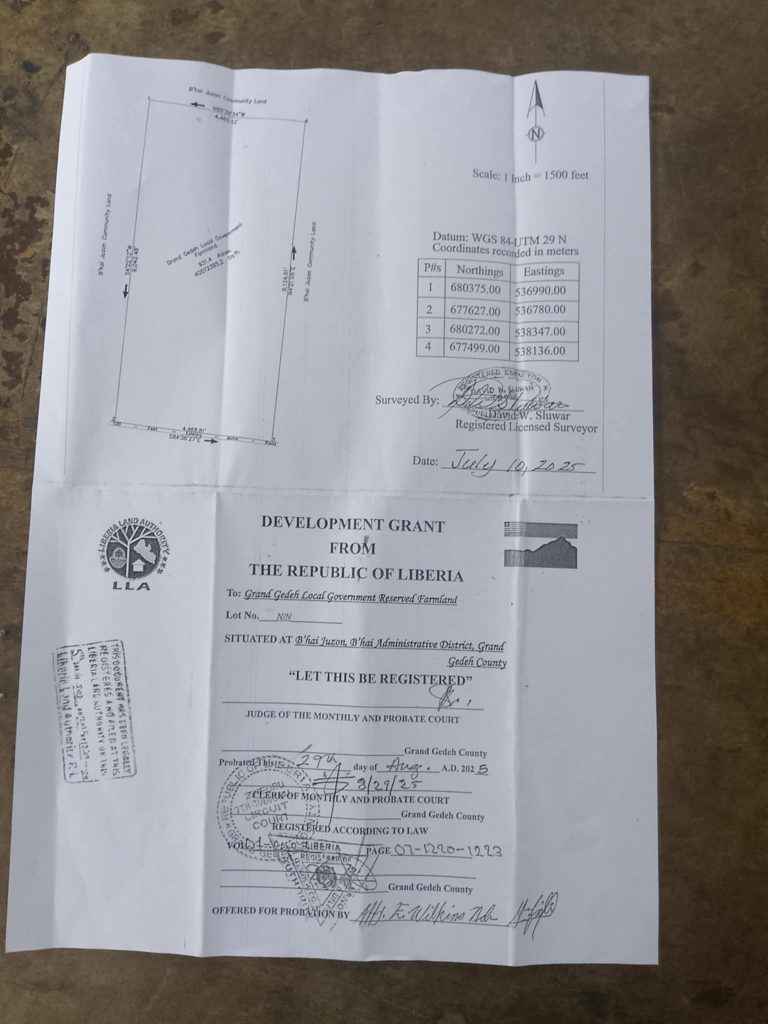
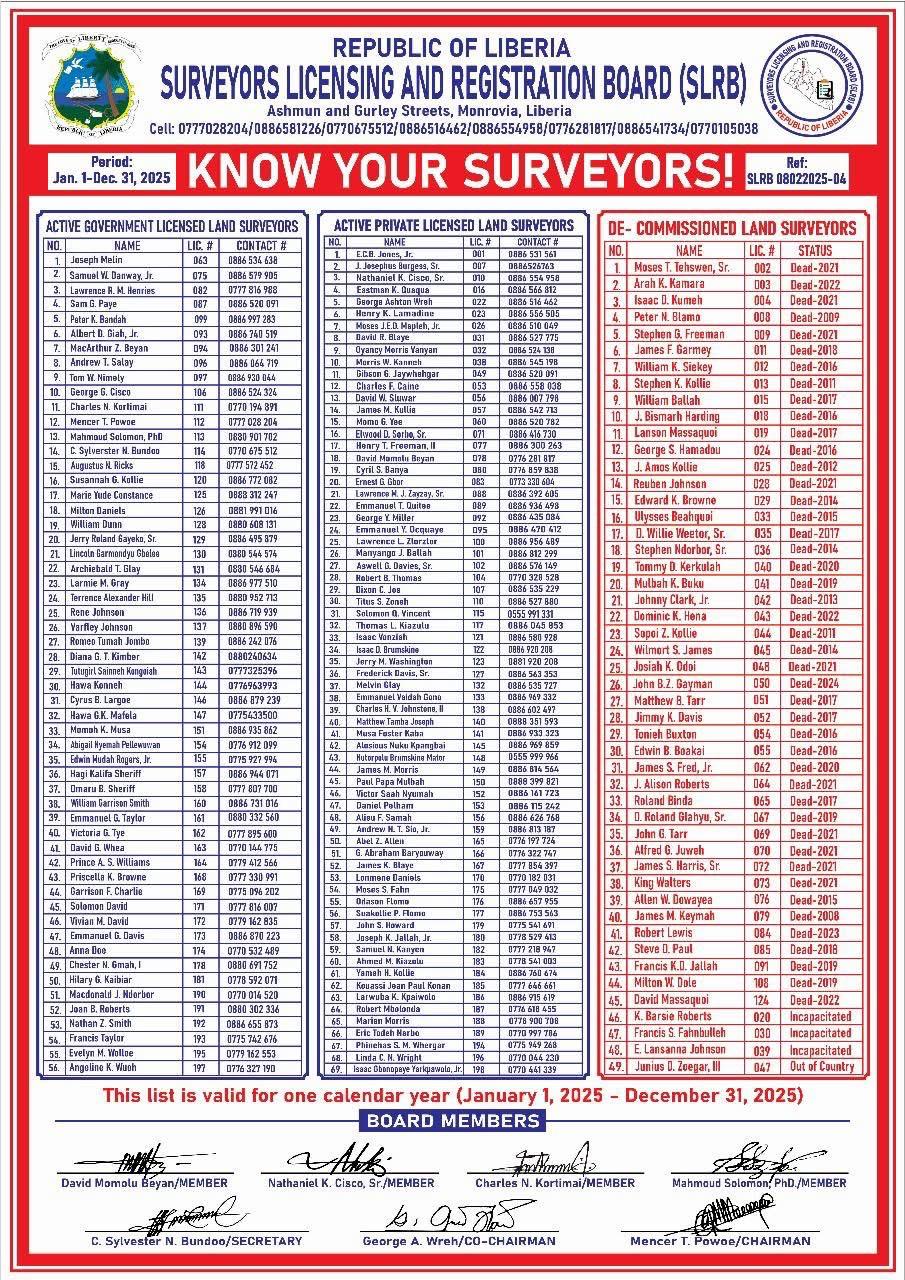
Kpakio signed the deed two days before the survey of the land was completed, against standard procedure. David Sluwar, who conducted the survey, was not licensed for a government or public land survey. Rather, Sluwar is licensed to survey only private plots, based on the official surveyors’ register. The Surveyors Licensing and  Registration Board did not respond to a DayLight inquiry on Mr. Sluwar’s role in the scandal.


Integrity Watch Liberia provided funding for this story. The DayLight maintained complete editorial independence over the story’s content.
Land Authority Boss Violated Moratorium and Broke Laws, Probe Finds

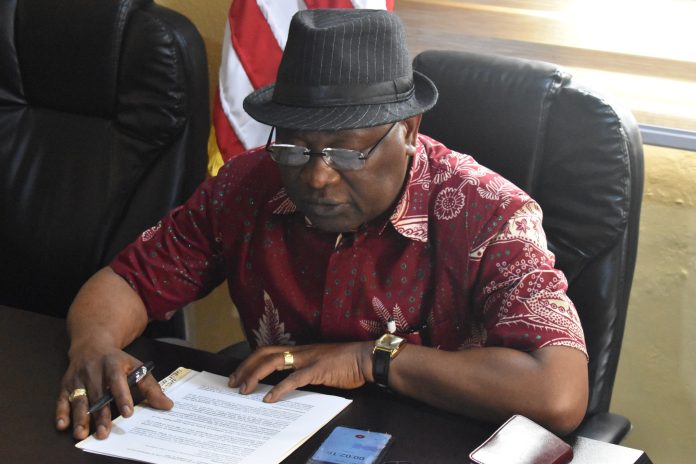
Top: The Chairman of the Land Authority, Samuel Kpakio, illegally signed a deed as part of a fraudulent cocoa agreement between Grand Gedeh County and a Burkinabé businessman. Filed picture/Liberia Land Authority


By James Harding Giahyue and Varney Kamara


  • The Chairman of the Liberia Land Authority, Samuel Kpakio, signed a deed for a 500-acre cocoa farmland in Grand Gedeh County, violating a moratorium that President Joseph Boakai pronounced in the State of the Nation Address.
  • The transaction was a part of a fraudulent agreement between Grand Gedeh County and a Burkinabé cocoa farmer, which, authorities say, has been terminated
  •  The surveyor who surveyed the land is unauthorized to conduct a government survey. Mr. Kpakio even signed the deed before the surveyor completed his work.
  • The survey was secretly conducted, and there was no record that the land was put out for competitive bidding as required by law
  • The deed was issued to an unlawful, inexistent recipient  

MONROVIA – Over the weekend, the Liberia Land Authority said Grand Gedeh County Superintendent Alex Grant “misled” it in a fraudulent cocoa farming agreement with a Burkinabé businessman. The 30-year deal, worth US$600,000, has been canceled, according to county officials.

“The Superintendent and the County Land Administrator of Grand Gedeh misled the … [Land Authority] during the issuance and signing of the said deed, thereby bypassing established procedures and guidelines required for granting a development grant deed,” the Land Authority said in a statement. It provided no evidence to back that claim.

The Land Authority revoked the deed and suspended two staffers in its Grand Gedeh Office in connection with a deal that targeted 500 acres of ancestral land in the B’hai District. It said it was investigating Paye Freeman, the County Land Administrator, and David Togbasie, Land Dispute Officer. The two men would not speak on the matter.

But a DayLight investigation has uncovered that the Chairman of the Land Authority, Samuel Kpakio, masterminded the deal. Government documents and interviews with officials revealed that Kpakio violated a moratorium to support the agreement. The Land Authority boss utilized an unauthorized surveyor and skipped the legal processes, as mentioned in the weekend press release. The deed was even intended for an unlawful recipient.

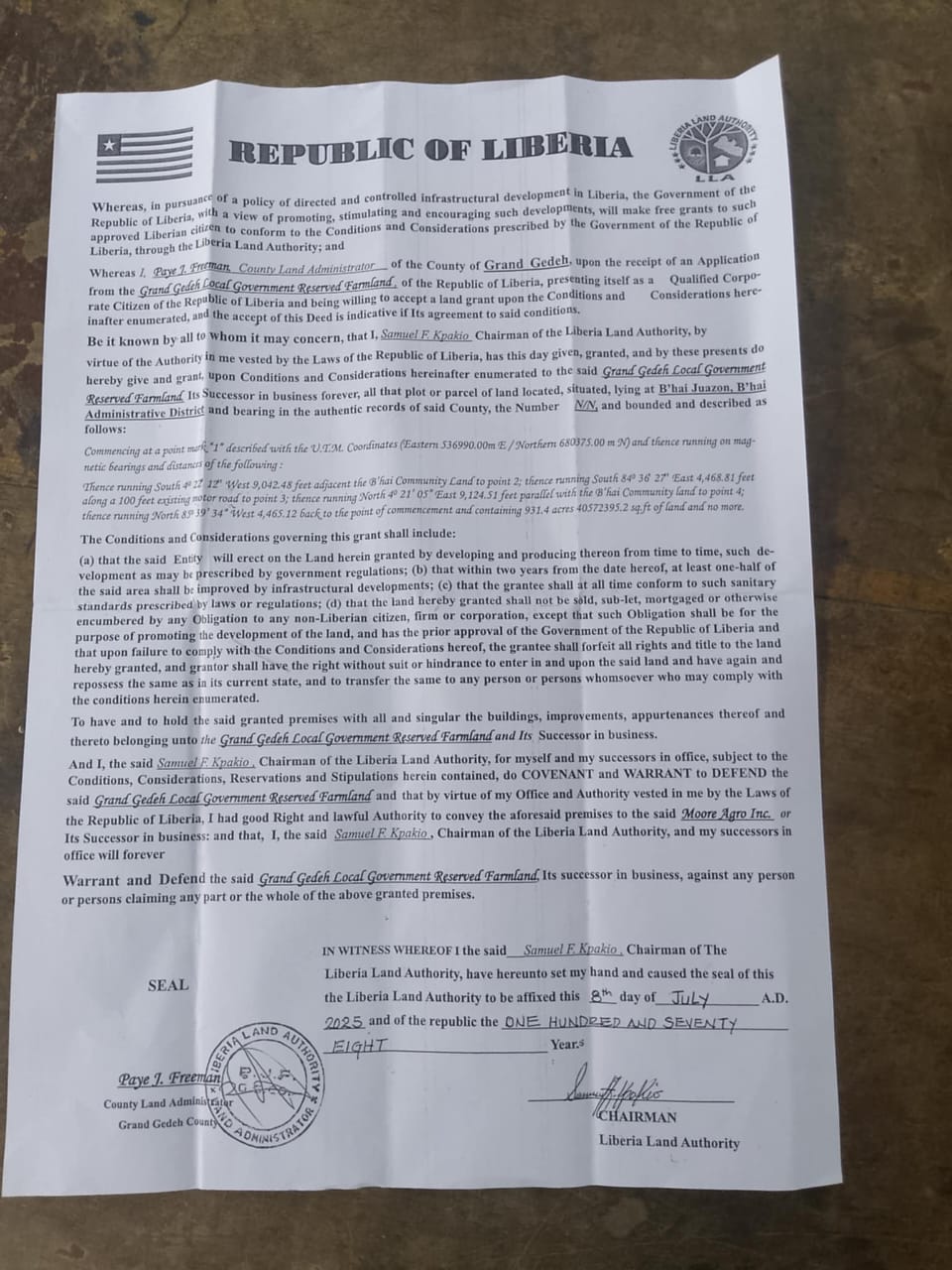
The DayLight obtained the deed in question for the 500 acres and observed several issues with the document.

First, Kpakio signed the deed on July 8, 2025, when the moratorium on public land sale was active.  The moratorium was issued last year and announced by President Joseph Boakai during this year’s State of the Nation Address, pending the creation of guidelines to prevent land-grabbing.

“These efforts aim to enhance tenure security, resolve conflicts, and promote sustainable land investment throughout Liberia,” the President said. It was lifted on July 31, 2025, twenty-three days after Kpakio signed the deed.  

In Friday’s press release, the Land Authority detailed the accusations against Mr. Grant, citing provisions in the Land Rights Act he had allegedly violated. However, the institution glossed over its own actions and inactions, failing to say why it suspended the staffers. This concealed Kpakio’s role in the scandal, while shifting blame to Grant, Freeman, and Togbasie.

While Freeman and Togbasie’s roles in the scam are unclear, the evidence establishes Mr. Grant’s wrongdoing: not obtaining the community people’s consent. However, Mr. Kpakio’s blame game contradicts his position as head of the Land Authority.

Mr. Kpakio is no stranger to land matters.  Before being appointed Chairman of the Land Authority, Mr. Kpakio served as director of land use planning and management with “distinction,” according to the institution’s website. Moreover, the Liberia Land Authority was established as a “one-stop shop” for land transactions countrywide, not the Office of the Superintendent.

The DayLight caught up with Mr. Grant in Paynesville on Saturday, but he declined an interview. However, he had admitted to his wrongdoing before canceling the agreement.

“I regret that the locals were not informed by the district’s authorities.  I think is a procedural error,” Grant told a team of reporters in an interview in Zwedru City. “Once they don’t agree, and we agreed, we can both come to the negotiation table and have a conversation around it.”

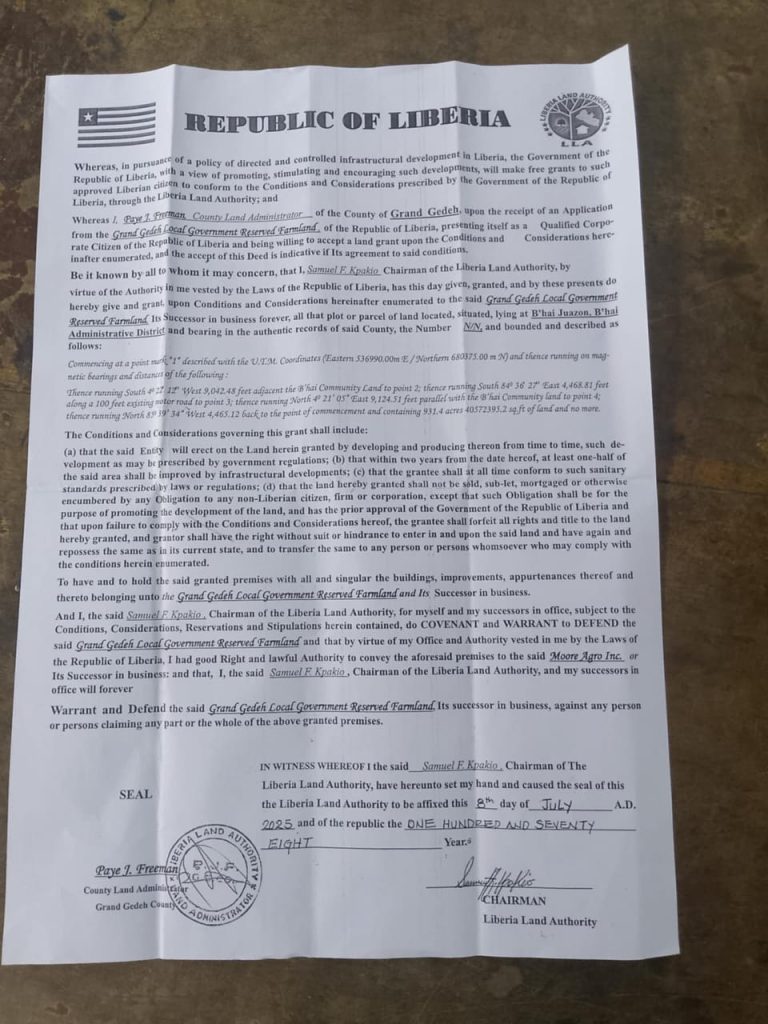
A copy of a fraudulent deed bearing the signature of the Land Authority’s Chairman, Samuel Kpakio 

Second, The DayLight also observed another irregularity with the deed Kpakio signed that has nothing to do with Grant. David Sluwar, a licensed private surveyor, had surveyed the land and signed the document, a red flag, the surveyor’s roster shows.  A private land surveyor does not survey a government plot; there are 56 government surveyors registered to do this job.  

People familiar with public land procedures and processes believe Sluwar played a crucial part in the scandal. “No government surveyor could have signed that deal,” said one official, who asked not to be named over fear of retribution.

There is another issue regarding Mr. Sluwar, though. Mr. Kpakio signed the deed before the private land surveyor completed the survey, another red flag. The document shows that Mr. Sluwar signed it on July 10, two days after Mr. Kpakio. In normal land transactions, the Chairman of the Land Authority signs a deed after the survey is completed, not before.

Furthermore, details of the survey were not published in line with the Land Rights Regulation. The 2022 instrument calls for published details of a government land survey to be published in a government gazette, in at least two newspapers and radio stations, in local languages.

The regulation also requires the Land Authority to publish a survey notice for at least one month. Like the details, there is no record that a survey notice was published.

The Chairman of the Land Authority, Samuel Kpakio, signed the deed before the survey was completed.

Efforts to get Sluwar’s side of the story did not materialize. His mobile phone number was switched off on Sunday and Monday, and he did not respond to text messages. The DayLight has contacted the Surveyor Licensing and Registration Board about Mr. Sluwar’s role in the scandal.  

Third, The DayLight gathered evidence that the Land Authority did not vet the land in question before Kpakio signed the deed. Normally, its vetting department verifies whether there are issues.

Failure to verify explains why the agency did not identify that the 500 acres were customary land. The land, located on the Liberia-Ivory Coast border, was unused because it is a far-to-reach area. However, the plot is easily accessible from the Ivorian side.

Fourth, there is no record that the land in question was put out for a competitive bidding process as mandated by the Land Rights Act.

The newspaper observed one more inconsistency. The deed was granted to the Grand Gedeh Local Government Reserved Farmland, which does not exist. A development grant deed is not awarded to a farmland. Rather, it is issued to a person, an institution, an NGO, or any legal entity. In fact, such a deed is so delicate that the new guidelines require the signatures of three commissioners.

Mr. Kpakio evaded all The DayLight’s efforts for an interview. He did not respond to detailed questions on WhatsApp on Sunday and directly to his office on Monday.  He also declined an interview on Tuesday and was unavailable on Wednesday.

Regardless, Mr. Kpakio’s well-documented actions contradict his induction speech in February, in which he spoke about reforming the Land Authority.

“There will be no room for unethical and unprofessional conduct, both in administration and in our interactions with our development partners and the Liberian public,” said Kpakio.

“The Liberia Land Authority will operate differently this time. Our work will be grounded in our core values: quality service delivery, transparency, fairness, accountability, integrity, professionalism, and respect.”


[Additional reporting by Paul Rancy in Zwedru, Grand Gedeh County]

Integrity Watch Liberia provided funding for this story. The DayLight maintained complete editorial independence of its content.

Podcasts