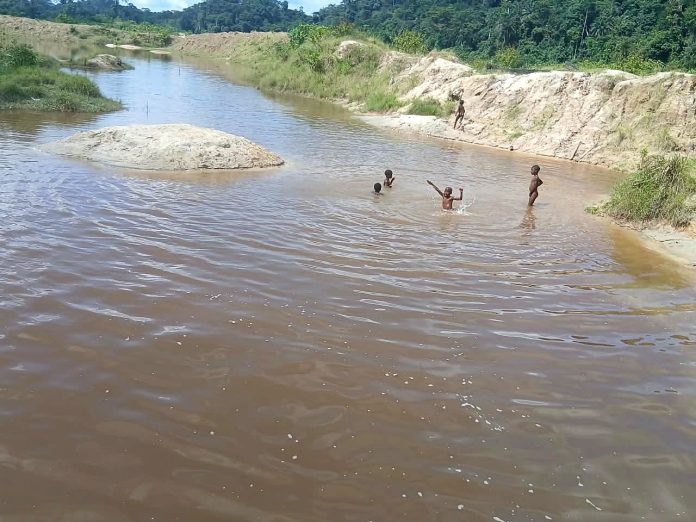
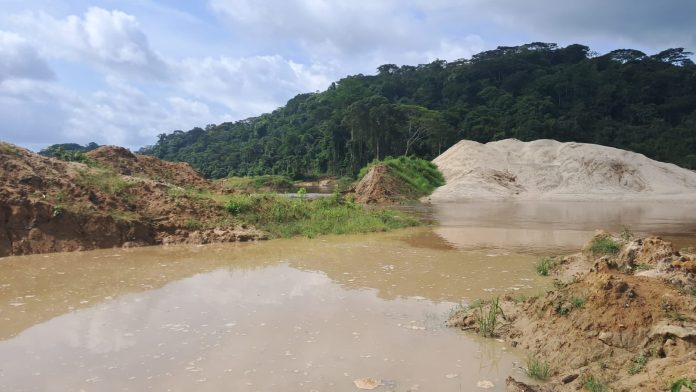
Children play in a mine water in Tartuken, River Gee
Top: Some minors bathing in an open mine pit left behind by Gee Mining. The DayLight/Prince Copeland
By Esau J. Farr, Sr.
TARTUKEN, River Gee County – It is Saturday, October 17, 2026, and six children swim in a mining pit just outside of Tartuken, a large, hilly town in River Gee’s Nyeniwroken District. Shortly after, a relative of one of the children came by and made them vacate the water.
“What are you doing there?” The woman asked the fleeing children. “Didn’t we tell you not to swim in this water? Do you want your mothers to wear black?”
The water the children were swimming in was not always there. It is a remnant of illegal mining activities conducted last year by the Gee Mining Resources Limited, a new company with links to a notorious miner.
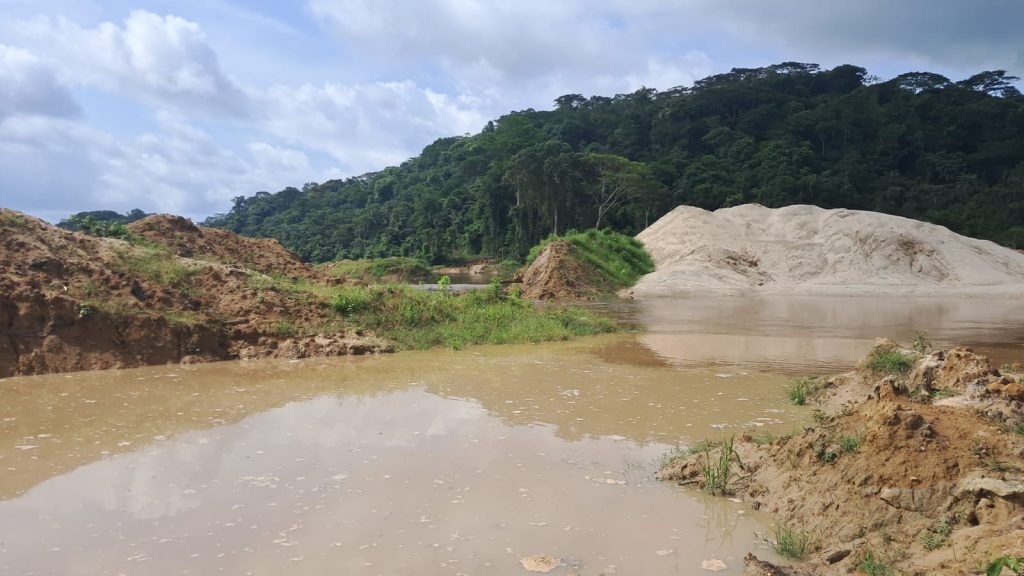
Last year, Gee Mining obtained a class B or medium-scale license to mine gold in Tartuken, just five months after it was established. It diverted a creek into an open field and created what residents dub a “river,” and dug gigantic holes. After roughly two years, Gee Mining ceased its operations and left the site without having fully restored the land.
Residents fear for the worst. They say the open pits, a minute’s walk away, are too close to the town to be avoided. Reporters photographed people who had to swim to cross the pits to their farms.
“The way the place is opened is not correct. It is a threat to us. It could bring trouble to the town in the future,” said Lawrence Dweh, a Tartuken classroom teacher. “We are fearing for the lives of our children and ourselves.”
Paul Kity, Tartuken’s chief elder, shares locals’ concerns about the endangerment of lives there. “We don’t want death trouble here,” Kity said.
A portion of one of two mines Gee Mining Resources Group Limited operates in Tartuken, River Gee County, that is outside its authorized claim. The DayLight/Prince Copeland
Sylvester Shaw, Gee Mining’s liaison officer, agrees with the townspeople, but blamed them for the hazard. He said Gee Mining wanted to refill the holes, but community leaders stopped them because they wanted to mine there themselves.
Elders confirmed Shaw’s claim. They told The DayLight they were receiving LD$5,000 (about US$30) weekly from sifting the pits.
“We told them that they should not close those holes so we can put our [machines] there and get small money,” said Kity.
Realizing the danger their decision poses to residents, Kity conceded. “I think the way it is happening there, let them close [the pits],” he told The DayLight.
Regardless of the agreement between the company and the community, the Minerals and Mining Law of 2000 mandates all license holders to reclaim their mines after their closure. The same goes with the Environmental Protection and Management Law. Both statutes do not leave any room for leaving a mining site partially restored upon locals’ request.
David Sayon, an agent of the Ministry of Mines in the region, confirmed Gee Mining violated the law. He said its other activities were illegal too.
“Diverting the water is dangerous for lives and living things in the water. That was the first crime they committed, and it is not also good for our people,” said Sayon in a phone interview.
The head of the Environmental Protection Agency in River Gee said the EPA would punish Gee Mining. Johnson Nowon said he had sent a report of Gee Mining’s illegal actions to the EPA’s headquarters in Monrovia.
“When they leave the place, they are not leaving the country. Wherever they go, we will trace them and bring them back to reclaim the land,” Nowon told The DayLight.
Worjolo, Gee Mining’s owner, said he was open to going back to Tartuken to fully restore the site. He had diverted the creek because he wanted to provide towns and villages downstream with clean water.
Other offenses
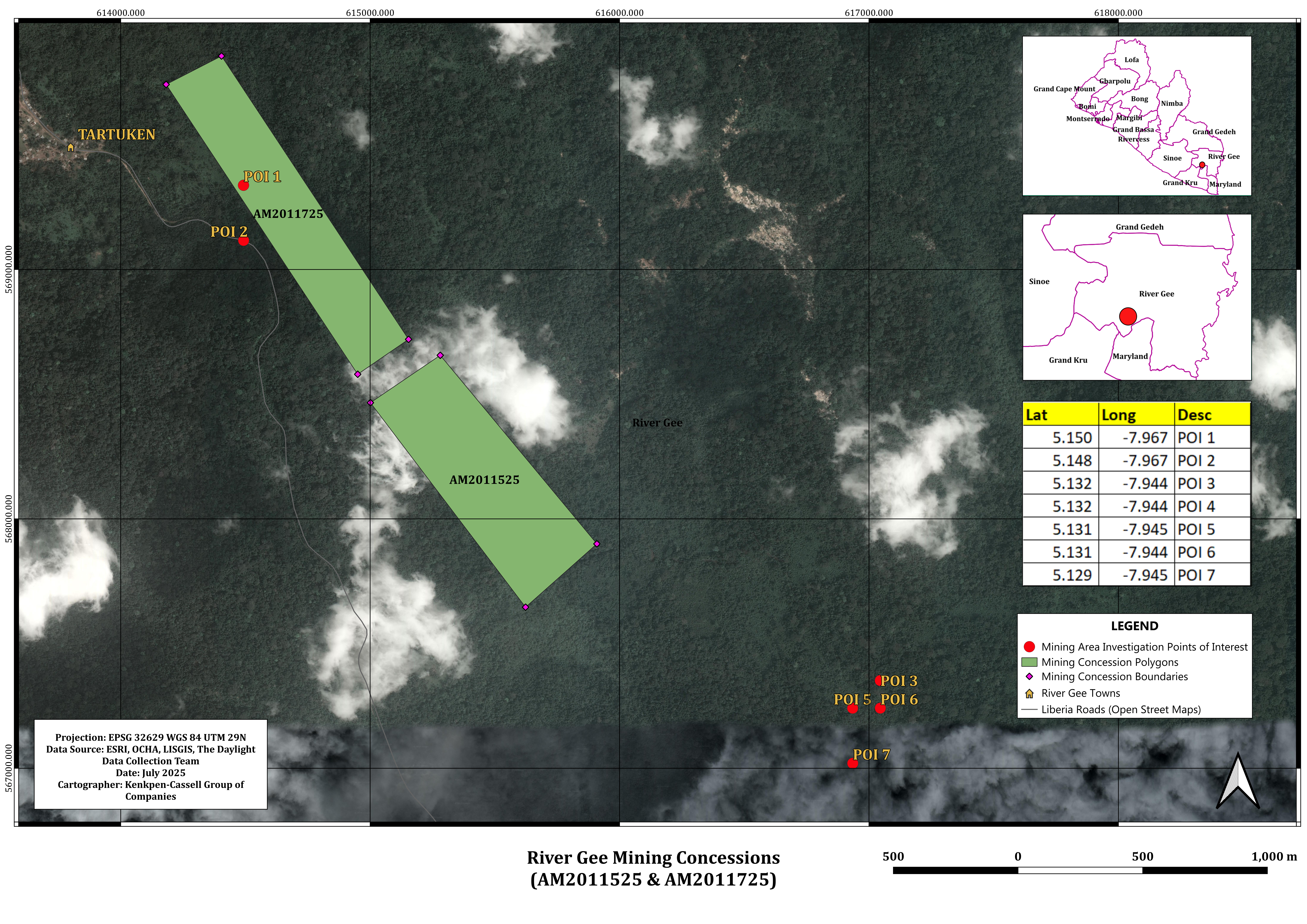
Besides diverting a creek and not fully restoring the land, Gee Mining committed other offenses in Tartuken. Its environmental permit prohibits the company from operating outside its licensed area. However, a DayLight investigation utilized satellite imagery and found that Gee Mining operated at least a thousand meters from its claim.
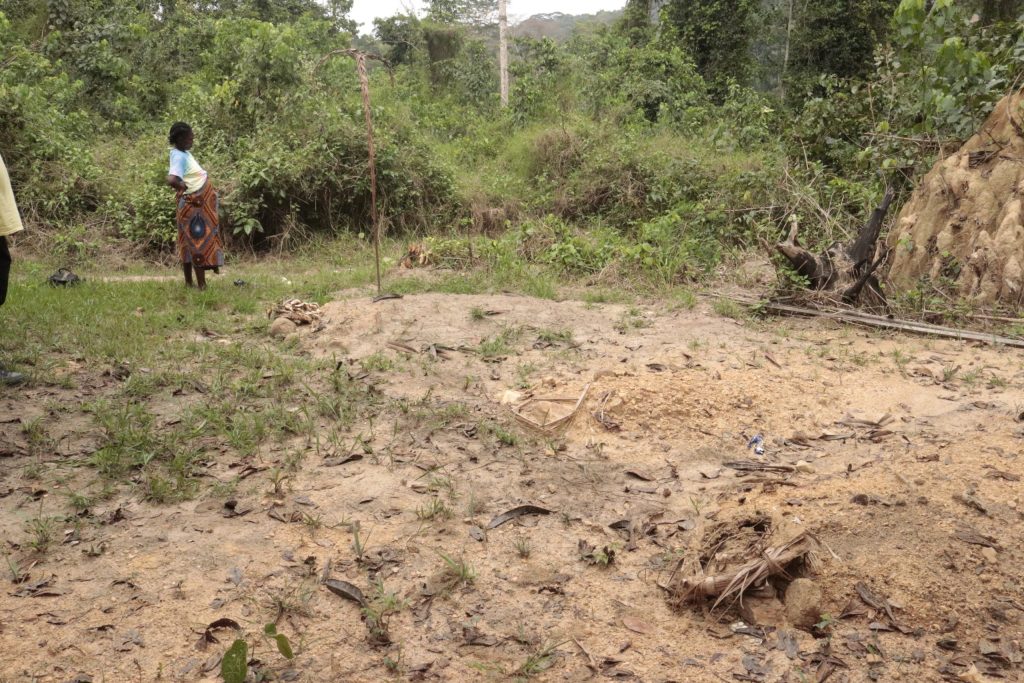
A graveyard of miners who drowned in abandoned mining pits in Lofa. The DayLight/Samuel T. Jabba
The offenses began even before Gee Mining dug the first hole in Tartuken. Although it conducted the mining activities, Gee Mining did not sign an MoU with Tartuken. (A company signs an MoU with host communities as a legal obligation).
The company that signed the MoU was RAC Incorporated, owned by Randy Scott, a miner involved in several offenses across the country. About the same time RAC signed the Tartuken MoU, several miners drowned in mines operated or associated with Scott in Gbarpolu and Lofa.
RAC had signed the MoU in July 2024, a month before Gee Mining was established. However, it had compliance issues, so Scott contacted Nelson Worjolo, his aide, to establish Gee Mining to continue the work. Gee Mining promised to correct the MoU to remove RAC, but failed to do so.
Campaigners calling for reform of the mining industry want a new law that strengthens environmental safeguards and enforcement of land reclamation and accountability for environmental degradation.
This story is produced by DayLight with support from theEmbassy of IrelandthroughIntegrity Watch Liberia. The DayLight maintained editorial independence over its content, which does not reflect the position of the Embassy of Ireland or Integrity Watch Liberia.
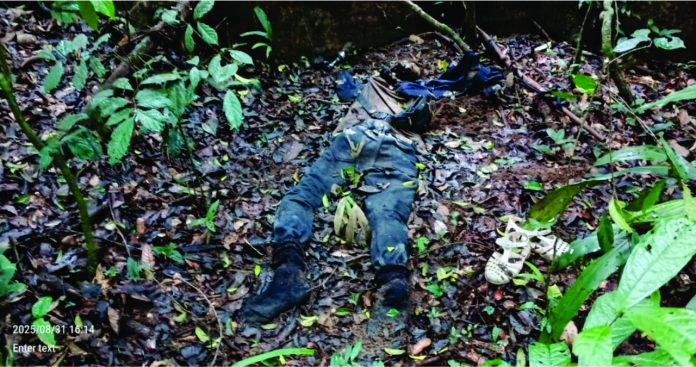
Top: The decomposed body of Deppuh Kobera, a 15-year-old Ivorian cocoa farmer, is discovered in a River Gee forest. The DayLight/Prince D. Copeland
By Prince D. Copeland
FISH TOWN – An Ivorian boy who recently crossed the Ivorian border into Liberia to work on a cocoa farm has been found dead in a River Gee Forest, the police said.
Fifteen-year-old Deppuh Kobera had gone missing last Wednesday, farming cocoa in the Kwawe Gee-forest in Glorra District Forest, according to the River Gee Police Detachment. His body was discovered three days later in a nearby forest, beheaded, with bullet wounds to the head. A 15-man jury confirmed foul play.
“The investigation is growing deeper to establish who his killers are, how he came to Liberia, who lodged him, and where he was living,” said Theophilus Togba, River Gee Assistant Police Commander. “The situation is really tragic and embarrassing because someone crossed the border from the Ivory Coast into Liberia and lost his life here.”
No suspects have been arrested since the discovery. Meanwhile, the investigation continues, according to the police.
“We have started speaking with residents in that place, and they are giving us some traces of the incident,” Togba said to this reporter without stating when the outcome of the investigation would be released to the public.
Kobera’s death is the fourth in the region linked to the influx of Burkinabe cocoa migrants. Last month, Eric Nyenpan, Sabastine Saylee, and Aaron Teah, three men of the Kiteabo and Glarro subtribes, were murdered in a land dispute. Over 20 suspects were arrested and sent to the Fish Town Central Prison, where they await trial in that case.
With support from Liberian hosts, Burkinabes cross the border along the Cavalla River in search of cocoa farmland. Immigration authorities have recorded 55,000 Burkinabés, with over 4,000 recorded in River Gee.
This story was a Community of Forest and Environmental Journalists of Liberia (CoFEJ) production
Top: A portion of one of two mines that Gee Mining Resources Group Limited operates in Tartuken, River Gee County, that is outside its authorized claim. The DayLight/Prince Copeland
By Prince Copeland, for The DayLight
One company, RAC Incorporated, has an MoU with a River Gee community, while another, Gee Mining Resources Ltd, conducts the operations
Satellite imagery shows that the operations are outside Gee Mining’s two claims in the Nyeniwroken District, a violation of the Minerals and Mining Law
RAC’s business registration certificate expired on Independence Day last year. However, it was issued an exploration license. Randy Scott, RAC’s majority shareholder, is one of Liberia’s most notorious miners
The evidence suggests that Nelson Worjolo, Gee Mining’s owner, is fronting for a non-Liberian
Townspeople benefit from dredging activities on the Gee River next to Gee Mining’s claims, and right under a local Ministry of Mines agent’s nose
TARTUKEN, River Gee County – Towering trees background huge sand mounds, water-filled pits, earthmovers, plastic barrels and a fuel tank. Mineworkers operate machines, digging through the brown earth. Pipes transport water from a nearby river to large, makeshift plants, where gold nuggets are trapped in inclined carpets.
This goldfield in Tartuken, Nyeniwroken District, looks like one of River Gee’s 48 active regulated mines. However, official documents, satellite imagery, a Ministry of Mines repository, and interviews proved otherwise. Turns out, the mine is illegal and is linked to one of Liberia’s most notorious miners.
Our story starts on July 10 last year, when RAC Incorporated, owned by a man named Randy Scott, signed an MoU with Tartuken’s chiefs and elders. In the document, RAC promised to build a guesthouse, a clinic and pay the community US$500 each month, among other things.
The company is delivering on its promises. This reporter documented three hand pumps, the five-bedroom guesthouse, while the elders confirmed that RAC paid monthly fees, including US$100 each for six teachers.
But the reporter noted a red flag when he interviewed townspeople. RAC had signed the MoU on behalf of Gee Mining Resources Group, a five-month-old company with no prior mining experience. Nelson Worjolo, Gee Mining’s owner, signed the document for Scott.
Confronted with the finding, Scott confirmed the information in a phone interview with the reporter. He disclosed that Gee Mining conducted the actual mining, while RAC handled community projects.
An excavator at work at a Gee Mining mine in Tartuken, River Gee County. The DayLight/Prince Copeland
“Yes, Gee Mining and RAC are in partnership. They are the same,” Scott, who holds 95 percent of RAC’s shares, phoned this reporter.
Worjolo also confirmed the inconsistency. He said RAC had intended to conduct the operation but it had a “small issue,” so Scott contacted him. He had spoken with the community about correcting the MoU but suspicious locals refused. He would rectify the issue in the coming weeks.
Elijah Toe, an elder who signed the MoU, denies Worjolo’s story. “No, they never came back to tell the townspeople that they were changing the company’s name from RAC to Gee Mining,” said Toe.
Myers Moyan, a Tartuken elder, corroborated Toe’s comments. “They didn’t tell us the elders the difference [between the two companies],” Moyan said.
‘Hold the ground’
Seeking the truth, the reporter turned to RAC and Gee Mining’s documents and the Ministry of Mines and Energy repository.
The search proved Gee Mining had two medium-scale or class ‘B’ gold licenses in the Tartuken area, and RAC Incorporated’s only license is in Zorzor, Lofa County. So, RAC truly signed the MoU but Gee Mining conducted the operation, a red flag.
But the repository shows that the Tartuken MoU was signed at least six months before the licenses were issued, and three months before Gee Mining prospected the area.
Worjolo said they signed the MoU that early because it was part of the requirements for the licenses. Asked why he signed the MoU before prospecting, he said they were sure the area had gold, which is not a requirement but is not illegal. “We did that to hold the ground first before prospecting,” Worjolo said.
A portion of Gee Mining’s illegal gold mine in Tartuken, River Gee County. The DayLight/Prince Copeland
Next, the reporter reviewed RAC and Gee Mining’s business registration certificate. Interestingly, RAC’s business registration certificate had expired on Independence Day last year and has not been renewed as of August 5. This means that RAC was ineligible for the gold-exploration license it was awarded in January for Lofa County.
Gee Mining’s business registration certificate and article of incorporation identify it as a Liberian company. However, the ministry’s repository recognizes it as a “Liberian and foreign-owned.” This appears to explain why Worjolo said he needed to talk to his boss in Monrovia before talking to us. The evidence suggests he is fronting for a mysterious non-Liberian.
Worjolo did not respond to queries for comments about his company’s ownership.
Outside the claims
Now suspicious of everything, the reporter decided to focus on the mine’s location. Was the digging inside or outside Gee Mining’s claims? Is the claim this close to the river?
To answer those questions, the reporter turned once more to the Ministry of Mines’ repository. There, the ministry stores maps of all medium and large mining claims. Those maps come with the shapes of the claims and coordinates, imaginary vertical and horizontal lines called longitudes and latitudes.
Armed with that information, the reporter took the photographs fitted with Gee Mining’s goldfield coordinates and presented them to a DayLight geolocation expert.
The expert uploaded the data into a certain software. Utilizing data from the Liberia Institute for Statistics and Geoinformation Services (LISGIS), the expert found the location. Then he drew up a map with Google Earth, a computer program that uses satellite imagery.
The map established that the mine the reporter photographed was at least 1,000 meters away from Gee Mining’s claims. Even a second mine the reporter snapped was just outside the company’s other claim.
This Google Earth map shows that Gee Mining operates outside its legal claims in Tartuken, River Gee County. Kenkpen Cassell Group of Companies for The DayLight
Confronted with this evidence, Worjolo said it was “not to my knowledge” that his operations were outside the authorized locations.
Scott, on the other hand, suggested that Gee Mining had a small-scale license for the operations in question. However, the repository shows that neither RAC nor Gee Mining has a small-scale or class ‘C’ mining license. Even if it did, earthmovers are outlawed in small-scale claims with soft or sandy grounds as Tartuken.
Mining outside one’s claim is a criminal offense, according to the Minerals and Mining Law. Violators face a US$2,000 fine, up to 24 months in prison, or both fine and term upon conviction by a court. The penalties could be harsher if prosecutors increased the charges.
Dredges on the river
RAC/Gee Mining’s illegal mines lie next to the Gee River, after which the county got its name in 2000. Gee or Chee means “leopard” in the Grebo language, but there was no sighting of the critically endangered big cat. Instead, four dredges, rafts made of plastic barrels with machines used to suck sediments from water, decorated the muddy river.
This alerted the reporter, who was aware that dredging had been banned since 2019 due to its associated environmental harms. From that moment, the reporter’s attention switched from land to water, and the mystery began to unravel instantly.
The miners operating the dredges said that they paid Tartuken’s locals a weekly fee they would not say. Chiefs and elders corroborated their claim. “It is true they were asked to pay L$15,000 per canoe (dredge) but they accepted to pay L$10,000 per canoe. We have only received L$30,000, which is equivalent to three canoes,” said Paul Kity, an elder spokesman.
Miners conduct a slew of dredges on the Gee River in Tartuken, River Gee County. The DayLight/Prince Copeland
The dredge operators said they paid the RAC/Gee Mining an undisclosed amount weekly. They also paid one gram of gold or L$20,000 (US$100) monthly to Tanneh Borteh, the ministry’s agent for that region.
“If we are not paying anything, I will tell you, but we are paying dues to the mining agent, the town people, and the claim agent too,” said Habib Zigi, a Ghanaian miner who operates two dredges.
Worjolo, RAC/Gee Mining’s owner, denies Zigi’s claim. He said he had driven the dredgers from the area on multiple occasions, but they always returned.
Similarly, Borteh, the ministry’s agent, who also denies any wrongdoing, said the same thing. “I went there and I told them to leave the water, ‘I don’t want you to lose your properties.’ Since then, I have not gone there,” Borteh said via mobile phone.
Notorious illegal miner
Based on Gee Mining’s legal documents and a desk review, Tartuken could be Worjolo’s first known illegal mining operation. However, it only adds to Scott’s brushes with the law.
In 2023, a DayLight investigation found that Urban and Rural Services, a company Scott has ties with, operated an illegal gold mine in Todee, with the aid of Montserrado County officials. It found that the company ran a full-scale mining operation with a prospecting license.
A relative of Prince Hali, a mineworker who drowned in a mining pit left by illegal mining activities in Bella Yalla, is helped from the scene after his body was recovered in January 2024. The DayLight/James Harding Giahyue
A follow-up investigation established that the license had expired and that the company had evaded taxes. Scott claimed that the license overstayed due to the coronavirus, though the pandemic had no such impact on the industry. Except for the involvement of two companies, Scott’s Todee illegal operations bear a striking resemblance to his Tartuken illicit activities.
A year after Todee, Scott was involved in a US$48.8 million lawsuit in Belle Yalla, Gbarpolu County. It was what Worjolo referenced in explaining why Gee Mining stepped in for RAC, though it signed the Tartuken MoU.
Perhaps the largest illegal mining scandal in Liberia’s history, Scott, Gao Feng, a Chinese nicknamed “the real minister,” and other people, allegedly encroached on another company’s mine. Scott was accused of defrauding the Liberian government of nearly US$12 million, according to a Ministry of Justice estimate.
Scott and the other suspects were accused of economic sabotage, tax evasion, criminal conspiracy and environmental degradation. In January last year, a man in his 20s drowned in a mine pit that mineworkers had abandoned in the community.
This story was a production of the Community of Forest and Environmental Journalists of Liberia (CoFEJ).