Home Tags Konobo Community Forest

Tag: Konobo Community Forest

Shadow Firm Smuggled over US$400K of Timber to Ivory Coast

Shadow Firm Smuggles over US$400K of Timber to Ivory Coast
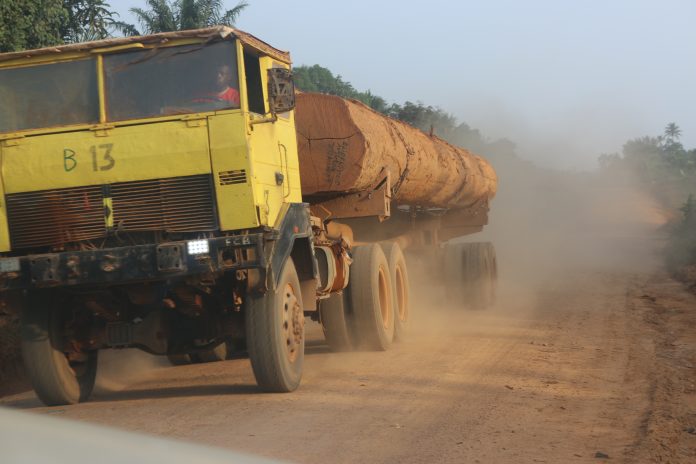
A truck transports logs outside Greenville, Sinoe County in 2023.

Top: A truck transports logs outside Greenville, Sinoe County, on January 3, 2023. The DayLight/James Harding Giahyue


By Varney Kamara


MONROVIA – Horizon Logging Limited, an Israeli-owned logging company with unknown owners, smuggled timber to the Ivory Coast on multiple occasions, valued at US$437,000, A DayLight investigation found.

The two shipments occurred in 2023 and 2024, according to Trademo, a US-based business platform that publishes international trade data. However, those shipments happened outside of LiberTrace, Liberia’s legal timber-trading system.

Of the total value, Horizon shipped US$163,790 in 2023 and  US$273,380 in 2024, the data shows. One of its Ivorian buyers is the Abidjan-based Sdma, which offers sea, air and land transport services.  

A review of all of Horizon’s export records through LiberTrace shows no trace of the Ivorian shipments. Further review of its trading at the Ministry of Commerce & Industry and the Liberia Revenue Authority produced the same result.

Companies can trade outside LiberTrace and still pay export taxes to the LRA due to weak coordination among public entities. However, Horizon did not pay any taxes for its Ivorian shipments, the LRA records show. This means the exports happened outside the entire government system and were smuggled across the eastern borders. The exports were documented because the Ivorian government declared them under international trade protocols.

Exporting logs outside the legal system violates the Regulation on Establishing a Chain of Custody System. The regulation provides that timber is traced from its origins to the final destination. The idea is a centerpiece of forestry reform and Liberia’s timber trade agreement with the European Union, which has decided to terminate the deal over continued violations.

Ivory Coast, likewise, prohibits the illegal importation of timber, according to the country’s regulations on the import and export of forest products. The laws state that entities engaged in the import of forest products must get approval from the Ivoirian Minister of Water and Forests, and documentation of a timber legal origin.

“Illegal timber extraction and shipments create a compounded loss for Liberia. Communities lose legitimate forest benefits, livelihoods and climate resilience, while government loses revenue and potential economic benefits, says Dayugar Johnson, the lead campaigner at the Civil Society Independent Forest Monitor.

“At the community level, illegal logging and exports can deprive forest-dependent communities of social benefits and other revenues that could support schools, health facilities, roads, water systems and livelihoods, undermining their rights, as well as fueling local conflicts.” 

Mystery owners

The illegal shipments are not the company’s only wrongdoing. The DayLight found other issues with Horizon’s ownership. Horizon Minerals BV holds 99 percent of Horizon’s shares, and one Dov Aronvich holds the remaining. However, Horizon Minerals BV does not list its shareholders, a requirement under the Beneficial Ownership Regulation of 2023.

Originating from the Liberia Business Association Act, the regulation requires companies to declare their ultimate beneficial owners or the individuals who own them. It is part of a global scheme to combat financial crimes, including money laundering, terrorist financing, and tax evasion. As part of that fight, the Liberian cabinet approved the establishment of a beneficial ownership registry.
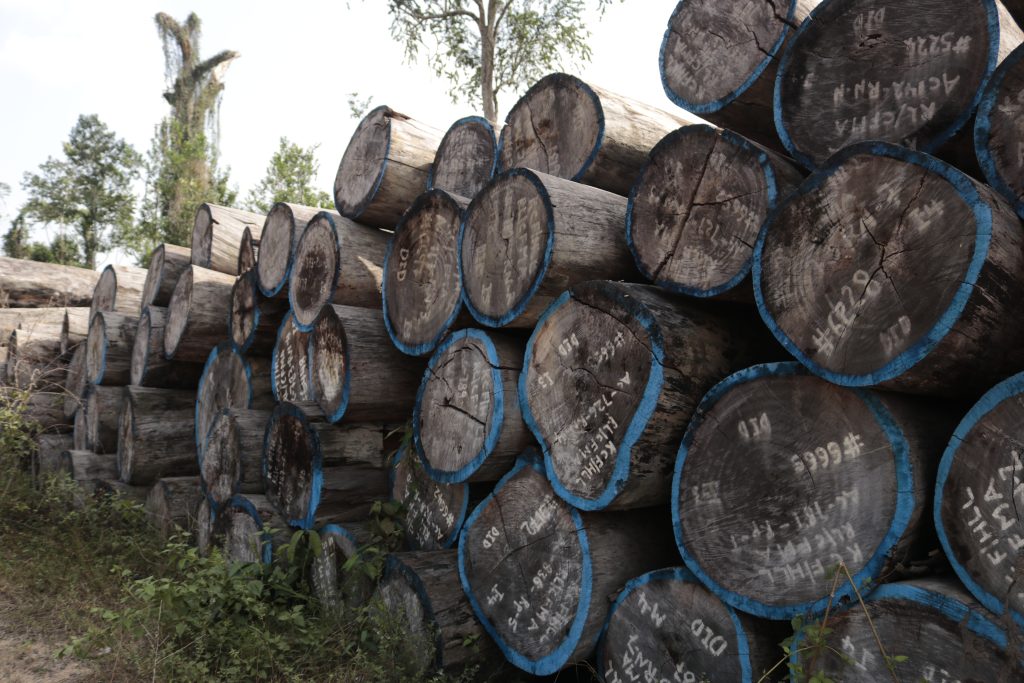
Horizon Logging Limited abandoned several logs in Konobo Community Forest, Grand Gedeh County. DayLight/Samuel Jabba

Horizon has been inactive for two years now, according to its business registration certificate. It deserted a 15-year logging contract with the Konobo Community Forest in Grand Gedeh County. It promised to pay the community, build a school, and erect hand pumps, among others, in exchange for harvesting Konobo’s 49,627-hectare forest. Instead, it left unpaid benefits and several logs in the moggy forest and other locations.

Horizon did not respond to The DayLight’s queries for comments.

Augustus Abram, one of its executives, acknowledged receipt of the newspaper’s queries. Later, he denied it was him, even though the newspaper had contacted him earlier this year about Horizon. The DayLight also called his number on official documents and emailed him, but both attempts failed.

Moreover, The DayLight tried contacting Lev Segev, another Horizon executive, but that effort proved unsuccessful. The newspaper then emailed Jamil Ali Fayad, Horizon’s incorporator, but that too did not materialize.     
Cocoa Changing Lives but Destroying Grand Gedeh’s Largest Forest

Boundary Town deforested 1 scaled

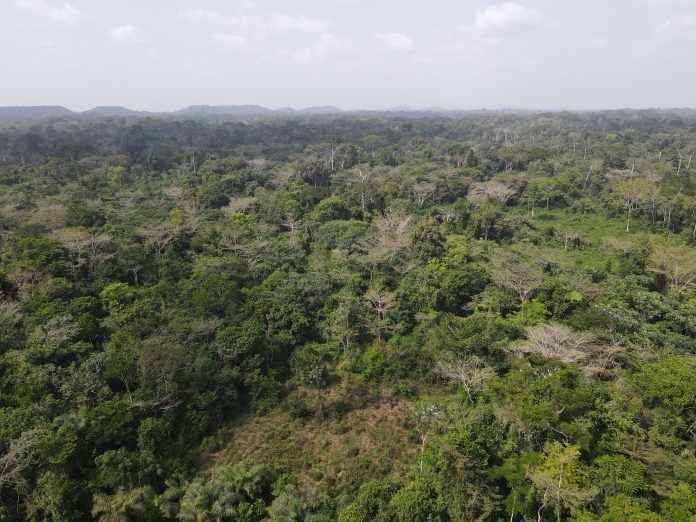
Top: A partial view of the Konobo Community Forest in Grand Gedeh County. The DayLight/Samuel Jabba


By Esau J. Farr   


BOUNDARY TOWN, Grand Gedeh County – Lawrence Koolor woke up one cool morning, his face beaming with a smile and joy pouring out of his heart. Koolor’s dream became a reality late last year when he moved his family into his new house. He had lived in his uncle’s house for decades.

Koolor built his home out of money he received from Burkinabé cocoa farmers he hosts in Konobo. His house—part-mud, part-concrete with metal roofs— stands out among huts with thatched roofs in Boundary, a town on the border between the Konobo and Tchien Districts in Grand Gedeh County.

“I felt so happy that day for me to go and live in my own house at that time,” recalls Koolor. “That was a complete relief for my family to [move from one bedroom] to a whole house.”

Koolor is one of several residents of Konobo, who, along with their Burkinabé guests, have encroached on Grand Gedeh’s largest remaining rainforest. Townspeople in Konobo say the arrival of Burkinabé cocoa farmers in their communities has transformed their lives.

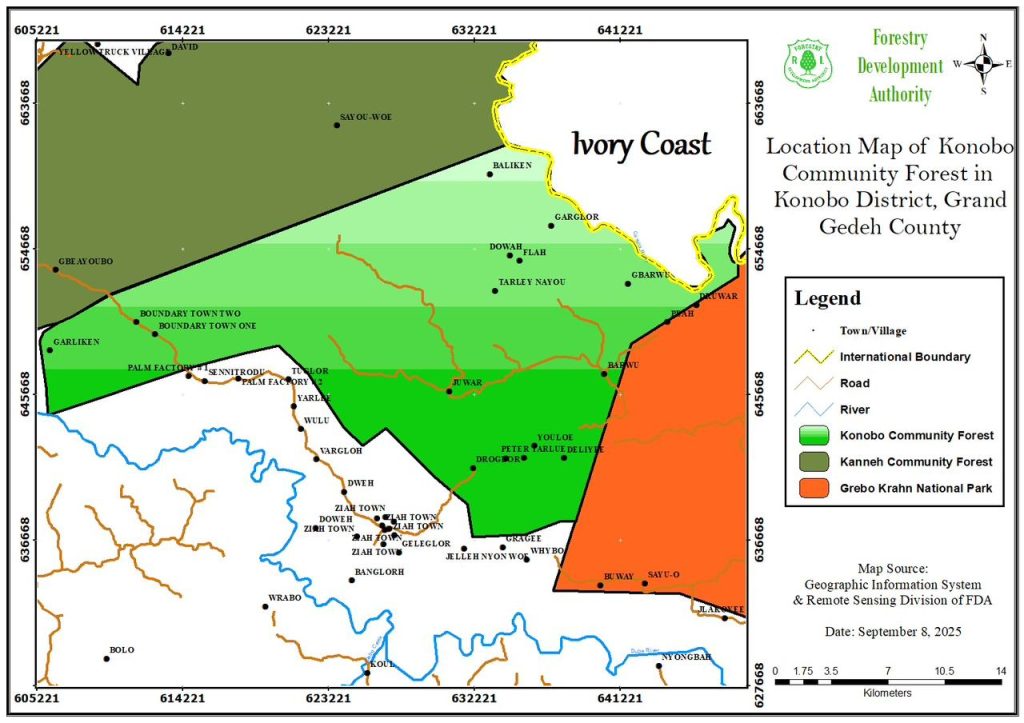
The map of Konobo. File photo/Forestry Development Authority

Konobo has 390,000 hectares of natural forest, according to Global Forest Watch, an application that tracks deforestation. Gbarzon and Tchein Districts are second to Konobo District in Grand Gedeh County, with higher rainforest, 360,000 hectares each.  

Burkinabés likely started migrating into Liberia from the neighboring Ivory Coast in 2014 in search of cocoa farmlands. The Liberia Immigration Service (LIS) has profiled 55,000 Burkinabés in southeast Liberia, 48,000 in Grand Gedeh. Burkinabés, also known as “Mossi,” have agreements with locals in which they provide investment and labor, while the locals provide land.

“The cocoa business that came here is helping to take us from zero to hero,” says Alice Doe, who hosts six Burkinabé migrant workers in Boundary Town.

“Before, we could not get a dime to buy a sheet of zinc. But for now, that story has changed, because before the Burkinabés enter your [forest], they give you [money],” adds Doe.

Interviews and reporters’ observations show Konobo District—a low-income community of 26,588 people—is transforming in several ways. People are earning income from cocoa that they have never earned in their lives. New houses are being built, and one resident is sponsoring his son’s studies in Spain.

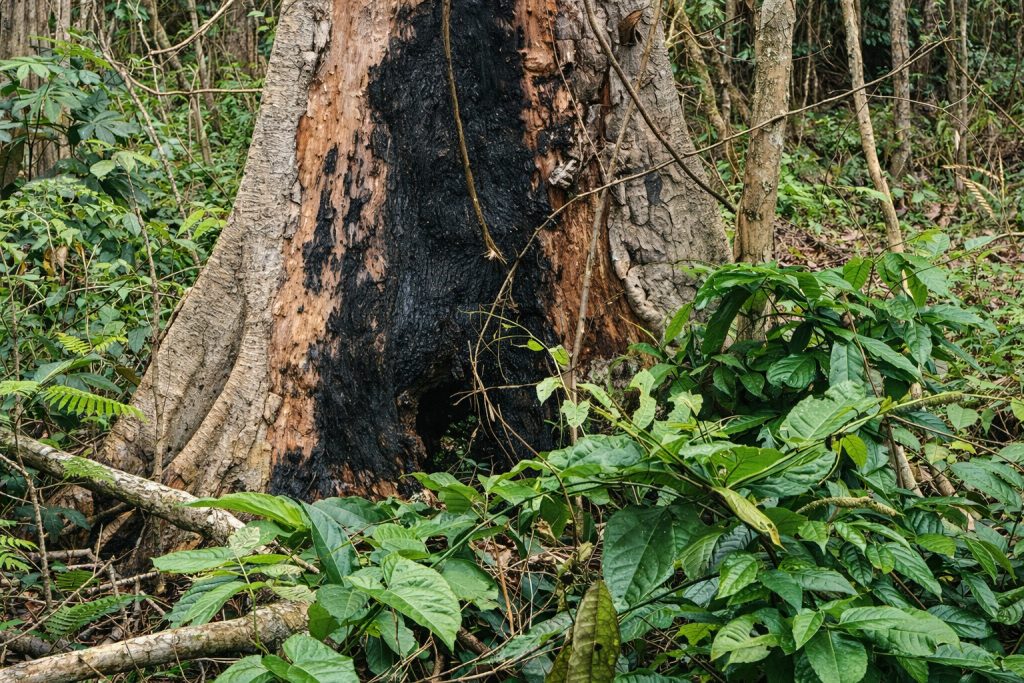
Cocoa farming might be transforming lives in Konobo, but it is wiping out the district’s forest. To plant cocoa, Burkinabés burn down the forest. Reporters saw trees losing their foliage, gradually morphing into woody skeletons.  

Between 2002 and 2024, Konobo lost 9,300 hectares of primary forest. A 2024 study found that 15 percent of Liberia’s deforestation is linked to cocoa cultivation. Then, last November, the London-based Global Witness linked top European chocolate makers to deforestation in Liberia.

‘Under threat’

Satellite imagery confirms that cocoa farmers are encroaching on the Konobo Community Forest, a 49,625-hectare woodland meant for logging. Konobo and the Forestry Development Authority (FDA) signed an agreement in 2020 to co-manage logging activities with the regulator. The agreement outlaws farming in the community forest.

And that is exactly the case. Drone shots show cocoa pods sprouting amid decaying trees and cultivated forests. 

“When the Burkinabés enter the forest, they burn all the trees…,” says Beyan Woi, FDA’s regional manager in Grand Gedeh. “Most of [those] community forests that people wanted to do logging and conservation in are under threat by Burkinabés.”

Burkinabé migrants set fire or apply chemicals to the base of trees in clearing the forest for cocoa cultivation.  File photo/Forestry Development Authority

Woi says the FDA has made efforts to curtail encroachment on forests in the southeast, including prosecution.  

Wulu Gaye, the chief officer of Konobo Community Forest, echoes Woi’s comments. The encroachment is the biggest challenge Gaye, who was recently elected, faces.   

“As we speak, the forest is not well protected. There are illegal farmers farming in the forest,” says Gaye.

Burkinabés-hosts in Konobo deny farming in the community forest, claiming the farmland was their private property.

“I have more than 20 Burkinabés working for me on more than a-kilo-hectare of our farmland here in Boundary Town,” said Dennis Jakar, a classroom teacher and a resident of Boundary Town. Jakar claimed he is using ancestral land for his cocoa farm.

The DayLight could not independently verify Jakar’s and other townspeople’s comments due to the distances to the farms and the security of the reporters. Furthermore, the newspaper could not identify the owners of the farms the drone captured.

However, farmers hosting the Burkinabés say people are farming in the community forest because logging has failed them. Their position is a reference to an inactive logging agreement locals have.

In May 2021, Konobo and Horizon Logging Limited, a Monrovia-based firm, signed a contract. Horizon agreed to construct health facilities, handpumps, and latrines in the affected communities in addition to land rental and harvesting fees. The company failed to carry out the projects, leaving behind unpaid debts and abandoned logs.  Horizon did not respond to queries for comment on the contract.

The contract’s failure is visible throughout Konobo. Several logs are abandoned in Boundary Town, behind a clinic and at other locations. Locals drink from creeks, and there are no public latrines.

“They (Horizon) lied to us; so, we were left with no other option but to put Burkinabés in the concession area to [farm for us],” says Christian Menyeah, a Konobo resident, who hosts three Burkinabé migrants.

“The money we are now getting from cocoa farming is plenty and quicker than what a logging company would give us,” adds Bill Yallah, a host of dozens of Burkinabés migrants.

Gaye, Konobo’s chief officer, says his leadership is working with county authorities to remove the encroachers from the community forest.

Gaye says, “Well, all the local authorities [bought] the idea that there’s a need that we remove the illegal farmers…”


Samuel T. Jabba contributed to this story.


This story was a production of the Community of Forest and Environmental Journalists of Liberia (CoFEJ).