
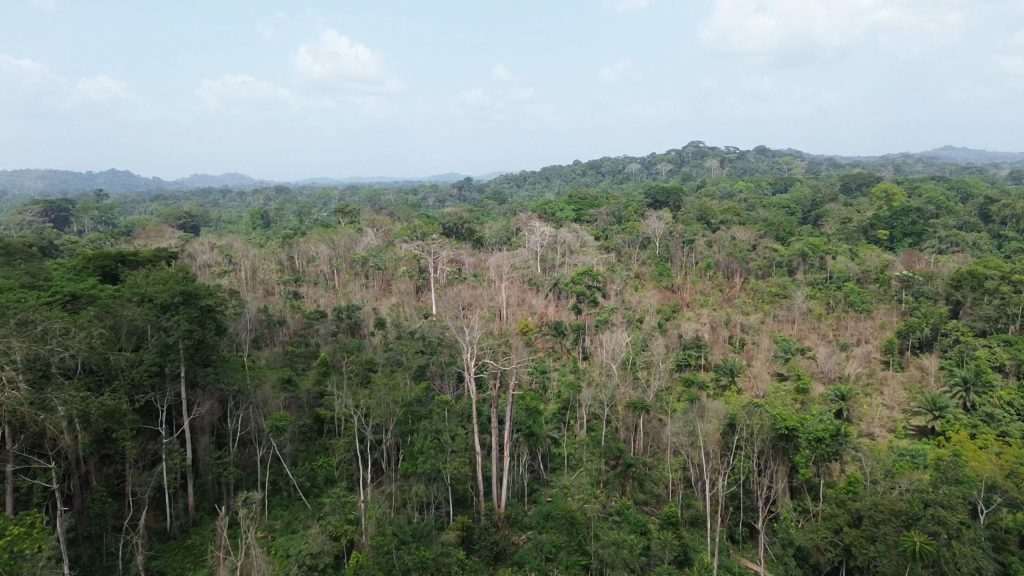
Top: A deforested area in Polar Town, Neezonnie Clan, Grand Gedeh County. The DayLight/Samuel Jabba
By Carlucci Cooper
KUEBO TOWN, Grand Gedeh — Princess Monjolo, the Town Chief of Kuebo, a forest-enveloped town situated within the Neezonnie Community Forest, was there from the formation of Neezonnie in 2011. The community obtained the right to co-manage logging activities alongside the Forestry Development Authority (FDA).
However, in recent years, French-speaking men from the neighboring Ivory Coast have begun arriving there on foot, on motorbikes, and by canoe. They encouraged locals to farm cocoa, assuring them it would improve their lives in no time. Townspeople here, including Monjolo, agreed.
“We used to plant rice and other crops before; our lives didn’t change. Now, seeing how the livelihood of the people in the next town is improving, we don’t want to be left behind,” Monjolo says in an interview in Kuebo. “That’s why we agreed to enter the cocoa business.”
Like Monjolo, local people and Burkinabé migrants they host have encroached on the Neezonnie Community Forest to cultivate cocoa. The people here say low living conditions push them towards illegal cocoa cultivation, citing a failed logging contract as their justification.
It was not a tough decision, though, just as Monjolo, who has a six-hectare cocoa farm and hosts eight Burkinabé migrants, puts it. Neezonnie’s neighbors, Marbo-1 and Marbo-2, had done the same years ago and were benefiting from their cocoa production. Modern houses are mushrooming, and businesses are booming.
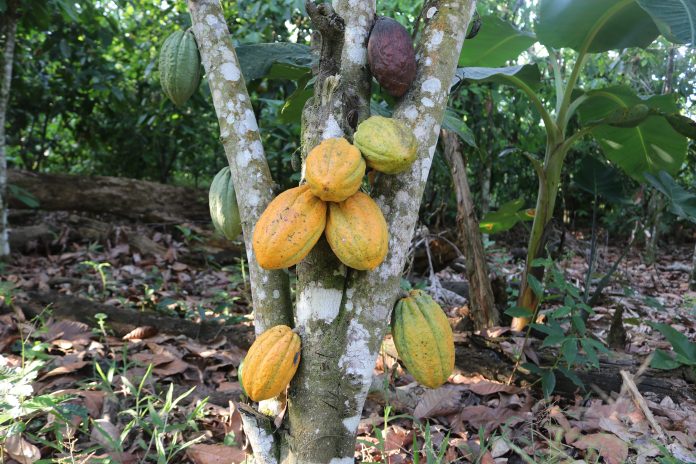
The transformation here from logging to cocoa, known as the “brown gold,” is touchable. Young cocoa farms line both sides of the road from Polar Town to Tiah Town, as it was in other communities. In Tiah Town, Burkinabé migrants spread cocoa beans on a platform to dry, with the migrants everywhere, outnumbering their landlords. The Liberia Immigration Service has recorded 55,000 Burkinabe migrants in the country, with 48,000 in Grand Gedeh County alone.
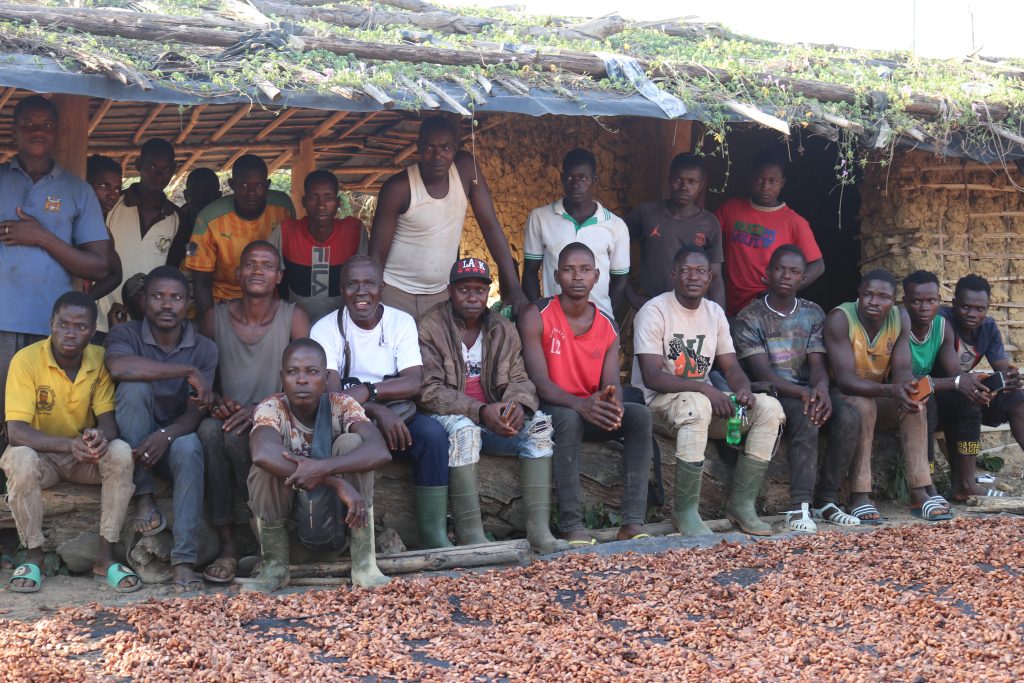
The Burkinabés have an agreement with their Neezonnie hosts: The landlords provide land, while the migrants invest cash and labor. In some cases, locals hire Burkinabé to clear the forest for cocoa.
The people in are hopeful that when their cocoa harvest they will begin to experience a better life, like their neighbors in Marbo-1 and Marbo-2.
“My three boys have graduated from high school, and I’m depending on my cocoa to support my children in the university,” says Amelia Sioseoh, a 10-hectare cocoa farmer in Polar Town, one of the communities that owns Neezonnie.
“I inherited eight hectares of cocoa farmland from my parents. The farm was giving me a hard time, but when the Burkinabes came, they transformed the farm, and I will be harvesting soon,” adds Eddie Gaye, a cocoa farmer in Kuebo Town.
Morris Totaye, a Polar Town resident and, like Sioseoh, has a 10-hectare farm in the community forest, is already benefitting from cocoa. Totaye says he has generated US$22,000 from his cocoa farm. His new house—a two-storey building, part mud, part concrete, with a metal roof—is near completion.
“Without this farm, I am not sure that I would be successful,” Tataye tells The DayLight.
“Those who are saying that the Burkinabes should go back have a point. As for me, I would like to apologize: Let the Burkinabés stay because they are helping,” he adds.
But the forest pays a great price for Neezonnie’s newfound prosperity. Since 2022, Neezonnie has lost most of its 42,424 hectares to cocoa cultivation. It is one of eight community forests, the FDA reports. Burkinabés and their hosts have encroached on Grand Gedeh, in addition to proposed protected areas and large-scale logging concessions.
Gbarzon District—where Neezonnie is located—is the worst-deforested region, accounting for 37,000 hectares of primary forest loss between 2002 and 2024, according to Global Forest Watch, an application that tracks deforestation in real time. Permanent agriculture accounts for over 86 percent of that primary forest loss.
“For now, I cannot tell you there’s any forest left in Neezonnie that the government can utilize. Except the government wants to use the dry logs by doing clear-felling. They are burning trees daily, and community dwellers themselves are involved,” says Beyan Woi, the FDA’s deputy regional management officer in Grand Gedeh and Sinoe.
‘Cocoa money’
Townspeople might be thrilled with their cocoa prospects; however, their farms violate the agreement they signed with the FDA. Under the agreement, Neezonnie cannot clear-cut a forest for agricultural processes.
People here use the failure of a contract between Neezonnie and a logging company to justify their encroachment on the forest. In 2019, the Liberian Hardwood Corporation deserted the contract, abandoning hundreds of logs to decay and failing to deliver on required projects.
Then Neezonnie filed a lawsuit against the company, winning an initial judgment of US$123,332 for damages at a local court. However, in 2021, the Supreme Court overturned the ruling, ordering Liberian Hardwood to vacate the forest.
“We know the forest is for concession, but they are not working. We can’t be sitting down while other towns are getting rich from their forests.
The FDA is in a daily struggle to save the region’s forests. The agency creates awareness, but those efforts have proved unsuccessful. Last year, it arrested 31 Burkinabés at the border between Marbo-1 for encroachment, one of the single-largest apprehensions of the West African migrants. The group was later charged with criminal trespassing and criminal mischief. They deny any wrongdoing.
Neezonnie’s leadership is aware that planting cocoa in the community forest is illegal, but it struggles to prevent intruders. It is the direct opposite of the Bloquia Community Forest, where Sampson Zammie, its leader, works with townspeople there to keep out intruders.
“Our people’s lives are improving, but it will embarrass us in the future. We will not have anywhere to farm in the next five or six years,” says Albert Mohwen, an advisor to Neezonnie’s community forest leadership.
Monjolo acknowledges the negative impacts of cocoa farming, but does not change her stance.
“When we cut down all the trees in the forest,” Manjolo says, “we will buy planks and cement to build our homes from the cocoa money.”
This story was a production of the Community of Forest and Environmental Journalists of Liberia.