
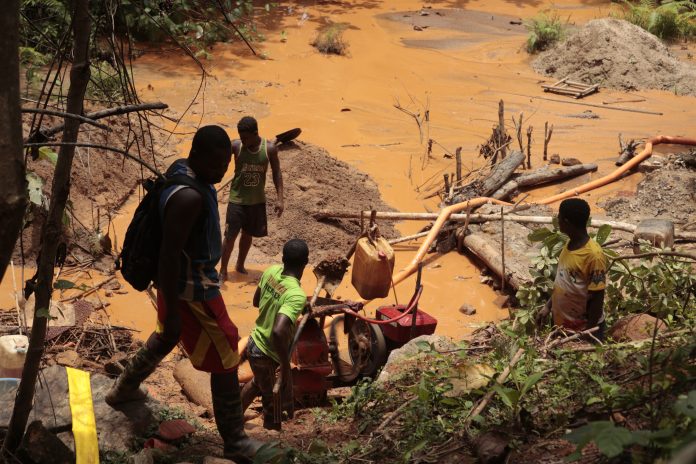
Top: “Gold boys” operating in a mining pit deep into the forest in Salayea, Lofa County. The DayLight/ Samuel T. Jabba
By Samuel T. Jabba
BETIBA, Lofa County — Illegal miners are destroying the Wologisi Proposed Protected Area, clearing the mountainous forests, polluting watercourses beneath it, and carving huge pits into the landscape in an unrelenting hunt for gold.
Amid the ongoing gold rush, unlicensed miners, known here as “gold boys,” say it is their only means for survival.
“The one that encourages me is because I’m getting my living from there,” said James Jallah, a 23-year-old gold boy and sixth-grade dropout. “I will not sit down, and be suffering, and there’s no work for me to do. I should go to the forest that has money.”
For the illicit miners, the Wologizi Protected Park is their fortress. They say they make a lot of money. Some of them own businesses and have built houses.
The illicit miners blame their situation on a lack of opportunity.
“We are mining in plenty of areas here. We get Betiba, we get Darbu, LISCO, Karza, all of them in this same zone. All those places are mining areas. We get more field here to hustle. That is, a lazy man can’t eat, so if I work a day, when God blesses me, I can buy you anything you want,” Sampson Fayiah
The Wologizi Proposed Protected Area is one of nine forests the Liberian government has designated as a reserve. Zigzagging the Wologizi Mountain, and measuring 99,538 hectares, it is home to various endangered species, including monkeys and chimpanzees. It is a part of a US$9 million project that aims to preserve the forest and enhance the use of its natural resources.
Despite these efforts, Wologizi faces a growing threat of deforestation and forest degradation. In 2025, Voinjama, which hosts the forest, lost 3,100 hectares of natural forest, according to Global Forest Watch, an online deforestation-tracking application.
Reporters witnessed this firsthand. Just at the edge of the forest, on a hill three to five minutes from Betiba, a large town beneath the Wologizi forest, lies a site locals call Umaru Field. A hub for gold boys, it hosts numerous illicit mining operations that involve forest clear-cutting, land degradation and pollution.
The illicit miners carved huge open pits into the earth, where they dig for gold. After washing the mineral, muddy water forms a polluted pond that flows into nearby streams locals depend on for drinking, fishing, and washing. Drone footage revealed a network of countless pits or “bogeyman holes,” as the gold boys call them in reference to the danger they pose to people.
When DayLight reporters asked how to address the water pollution, they said a company in the area is responsible for it. They said that they even have to carry drinking water with them to the fields, and that they expect farmers to do the same.
“The water is not giving me money, so how will I stop? What I want is money. “If money can come, that one,” I will stop the work, Jallah said.
For residents of nearby communities, the damage is already being felt, especially in Betiba. Once clear and promising, streams have turned murky, while the encroaching mining pits and felled trees threaten farmlands near the forest.
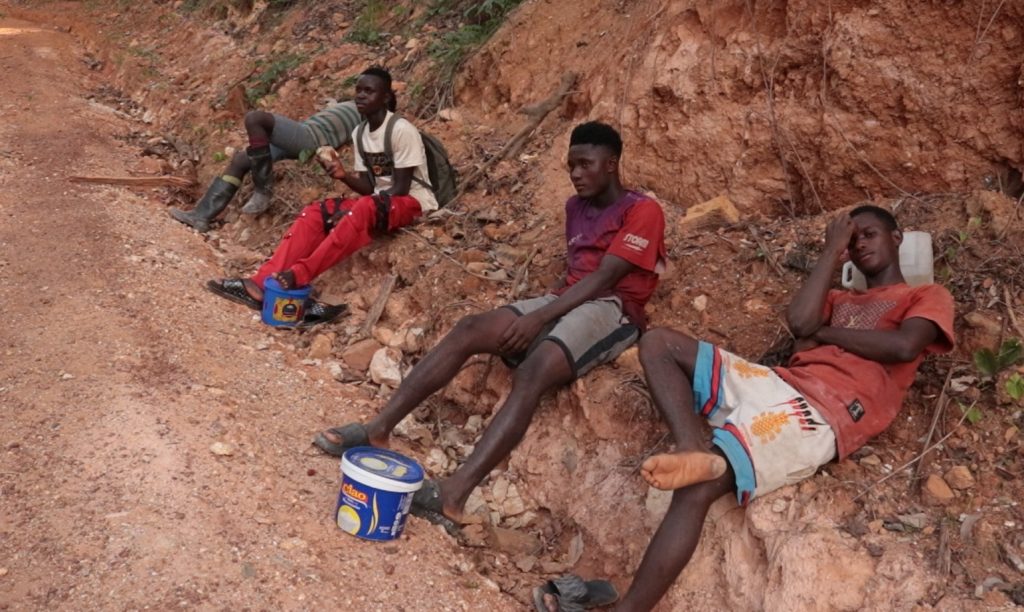
To curb these activities, the community land leadership set up a team to monitor mining activities in the region and apprehend illicit miners. The team visits various mines and contacts other communities on the issue.
“We are appealing to the government to put a stop to the illegal mining activities here,” said Yassa Smith Kullie, the Betiba’s land leader. “The Illegal mining is too much in our community. People have two to three mining fields, but when you ask them for documents, they will not show you any.”
Kullie’s claims are backed by evidence. Records from the Ministry of Mines and Energy show only four licenses in that region for two companies. Mining without a license in Liberia is punishable by a fine, a prison term, or both, upon conviction.
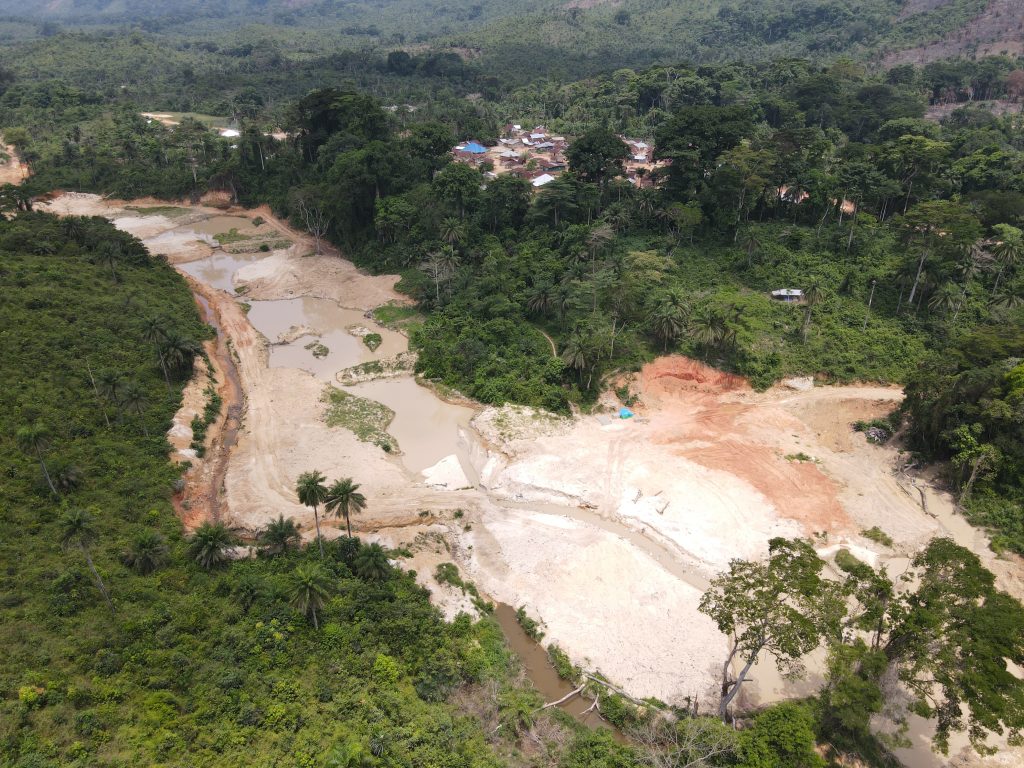
But not everyone in Betiba disapproves of the illicit mining. Some residents get their livelihoods from illegal activities. They no longer travel to Voinjama or other long distances to the market. To them, life with the miners is better than without them.
Betiba is a city in the middle of the forest. Businesspeople set up a market in the town hall located at the heart of the town. Clothes on sale hung on the wall, while household materials and foodstuffs filled tables. New houses built by gold boys adorned the town. Two small entertainment centers sell cold drinks and beverages. There is a local electricity facility with wires running through the town.
“We cannot have all this forest standing while people are suffering. We are poor farmers. We need help to make a living,” Sonie Supo, a leader in Betiba. “If the government wants us to protect the forest and doesn’t allow people to mine in it, let them give us US$50,000.”
Kullie, Betiba’s land leader, said that poverty could not justify illegal mining and environmental harm.
“If we continue to look at poverty and always behave this way,” Kullie said, “they will destroy all of our land, and when the resources are destroyed, they will leave the area empty.”
This story was produced by The DayLight with support from the Embassy of Ireland through Integrity Watch Liberia. The DayLight maintained editorial independence over its content, which does not reflect the position of the Embassy of Ireland or Integrity Watch Liberia.