
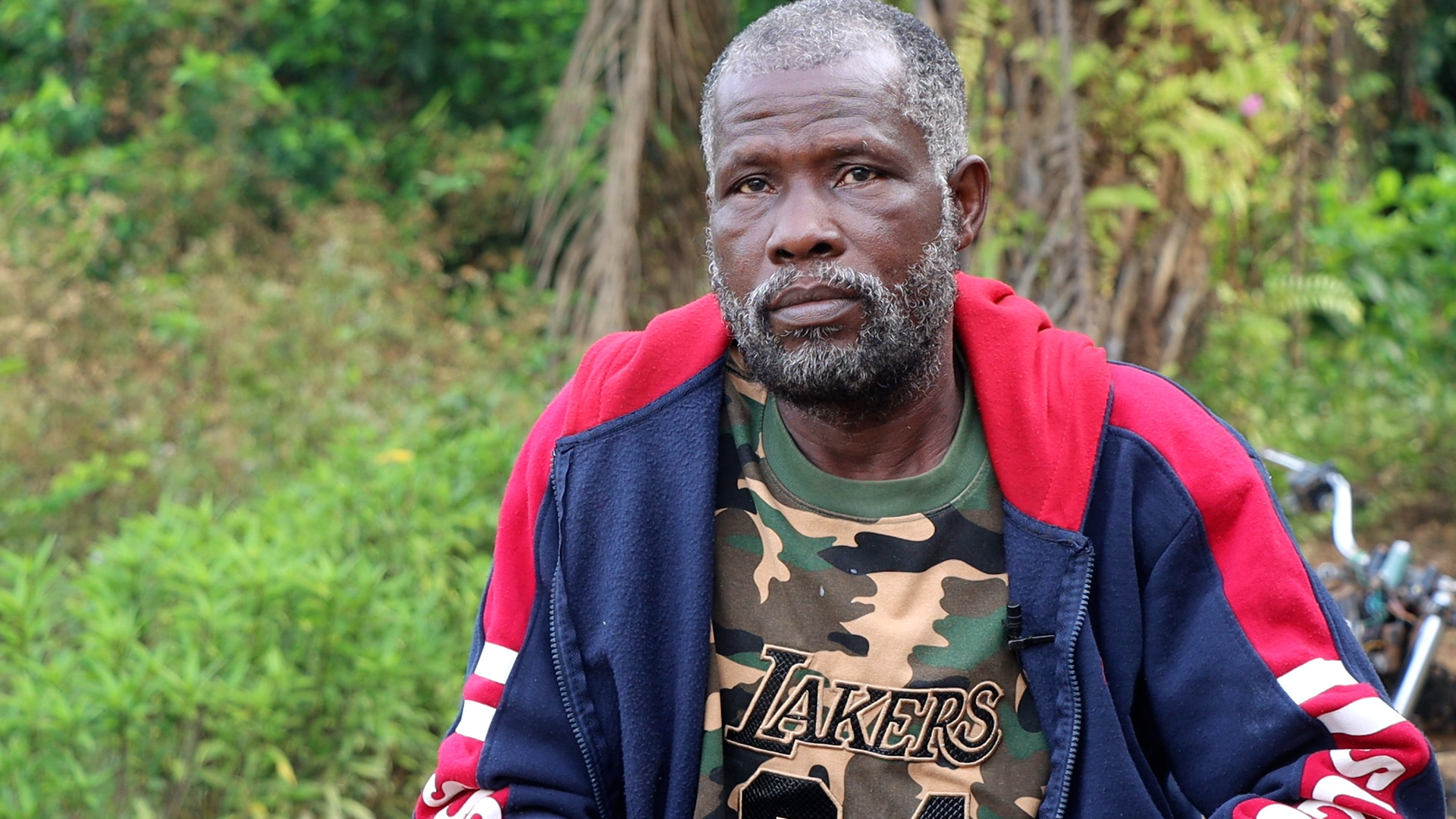
Top: Sampson Zammie, Chief Officer, Bloquia Community Forest, Gbarzon District, Grand Gedeh County. The DayLight/Harry Browne
By Varney Kamara
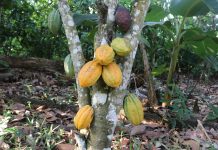
CHAYEE TOWN, Grand Gedeh –During the Liberian civil war, warring factions fought over forest resources. Sampson Zammie, an ex-combatant, finds himself protecting the very forest he once scrambled for two decades after the conflict ended. However, this time, he has a different foe: cocoa farmers.
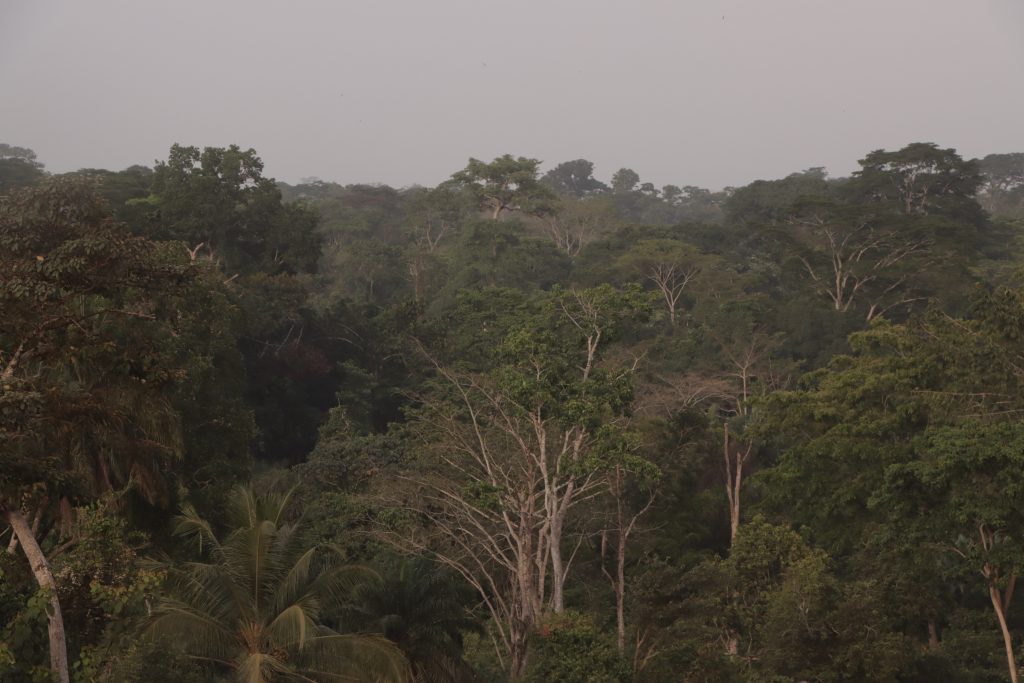
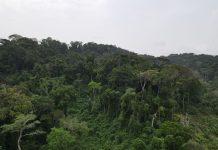
Zammie is the leader of the Bloquia Community Forest, who, against all odds, has fought illegal cocoa cultivation. Bloquia measures 43,796 hectares in Grand Gedeh’s Gbarzon District along the Cestos River on the borders with River Gee and Sinoe Counties.
“It’s a bad idea to clear the forest because it is our supermarket, food warehouse, building material and drug store. Whenever our people get sick, we go in there and pick those special traditional leaves and treat them,” says Zammie in an interview with The DayLight in Chayee, his hometown.
“It is our ancestral heritage. We are under an obligation to protect it.”
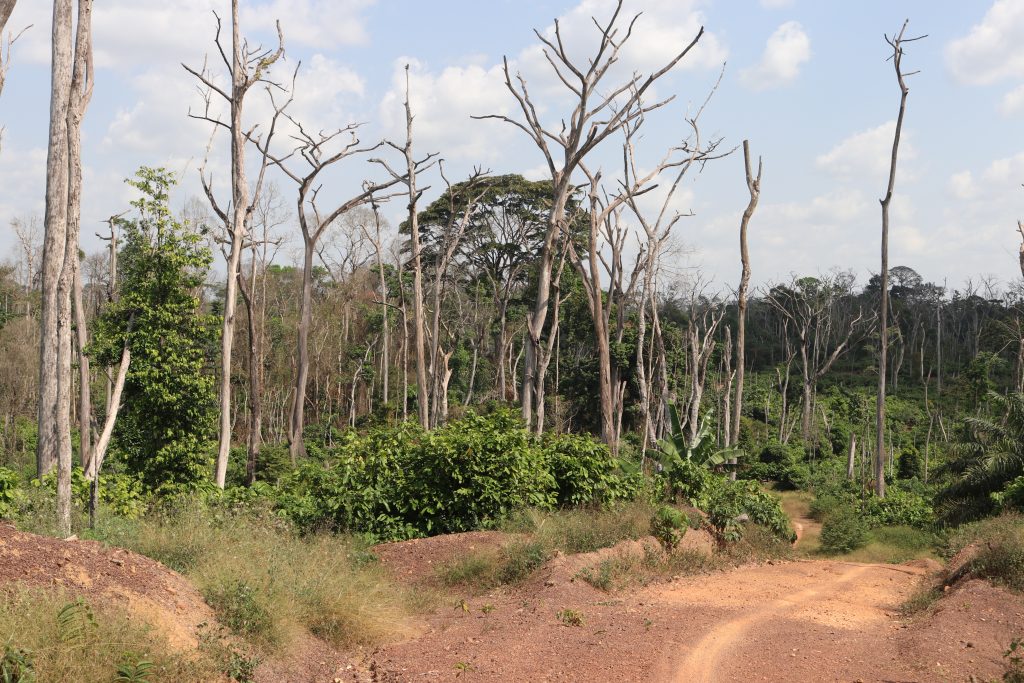
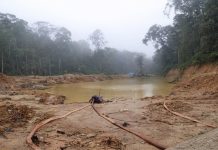
Thanks to Zammie and local forest guards, Bloquia is the only community forest that has not been cleared for cocoa farms. Burkinabe migrants have encroached upon every forest in Grand Gedeh County. The tally includes eight community forests, several large-scale logging concession areas, and two proposed parks. Backed by their Liberian landlords, the migrants apply chemicals or set fire to the base of trees, gradually transforming virgin woodlands into vast forest graveyards.
Between 2002 and 2024, Liberia lost 390,000 hectares of primary forests, according to the Global Forest Watch, an app that tracks deforestation, utilizing satellite imagery. Grand Gedeh alone lost 59,000 hectares during this time. Last November, London-based Global Witness found a link between the world’s leading chocolate producers and deforestation in Liberia.
The Burkinabes, also known locally as “Mossi,” migrated to the Ivory Coast in the 1930s, becoming a majority of the plantation workforce and boosting that country’s cocoa industry. In search of new cocoa farmland, they began crossing into Liberia in the 2010s by canoe, on foot, and on motorbikes. The Liberia Immigration Service has registered 55,000 Burkinabés in southeastern Liberia, with 48,000 in Grand Gedeh alone.
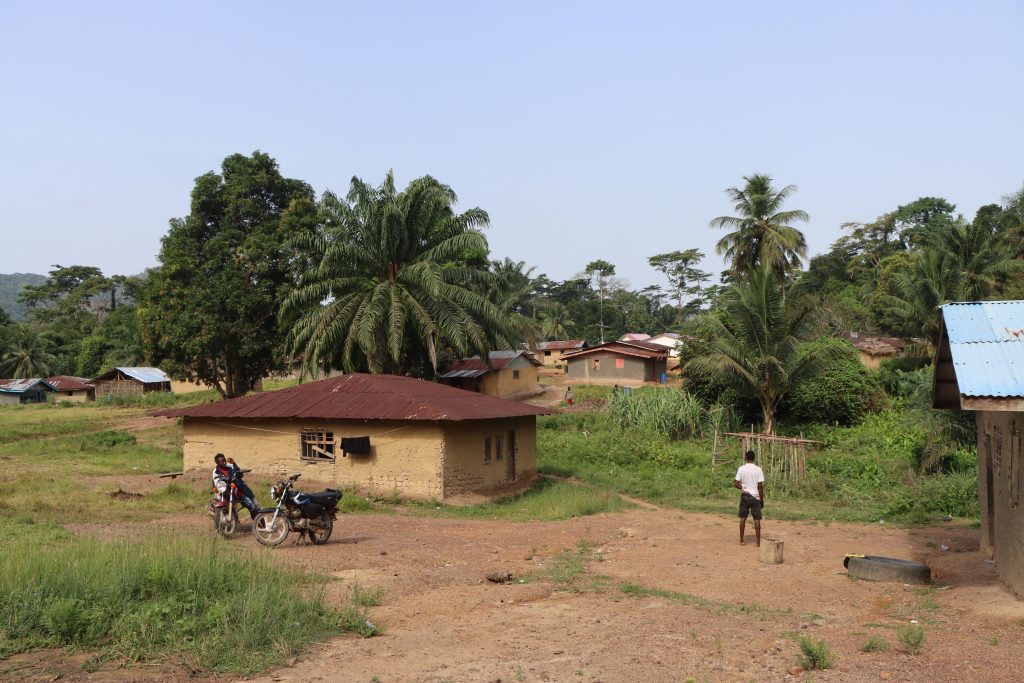
Locals, including people in the neighboring Neezonnie Community Forest, welcome them with open arms. They see cocoa as an end to years of poverty and underdevelopment. The locals enter agreements with the migrants, wherein they provide the land and the migrants plant and nurture the cocoa.
“I don’t have a problem with the Burkinabés because through them, I have a house today that is worth more than US$17,000,” said Morris Totaye, a Polar Town resident.
“They are very strong, hard-working, and always willing to work. In my mind, they should stay here because they are helping to develop the community.”
Residents of Totaye and Neezonnie cite a failed logging contract as justification for their cocoa activities in their community forest. In 2011, Neezonnie and Bloquia signed a logging contract with A&M Enterprises Inc., owned by Aisha Conneh, the wife of Sekou Conneh, the ex-leader of Liberia United for Reconciliation and Democracy, or LURD. A&M then subcontracted another firm, the Liberia Hardwood Corporation. The contract promised roads, schools and a clinic for residents. However, instead, the contract ended in a fierce legal battle at the Supreme Court in Monrovia.
‘…Never betray my people.’
Zammie and the people in Bloquia are aware of the opportunities that cocoa brings. However, they have chosen legality and heritage over ill-gotten wealth. In forestry, farming in a community forest without the FDA’s authorization is illegal. There are several cases involving the FDA, Burkinabé migrants, and local people.
Zammie has refused several offers to rein him in. In an audio recording of a phone call with Emmanuel Zongo, a spokesperson for the Burkinabé community, Zongo promises Zammie CFA 5 million (US$8,853.13) to plant cocoa in Bloquia. Zammie turned down Zongo’s offer.
“I rejected his offer because it amounted to bribery and corruption,” Zammie says. “I told him that I would be destroying my children’s future if I had accepted his offer, and that would amount to a betrayal of the community’s trust. I can never betray my people.”
Reporters traveled on motorbikes for over five hours, deep into the isolated belly of Grand Gedeh, where the forest thickens, and the road steadily disappears beneath bush and broken earth. A convoy of two motorbikes squealed over fragile wooden bridges and through narrow, mud-slashed paths, tilting dangerously at every bend. There was Zammie.
A soft-spoken, slim, grey-headed man, Zammie joined the Armed Forces of Liberia in 1990 as a private. From 1992 to 2003, he served the disbanded Liberia Peace Council and the Movement for Democracy in Liberia as a battalion commander. After the war, Zammie, now disarmed, returned to Chayee Town, desperate to turn his life around, eager for a fresh start.
His chance came in 2016 when Bloquia, established five years earlier, headed for elections. Zammie contested for the chief officer, the one who runs the daily affairs of a community forest, and won on a white ballot. Liberia had passed the Community Rights Law…, empowering locals to participate in forest governance and share in its benefits.
Zammie uses his wartime experience to organize the community’s forest guards. With Zammie’s oversight, guards regularly deploy across the forest to monitor and remove illegal occupants. His guardianship against encroachment also extends to protecting a 266,910-hectare logging concession adjacent to Bloquia, ravaged by cocoa cultivation.
But like his time as a combatant, leading Bloquia has been a difficult journey for Zammie, who often faces off with encroachers and local authorities.
In 2023, Zammie was removed as chief officer of Bloquia, following a controversial election. However, he was later reinstated after the FDA overturned that election’s outcome, retaining him pending a fresh poll.
Zammie and his guards struggle daily to prevent Burkinabés and their Liberian hosts from illegally occupying the Bloquia forest. At least 30 Burkinabés have been detained and removed from Bloquia by the Zammie-led forest guards, a video shows.
In the video, Zammie can be heard interrogating a group of Burkinabes in Farblor, a village between Bloquia and the large-scale logging concession. Sitting on the ground with folded hands, the men listen to Zammie nervously as he scolds them for encroaching on the community forest.
Zammie also faces threats from Grand Gedeh authorities.
Last April, anti-riot police officers fired at forest guards who had gone to evict illegal occupants. In a video clip of that incident, Zammie is seen presenting ammunition to a local official.
Applause
Zammie accuses Alex Grant, the Superintendent of Grand Gedeh County, of masterminding the shooting incident. Now, Zammie travels with dozens of men in a motorbike convoy, as the cocoa crisis in the southeast has resulted in deaths and injuries.
“Grant has always threatened to get rid of me because he said I am standing in his way,” says Zammie. “He wants to take over Bloquia and make it his personal farm.”
Grant did not respond to queries. However, speaking on “Forest Hour” on Okay FM last year, Grant called Zammie “a fugitive.” He called on the police to arrest him “wherever he is found.”
Forestry campaigners have frowned on the constant harassment of Zammie. In a joint press statement last July, they showed solidarity with the Bloquia savior.
“Such threats against a citizen who is acting in the national interest are unacceptable,” says Andrew Zelemen, a forestry campaigner. “We take these allegations seriously and demand a full, impartial investigation. Zammie’s safety must be guaranteed.”
Grant is a major player in Grand Gedeh’s cocoa rush. Last October, Grant signed a 30-year lease agreement with a Burkinabe businessman for 500 acres of ancestral territory in the B’hai District. The deal was later terminated due to several irregularities. Months earlier, Grant had received over CFA 4 million (US$7,111) from B’hai citizens to secure a deed for the same land.
Nevertheless, Zammie’s effort to protect Bloquia Community Forest has been hailed. Beyan Woi, regional management officer for the southeast, is one of his admirers.
“I would like to give it out for the Bloquiah Community Forest. I want to thank Sampson Zammie…,” says Woi. “He is working tirelessly daily and, through him, we don’t have any Burkinabe in that forest.
“Everyone must give him applause for his great work in that area.”
This story was a production of the Community of Forest and Environmental Journalists of Liberia (CoFEJ).

Facebook Comments