
28.1 C
Monrovia
Tuesday, December 23, 2025
Home 2025 September

Monthly Archives: September 2025

Security Forces Remove Over 2,000 from Sapo Park

#image_title

Top: Some of the over 2,000 illegal occupants the Armed Forces of Liberia removed from the Sapo National Park in Sinoe County, so far. Filed pictures/Joint Security Forces


By James Harding Giahyue


Monrovia – Joint security forces have removed over 2,000 illegal occupants from the Sapo National Park in a crackdown on transnational crimes and regional insecurity.

A report on “Operation Restore Hope IV,” seen by The DayLight, said the forces had full control over “Camp America,” one of the park’s 13 illegal settlements. It said soldiers had set up camps at one location each in Sinoe, Grand Gedeh and River Gee.

“People were processed into two categories to exit the park: women and children first and then men,” the report said. “The men were also placed into categories to exit the park in order not to overwhelm the officers escorting them out of the park.” The report said some of the illegal occupants fled the camp.

The report said a gradual and humane approach was required to remove the occupants because many had stayed there for over a decade. All entrances to the camp have been shut down, with only people exiting the park allowed, it added.

Over 200 officers walked for nine hours to Camp America in the 697-square-mile Sapo. There, they demolished structures and mines, and seized illegal items before amicably removing occupants.

Pictures in the report show illicit drugs, a bottle of mercury and a single-barreled gun. One picture shows soldiers standing before a crowd of cooperative occupants, with tarpaulin-roofed huts in the background.

Security forces observed that occupants used only the L$500 and L$1,000 notes, with the report calling for an anti-money laundering investigation.

The report also cited a high level of prostitution, human trafficking and cruel acts, which are “far from human civilization.”

Established in 1983, the Sapo National Park is the largest in Liberia and the second largest in the Mano River region. It is home to a variety of endangered species, including African elephants, pygmy hippopotamuses, and western chimpanzees. With the highest diversity of mammal species, it is one of the world’s biodiversity hotspots.

However, the park has been plagued by illegal activities for decades.  

Illegal occupants leave the Sapo National Park in August. Filed picture/Joint Security

The operation is the largest since United Nations peacekeepers removed 5,000 occupants in the 2000s, marking the end of Liberia’s civil wars. It’s part of broader efforts to combat illegal cross-border activities, illicit financial flows, and the influx of undocumented migrants into southeastern Liberia. Immigration authorities have recorded over 54,000 Burkinabés in the region, an EU envoy linked to a Sahel migrant crisis.

In all, the joint security, comprising soldiers, policemen, border guards, rangers and anti-drug agents, intend to remove an estimated 15,000. They are expected to move to the other 12 known camps, including the most infamous Camps Afghanistan and Iraq.  
Miner Filed Fake Document and Got a License

#image_title

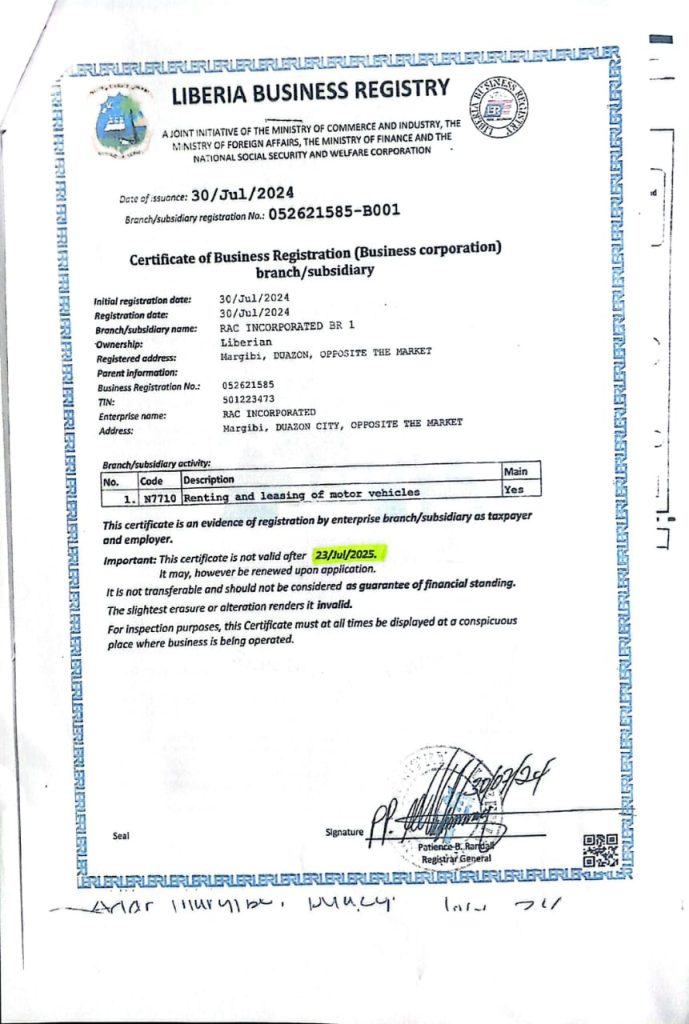
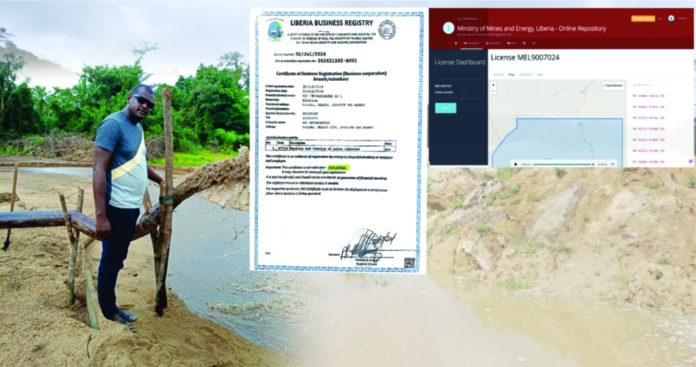
Top: This poster shows Randy Scott, one of Liberia’s most notorious miners, a mine he is associated with in River Gee, an exploration mining license his company RAC Inc. has for Lofa, and a fake business registration certificate RAC Inc. presented to obtain the license. Picture credit: Facebook/Randy Scott and Prince Copeland for The DayLight


By James Harding Giahyue


MONROVIA – In January, RAC Incorporated, a mining firm owned by Randy Scott, who was involved in Liberia’s largest mining scandal in Gbarpolu, acquired a gold-exploration license for Lofa County. The three-year license covers 210.76 square kilometers in the Zorzor and Salayea Districts.

But what the Ministry of Mines and Energy apparently did not notice was that at least one of RAC’s documents was fake. A DayLight desk review found over a dozen inconsistencies on RAC’s business registration certificate, ranging from dates to markings.

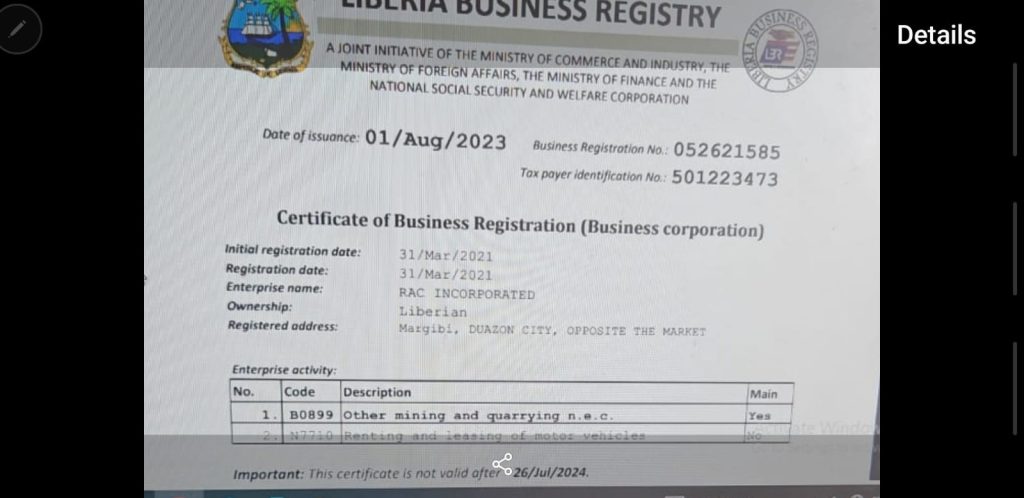
RAC’s actual certificate was issued on August 1, 2023, and expired on July 26, 2024, according to the Business Registry’s records. It has not been renewed. RAC was first registered on March 31, 2021, about the same time it was founded, according to the company’s business registration certificate and articles of incorporation, and was enrolled at the Liberia Business Registry. An official listing of all the companies Mr. Scott owns or co-owns revealed RAC’s certificate indeed expired on Independence Day last year and had yet to be renewed.

The document RAC filed with the Ministry of Mines claims it was originally registered with the Business Registry on July 30, 2024. It was a red flag because the information contradicted the Business Registry’s records. Moreover, the Ministry of Mines’ records show that RAC’s operations date back to 2022, further proof that RAC could not have initially registered in 2024.

The document in question indicates that RAC’s business registration ran from July 30, 2024, to July 23, 2025. This is inconsistent with certificates issued by the Business Registry. Normally, certificates, which are issued in July, expire in June the following year.

The document identifies the company as “leasing and renting of motor vehicles.” This description omits mining and quarrying, RAC’s main scope of business. Also omitted is the Liberian seal, which is a crucial feature on known samples of valid business registration certificates.

A fake business registration certificate RAC Incorporated, owned by Randy Scott, a notorious illegal miner, presented and obtained a gold-exploration license in Lofa County, covering 210.76 square kilometers.
Liberia Business Registry records show that RAC’s valid business registration certificate expired on July 26, 2024, and has not been renewed

A tax identification number—unique to a taxpayer—appears at the top-right corner of valid certificates. However, RAC has that detail in the body of the document. It even repeats the company’s business registration number, which, like a taxpayer identification number, appears only once on valid certificates.

Generally, the document in question contains more wording than real business registration certificates. The most telling is a line at the bottom of the document that reads: “This certificate is evidence of registration by enterprise branch/subsidiary as a taxpayer and employer.” The clause is unique to RAC, as valid certificates do not contain that line, suggesting that RAC deployed it to deceive the Ministry of Mines —and it worked.

Forging a document is a crime under the Minerals and Mining Law of Liberia, with a fine between US$1,000 and US$2,000, or a two or three-month prison term after a court process.  

‘Go [and] sue me’

The investigation is a follow-up to an initial publication, which established that RAC Incorporated had been issued the exploration license with an expired business registration certificate. It had also found that RAC and Gee Mining Resources Ltd., its affiliate, were involved in illegal mining in River Gee County. The evidence established that RAC signed an MoU with local people, while Gee Mining conducted the mining. Satellite imagery showed that Gee Mining operated over 1,000 meters outside the nearer of its two claims.

The DayLight has written Minister Wilmot Paye about RAC’s forgery and illegal mining activities in River Gee, and the regulator has contacted the Business Registry to verify the document.

Confronted with evidence of the fake document, Scott sounded unbothered. “If you have evidence that my document is fake, go and sue me,” he said in a phone interview. “Do you know a fake document?” Scott holds 95 percent of RAC’s shares, while one Moses Luther holds the remaining shares, according to the company’s articles of incorporation.

This is not the first time Mr. Scott, who co-owns and is linked to multiple companies, has been involved in illegal mining activities. Last July, he and several Chinese nationals were indicted in Liberia’s largest mining scandal, valued at US$48.8 million. Earlier, the Environmental Protection Agency fined J.M. Mining, another of Mr. Scott’s companies, US$95,000 for operating without a permit. Before that, Urban and Rural Services Inc., to which he is connected, operated with an expired license.


Integrity Watch Liberia provided funding for this story. The DayLight maintained editorial independence over its content.

FDA, Firm Ask Court to Dismiss US$5M Lawsuit

#image_title

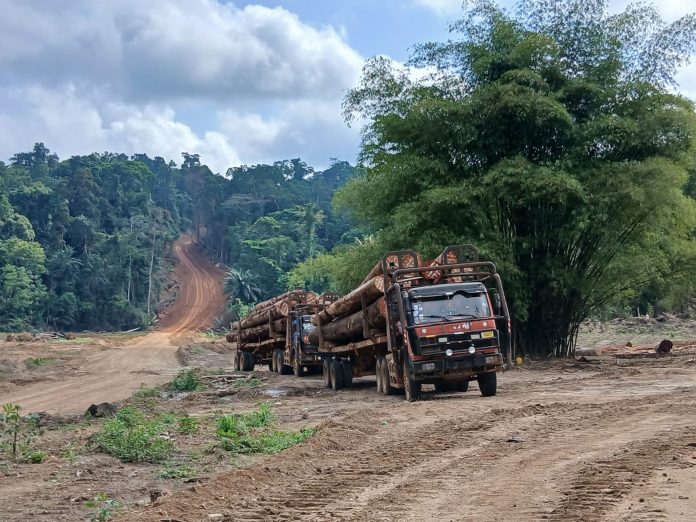
Top: C&C Corporation’s truckload of timber leaves Vambo Township in mid-March. The DayLight/Ojuku Kangar


By Emmanuel Sherman


MONROVIA – The Forestry Development Authority (FDA) and a logging company have asked the Commercial Court at the Temple of Justice to dismiss a US$5 million lawsuit against them for alleged damage to 3,200 acres of land in Grand Bassa County.

Khalil Haider, a Paynesville resident, claims that the FDA authorized C&C Corporation to harvest logs on the plot without his consent. He further alleges that the FDA honored a letter that forged Haider’s signature, ignoring his warning and approving C&C’s operations.

The land in question lies between the St. John River and Mt. Findley in the Vambo Township of Grand Bassa’s Compound Number Two.

The defendants challenged Haider’s claim and questioned the procedure through which he filed the lawsuit.

In its response, the FDA questioned the validity of Haider’s deed. The regulator argued that it was unlikely a deed was signed in 1958, 111 years after Liberia gained independence in 1847.

“Haider is a fabricator who would go to any length to tarnish the reputation of individuals managing the forestry sector, as evidenced by his assertions, which are all lies,” read the regulator’s petition.  

The FDA added that Haider should have filed the lawsuit in his mother’s name instead of his own name. It denies receiving any communication from Haider, warning it about an alleged fake letter. 

C&C’s only argument was about Haider filing the lawsuit in his name. It cited the Decedents Estate Law, a 1956 act that requires children to represent their late parents.

It is the prayer of [C&C Corporation] to dismiss  [Haider’s] motion because it lacks legal basis,” the company’s petition read.

Haider’s counterargument

Haider insists on his US$5 million damages in his response to the FDA and C&C.

Khalil Haider. Picture credit: Khalil Haider

Haider counterargued that the FDA questioning of his deed’s validity was “unintelligible and lacked legal coherence.  

“If counsel argument is that a deed executed in 1958 is invalid merely because Liberia gained its independence in 1847, such reason is unfounded,” read Haider’s response. “By that logic, all subsequent land transactions would be inherently fraudulent, which is patently absurd.”

On his lawsuit procedure, Haider said that Decedents Estate Law C&C referenced empowered him to sue in his name. He said his petition recognized his late mother as owner of the property. Haider’s response referenced a 1983 case and two 2001 cases.

“In view of the above, I pray respectfully that the Honorable Court deny Defendant’s request for dismissal,” said Haider, “as said request lacks legal merit.”


This story was a Community of Forest and Environmental Journalists of Liberia (CoFEJ).

Body Discovered in River Gee Cocoa Farming Dispute

#image_title

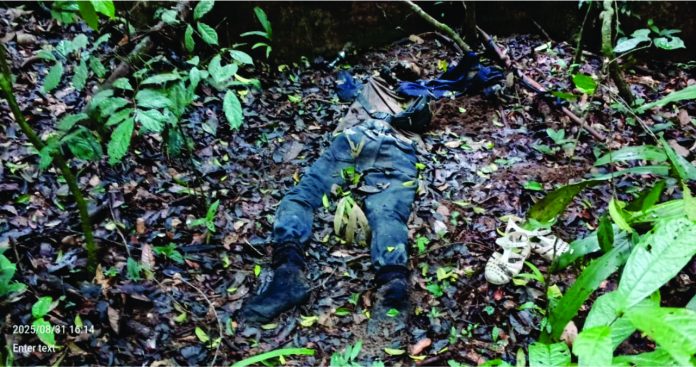
Top: The decomposed body of Deppuh Kobera, a 15-year-old Ivorian cocoa farmer, is discovered in a River Gee forest. The DayLight/Prince D. Copeland


By Prince D. Copeland


FISH TOWN – An Ivorian boy who recently crossed the Ivorian border into Liberia to work on a cocoa farm has been found dead in a River Gee Forest, the police said.

Fifteen-year-old Deppuh Kobera had gone missing last Wednesday, farming cocoa in the Kwawe Gee-forest in Glorra District Forest, according to the River Gee Police Detachment. His body was discovered three days later in a nearby forest, beheaded, with bullet wounds to the head. A 15-man jury confirmed foul play.

“The investigation is growing deeper to establish who his killers are, how he came to Liberia, who lodged him, and where he was living,” said Theophilus Togba, River Gee Assistant Police Commander. “The situation is really tragic and embarrassing because someone crossed the border from the Ivory Coast into Liberia and lost his life here.”

No suspects have been arrested since the discovery. Meanwhile, the investigation continues, according to the police.

“We have started speaking with residents in that place, and they are giving us some traces of the incident,” Togba said to this reporter without stating when the outcome of the investigation would be released to the public. 

Kobera’s death is the fourth in the region linked to the influx of Burkinabe cocoa migrants. Last month, Eric Nyenpan, Sabastine Saylee, and Aaron Teah, three men of the Kiteabo and Glarro subtribes, were murdered in a land dispute. Over 20 suspects were arrested and sent to the Fish Town Central Prison, where they await trial in that case.

With support from Liberian hosts, Burkinabes cross the border along the Cavalla River in search of cocoa farmland. Immigration authorities have recorded 55,000 Burkinabés, with over 4,000 recorded in River Gee.


This story was a Community of Forest and Environmental Journalists of Liberia (CoFEJ) production

Actors Want Regulation Amended  to Enhance Communities’ Benefits

#image_title

Top: A log yard outside Greenville, Sinoe County. The DayLight/Derick Snyder


By Varney Kamara


MONROVIA – Forestry actors in Liberia are calling for amendments to the regulation on benefit-sharing to enhance communities’ share of resources generated from the sector.

They spoke recently at a national conference that brought together representatives from civil society, environmental groups, lawyers, and the government. The change would improve governance, transparency, and accountability, and ultimately lead to better sector performance, they said.  

“The idea is to ensure that we carry out a broader reform that includes other sectors that are important to leverage development across communities,” said Silas Siakor, lead campaigner at Integrated Development and Learning, which promotes development across communities.

“We are only looking back to see where we can strengthen the existing frameworks to move forward,” Siakor added.

The National Benefit Sharing Trust Board, created under the National Forestry Reform Law, serves as the main channel through which local people receive benefits from logging operations.

The law mandates that 30 percent of logging revenue from land rental be allotted to affected communities. A 2011 regulation also requires openness, transparency, accountability, and community participation in the management of forest resources.

Both the law and regulation empower the Trust to collect communities’ shares, consult with local land management committees, and identify and approve projects to be implemented within specific timeframes.

As of December 2024, the board had completed 44 projects across communities, including schools, clinics, and the rehabilitation of farm-to-market roads.

Despite progress, several challenges remain. The board continues to struggle to deliver quality services. Its implementation outputs are weak, hampered by limited capacity and compliance issues.

However, with the right reforms, combined with a more resilient internal structure, sector leaders believe these challenges can be overcome.

To achieve this, they have proposed revisions to include mining and representatives of other sectors on the Trust. Other proposed changes include the election of the trust’s president and a provision allowing it to seek continuous donor support to ensure regular audits.

“During the discussion, we agreed that the board needs to improve its capacity, outsource contracts, and conduct regular audits to ensure transparency and accountability,” said Renee Gibson, an official of the Rural Integrated Center for Community Empowerment.

At the close of the meeting, delegates agreed to submit a proposed plan of action to the Forestry Development Authority (FDA) following a review process that will finalize its details within three weeks.

Podcasts