
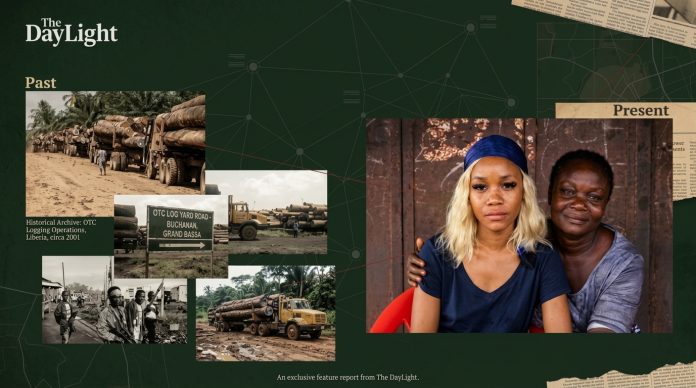
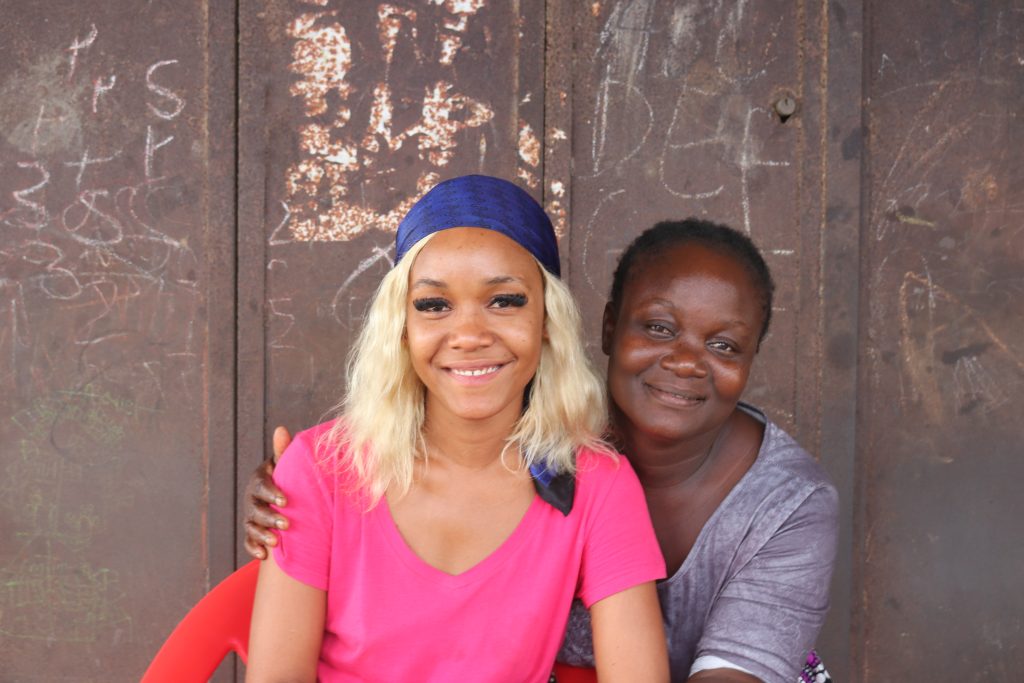
Top: A poster depicting OTC’s operations, combatants and Maya Lipin and her mother, Mahn Thomas. Poster by Michael Harijgens for The DayLight
By Emmanuel Sherman and Philip Quwebin
NEEZUIN, River Cess County – In 2000, Mahn Thomas, 17, visited her aunt in Buchanan, Grand Bassa. There she met Dennis Lipin, a 35-year-old Malaysian trucker with the Oriental Timber Company (OTC), the largest logging company then.
Initially, Mahn resisted Mr. Lipin’s proposal, as she “did not want a white man.” However, her aunt, who had a great influence over her, convinced her, and she gave in to Mr. Lipin. Shortly after, she moved to Neezuin, River Cess County, where Mr. Lipin was stationed. By 2001, she was pregnant with their first child, Maya, and another daughter, Nana, arrived two years later.
“He was nice and very good,” said Mahn.
But misfortune was right around the corner. Two months after Nana’s birth, a war between Liberian government forces and rebels intensified, and the family fled to Buchanan. When the war finally broke out in the port city, Mr. Lipin departed Liberia for Malaysia. That was the last time Mahn, Maya, and Nana ever saw him.
Maya and Nana are two of a large number of children fathered by Asian workers of OTC, which was owned and operated by Guus Van Kouwenhoven, a Dutch businessman who died last month in South Africa. Gus, as he was affectionately called in Liberia, collaborated with then-President Charles Taylor, making OTC and people connected to it targets for rebels.
When Taylor’s regime ended in October 2003, OTC’s Asian workers—Malaysians, Indonesians, Filipinos and Chinese—fled the country abruptly. But they left behind scores of children they had with Liberian women and never returned.
The ‘Red Sea’
Her OTC connection in mind, Mahn decided to escape Buchanan with her children and go to Firestone. They walked all night, and by dawn, they were stuck at the St. John Estuary in Upper Buchanan, where the Benson and Mechlin Rivers meet and discharge into the Atlantic Ocean. Many people drowned attempting to cross the watercourse. Afraid of that fate, she changed her mind and headed back to Buchanan with her daughters.
Interestingly, when she left, the water level miraculously dropped, allowing people to cross to safety. Overjoyed, people likened their experience to Moses leading the Israelites across the Red Sea in Exodus 14. “We called it the Red Sea, because the water parted and people walked on the [riverbed],” Mahn recalled.
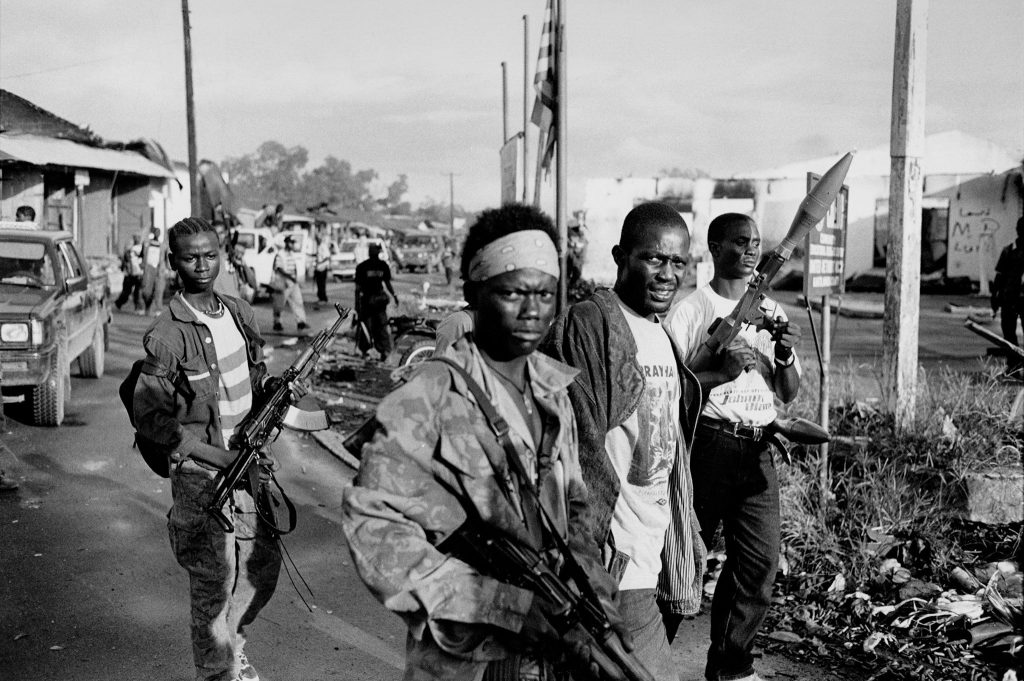
The rebel faction that attacked Neezuin and Buchanan was the Movement for Democracy in Liberia (MODEL). Led by Thomas Nimely Yaya, the future Grand Gedeh Senator, MODEL had become active in March 2003. The group was linked to another rebel faction and based on an Ivorian militia loyal to then-President Laurent Gbagbo.
MODEL clashed with Taylor forces for the OTC belt, stretching across Grand Bassa, River Cess, and Sinoe counties. The Taylor regime granted OTC 1.6 million hectares of forest land and the Port of Buchanan in exchange for millions of dollars to fund his war, which contributed to the killing of some 250,000 people. Kouwenhoven used Hotel Africa he had managed since 1980, as a base for illegal arms trading. Joseph Wong, a Malaysian executive of the OTC, supported Taylor’s ties to rebels in Sierra Leone, fueling the carnage there. Thus, Liberia’s wartime timber was coined “conflict timber,” “blood timber,” or “logs of war.”
Struggle and stigma after the war
Twenty-three years after the war, as their hopes of reuniting with their fathers faded, OTC-linked children have moved on with their lives, amid hardship and stigmatization.
Teta Giah did not meet her father, who reportedly died in Malaysia in 2004. A resident of New Buchanan, she struggles with accepting the life of fatherlessness. Her mother had met an OTC Asian worker during the war, who disappeared shortly after she was born.
“I used to think about my father when school fees, gala day fees, and other activities were hard to come by,” said Teta, a petty trader. She plans to attend college after she has saved enough money.
Prince Walker is a 23-year-old high-school graduate who no longer asks his OTC father for anything. Prince’s mother, Teta Doe, met his father in Compound Number Four. Prince lived with his grandmother, who cared for him since he was 11 months old. His father had already fled Liberia before he was born.
“Sometimes I tell him to forget about his father and move on with his life,” said Rebecca Walker, Prince’s grandmother.
For her part, Malissa Giah (no relation to Teta) lives with her aunt in Paynesville, outside Monrovia. Her father, whom she only knows as Johnny, was an OTC trucker. Before moving to Paynesville, Malissa sold in the market. Her friends used to scorn her as a “white woman selling pepper and [garden eggs].”
She wants to study accounting, but her uncle, who sponsored her through high school, cannot afford to send her to college. She is a single parent of a one-year-old girl.
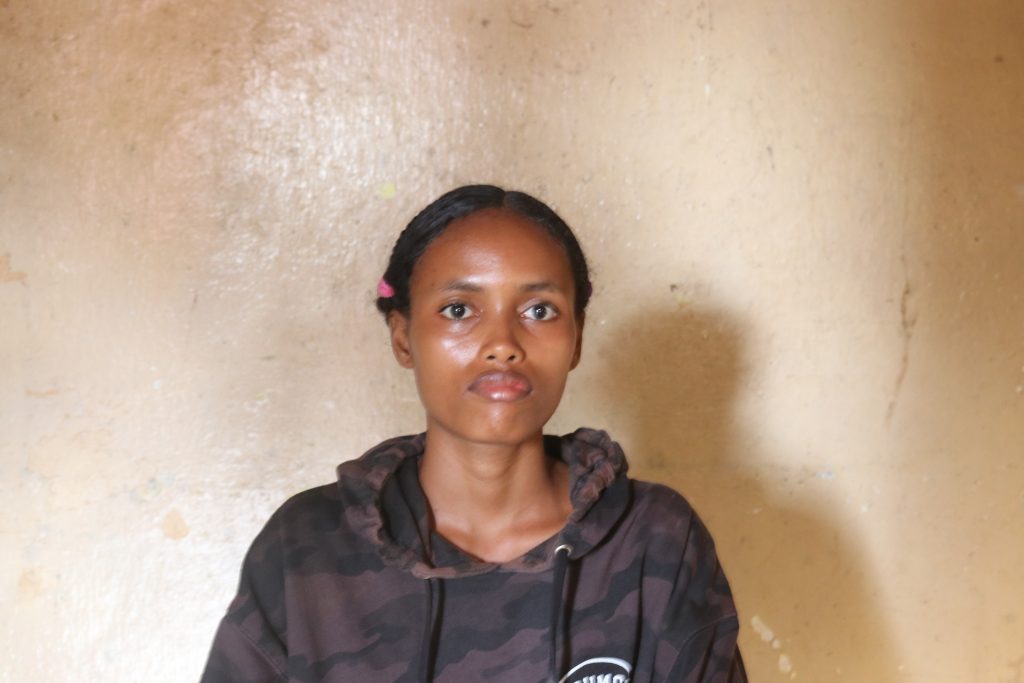
“Sometimes I feel hurt, but it is where I find myself. When I am alone, I cry, pray to God to change my situation,” said Malissa.
The Truth and Reconciliation Commission (TRC) found that children faced severe stigmatization, exclusion, and shaming as a result of the conflict, and made several recommendations. The Liberian government has started the process to create the war crimes court the TRC recommended. However, war victims have yet to receive any reparations.
“So far, successive governments have failed to create a national reparations trust fund,” said John Stewart, former Commissioner of the TRC. “A reparations trust fund and a reparations commission require strong political will.”
Eric Saab, 24, hopes to meet his father to help him finish high school.
Eric’s Malaysian father, Henry Garlawu, worked as a mechanic for OTC and left Liberia before the war. His mother, Oretha, now deceased, had met his father at an OTC camp in River Cess. Eric, like Prince, lives in Buchanan with his grandmother
“I want to see my father,” Eric sobbed in a phone interview with The DayLight.
Dead feelings
Not only did the OTC children’s world fall apart, but also OTC’s. the same year of the MODEL attack, the United Nations imposed a travel ban on Taylor, Kouwenhoven, and Wong for their roles in the conflict, and embargoed Liberian Timber. Taylor was later sentenced to 50 years for crimes he committed in Sierra Leone. A Dutch court sentenced Kouwenhoven to 19 years for war crimes he committed in Liberia while in South Africa, but he was not extradited to the Netherlands to serve the term.
Today, Mahn sells things and does manual work to sustain herself and the children. Both girls have graduated from high school, but she regrets raising the children alone.
“I regret it because he left his children with me. He is supposed to be talking with his children and talking with me,” Mahn told The DayLight.
Her eldest daughter, Maya, is now 24. She, too, has two children and wants to study nursing.
“My feelings for my father have died, because I feel he is not concerned about what he left behind,” Maya said. “If something is important to you, no matter what it takes, you will try to find it.”
This story was a production of the Community of Forest and Environmental Journalists of Liberia (CoFEJ).