
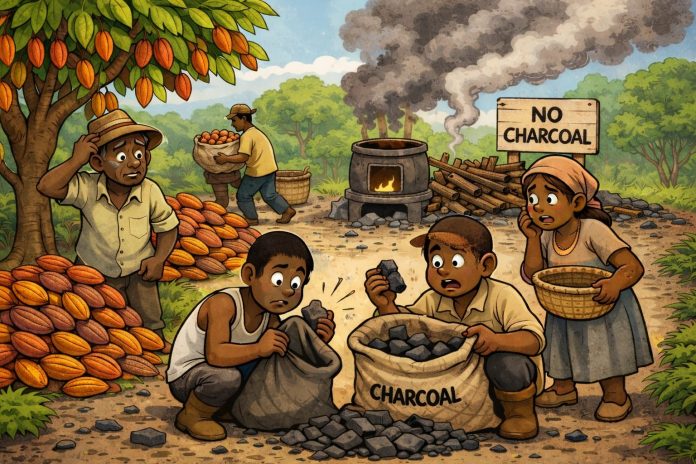
An AI-generated visual depiction of the charcoal crisis in Grand Gedeh County. The DayLight/Samuel T. Jabba
By Samuel T. Jabba
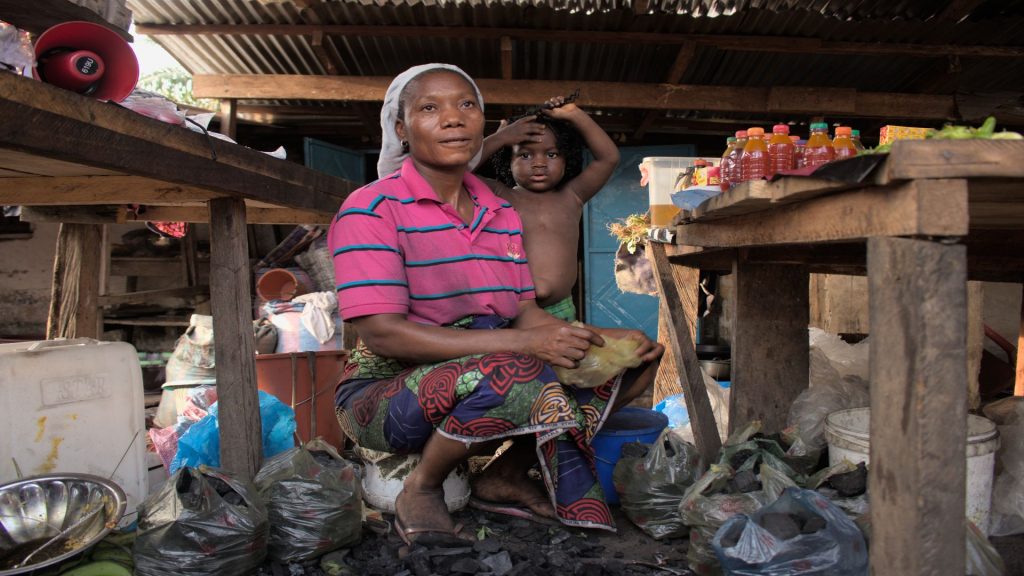
ZWEDRU, Grand Gedeh County – At any time five years ago, Josephine Nyenkor’s charcoal warehouse would be filled. She would have to stand on one bag of charcoal to reach the next.
Today, there is no charcoal in the warehouse, a concrete structure located in Zwedru’s main market. Several large bags filled with empty bags stand on the wall, and folded tarpaulins lie on the blackened floor.
“It’s just by the grace of God I am surviving. Selling charcoal is my only means for survival,” says Nyenkor, 41, who has sold charcoal for nearly two decades here.
“Charcoal used to give better profit but not [any longer],” she adds.
Nyenkor’s struggle reflects the impacts of the shortage of charcoal in Grand Gedeh County. For the first time, charcoal is in short supply, driving the commodity’s prices high. This is happening as Burkinabé migrants and local landlords are clearing the southeastern region’s vast forests to plant cocoa, forcing charcoal producers deeper into the forest.
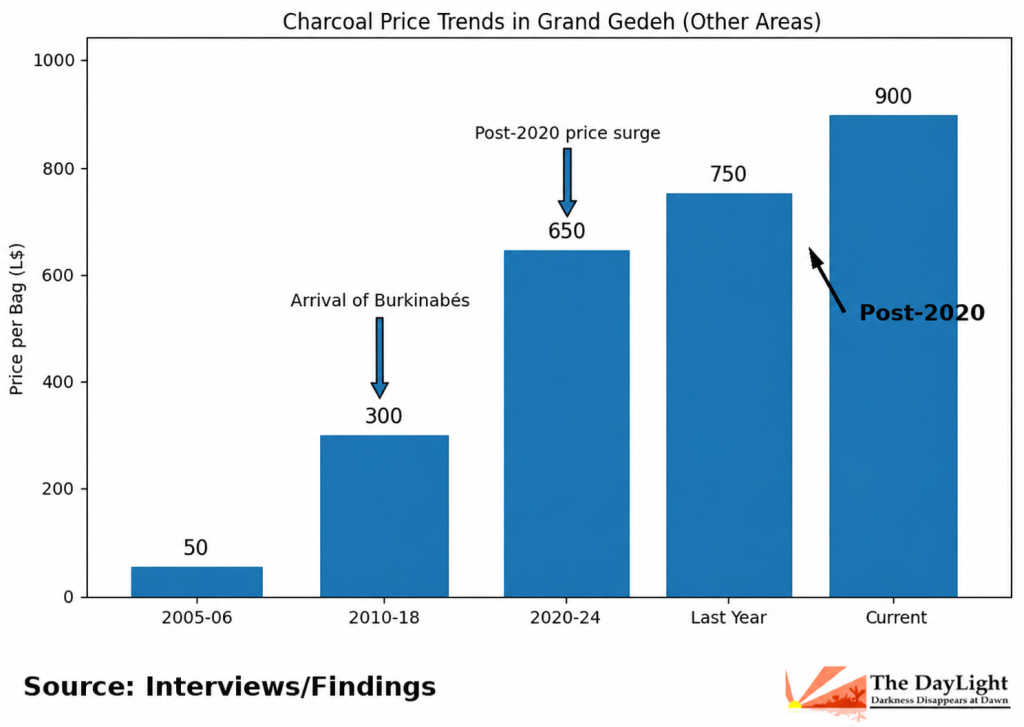
“In 2005 and 2006, we were buying a bag of charcoal for L$50. Today, charcoal is L$900, because of the deforestation,” says Marcus Toe, the executive director of One Health Advocacy Network. Toe works with local communities on health and the environment.
“Because the bush is being burned, you have to walk a far distance to get trees. So, the people who get them make them very expensive,” he added.
Burkinabés began migrating to Liberia from the neighboring Ivory Coast in the 2010s in search of farmlands. Once here, they entered an agreement with locals, who provided them with land. Immigration authorities recorded 55,000 Burkinabe migrants, with 48,000 in Grand Gedeh County alone.
Across Liberia, charcoal remains the leading cooking fuel and contributes to deforestation. Demand for it reached a record high in 2018, an estimated 337,000 metric tons valued at approximately US$46 million, according to a report by the Liberia Forest Sector Project.
However, cocoa cultivation has a larger impact on the forest. A 2024 study found that 15 percent of the deforestation in Liberia from 2001 to 2024 was driven by cocoa. During this time, Grand Gedeh lost 59,000 hectares of primary forest, according to Global Forest Watch, an online deforestation-tracking application.
Charcoal producers say Burkinabés aren’t giving them access to the forest, so they can’t produce the quantities they used to. They have to hire motorbikes to transfer charcoal from deep inside the forest, since cars cannot access the roads.
Margaret Ziahyee, a charcoal seller who shares the same warehouse with Nyenkor, confirmed this information.
“We will soon start using stoves to cook, because it is very hard to find trees to burn charcoal,” says Ziahyee. As she spoke, Daylight reporters saw a charcoal seller offload eight bags of the commodity from a motorbike at the front of her warehouse.
‘Zero to hero’
Across Grand Gedeh, the price of charcoal has risen to its highest ever. Between 2005 and 2006, a bag of charcoal was sold for only L$50. From 2010 to 2018, with the arrival of the Burkinabés, a bag was sold for at L$300 to L$450. Then prices soared to L$650 by 2020. Last year, the price climbed to L$750 and L$800. Currently, a bag costs L$900, the same as in Monrovia.
Due to the energy crisis, community dwellers switched to stoves. Townsfolk are now crossing to the Ivory Coast to buy stoves.
“My sister, who has a tea shop, has one and is using it already. To even find charcoal is not easy. Even I myself parked my coal pots because there’s no coal, and the small we have is very expensive. I’m using wood now. In a few times from now, I will send for my own stove.” Alice Doe, a resident of Boundary Town, said in an interview.
Konobo is the leading supplier of charcoal to Zwedru, thanks to its vast forest, according to Toe. Charcoal burning was less expensive, and producers had less work in finding mature and suitable trees. Charcoal producers found it easy to find trees and haul their chunks.
But now, it is the fastest-deforested region in the county. Producers travel beyond cocoa farms to fell trees and spend more money on chainsaw operators and haulers.
Amid the crisis, charcoal is losing ground to cocoa farming because of the less work associated with cultivating the crop.
“At least the cocoa business that came here is helping some of us, from zero level to hero,” says Alice Doe, another former charcoal producer and now a cocoa farmer from Boundary Town in Konobo district.
“Yes, before we used to just go into the forest and start felling trees. But now, you can’t just go into the forest and start felling trees. You will damage someone’s cocoa farm. So, everything is under restrictions because of the cocoa farms,” said Doe.
Civil Society Independent Forest Monitors provided the funding for this story. The DayLight maintained editorial independence over its content.