
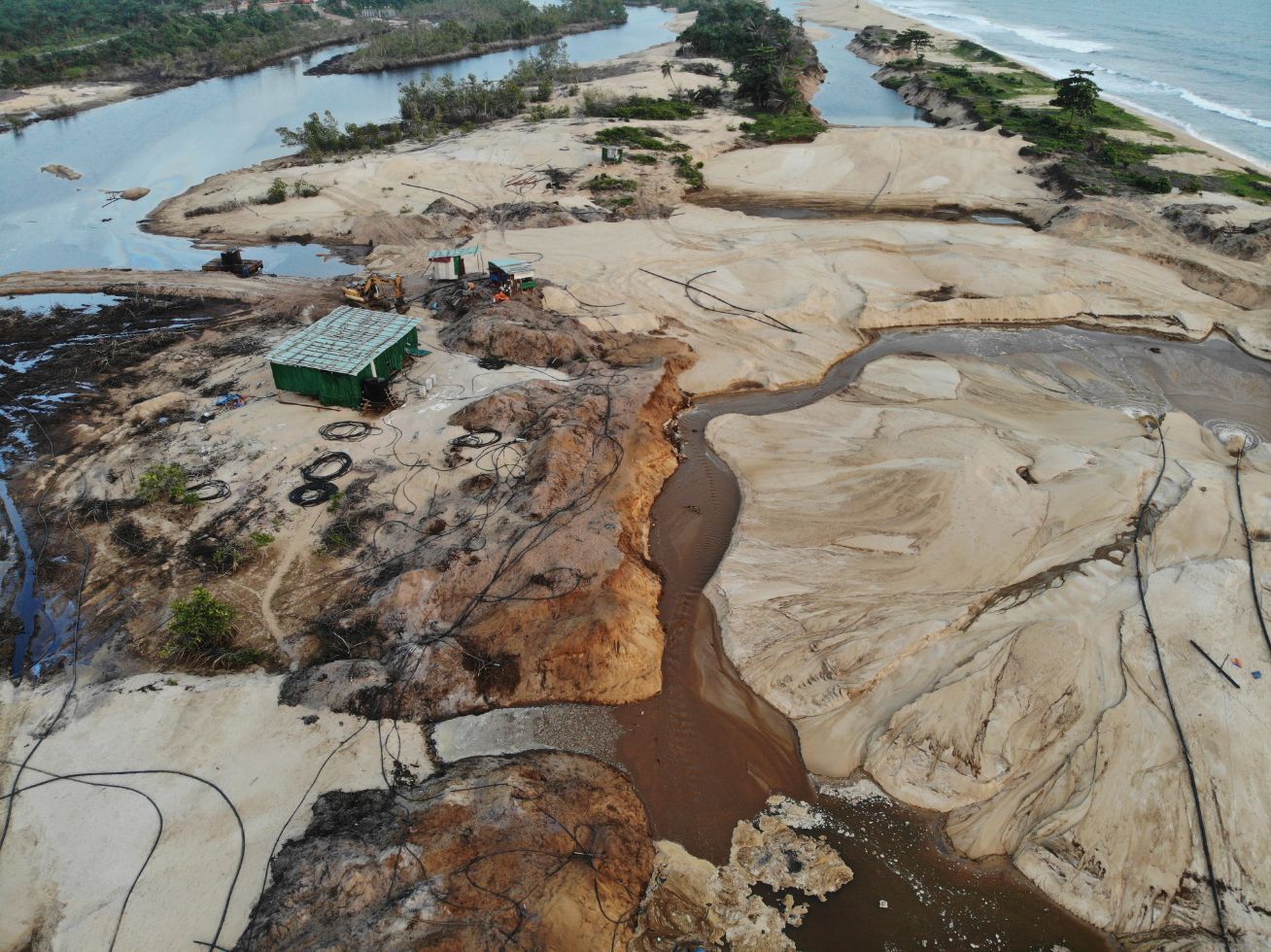
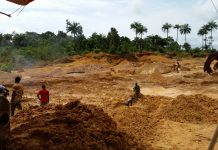
Top: A drone shot of a zircon sand mine in Greenville, Sinoe County, in 2023. The DayLight/Derick Snyder
By Varney Kamara
MONROVIA – Liberia’s mining sector failed to report US$2.7 billion in gold and iron ore exports between 2007 and 2023, likely due to underreporting and/or smuggling, a new report found.
The US-based Forest Trends found that Liberia reported US$5.1 billion from mining exports over the 16 years. However, researchers established that importing countries reported US$7.8 billion from Liberia, resulting in the US$2.7 billion discrepancy.
“The scale of the problem is massive,” said Arthur Blundell, one of the report’s co-authors. “There is no reason to believe that what the government reported was a mistake because Liberian sources agree with the numbers.”
The report—”A Rapid Assessment of Liberia’s Mining Sector…”—determined that underreporting of export commodities and smuggling were the potential reasons for the revenue loss. Moreover, there are strong indications that the country could be giving away valuable revenue at a staggering rate. For instance, Liberia’s sales of rough diamonds and iron ore fell below the international benchmark during the reporting period.
Weak enforcement likely enabled underreporting, smuggling, and tax evasion, as well as environmental violations, costing hundreds of millions of dollars annually.
The report recommends that the government halt illegal mining, improve trade oversight, protect ecologically critical areas, ensure transparency, uphold community rights, and enforce companies’ legal obligations fully.
The report utilized legal review, trade data, and geospatial analysis. Data used in the study were collected from various government agencies, including the Ministry of Mines & Energy, Liberia Extractive Industries Transparency Initiative, Forestry Development Authority (FDA), Central Bank of Liberia, Liberia Revenue Authority, and the Environmental Protection Agency. Researchers analyzed Liberia’s minerals exported to Switzerland, the EU, the United Arab Emirates, Turkey, and other countries.
Overall, the report found that it was impossible to calculate all losses due to a lack of transparency in the reporting process, as there were likely losses from unpaid import fees and withholding taxes, social security payments, surface rental, license fees, etc.
The Ministry of Mines did not return queries for comment on the report’s findings.
Community benefits and the environment
The report also established that unfulfilled promises, human rights abuses, and environmental damage, among other things, hinder the mining sector, which accounts for a fifth of Liberia’s GDP, while dominating exports and generating a significant share of government revenue despite the losses.
Mining impacts across communities have been staggering, the report found. The study revealed that communities were not benefiting from their natural resources. It shows companies are not complying with their legal obligations to communities.
There is no official reporting on whether mining companies are paying two percent of their exploration budget on local health and education, as required by the mineral exploration regulation, nor is there reporting on whether companies are giving five percent equity to communities as required by the Land Rights Act.
Overall, it found that 1.4 million hectares of community forest lands were overlapped by mining licenses, undermining local people’s economic opportunities, and thus their autonomy and right to self-determination. The mining environmental laws require permits for semi-industrial scale or class ‘B’ licenses.
Benefits legally guaranteed to communities remain unrealized, while affected communities increasingly face degraded lands, abandoned open pits—deepening their vulnerability and leaving them with more burdens than they can actually handle.
“We only know what has been reported for communities, not what has actually been done. Additional payments may have been made that were unreported, but also payments reportedly made for communities may also have been misdirected elsewhere,” said Blundell, noting that since 2012, rather than putting the revenue into community funds, the government has required all payments to first be deposited into the County accounts. “What has happened to these funds is not clear.” However, the report noted that the General Auditing Commission, in its most recent audit on County Development Fund spending, found gross violations and lack of oversight by the Ministry of Internal Affairs, which they said may “lead to fraud…through the processing and disbursement of illegitimate transactions.”
“Any reform should include immediate steps to stem financial losses, compel compliance, and ensure accountability of compensation and other benefits sharing with local communities,” Blundell concluded.
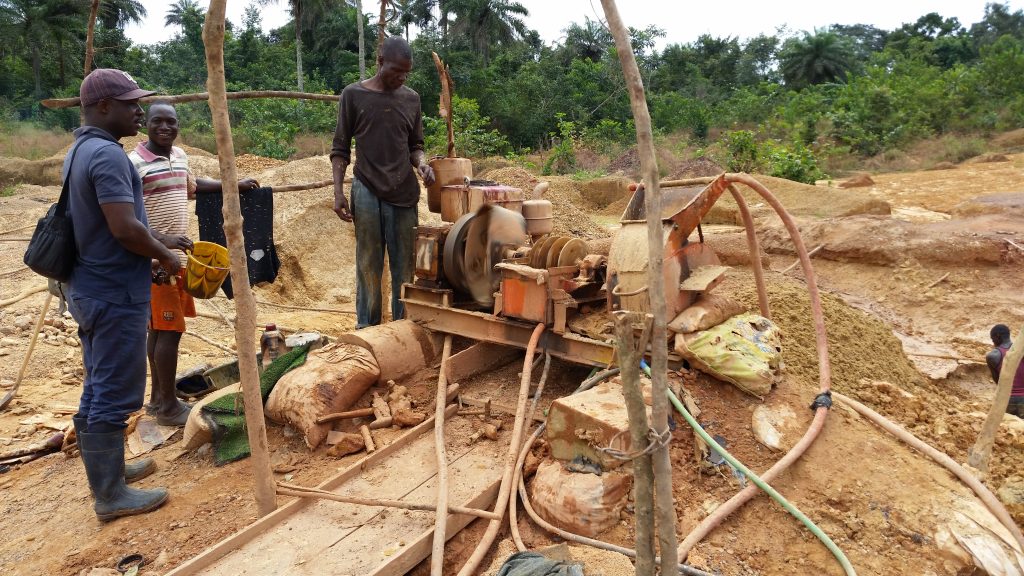
The report revealed Liberia’s forests are at risk, with licenses overlapping more than 2 million hectares nationwide. Mining is undermining the environmental health of these forests, citing a report by Liberia’s Environmental Protection Agency. For example, the EPA found that many Class ‘B’ license holders are not obtaining environmental permits, a major requirement under the mining law, and that companies were using heavy machines to pollute major watercourses.
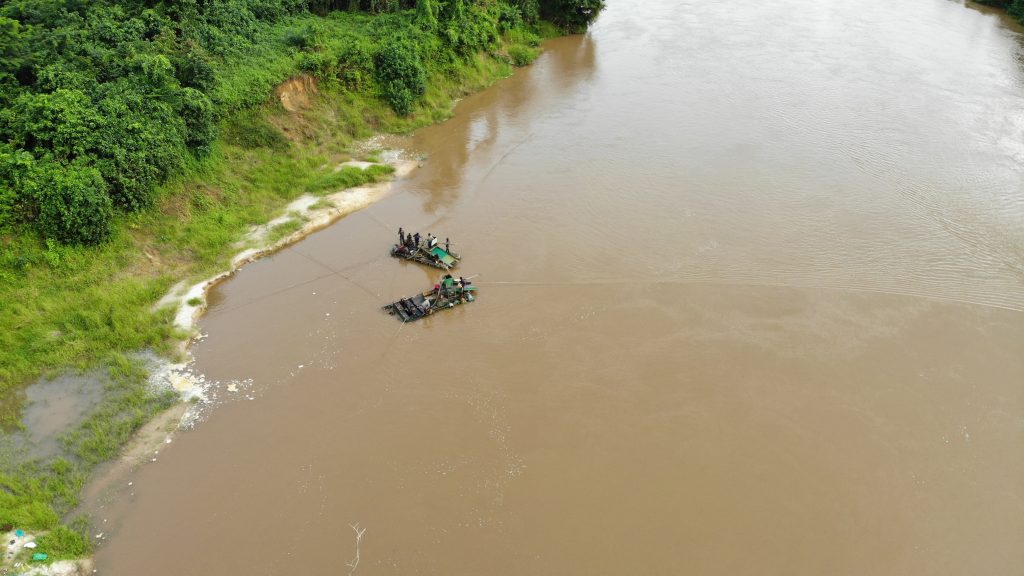
The assessment found mining-linked deforestation, hazardous chemical mismanagement, and water pollution at an increasing rate, while monitoring and enforcement remain major challenges to tackling those issues nationwide.
Moreover, the Forest Trends assessment cautioned that these statistics do not include widespread artisanal, unlicensed mining because these mines go unreported by the Ministry of Mines & Energy.
Between 2021 and 2024, Liberia lost 390,000 hectares of primary forest to deforestation due to logging, agriculture expansion, and illegal mining, according to the Global Forest Watch. The recent boom in cocoa farming in the country’s southeast has increased the pace of deforestation.
The report recommends that the government stop illegal mining, enforce existing mining laws and regulations, increase consultations between miners and communities, urging miners to refill holes they dig across communities.
“What is needed now is more transparency, accountability, and a fundamentally different model of resource governance—one that prioritizes social equity, environmental sustainability, and community rights,” the report concludes.


Facebook Comments