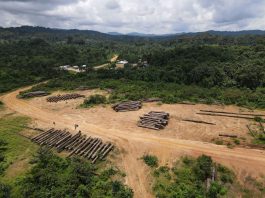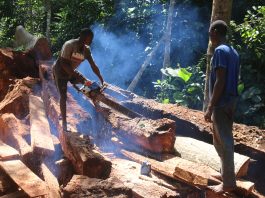
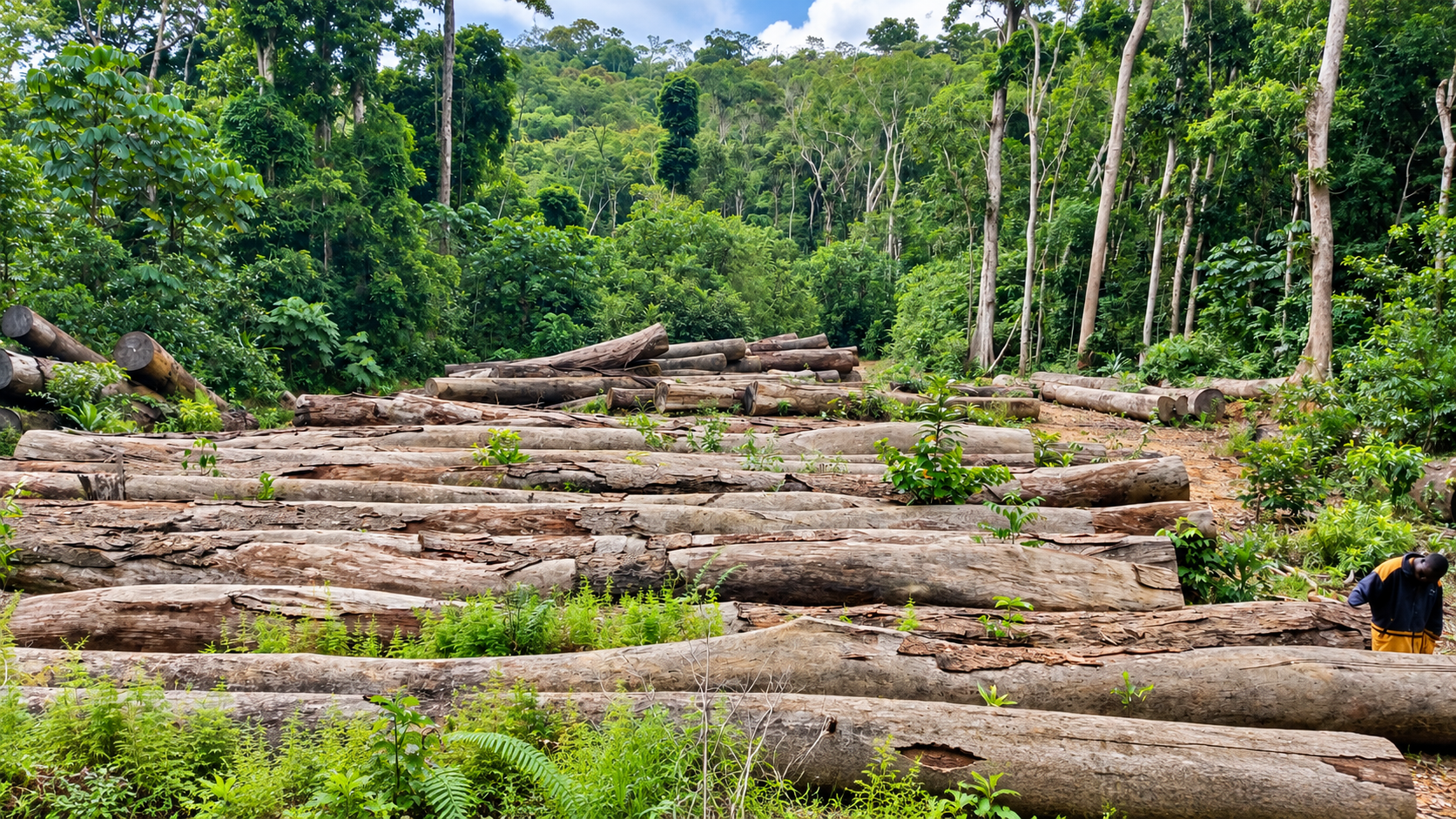
Top: Keshav abandoned logs in the Tonglay Community Forest, Gbarpolu County, The DayLight/Varney Kamara
By Emmanuel Sherman
TONGLAY; NORMON, Gbarpolu County – Villagers in the Tonglay Clan, Kongba District, celebrated after signing a logging contract with a new company in 2022.
Keshav Global Industries Limited promised to build roads, bridges, schools, scholarships, and healthcare assistance in exchange for Tonglay’s 18,611-hectare forest.
At about the same time, Tonglay’s neighbor, the Normon Clan, also signed a similar contract with Keshav for 12,483 hectares.
But both communities’ hopes were dashed because the agreements were short-lived, leaving behind debts, unfulfilled promises, and logs. That experience has shifted local people’s attention to conservation, a familiar recourse in that area.
“This left us disappointed because the community did not benefit anything from the contract,” said Karimu Fofana, Tonglay Community Forest’s chief officer. “There is similar disappointment in Normon.”
Keshav owes Tonglay US$79,000 for land rental, cubic meters, scholarships, healthcare, and forest guard fees, according to The DayLight’s analysis of the contract and financial records. The company failed to build two major roads in the clan between January 2023 and March 2024. It also failed to construct six concrete bridges it was required to complete by this year, among other things.
Apart from the unpaid fees, Keshav also abandoned several logs. The community puts the number at 565 logs, which were left in the forest and by the roadside. The DayLight counted 300 logs in one location.
Things are the same in Normon. Keshav owes the community an undisclosed amount and failed to build community roads, provide scholarships, healthcare assistance, and forest guardian fees.
The roads in the region are some of the most deplorable in Liberia, cutting off the region from the rest of the country. Motorcycles cannot even ply some areas.
“It hurts us a lot because the main thing we signed the contract for was to ensure the company builds our roads,” said Boakai Kanneh, head of Normon’s community leadership.
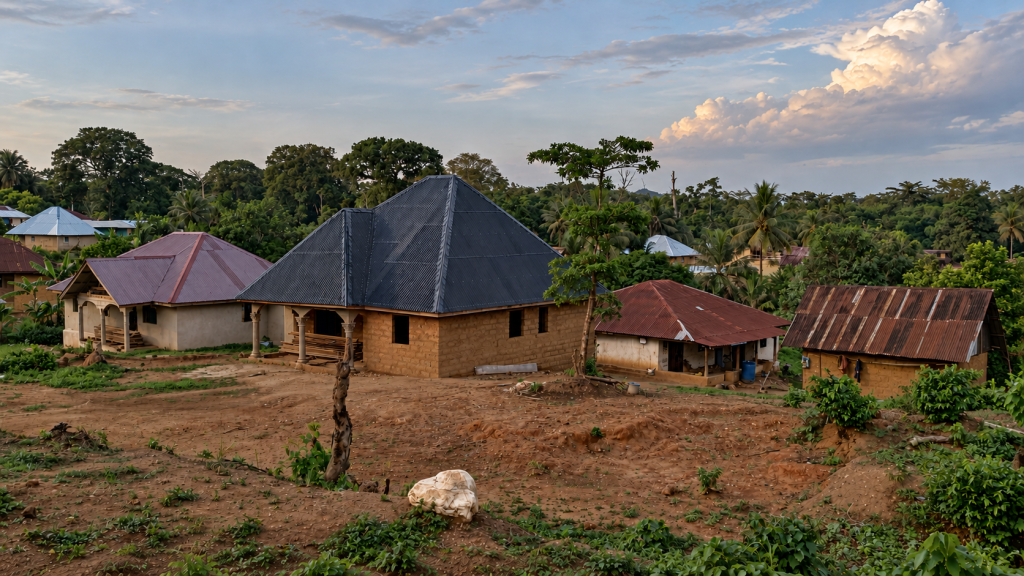
“We want cars to come into the community with goods in our towns and villages. Our people are suffering.”
Keshav felled 110 logs and left them in the forest in Normon, according to Kanneh. The DayLight could not independently verify the information because of the distance to access them. The Regulation on Abandoned Logs, Timber and Timber Products prohibits leaving logs unattended in a forest for three weeks.
Concerned about its abrupt closure, the two clans visited Keshav’s headquarters in Congo Town, outside Monrovia, but did not meet a representative there. Tonglay then wrote a letter to Vyom Garg, Keshav’s owner and CEO.
On April 9, 2025, Garg replied to Tonglay, blaming his company’s abrupt closure on the global financial crisis, which “significantly” impacted its operations.
“We are committed to beginning the payment of all the outstanding liabilities to the community no later than April 30, 2025,” read Garg’s letter. However, the payment has not happened.
The failure of Kehsav’s contracts dashed the hopes of people in Tonglay and Normon.
“We were carrying out some development, and we could not complete that development because we were financially depressed,” Fofana said. “Based on their failure, we could not go further with those things.”
Contract terminated
Last year, Tonglay filed a lawsuit in the 16th Judicial Circuit Court in Gbarpolu County to terminate its contract with Keshav, according to court records. The court sided with the community against the company, which was not represented in the two-month trial.
The court said it found no reason to deny Tonglay’s petition to cancel the third-party agreement.
“The third-party agreement between Tonglay and Keshav is hereby cancelled and terminated,” the court ruled.
With the contract terminated, Tonglay has held elections for a new corps of officers to strengthen its forest governance.
Normon, on the other hand, has not terminated its contract. To do so, the community must officially inform the FDA before heading to court.
If Normon terminates its contract, Keshav, whose vision is to work with certified forests in Africa and South America, would have no forestry contract in Liberia. Garg did not respond to queries for comment.
Keshav Global Industries Limited, an Indian-owned company, is a subsidiary of Keshav Global Trading LLC, based in Dubai, United Arab Emirates, and Keshav Global Private Ltd, based in Singapore. The conglomerate trades timber and agricultural commodities.
Conservation
Both Tongaly and Normon are weighing options on whether to pursue conservation or stick to logging. Back in 2021, Montserrado-based NGO the Society for the Conservation of Nature Liberia (SCNL) helped the clans obtain community forest status from the Forestry Development Authority (FDA). This allows locals to co-manage the woodlands alongside the FDA and share in forest resources.
The clans are part of the Gola communities adjacent to Gola National Park, a forest between Liberia and Sierra Leone, home to forest elephants, chimpanzees, and rare birds. Moreover, Normon shares a boundary with the Foya Proposed Protected Area between Gbarpolu and Lofa, which covers 168,628 hectares.
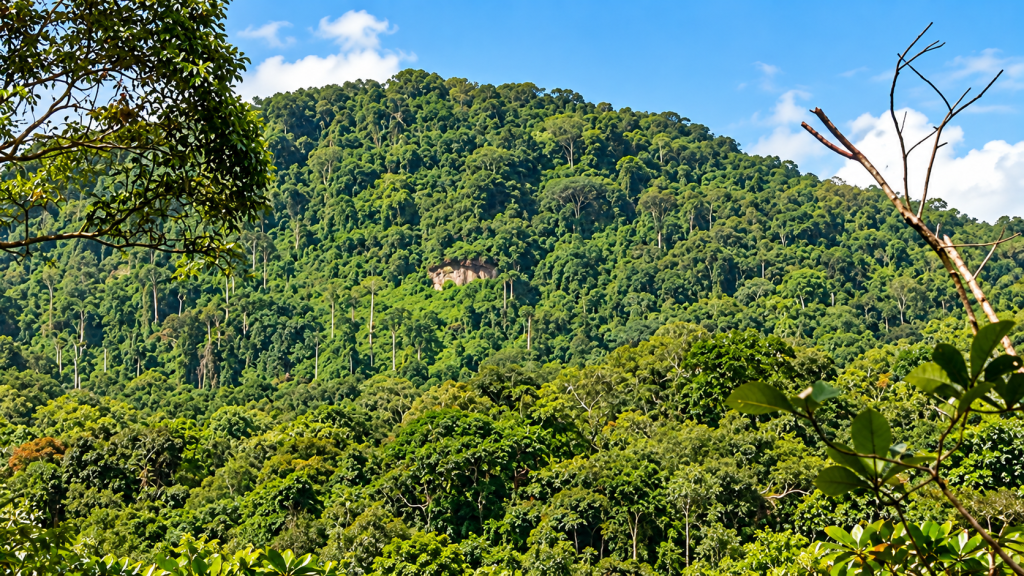
Tonglay is about to sign a conservation agreement as part of a three-year project that seeks to empower forest-dependent communities.
Normon, on the other hand, wants to do the same.
“We are in the process of terminating the contract just as the Tonglay Community Forest did. If we terminate Keshav’s contract, we will be able to sign the community conservation agreement with SCNL,” said Varney Kabba, the secretary to Normon’s leadership.
James Mulbah, forest landscape manager with SCNL, reveled in the clans’ potential switch to conservation.
Mulbah said: “Conservation is taking root, but getting communities on board a hundred percent takes time.”
This story was produced with support from Internews’ Earth Journalism Network.