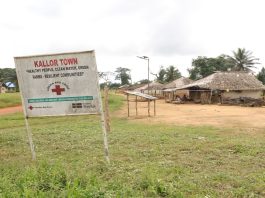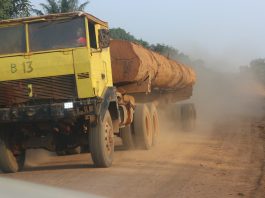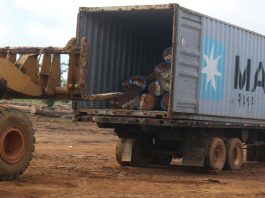
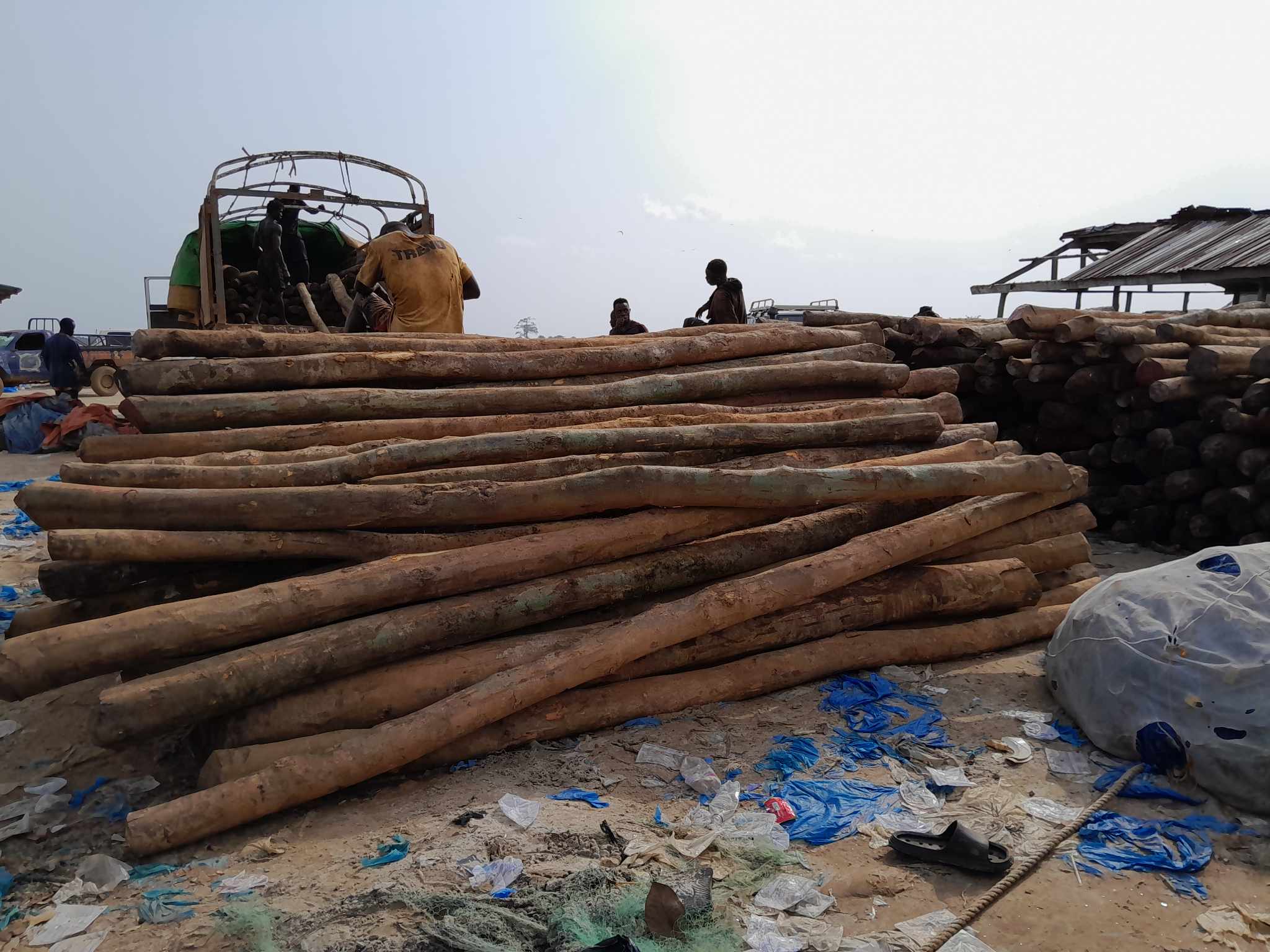
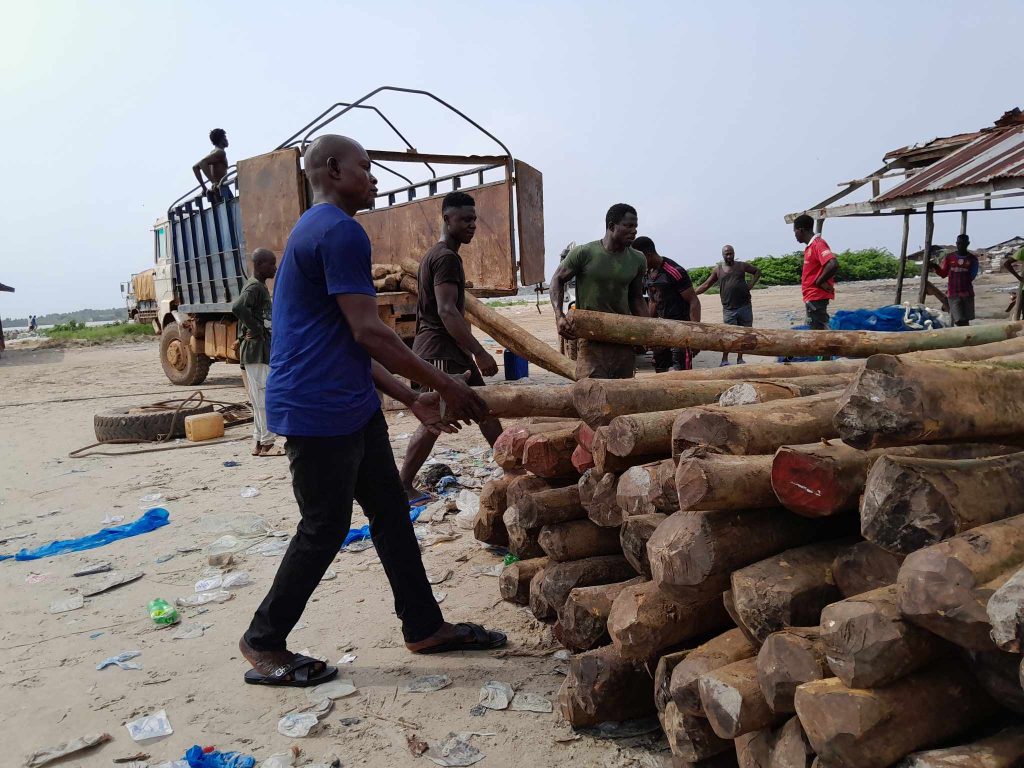
Top: Men offload non-timber forest products on a beach in Greenville, Sinoe County, in January 2024. The FDA permits export of the NTFPs amid a moratorium. File Picture: Anonymous
By Esau J. Farr
MONROVIA – A Chinese company was permitted to ship logs despite the existence of a moratorium against such shipment, official records show.
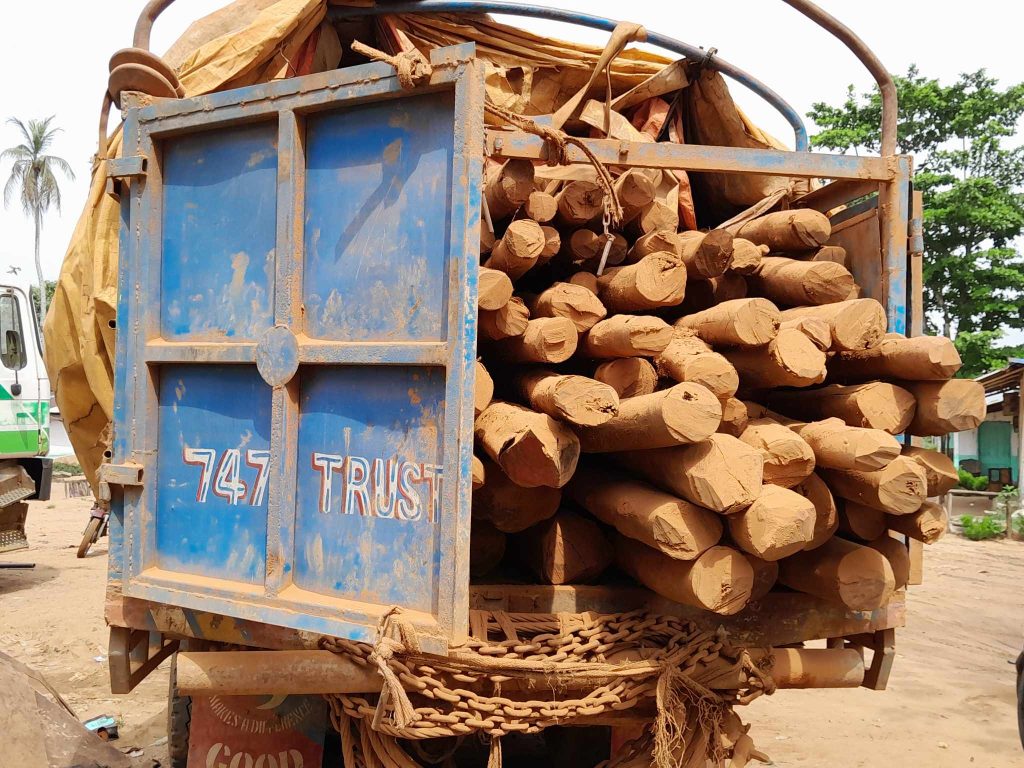
Jiuzhou International Liberia Limited, a sand mining company, exported 320 pieces of camwood to China in January, according to the Ministry of Commerce and Industry’s records. Camwood (Baphia nitida) is a hardwood tree grown mainly in West Africa used as a natural dye, soap-making and woodworking. It is among wood species with high price values in Liberia, selling US$550 per cubic meter.
Jiuzhou’s export was confirmed by Export Genius, a US-based business platform that publishes international trade data. Export Genius’ data also reveals that last year Jiuzhou made a similar export, both exports valued over US$13,000, and passed through the Freeport of Monrovia.
The Forestry Development Authority’s records show that Jiuzhou’s exports occurred outside the legal system for timber trade, or LiberTrace.
But in 2021, the FDA placed a moratorium on non-timber forest products (NTFPs), including camwood. Then, the FDA’s board of directors retained the moratorium in a July 2024 board meeting.
“All other certificates signed by the [Managing Director] become null and void,” according to unpublished minutes of the board meeting seen by The DayLight. “FDA needs to invite all those involved for a way forward.”
Albert Blanyon, the newly appointed FDA Deputy Managing Director for Technical Services, said the regulator does not enroll NTFPs in LiberTrace.
“I can’t confirm if a moratorium was passed,… as people I asked, who were here at that time, can’t confirm, nor is there any document to that effect,” said Blanyon.
The facts contradict Blanyon’s comments.
At the July 2024 meeting, the FDA board agreed that the moratorium remained in place until the Regulation on NTFPs, formulated in 2008, was reviewed. The board intended to use the review to address deforestation and the lack of benefits for communities that host NTFPs.
Two years on, however, there is no record that the review has happened. Key forestry NGOs, including the Botanical Products Association of Liberia, which raises awareness of the protection and trade of NTFPs, said they were unaware of it.
“We have not really been informed about any review on the NTFPs Regulation,” said Fredrick Gonkartee, the association’s president.
The Jiuzhou exports are not the first of NTFPs since the moratorium five years ago. Last year, The DayLight found evidence that the FDA violated it by awarding businesses permits to export chewing sticks.
An underground market
Jiuzhou was established in October 2013. It is owned by two Chinese nationals: Hao Shuli (80 percent shares) and Wang Depeng (20 percent shares). It has had 10 licenses between 2020 and 2026 for sand mining and rock quarrying in Margibi County. It could have one more license, which is under review for a sand mine between Margibi and Grand Bassa Counties.
In an interview, Li Yuan Hai, a Jiuzhou executive, denied any wrongdoing, as the FDA had approved the exports.
“Me, I didn’t do anything on my own,” Li said. “I paid my tax to the Liberia Revenue Authority (LRA). If the government was going to say I didn’t pay tax, then that’s my problem.”
Asked whether he was adding forestry to his company’s mining profile, Mr. Li now said he did not own the wood. He had aided friends to ship the consignment, using his company’s documents.
The underground NTFP exportation resembles Kpokolo—containerized timber blocks shipped outside the legal system, and banned in 2022.
Exporting outside LiberTrace leaves no trace, does not verify tax payment or community benefits, and does not show the exporter’s eligibility. Furthermore, like in the case of kpokolo, FDA managers control the accounts into which companies pay NTFP fees.
Forestry campaigners are critical of timber exports outside the legal system.
“Illegal timber extraction and shipments create a compounded loss for Liberia. Communities lose legitimate forest benefits, livelihoods and climate resilience, while government loses revenue…,” said Dayugar Johnson, the chairman of the Civil Society Independent Forest Monitors.
Johnson added, “Illegal logging and exports can deprive forest-dependent communities of stumpage fees, social benefits and other revenues that could support schools, health facilities, roads, water systems and livelihoods.”